Description
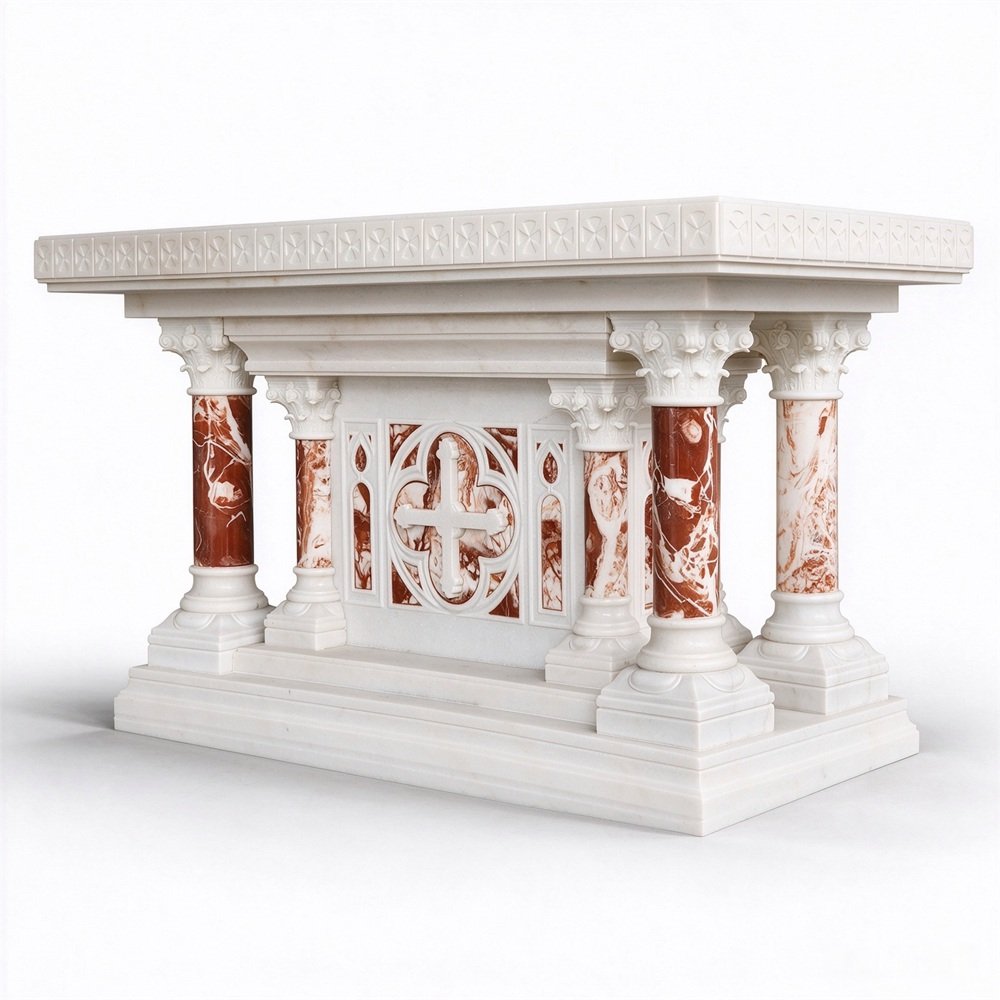
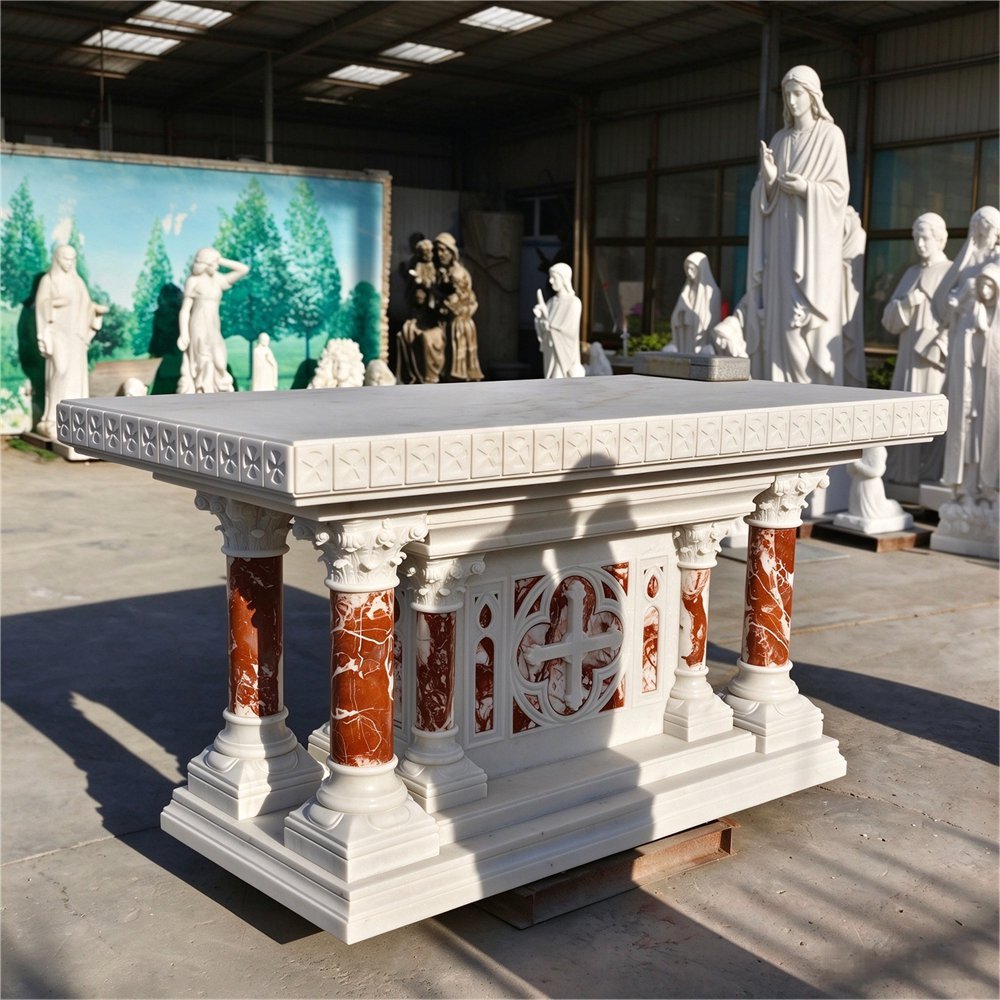
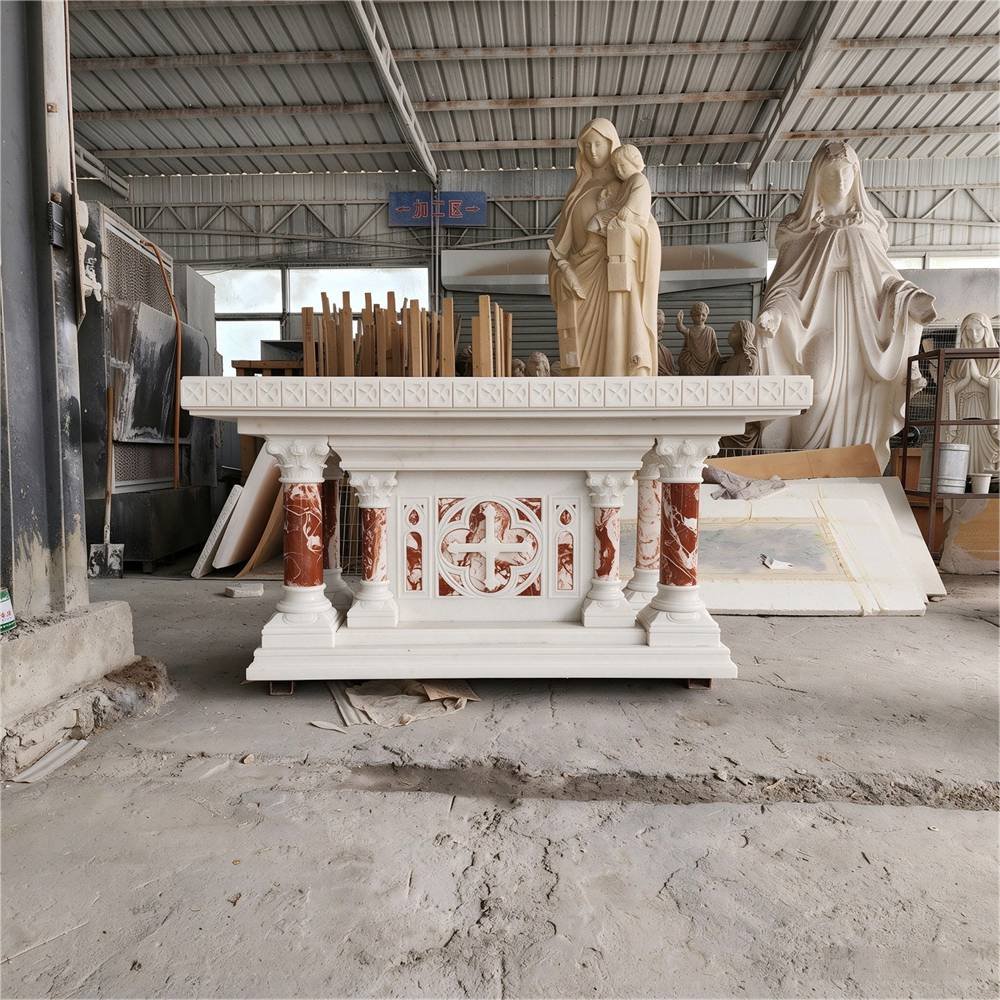
This is a free-standing altar of sacrifice in the Gothic Revival style. The body is cut from white marble; the top slab projects forward with a repeating geometric frieze — a row of small cross-and-quatrefoil reliefs running the full width of the altar. Below the slab, six columns support the mensa: the shafts are cut from veined red marble (Rosso Levanto), while the capitals and stepped plinths are carved from white marble in a Gothicized Corinthian leaf pattern.
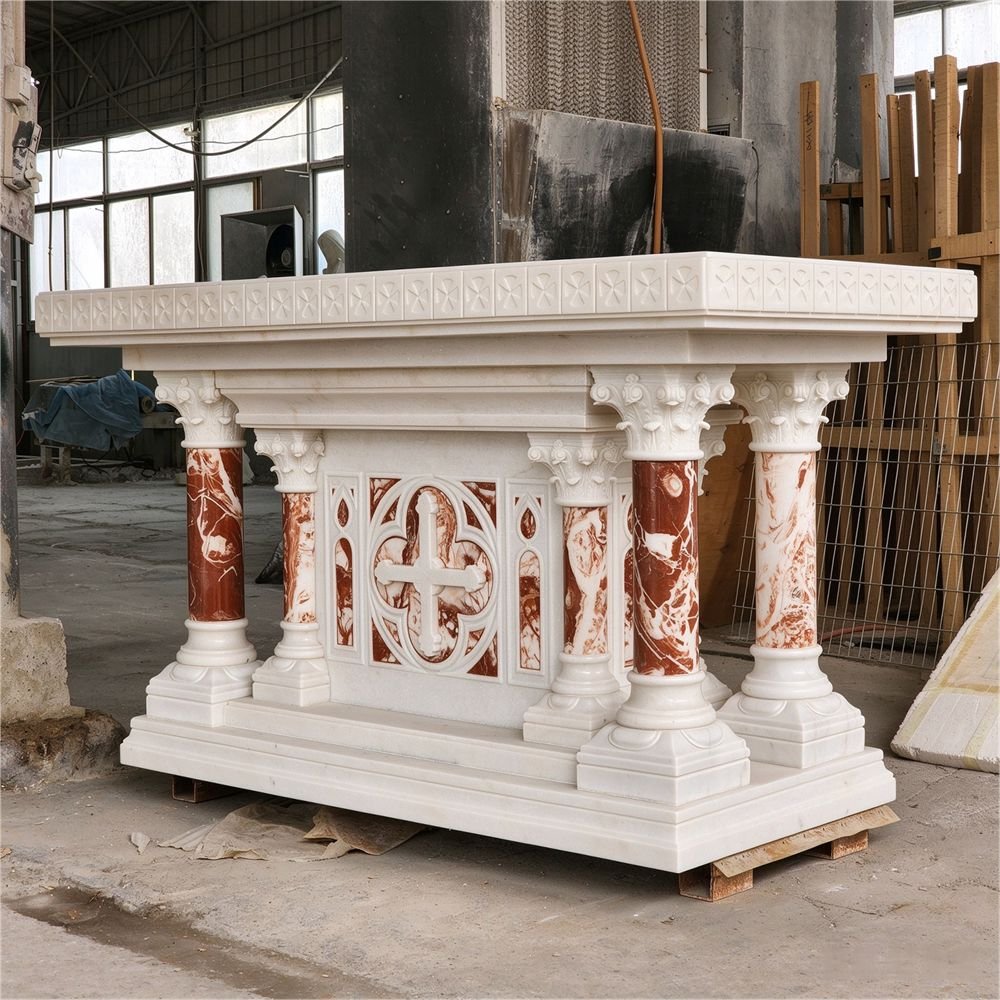
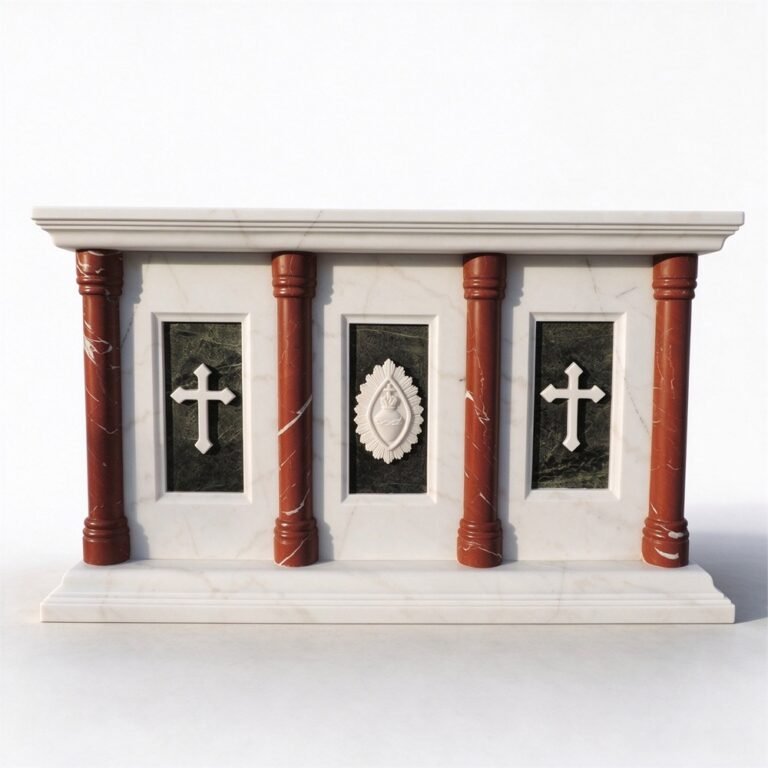
On the front face, a red marble panel is recessed into the white body. At its center, a white Latin cross is set inside a carved quatrefoil frame — the four-lobed window shape typical of Gothic church architecture. Narrow lancet-shaped red panels flank the central quatrefoil on left and right, echoing the Gothic arch motif. The whole piece stands on a two-stepped white marble plinth.
The two-tone composition — white body and capitals against red shafts and panels — is not decorative: white reads as purity, red as the Blood of Christ, and the Gothic quatrefoil around the cross marks the altar as the place where the sacrifice of the Cross is made present in the Eucharist.
The Gothic quatrefoil cross — what it means
The central motif is a Latin cross set inside a quatrefoil — a four-lobed, clover-leaf-shaped frame. This is one of the most ancient and widespread symbols in Christian stonework, found on altars, fonts, and stained glass across Catholic and Gothic Revival churches:
The cross at the center — the sacrifice of Christ, the reason the altar exists.
The four lobes of the quatrefoil — traditionally read as the four Gospels, or as the four ends of the cross reaching out to the four corners of the earth.
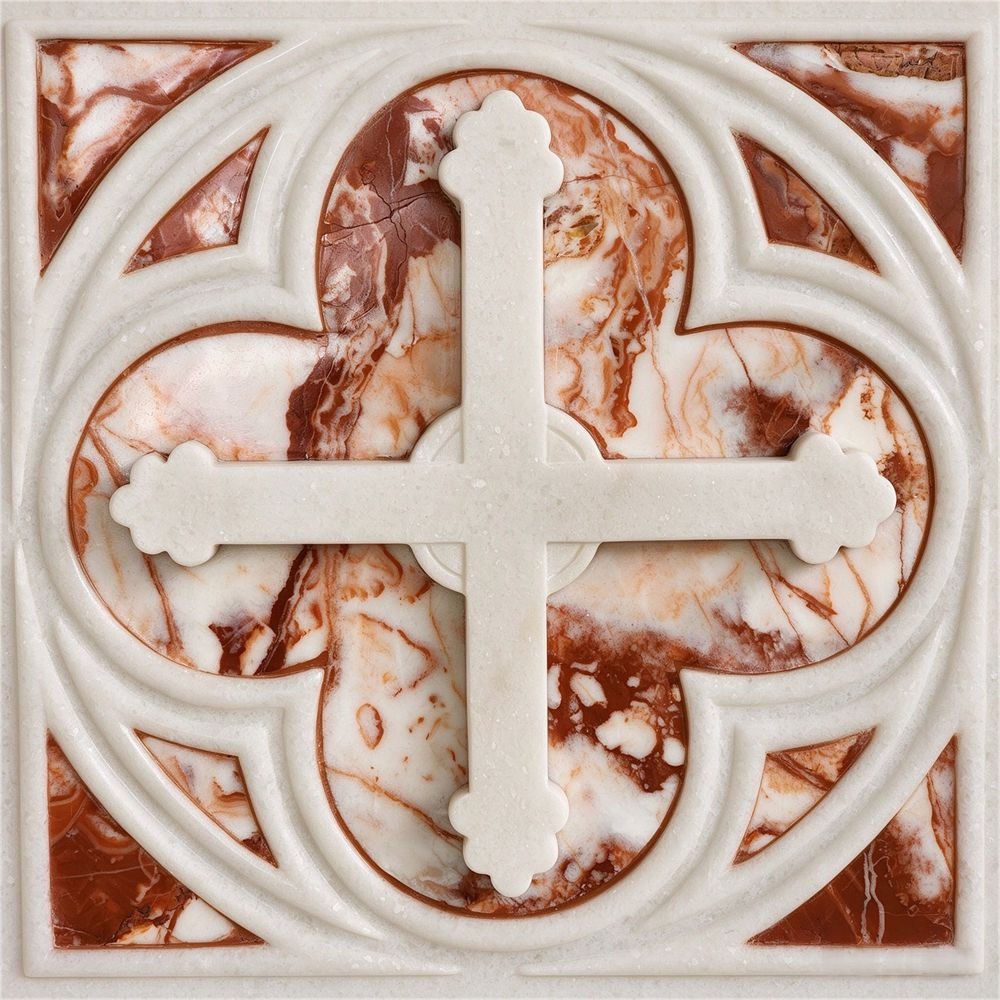
The cross is therefore not isolated; it is proclaimed to the whole world.
The lancet side panels — narrow Gothic arches framing the central panel, pulling the eye inward toward the cross. They echo the pointed arch windows of a medieval church, so the altar feels like a small building in miniature rather than a piece of furniture.
Exquisite hand-carving
Gothic carving is harder to fake than classical. The quatrefoil curves, the lancet arches, and the frieze pattern cannot be stamped or extruded — they have to be worked by hand.
The quatrefoil frame is carved in relief, not painted. The four lobes are chiseled out of the white marble and set over the red panel, so the cross appears to sit inside a stone window.
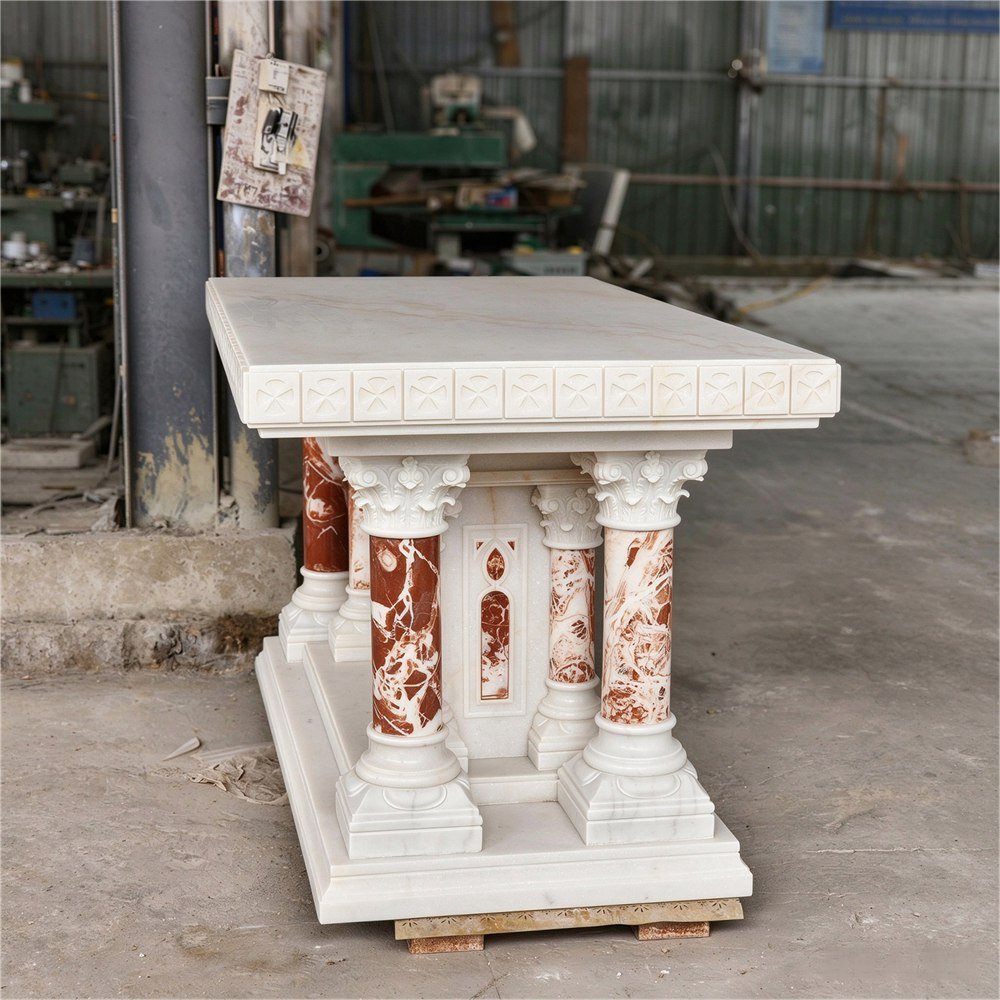
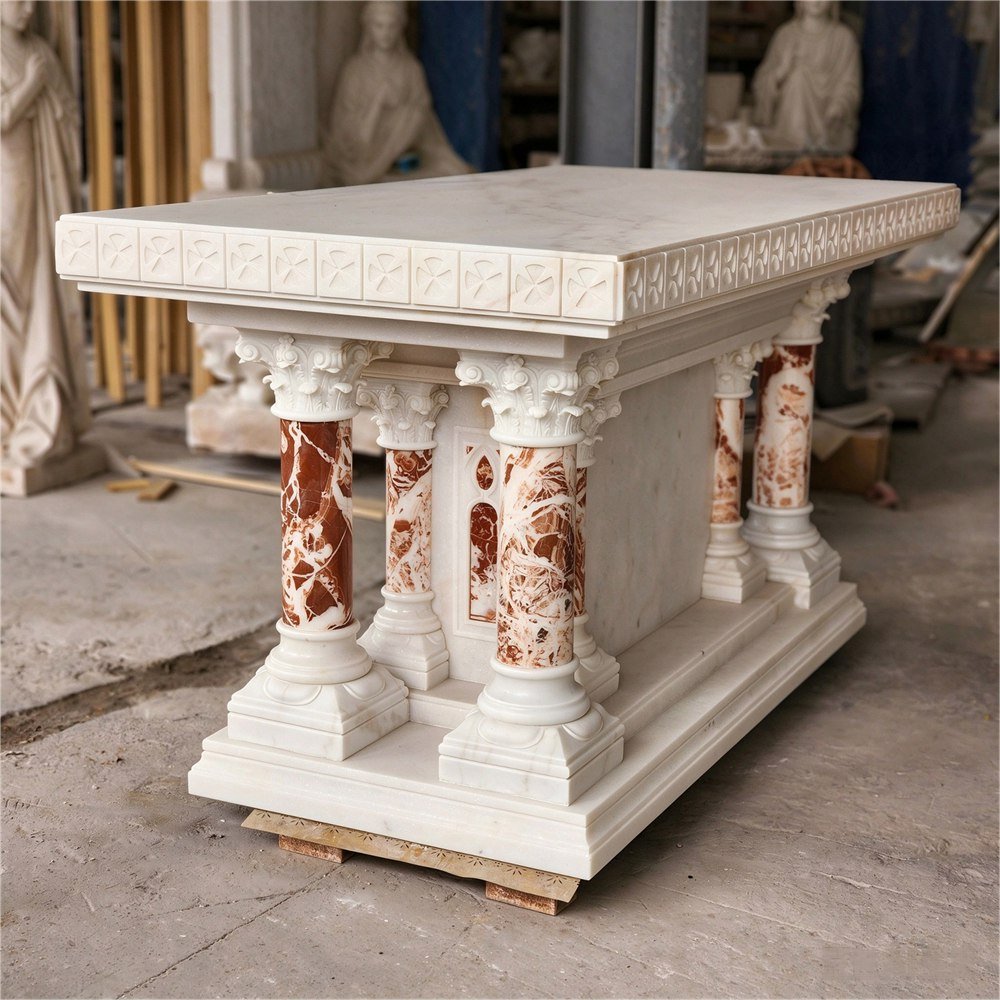
The frieze on the top is carved to a consistent rhythm. Each small cross-and-quatrefoil unit on the top slab is matched to the next to within a millimeter. Cast stone copies cannot hold this rhythm across a 1.8 m slab — you will see the drift.
The capitals are leaf-by-leaf. Each Gothicized leaf on the six capitals is carved individually; six capitals means six times the handwork of a classical altar with two columns.
The red shafts are turned, not veneered. Each column is a solid turned cylinder of red marble — not a white marble core wrapped in red veneer. Veneered columns crack at the joints within a decade; solid shafts do not.
What’s more, we also offer custom services to meet your requirements.
Suitable for
This beautiful marble altar is suitable for
Catholic parish church. A freestanding altar of sacrifice for a Gothic Revival sanctuary, sized to your reredos and designed to accept a consecration altar stone if required.
High-church Anglican / Episcopal church. Gothic Revival is the natural fit for an Anglo-Catholic or high-church parish; built plain or fitted with a tabernacle on top, according to your churchmanship.
Lutheran or historic Protestant church. A permanent marble altar replacing a wooden communion table in a neo-Gothic nave.
Chapel, school or retreat center. Scaled to smaller worship spaces — we reduce width and height without losing the six-column composition.