Description
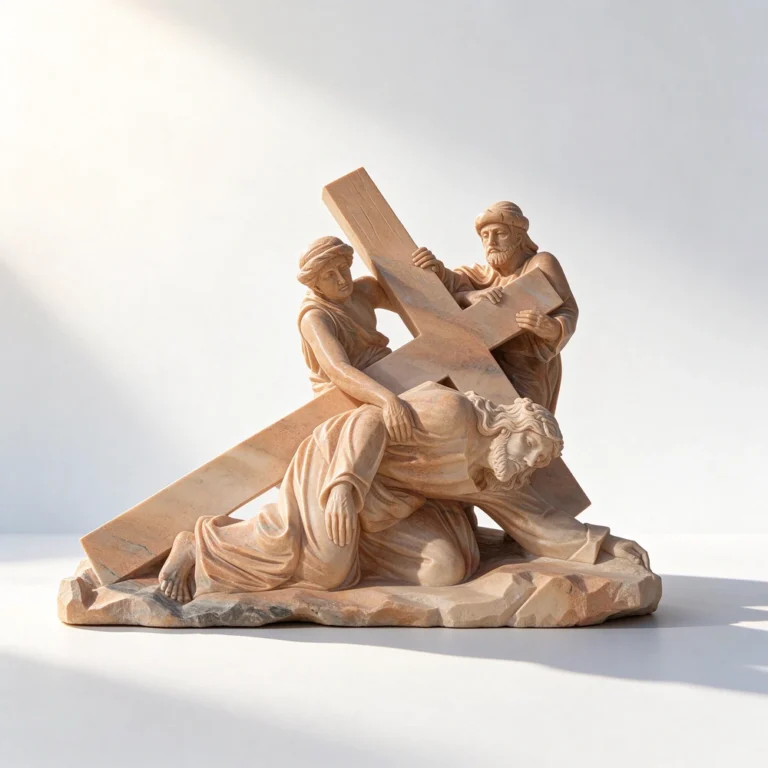
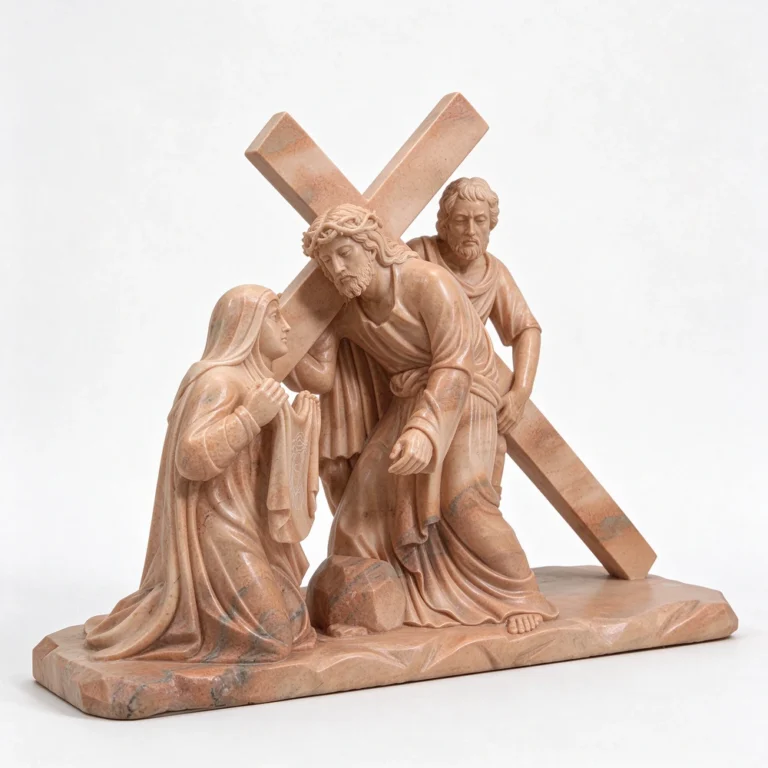
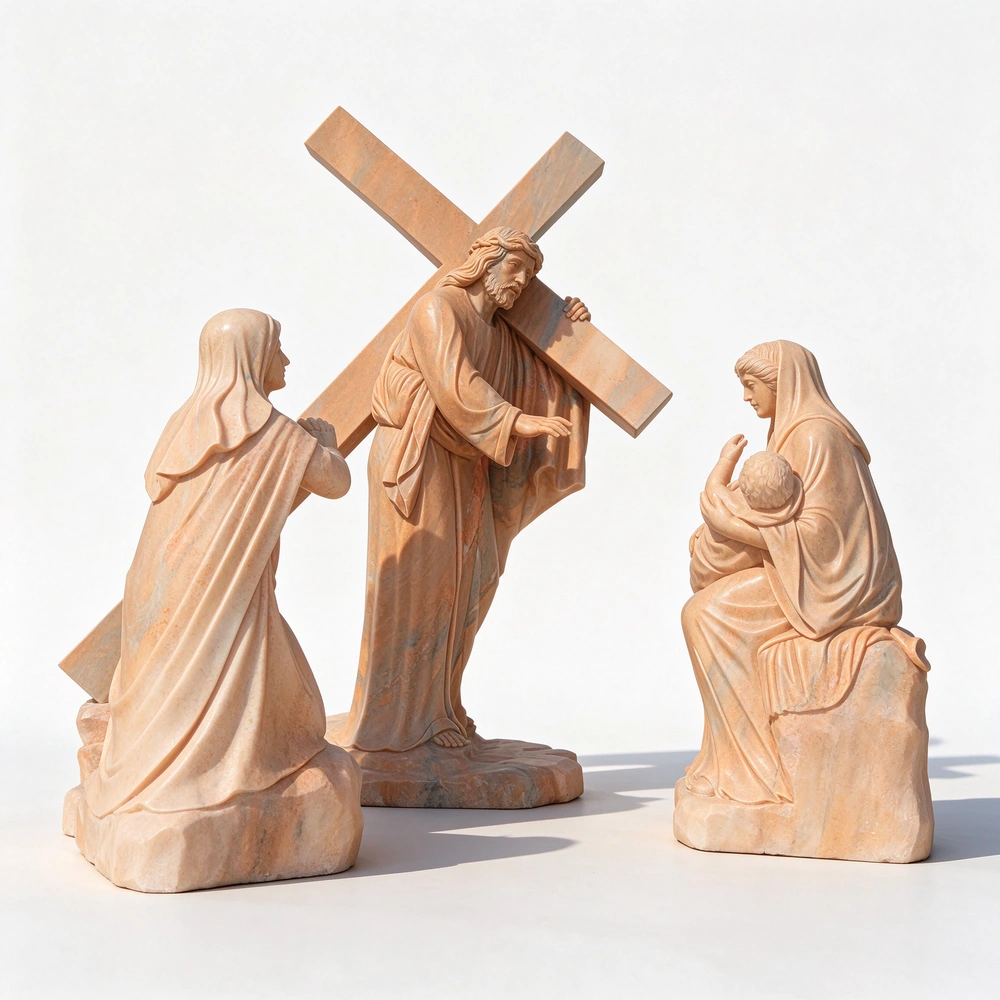
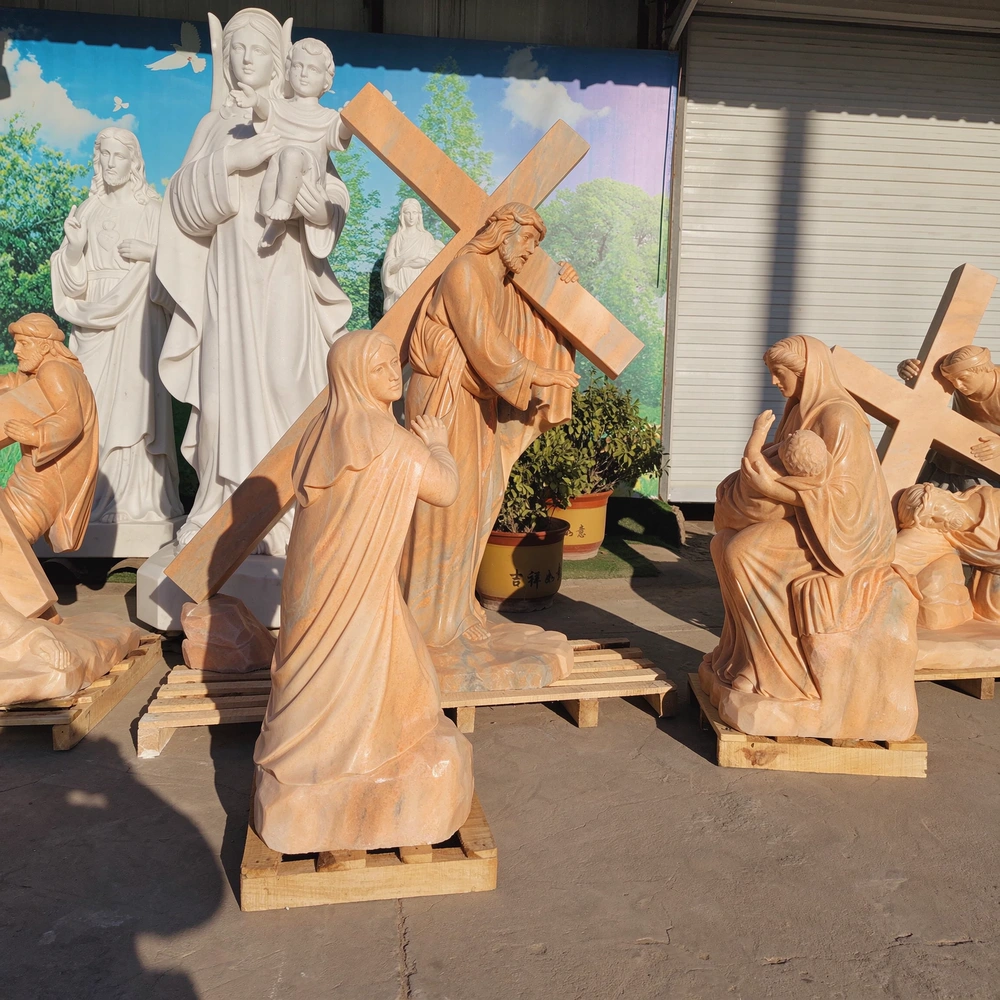
This Sunset marble group of Jesus speaking to the women of Jerusalem stands at the Eighth Station of the Via Crucis — the one station in which the condemned man stops to comfort the crowd, and not the other way round.
The scene rests on a sentence of the Gospel rather than on later devotion. Luke records that a great multitude followed Him, and women who bewailed and lamented Him; Christ turned to them and said,
“Daughters of Jerusalem, weep not for me, but weep for yourselves, and for your children.”
The group keeps that sentence at its centre: the cross still on His shoulder, the procession still moving, and one look thrown back across the beam.
Jesus Christ
Christ stands upright under the timber, His body still turned toward Calvary while the head and shoulders swing back to the women behind Him. The face is composed rather than collapsed — the consolation sits in the eyes and the open angle of the jaw, not in any gesture of pity. One hand steadies the cross; the other hangs free and slightly forward, as if the sentence had only just been spoken.
The Women of Jerusalem
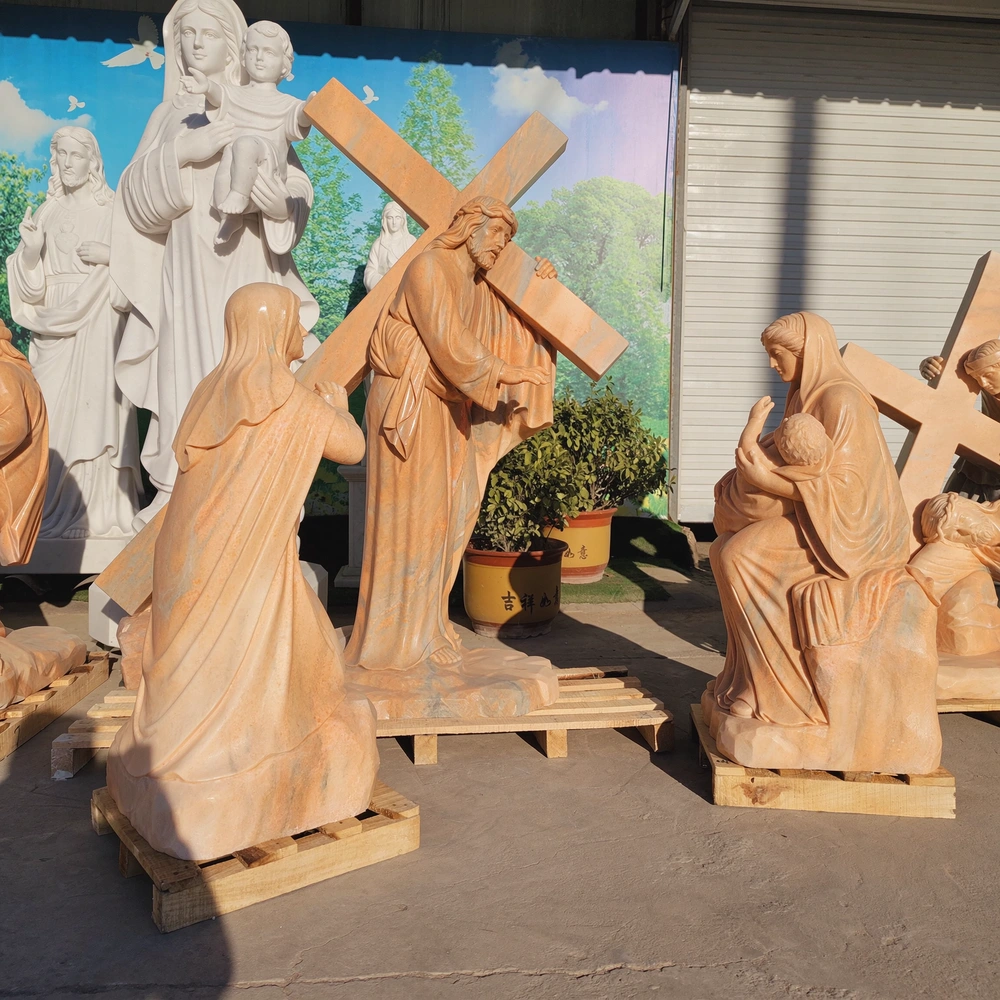
Two veiled women answer Him. The nearer one stands in profile with her hands lifted and her veil falling in long, unbroken planes from the crown of her head to the ground. The second sits lower on the rock, a child held against her shoulder — the and your children of the verse given a body, and the reason the group is cut as three pieces rather than one.
Our Advantages
For this marble statue of Jesus Speaking to Women, the primary issue is torsional twisting, not surface imperfection.
Christ’s body faces one direction, and His head another, and the neck has to carry that rotation while the shoulders keep the weight of the beam.
Our sculptors settle the twist on the clay model first — where the collar turns, where the mantle breaks over the shoulder blade, where the leading woman’s veil hangs straight from skull to hem without a single fold added to compensate.
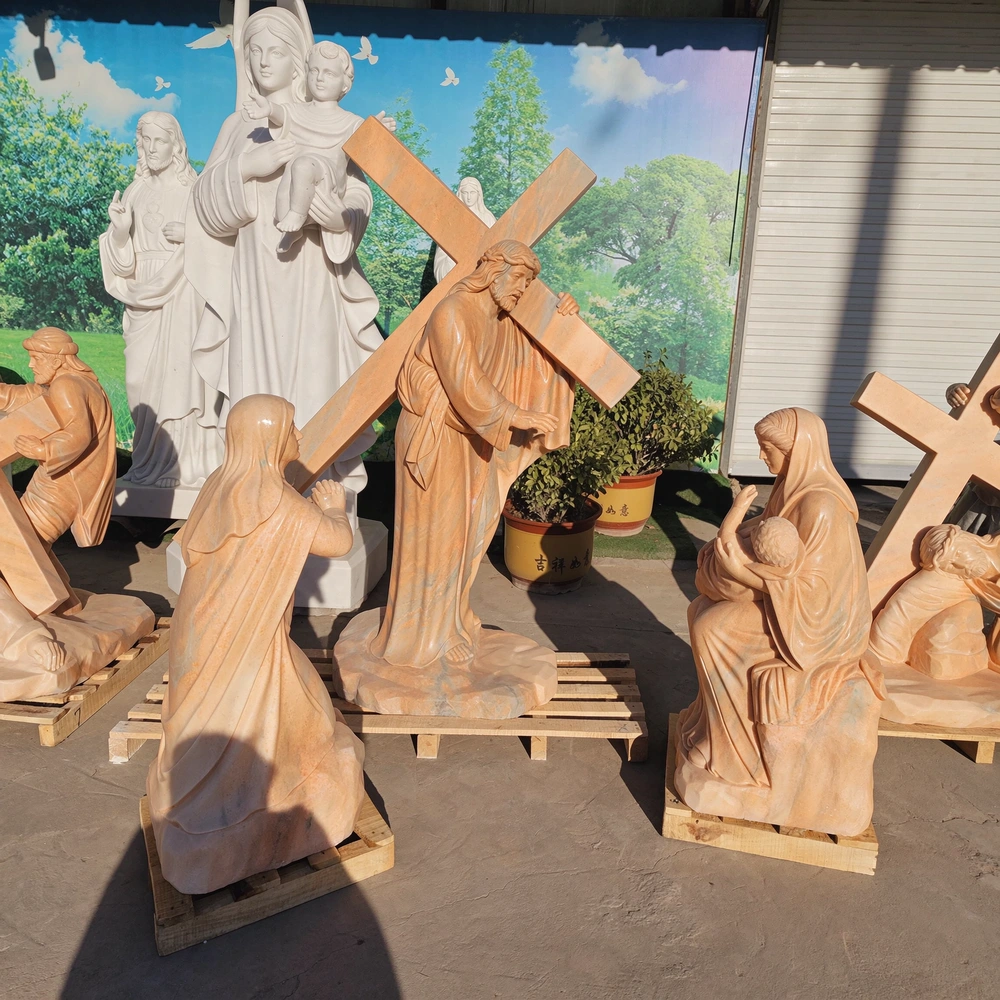
What’s more, this station is read as an exchange and not as a single figure; the spacing is part of the carving.
The three pieces are cut so they can stand at the intervals of a full Via Crucis and still hold their conversation — close enough for Christ’s glance to land on the women, far enough for a visitor to walk between them.
Numbering note: in the traditional Via Crucis this scene is Station VIII; in the Scriptural Via Crucis of 1991 it is Station IX, with Simon of Cyrene taking the eighth place. Tell us which numbering your garden follows, and the pieces will be lettered to match.
Ideal Placement
It is the widest station of the fourteen, and the only one that has to be laid out rather than simply set down.
Give it a stretch of path broad enough for three bodies to stand apart — the women behind and to one side of Christ, never crowded against Him — and the scene reads as an exchange; compress them and it becomes one object with three heads.
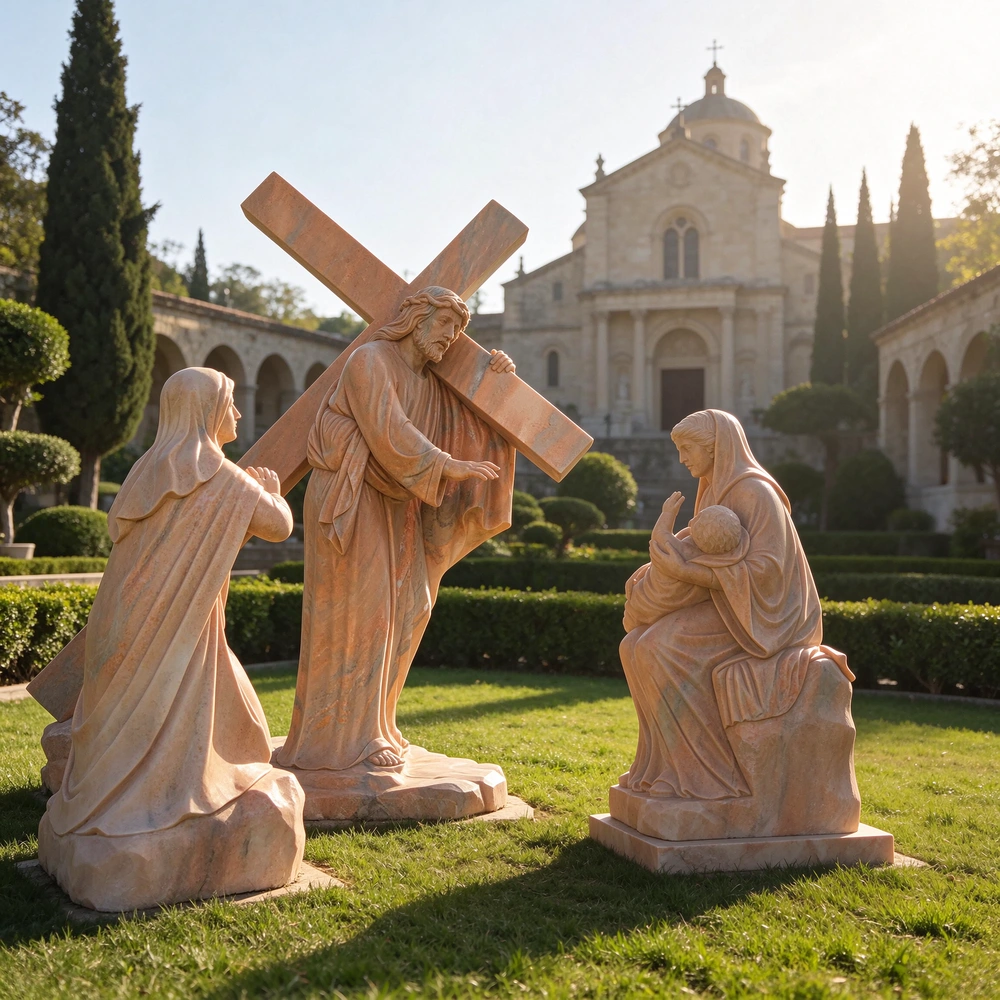
Parish gardens, cemetery walks, the grounds of Catholic schools and the longer retreat paths all take it well, and so do chapel porches and the wider side aisles where a group can be seen from either direction.
Please send us the width of your path and the spacing you have in mind, and we will quote the three pieces separately or as a set — with the marble matched to the Stations you already own. Our team replies within 24 hours.
Christ, who turned back to console the weeping, have mercy on us.