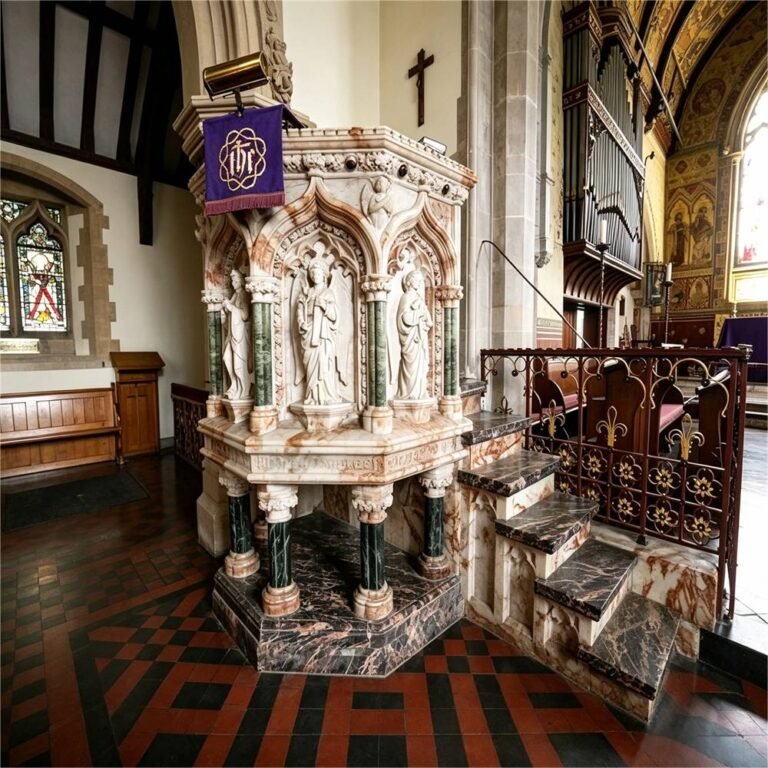
The Twelve Apostles were the closest and original followers of Jesus.
Their names are traditionally known as Peter, Andrew, James son of Zebedee, John, Philip, Bartholomew, Thomas, Matthew, James son of Alphaeus, Thaddaeus or Jude, Simon the Zealot, and Judas Iscariot.
They were not born as kings, philosophers, or powerful men.
Many of them came from rural villages, poor families, lakeside towns, and ordinary working lives.
Some were fishermen. One was a tax collector.
Some were quiet and almost hidden in the biblical record.
Yet these ordinary men became the foundation stones of Christian history.
Why Did We Carve 13 Apostles Instead of 12?
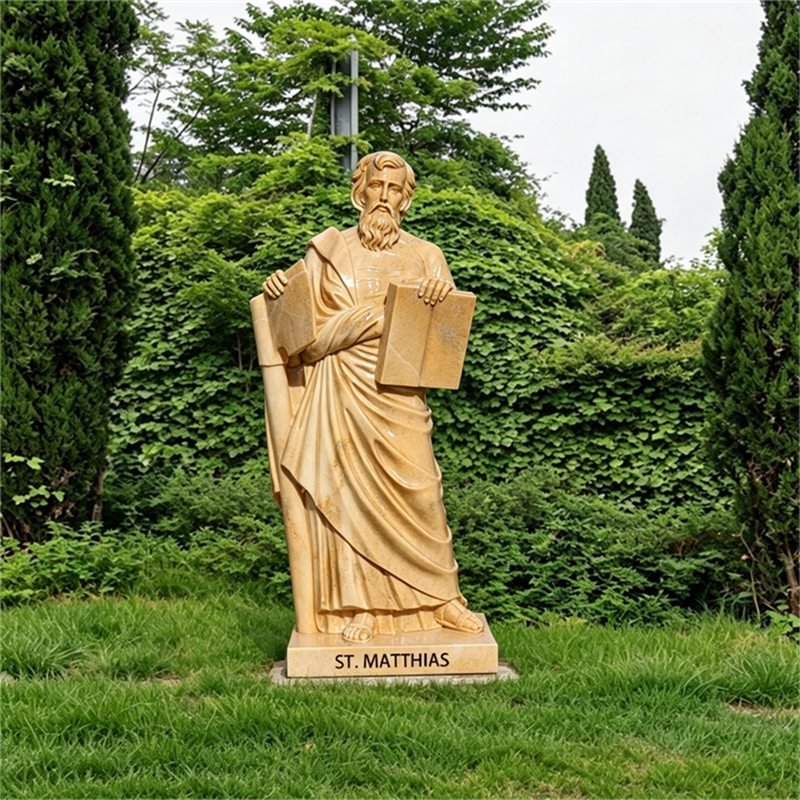
Personally, whenever I talk about the Twelve Apostles of Jesus, I am always reminded of the sunset-marble project of 13 apostles from our YouFine factory.
I still remember the wordless excitement and pride I felt when I took photos of the finished statues for my client and told him this biggest news:
All apostles were finally standing together!
You may wonder: why were there 13 statues instead of 12?
Because Judas Iscariot betrayed Jesus and was later replaced by Matthias.
In order to keep the full biblical and historical tradition, my client also ordered the statue of Judas Iscariot.
So our project became not only a group of the Twelve Apostles, but a fuller visual story of calling, weakness, betrayal, forgiveness, martyrdom, and mission.
In order to represent the most faithful and vivid images of the apostles, our team researched massive materials — from biblical texts and church traditions to classical paintings, medieval sculptures, and relic records. That is why I have the courage to introduce the Twelve Apostles of Jesus to you.
In this post, I will focus on their life stories, biblical facts, interesting traditions, relic locations, and the thoughts behind our carving work.
Without further ado, let’s start our reading journey.
St. Peter
Who is St. Peter?
“Even if I have to die with you, I will never deny you.”
This is one of the most moving promises Peter made to Jesus. But later, he failed his own words three times.
As the head, spokesman, and “prince” of the apostles, Peter became one of the most important figures in early Christianity. He is traditionally regarded as the first bishop of Rome and also connected with the early Church of Antioch.
Before he became St. Peter, he was called “Simon”. He was a fisherman from Galilee, living by the sea with his brother Andrew.
Then Jesus appeared and gave him a new name:
“You are Peter, and on this rock I will build my Church.” — Matthew 16:18
The name Peter means “rock”. But interestingly, Peter’s life shows us that even a rock can tremble.
The Weakness and Three Denials
The Gospels tell us a famous story:
Jesus walked on water, and Peter tried to follow Him. At first, Peter stepped forward with faith. But when he saw the wind and waves, he became afraid and began to sink.
This small story seems to hint at a greater weakness that would appear later — the famous “three denials of Jesus”.
Jesus had already foretold it:
“Before the rooster crows, you will deny me three times.”— Matthew 26:34
During the night of Jesus’ arrest, Peter denied knowing Him three times. A servant girl recognized him. Then another person accused him. Finally, people noticed his Galilean accent. Each time, Peter denied Jesus.
Then the rooster crowed.
For me, the most meaningful part of this story is not only Peter’s failure, but the sound of the rooster. It reminds us of the heavy burden inside Peter’s heart. We do not know how deeply he suffered in that moment, but we know his weakness is also the weakness all human beings share.
Three Times Saying Love to Jesus
After the Resurrection, Jesus appeared again by the water. Peter saw Jesus and jumped into the sea without hesitation and swam toward Him.
There, Jesus asked Peter three times whether he loved Him. Peter had denied Jesus three times, and now Jesus gave him three chances to confess love.
Each time, Jesus answered with a mission:
“Feed my sheep!”
This is one of the most beautiful recoveries in the Bible. Peter’s failure was not the end of his calling.
Martyrdom
Tradition says Peter was martyred in Rome around A.D. 64–68 during the persecution under Emperor Nero.
He was crucified upside down by his own request because he felt unworthy to die in the same manner as Christ.
Relics of St. Peter
Peter’s relics are traditionally believed to be buried beneath St. Peter’s Basilica in Vatican City. This makes the basilica one of the holiest Christian sites in the world.
There are also traditions connected with relics of his head being venerated at the Archbasilica of St. John Lateran in Rome, together with St. Paul.
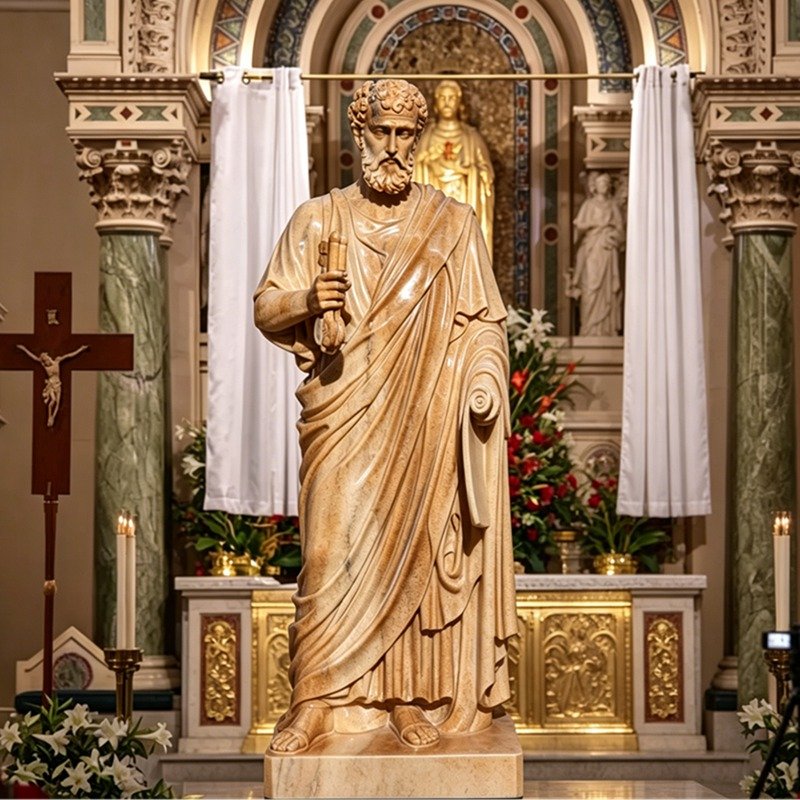
Based on these stories, our team carved Peter holding the keys and a book.
The keys represent the “keys of the Kingdom of Heaven,” one of Peter’s most recognizable symbols. The book represents teaching, authority, and the Gospel mission.
When we carved his face, we did not want him to look only powerful. We wanted to show a man who had failed, wept, returned, and finally became strong. So his expression carries both firmness and sorrow — like a rock that has been shaped by waves.
St. Andrew
Who is St. Andrew?
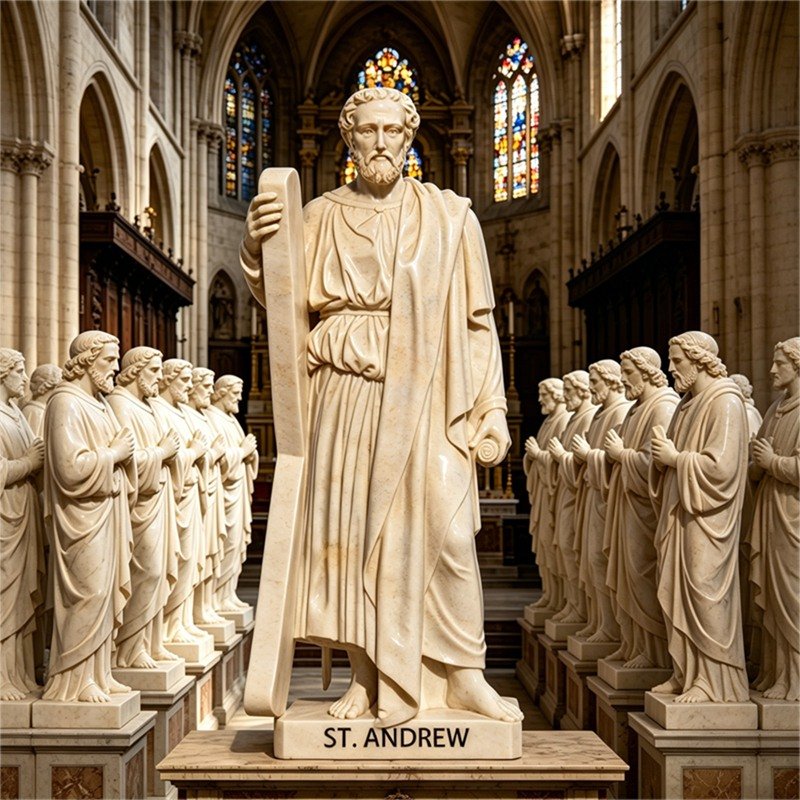
St. Andrew, also known as Andrew the Apostle, was a fisherman and one of the first disciples chosen by Jesus. His name in Greek means “manly” or “brave,” which beautifully reflects his later courage in preaching.
Andrew was born into a Jewish family in Bethsaida of Galilee. He was the brother of Simon Peter and, like Peter, made his living by fishing.
Before following Jesus, Andrew had been a disciple of John the Baptist. When John pointed to Jesus, Andrew followed Him and recognized Him as the Messiah. Then he immediately went to introduce Jesus to his brother Peter.
For this reason, the Eastern Orthodox Church honors Andrew as Protokletos, meaning “the First-Called.”
The Miracle of Feeding the Five Thousand
Andrew appears quietly but meaningfully in several Gospel scenes.
He was present when Jesus called Peter and Andrew to become “fishers of men.” He also told Jesus about the boy with the loaves and fishes before the miracle of feeding the five thousand.
When some Greeks wanted to see Jesus, they came first to Philip, and Philip went to Andrew. This small detail shows Andrew as a bridge — someone people could approach.
After Jesus’ Ascension
Ancient traditions say Andrew preached in Scythia, Thrace, Achaea, and around the Black Sea. Some traditions also connect him with Byzantium, later known as Constantinople.
According to church tradition, Andrew founded the See of Byzantium in A.D. 38 and appointed Stachys as bishop. This is why he remains deeply honored in the tradition of the Patriarchate of Constantinople.
Martyrdom
Andrew is traditionally said to have been martyred by crucifixion in Patras, Greece, around A.D. 60.
He was crucified on an X-shaped cross, now known as St. Andrew’s Cross. Like Peter, he believed himself unworthy to die on the same type of cross as Jesus.
Relics of St. Andrew
Major relics of St. Andrew are venerated in several places:
- Cathedral of St. Andrew in Patras, Greece
- Basilica of St. Andrew in Amalfi, Italy
- Some relics are also associated with St. Mary’s Cathedral in Edinburgh, Scotland
The return of some relics to Patras in the 20th century was an important event in modern Christian history.
St. James
Who is St. James?
St. James, also known as James the Great, was the brother of John the Evangelist and the son of Zebedee. He was a fisherman from Galilee.
Together with Peter and John, James belonged to the inner circle of Jesus’ disciples. He witnessed several important moments: the Transfiguration, the raising of Jairus’ daughter, and Jesus’ agony in Gethsemane.
Why Was He Called a “Son of Thunder”?
Jesus gave James and John the nickname Boanerges, meaning “Sons of Thunder.”
This nickname fits their bold, fiery personality.
One story shows this clearly. When a Samaritan village refused to welcome Jesus, James and John asked whether they should call down fire from heaven. Jesus rebuked them.
Their zeal was real, but it still needed to be purified.
Another story happened when their mother asked Jesus to give them seats of honor in His kingdom. Jesus asked whether they could drink the cup He was going to drink. They answered,
“We can.”
They did not fully understand what this meant, but James would later truly drink the cup of martyrdom.
Martyrdom
James was the first apostle to be martyred.
According to Acts 12, King Herod Agrippa had James killed by the sword. This happened around A.D. 44.
His death shows how quickly apostolic courage became apostolic sacrifice.
Relics of St. James the Great
The relics of St. James the Great are traditionally venerated at the Cathedral of Santiago de Compostela in Spain.
This shrine became one of the most important pilgrimage destinations in Christian history. The famous Camino de Santiago still attracts pilgrims from all over the world.
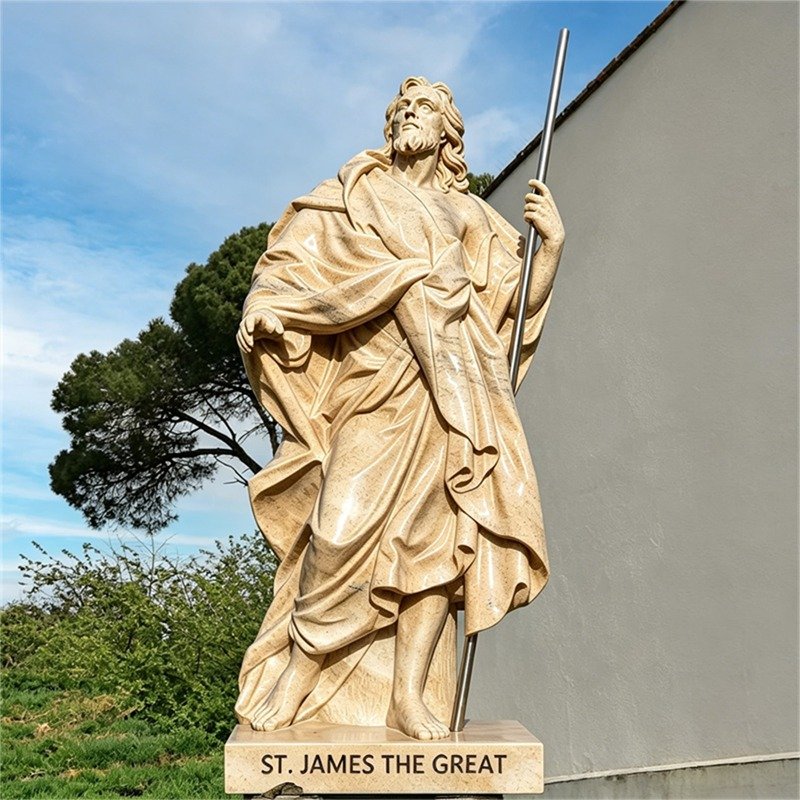
For James the Great, we wanted to show both zeal and pilgrimage.
In many artworks, James is shown as a pilgrim with a staff, cloak, and shell. We used these symbols to connect him with Santiago de Compostela.
His face was carved with strong lines, because he was not a mild background figure. He was a “Son of Thunder” — passionate, quick, brave, and finally faithful unto death.
St. John
Who is St. John?
St. John the Apostle was the younger brother of James the Great and is traditionally regarded as the youngest of the Twelve Apostles.
He is often identified with John the Evangelist, the author of the Gospel of John, the Epistles of John, and the Book of Revelation according to church tradition.
The Main Theme of John: Love
The story of John has already appeared in the section about James. But what I mainly want to share here is John’s thought.
The central theme of John’s Gospel and letters is love.
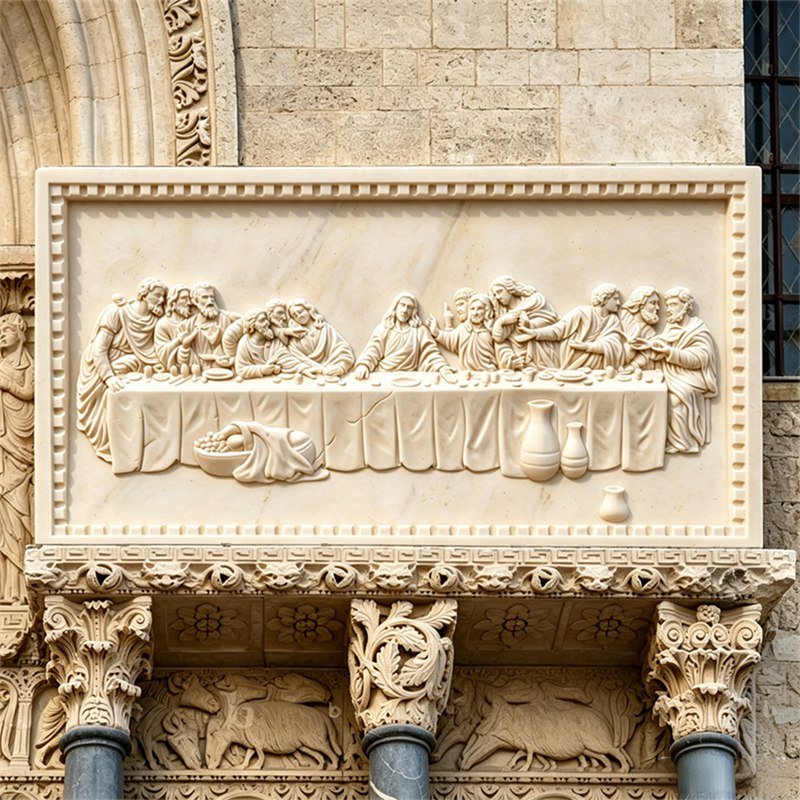
In John’s telling of the Last Supper, Jesus’ final teaching focuses deeply on love: to remain in His love and love one another.
John’s Gospel also contains details not found in the other Gospels. It names certain minor characters and gives special attention to the Holy Spirit. Most importantly, John’s Gospel begins with one of the most profound declarations of Christ’s divinity:
“In the beginning was the Word.”
Peaceful Death
John is traditionally believed to be the only apostle who did not die by martyrdom.
He suffered exile on Patmos, where tradition connects him with the Book of Revelation, but he is said to have died peacefully in old age at Ephesus.
Relics and Tomb of St. John
Unlike many other apostles, there are no universally accepted bodily relics of St. John.
His traditional tomb is located at the Basilica of St. John in Ephesus, near modern Selçuk, Turkey. The site became an important pilgrimage place in the Byzantine world.
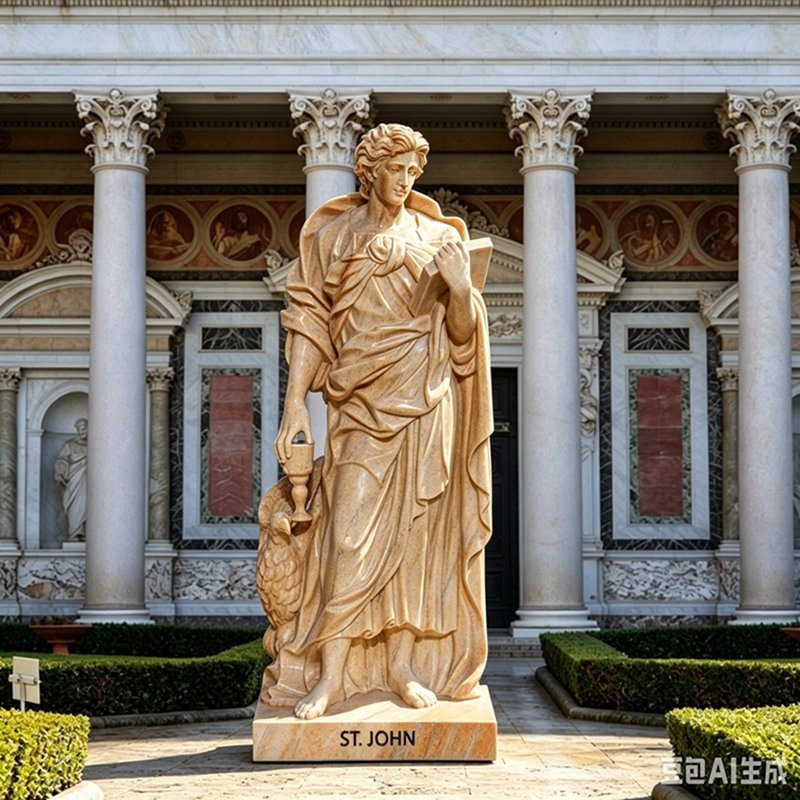
For John, we avoided an overly old or severe image. Since he is remembered as the youngest apostle, we carved him with a gentler and more contemplative expression.
His symbol is often the eagle, because his Gospel rises high into the mystery of Christ’s divinity. In our carving, we focused on the feeling of spiritual depth — not loud emotion, but quiet fire.
St. Philip
Who is St. Philip?
Philip was a native of Bethsaida on the Sea of Galilee, just like Peter and Andrew.
After Jesus called him, Philip immediately went to Nathanael and said that they had found the one Moses and the prophets wrote about. Nathanael was skeptical and asked,
“Can anything good come out of Nazareth?”
Philip simply answered:
“Come and see.”
This short sentence is the beautiful invitation of Philip’s life.
What the Story of Philip?
The stories of St.Philip are related to St.Andrew.
When Jesus faced a large hungry crowd, He asked Philip where they could buy bread. Philip answered practically that even a large amount of money would not be enough.
Later, when Greeks came and wanted to see Jesus, they approached Philip. Philip then went to Andrew, and together they told Jesus.
At the Last Supper, Philip said,
“Lord, show us the Father.”
Jesus answered that whoever had seen Him had seen the Father.
Philip’s questions are very human. He is not a dramatic apostle, but his honesty makes him close to us.
Martyrdom
St. Philip is traditionally said to have been martyred by crucifixion in Hierapolis around A.D. 80.
Some traditions describe him as being crucified upside down.
Relics of St. Philip
Relics of St. Philip are traditionally venerated at the Basilica of the Twelve Holy Apostles in Rome.
His tomb or memorial site is also associated with Hierapolis, where archaeological discoveries have strengthened interest in the ancient tradition of his burial there.
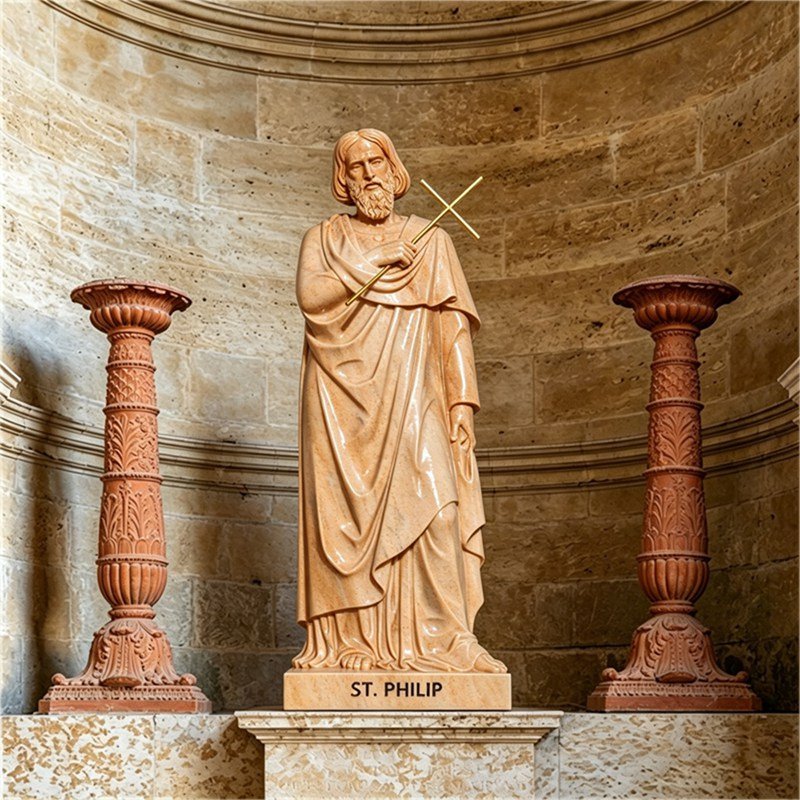
In medieval art, Philip is often symbolized by loaves of bread because of his role in the feeding miracle, and also by a cross because of his martyrdom.
For our statue, we chose a calm and approachable image. Philip’s greatness is not thunder, but invitation. His “Come and see” feels very simple, but it opened a road of faith for Nathanael and for many others.
St. Bartholomew
Who is St. Bartholomew?
The information about St. Bartholomew in the Bible is very limited.
He is listed among the Twelve Apostles, and many traditions identify him with Nathanael, the man Philip invited to meet Jesus.
He is the patron saint of leatherworkers, bookbinders, plasterers, butchers, tanners, and shoemakers.
When we prepared to carve this statue, our head artist Yuan gave us a very useful and constructive suggestion: do not only search for a gentle apostle image. Search for the symbol of his martyrdom.
Following this suggestion, we finally found the proper visual direction.
Mission and Legends
Traditions say Bartholomew preached in India and Armenia.
One legendary story says he traveled to a region controlled by a demon named Astaruth. Through prayer and preaching, he defeated demonic power, healed the sick, and converted many people.
These legends may not all be historical in the modern sense, but they show how ancient Christians remembered Bartholomew: as an apostle of spiritual courage.
Martyrdom
The most famous tradition says Bartholomew was flayed alive and then killed, possibly by beheading.
This is why his most recognizable symbol is a flaying knife.
In Milan Cathedral, there is a famous sculpture of St. Bartholomew Flayed, showing him holding his own skin. It is one of the most unforgettable images in Christian art.
Relics of St. Bartholomew
His relics are traditionally connected with several places:
- First translated to Lipari, an island near Sicily
- Then to Benevento, Italy
- Later major relics were venerated at the Basilica of St. Bartholomew on the Island in Rome
Benevento Cathedral also preserves an important Bartholomew relic tradition.
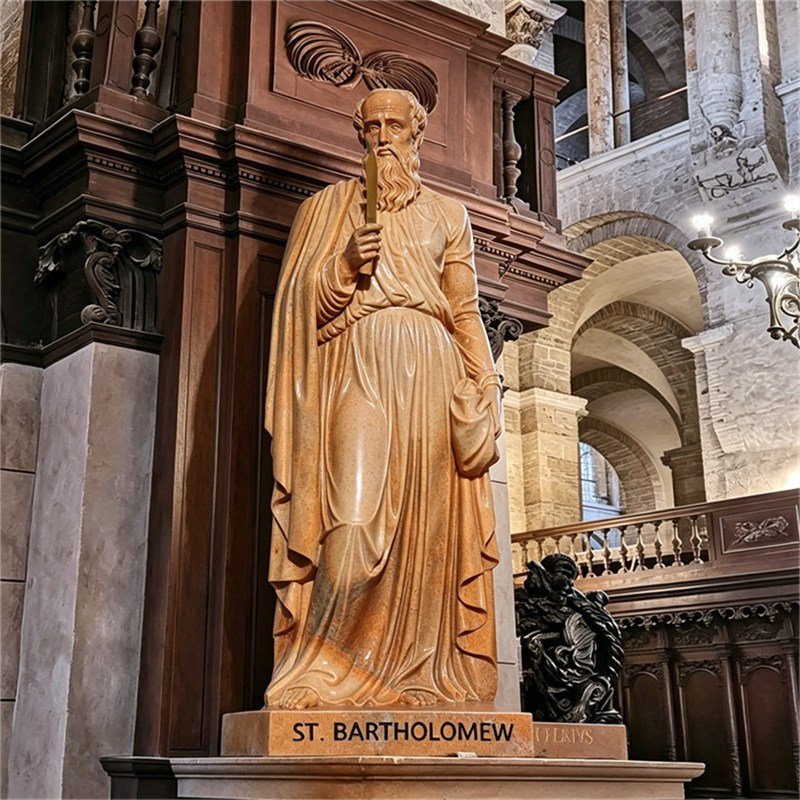
Based on these stories and facts,we let St. Bartholomew hold a flaying knife in his hand.
His eyes stare at the knife with a calm and almost indifferent expression. Our head artist deeply admired the courage of St. Bartholomew and wanted him, at least in marble, to hold the instrument of his suffering as if it could no longer hurt him.
This was one of the most emotionally difficult statues in the project.
St. Thomas
Who is St. Thomas?
St. Thomas was one of the Twelve Apostles. He is often remembered as “Doubting Thomas,” but this name is not completely fair.
He was not only doubtful. He was also brave.
When Jesus decided to return to Judea to visit Lazarus, the disciples knew it was dangerous. Thomas said to the others:
“Let us also go, that we may die with him.”
This sentence shows his courage.
Why Is He Called “Doubting Thomas”?
Thomas is best known for his response to the Resurrection.
When the other apostles told him they had seen the risen Lord, Thomas said he would not believe unless he saw the wounds.
Eight days later, Jesus appeared again and invited Thomas to see His hands and side. Thomas then made one of the clearest confessions of faith in the New Testament:
“My Lord and my God.”
So Thomas’ doubt became the road to one of the strongest statements of belief.
Mission to India
Tradition says Thomas preached in Parthia, Persia, and finally India.
The ancient Christian community on the Malabar Coast still honors him as the apostle who brought the faith to India. They are often known as St. Thomas Christians.
The Assumption Tradition
Some medieval texts say Thomas was the only apostle to witness Mary’s Assumption into heaven and received her girdle as a sign. This story became popular in medieval and Renaissance art.
Martyrdom
A common and strong tradition says Thomas was martyred near Mylapore, in modern Chennai, India. He was pierced with a spear or lance.
Some later stories contain different details, but the spear became his most common symbol.
Relics of St. Thomas
Important relic sites include:
- San Thome Basilica in Chennai, India, built over the traditional tomb of St. Thomas
- Basilica of St. Thomas the Apostle in Ortona, Italy, where many relics were translated from Edessa
- Earlier traditions also connect his relics with Edessa, now Şanlıurfa in Turkey
According to these traditions, we carved St. Thomas as a thoughtful young man holding a scroll.
We did not want to mock him as “the doubter.” Instead, we wanted to show a man who needed truth deeply and, once he found it, carried it far away to India.
His doubt was not the end of faith. It became the beginning of mission.
St. Matthew
Who is St. Matthew?
St. Matthew was one of the Twelve Apostles and is traditionally regarded as the author of the Gospel according to Matthew.
Before following Jesus, he was a tax collector. His other name was Levi.
As a tax collector in Capernaum, Matthew worked in a profession hated by many Jews, because tax collectors were often associated with Roman power, greed, and social betrayal.
Then Jesus saw him sitting at the tax booth and said:
“Follow me.”
Matthew rose and followed Him.
Matthew’s Feast with Sinners
After his calling, Matthew held a feast in his house. Many tax collectors and sinners sat at table with Jesus and His disciples.
The Pharisees complained. But Jesus answered that He came not to call the righteous, but sinners.
This makes Matthew’s story very touching. He was not chosen because people respected him. He was chosen while people despised him.
Mission and Tradition
Ancient writers say Matthew preached among the Hebrews and later in other lands. Traditions mention places such as Ethiopia, Persia, Macedonia, Syria, and Parthia, though the exact historical details are uncertain.
Martyrdom
Traditions disagree about Matthew’s martyrdom. Some say he was burned, others say stoned, stabbed, or beheaded.
The Roman Martyrology remembers him as a martyr who preached in Ethiopia, though the exact place and manner remain uncertain.
Relics of St. Matthew
The main relics of St. Matthew are traditionally venerated in Salerno Cathedral in southern Italy.
This cathedral remains one of the most important pilgrimage sites connected with him.
Matthew’s traditional symbol is a winged man or angel, because his Gospel begins with the human genealogy of Christ.
For the statue, we emphasized the transformation from tax collector to evangelist. We gave him a book to represent the Gospel and wisdom, but his face carries humility. He is a man who knew what it meant to be called out of an old life.
St.James the Lesser
Who is St. James the Lesser?
St. James the Lesser, also called James son of Alphaeus, is one of the most mysterious apostles.
He is called “Lesser” or “Minor” to distinguish him from James the Great, the son of Zebedee.
Tradition sometimes identifies him with James the Just, the relative of Jesus and leader of the Jerusalem Church, though historians and churches have discussed this identification for centuries.
Because of this, his story carries some complexity.
A Pillar of the Church
James is traditionally remembered as a leader in the early Church of Jerusalem. St. Paul refers to a James as one of the “pillars” of the Church.
He was respected for his righteousness and prayer life. Some ancient traditions say he prayed so often that his knees became hard like a camel’s.
This is why he received the name James the Just.
Witness of the Resurrection
According to early Christian tradition, James was among those who witnessed the risen Christ.
He became a symbol of stability, prayer, and justice in the early Church.
Martyrdom
Traditions say James was thrown from the pinnacle of the Temple, then stoned, and finally struck on the head with a club.
Because of this, he is often shown in art holding a club, the instrument of his martyrdom.
Relics of St. James the Lesser
Relics of St. James the Lesser are traditionally venerated together with those of St. Philip in the Basilica of the Twelve Holy Apostles in Rome.
This is why the two apostles are often celebrated together in the Western Church.
For James the Lesser, our team chose a quieter and more reserved expression.
Unlike Peter, Andrew, or James the Great, he does not have many dramatic Gospel scenes. So we carved him as a man of hidden strength.
His club was included not as a violent object, but as a sign of faithful endurance. Some saints are remembered through dramatic speeches. James the Lesser is remembered through steadfast silence.
St. Jude Thaddaeus
Who is St. Jude Thaddaeus?
St. Jude, also called Thaddaeus, was one of the Twelve Apostles.
He should not be confused with Judas Iscariot. Because of the similarity of names, many Christians later preferred to call him Jude or Thaddaeus.
He is often remembered as the patron saint of hopeless or difficult cases.
Jude in the Gospel
Jude appears briefly in the Gospel of John during the Last Supper. He asks Jesus why He will reveal Himself to the disciples and not to the world.
It is a small question, but it shows Jude’s desire to understand the mystery of Christ’s mission.
Mission and Tradition
Tradition says Jude preached in Judea, Samaria, Syria, Mesopotamia, Libya, and Persia. He is often connected with Simon the Zealot in missionary tradition.
Some traditions say Jude brought healing to King Abgar of Edessa by carrying an image of Christ or preaching the Gospel there. This story later became connected with the famous tradition of the Image of Edessa.
Martyrdom
Jude is traditionally said to have been martyred in Persia, often together with Simon the Zealot.
His common symbol is a club, axe, or halberd, depending on the artistic tradition.
Relics of St. Jude
The relics of St. Jude are traditionally venerated in St. Peter’s Basilica in Vatican City, in the same area associated with St. Simon.
There are also important devotional shrines to St. Jude around the world, but the Vatican tradition is the major relic location.
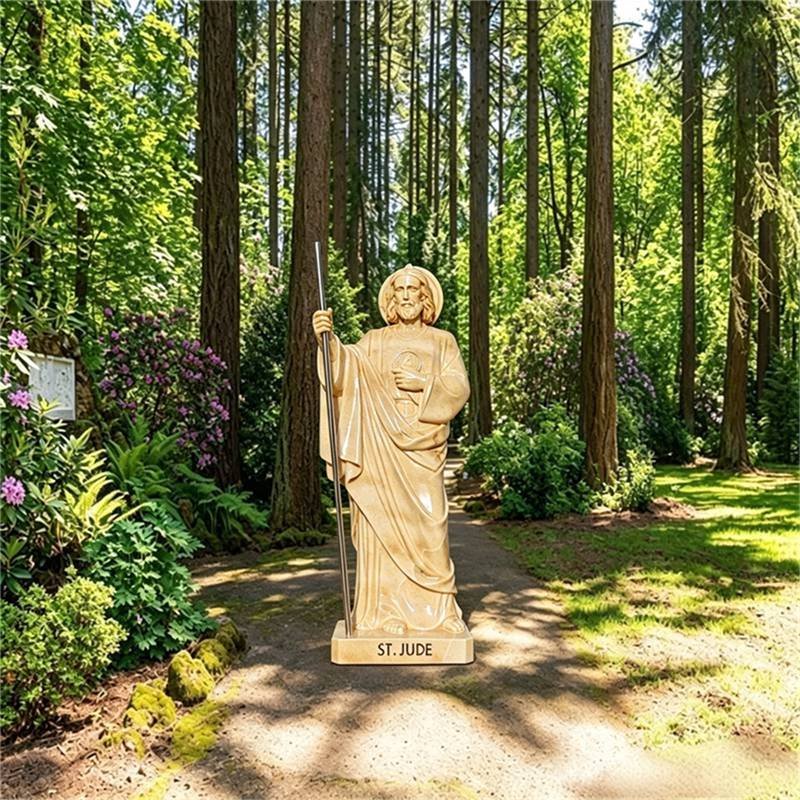
When carving Jude, we wanted to avoid any confusion with Judas Iscariot. His face needed to be noble, faithful, and compassionate.
Because he is the patron of difficult cases, we gave him a gentle but firm expression — like someone who has heard many desperate prayers and still carries hope.
St. Simon the Zealot
Who is St. Simon the Zealot?
St. Simon is called “the Zealot” to distinguish him from Simon Peter.
The title may mean he was passionate for Jewish law, or that he had some connection with a zealot-like movement. The Bible gives very little detail about him, which makes him one of the quieter apostles.
But his title tells us something important: he was a man of fire.
Mission and Tradition
Traditions about Simon vary. Some say he preached in Egypt, North Africa, and Persia. Others connect him with Britain or Armenia.
In many traditions, he preached together with St. Jude. This is why they are often remembered as missionary companions.
Martyrdom
One common tradition says Simon was martyred in Persia. In Western art, he is often shown with a saw, because some traditions say he was sawn in two.
This makes his image unforgettable and very solemn.
Relics of St. Simon
Relics of St. Simon are traditionally venerated in St. Peter’s Basilica in Rome, near those of St. Jude.
Other local traditions also claim relics or memorials, but the Vatican is the most recognized site.
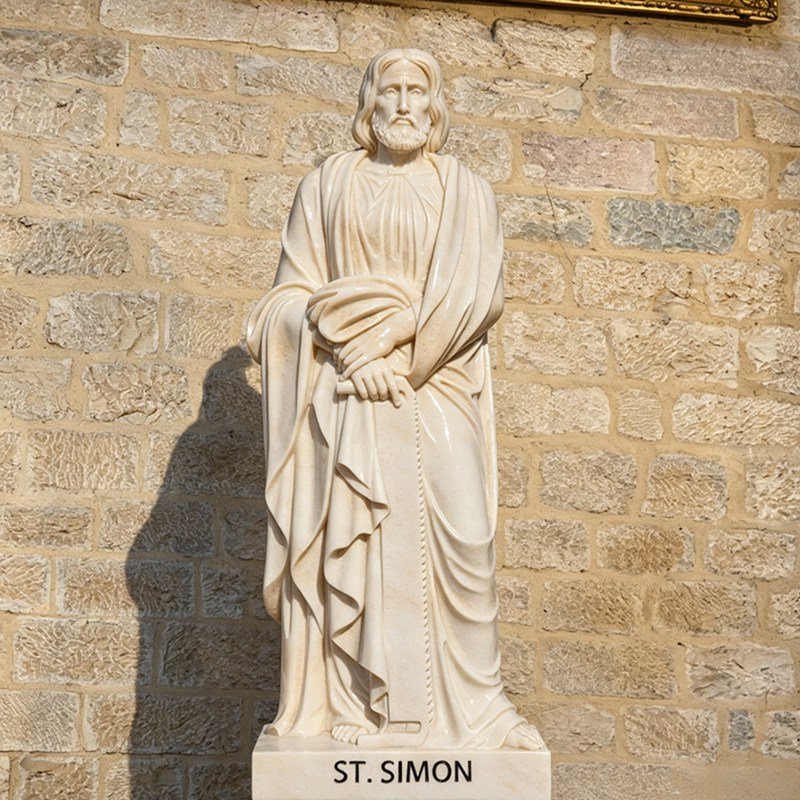
For Simon the Zealot, our team focused on inner fire.
He is not as famous as Peter or John, so the challenge was how to create a strong image with little biblical information.
We used the saw as his symbol, but we did not make the statue too tragic. Instead, we carved him with a determined expression, as if his zeal had been transformed from political passion into spiritual courage.
St.Judas Iscariot
Who is Judas Iscariot?
Judas Iscariot was one of the Twelve Apostles, but he is remembered as the one who betrayed Jesus.
His story is painful, but it is impossible to tell the full story of the apostles without him.
He was trusted enough to hold the common money bag, yet he later agreed to betray Jesus for thirty pieces of silver.
The Betrayal
At the Last Supper, Jesus said one of the disciples would betray Him. Judas later identified Jesus to the authorities with a kiss in the Garden of Gethsemane.
The kiss should have been a sign of love. In Judas’ story, it became a sign of betrayal.
This is why his figure is one of the most tragic in Christian history.
Death
The New Testament gives two related but different accounts of Judas’ death. Matthew says he hanged himself. Acts describes a violent death in the field associated with his betrayal money.
The place became known as Akeldama, the Field of Blood, near Jerusalem.
Relics of Judas Iscariot
There are no venerated relics of Judas Iscariot in the Christian tradition.
Unlike the saints, Judas is not honored with relics or feast days. His memory is preserved as a warning, not as an object of devotion.
This was the most difficult statue for our team.
Because my client wanted the full tradition, we carved Judas together with the other apostles. But we did not want to make him look like a simple villain. His tragedy is more frightening because he once walked with Jesus, heard His words, and still chose betrayal.
We carved him with a tense, conflicted expression. His body language is slightly withdrawn from the group. In the marble, he becomes a reminder that the human heart can stand very close to holiness and still fall into darkness.