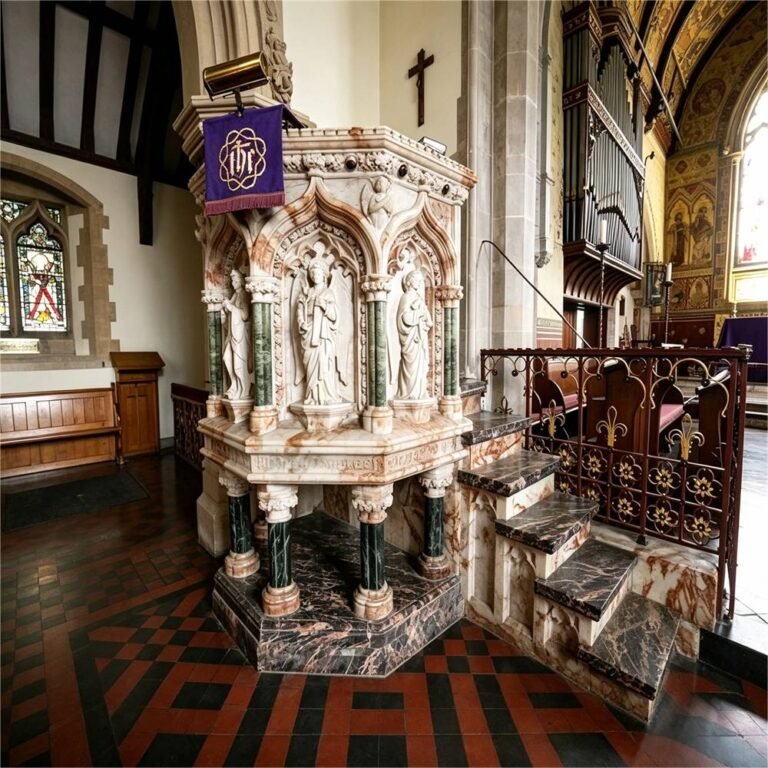
There is a quiet distinction between a prayer corner and a family altar. A prayer corner is a shelf with a cross. A family altar is the sacred centre of a Catholic home — the place where generations gather for morning and evening prayer, where children are taught to genuflect, where the family’s patron saints stand watch, and where — in the grandest homes — a private chapel may be maintained with the guidance of the Church.
For discerning Catholic families, the family altar is not a trend. It is a patrimony. The marble mensa carved in your lifetime will stand in the same house for your grandchildren and their children, worn smooth by the hands of those who prayed before it. It is not purchased on a weekend; it is commissioned, blessed, and handed down.
This guide is written for those who wish to build such an altar well — with traditional dimensions, sacred elements, and the permanence that becomes a domestic church.
Why Many Catholic Families Choose a Permanent Altar
The family is the domestic church (ecclesia domestica). When a priest blesses a home with the Rituale Romanum, the house is set apart.
St. John Chrysostom wrote in the fourth century:
“Where Christ is, let no demon enter. Make your home a church. For where there are psalms, and prayers, and the singing of prophets, no one will err if he call the assembly a church.”
— St. John Chrysostom, 4th century
A family altar makes this visible.
For families who wish to give a more permanent and visible form to the domestic church, it can become the anchor of the home: the place where the family gathers for the Rosary, where guests are invited to pray, where the household’s feast days are kept, and where — in homes with a properly arranged private chapel — the Holy Sacrifice may be offered according to the guidance of the Church.
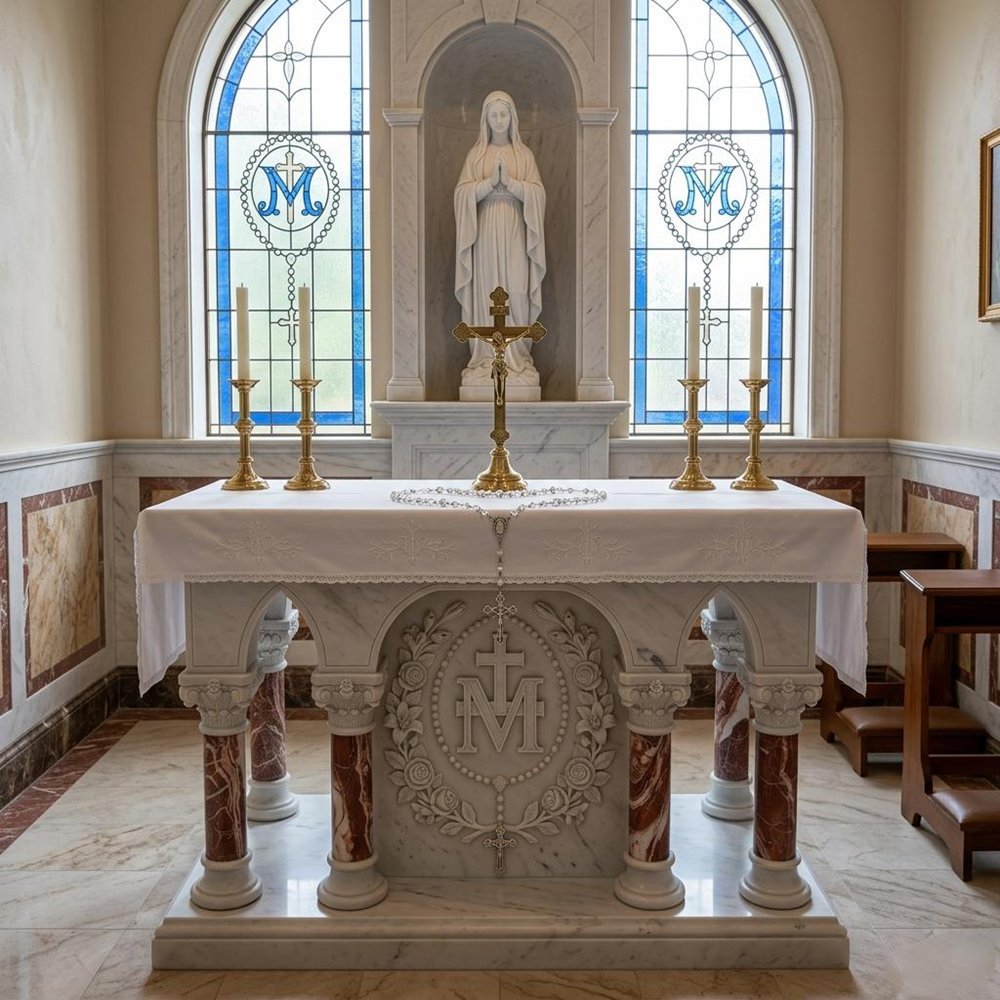
For families of means, the family altar is also a form of stewardship. Just as you would not place a folding table in a library of rare books, you do not place a mass-produced devotional shelf at the centre of your prayer life.
The altar should be created to serve your family for generations to come.
What to Consider When Designing a Catholic Family Altar
Before commissioning a family altar, four principles should guide the design.
It Is Reserved for Sacred Use Alone
If a table or altar is intended for the regular celebration of Mass, it should be treated with reverence and reserved for sacred use.
It should not hold correspondence, serve as a desk, or be used for ordinary household purposes.
This is not mere sentiment, but a matter of respect for sacred worship and should be discussed with one’s priest when liturgical use is intended.
A true family altar should be a dedicated furnishing, set apart for prayer.
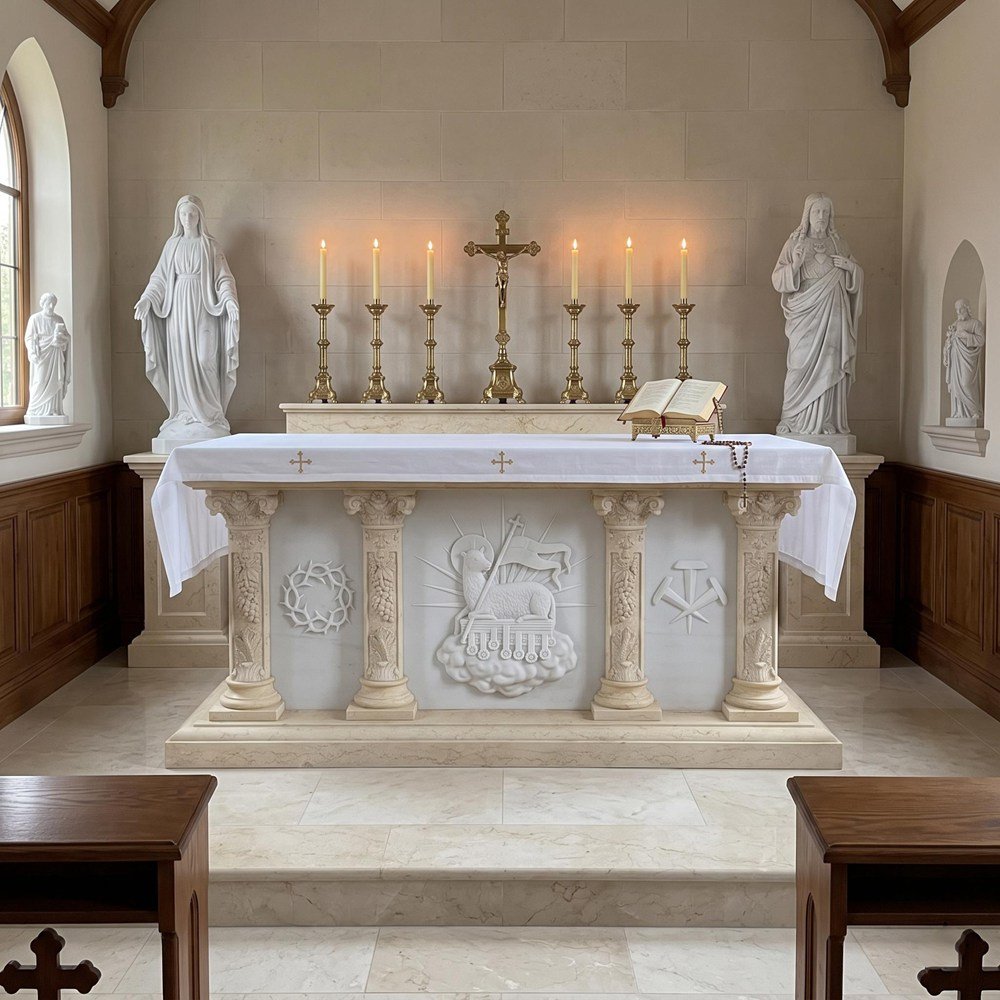
For families building a private chapel, this is straightforward.
For those setting an altar within a living room or study, choose a dedicated furnishing — ideally marble for permanence and dignity — that no other household function will ever touch.
It Should Be Built to Liturgical Dimensions
Most tables are built for sitting.
An altar is built for a priest standing at it, ad orientem. The dimensions below are drawn from the traditional Roman liturgical tradition and have been found by priests to be eminently suitable for a family altar intended for the celebration of Mass:
| Dimension | Measurement | Purpose |
|---|---|---|
| Height | 39 in (100 cm) | The standing priest does not stoop; altar cards and the missal rest at a natural reading angle. |
| Width | 59 in (150 cm) | Accommodates the crucifix, six candlesticks, missal stand, and corporal with room to spare. |
| Depth | 20 in (50 cm) | Holds the chalice, cruets, and altar cards without crowding the priest. |
For a smaller home altar where Mass is not regularly offered, dimensions may be reduced to 36 in high × 48 in wide × 18 in deep — but the 39-inch height should be preserved wherever possible. When the room allows, the altar should rest on three steps (a predella), symbolizing the ascent to the holy of holies, and it gives even a modest chapel the gravity of a church.
Relics and Altar Stones Should Be Discussed With a Priest
In the Roman Catholic tradition, fixed altars have historically been associated with the relics of saints and martyrs. The priest kisses the altar before the Introit, praying:
“We beseech Thee, O Lord, by the merits of Thy Saints whose relics are here, and of all the Saints, that Thou wouldst vouchsafe to forgive me all my sins. Amen.”
For a family altar intended for the celebration of Mass, questions regarding relics, altar stones, blessing, and lawful use should be discussed with a priest or the local diocese. Relics are sacred and are not commercial objects; they should never be bought or treated as decorative additions. If required, the marble mensa can be designed to accommodate an altar stone.
It Faces East Where Possible
The ancient Christian arrangement is ad orientem: priest and people facing East together, toward the returning Sun of Justice.
Where the architecture of the home allows, a family altar may be placed against an eastward wall of the chapel, with the reredos behind it and a tabernacle only where reservation of the Blessed Sacrament is lawfully permitted.
This orientation is traditional, symbolically rich, and deeply rooted in Christian worship.
For the family, an eastward arrangement can also create a practical order: the altar against the wall leaves the room open for the household to gather before it.
Four Elements of a Family Altar
The Mensa — A Commissioned Marble Altar Table
The mensa (altar tabletop) is the heart of the chapel.
In the Catholic tradition, stone has long been one of the noblest materials for altars. The early Christians built them over the tombs of martyrs; St. Peter’s Basilica rests over the tomb of St. Peter.
Marble is one of the most refined and enduring materials for sacred furnishings because it is permanent, dignified, and suitable for fine carving.
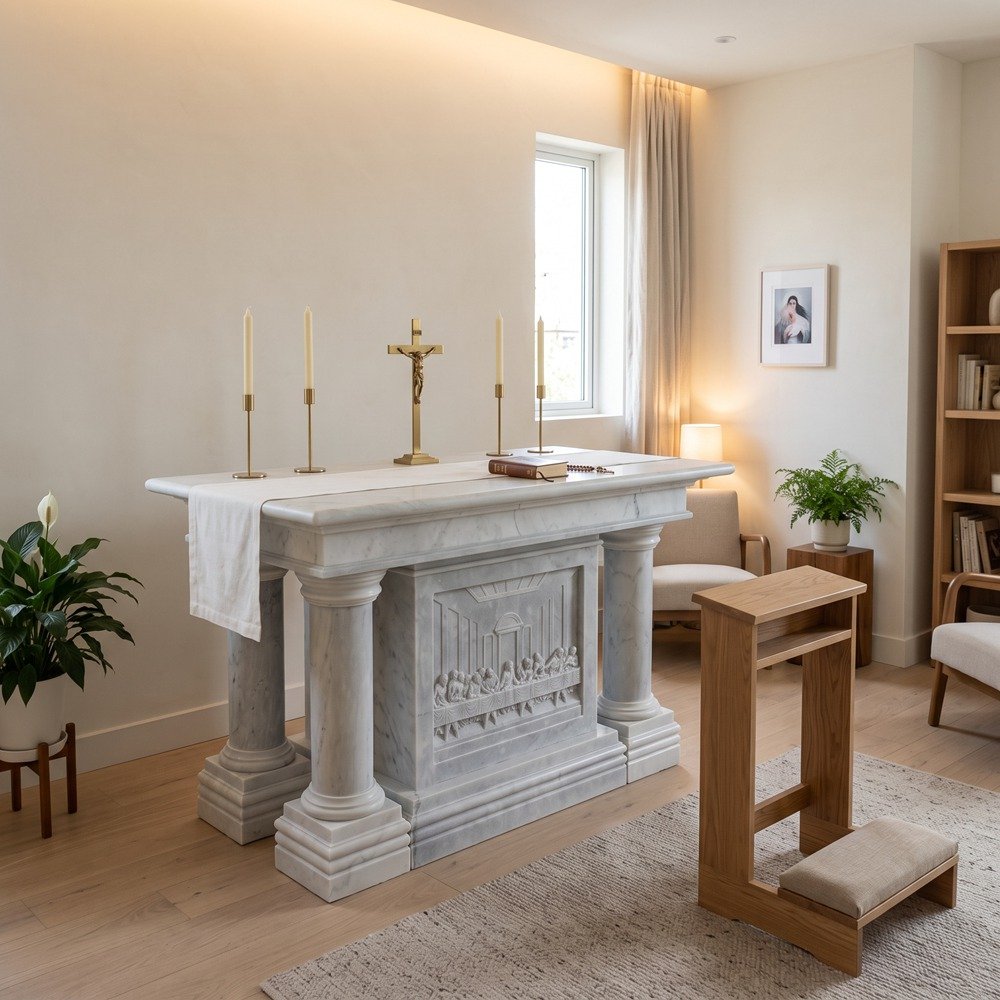
A commissioned marble family altar is not a piece of furniture purchased from a religious goods catalogue. It is carved to order from carefully selected blocks of A-grade white marble, with proportions matched to your chapel, and with front reliefs chosen from the family’s devotional life — the Lamb of God, the Last Supper, the IHS monogram, the Cross, or the family’s patron saints.
A marble mensa will outlive your children’s children. It is not consumed by use. It can be refinished, re-blessed, and moved with care — and unlike temporary materials, it will not rot or warp.
A Central Crucifix
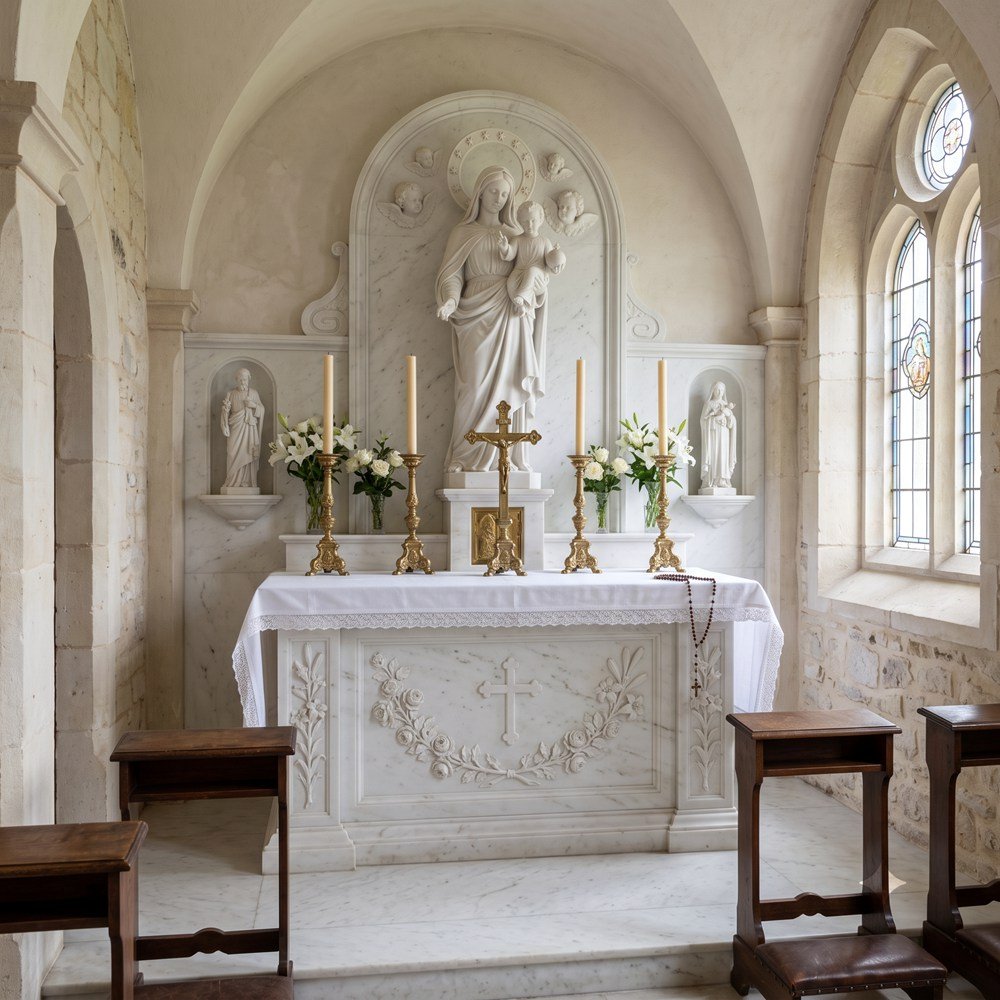
At the centre of the altar stands the crucifix — not a bare cross, but the corpus of Christ. For a family altar of 39 inches, a standing crucifix of 14–20 in (35–50 cm) is proportionate; in a chapel, a larger wall crucifix of 24–36 inches may be hung above the reredos. The crucifix is the focal point; everything else arranges around it.
Marble Statues of the Saints
To the left and right of the crucifix, place statues of the Blessed Virgin Mary, the Sacred Heart, the family’s patron saints, and the saints to whom the family has a particular devotion.
For a family altar, statues of 18–30 in (45–75 cm) in white marble are often a suitable scale — large enough to give dignity to the room, not so large that they dominate the altar.
White marble statues are the natural complement to a marble mensa. They match in material, improve with age, and convey the same sense of permanence.
A family that commissions a marble altar will often commission matching marble statues at the same time, so that the chapel reads as one design.
Linens, Vessels, and Furnishings
A family chapel maintained for the celebration of Mass may require:
- Altar linens: corporal, purificator, pall, and three linen cloths
- Candlesticks of brass or gilt, holding beeswax candles according to local liturgical guidance
- Cruets for water and wine
- Altar cards and a missal stand
- A sanctuary lamp, burning perpetually if the Blessed Sacrament is lawfully reserved
- Altar frontals (antependia) in the liturgical colours of the season — white, violet, red, green, black
For a chapel intended for liturgical use, these furnishings should be selected under the guidance of a priest and with proper attention to reverence and tradition.
Three Classical Configurations
| Configuration | Chapel Scale | Typical Commission |
|---|---|---|
| Traditional Roman | Larger private chapel, where Mass may be offered with proper permission | White marble mensa on three steps, reredos, six brass candlesticks, marble statues of Mary and Joseph, antependia in seasonal colours, and a tabernacle only where lawfully permitted. |
| Gothic Revival | Larger chapel, high-ceilinged room | White marble altar with twisted columns, pointed arches, marble relief of the Last Supper, sanctuary lamp, carved marble predella. |
| Renaissance / Classical | Formal family chapel, often in a library or gallery | Marble mensa with classical moulding, IHS monogram relief, pair of marble angel statues, gilt candlesticks, restrained ornament. |
In every configuration, the altar is the dominant furnishing in the room. It should not be treated as ordinary interior decoration; rather, the surrounding interior should support the dignity of the altar.
Where the Family Altar Belongs
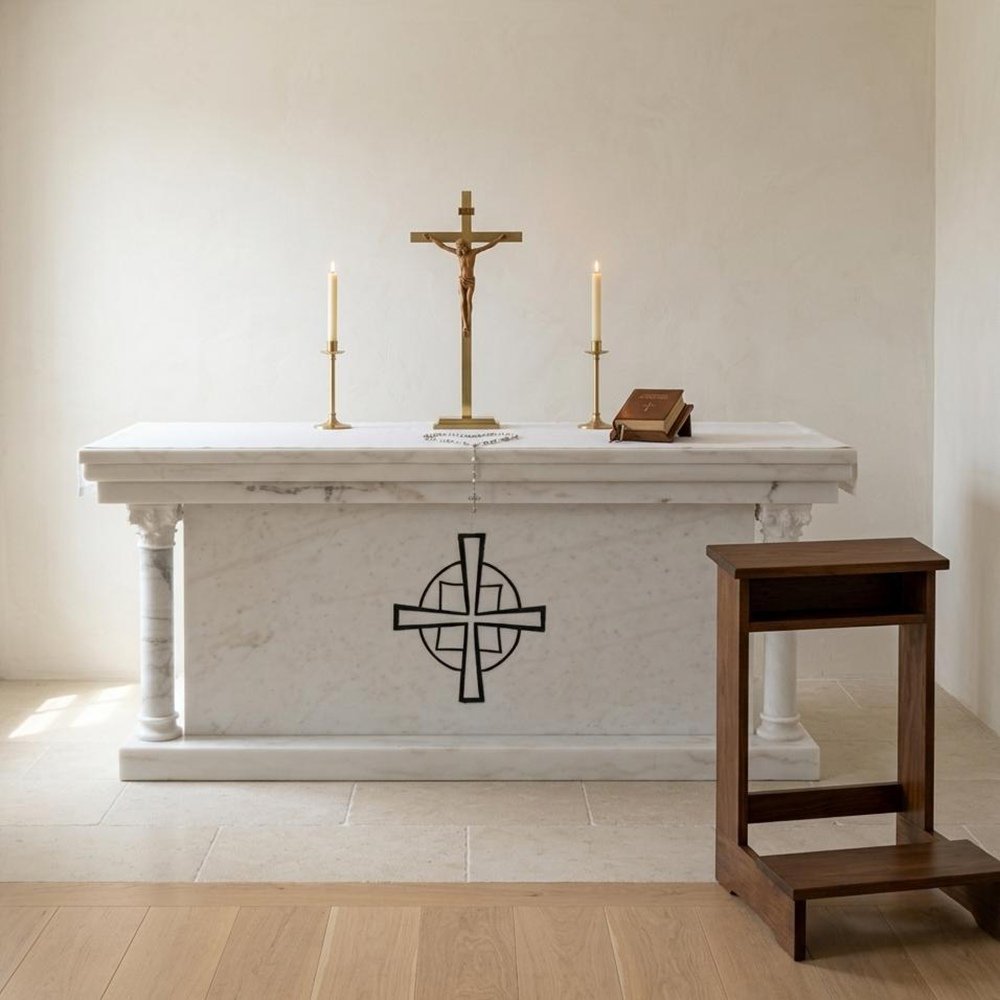
The family altar belongs in a room that is itself set apart: a chapel, a dedicated oratory, or — at minimum — the quietest, most dignified corner of the home.
- — Eastward wall where possible, with the altar placed against it
- — Natural light from an east window, if possible
- — No competing focal function: ideally, the room should not also serve as a television room, gym, or busy work area
- — Generous clearance around the altar for the family to kneel or stand
- — Adequate ceiling height: a 39-inch altar with crucifix and reredos may reach 7–9 feet; the room should accommodate it without crowding
Where possible, the family altar should not be placed in a hallway, kitchen, or other area of distraction. It should feel like the sanctuary of the house.
How to Commission a Family Altar?
A marble family altar is commissioned, not bought off a shelf. The process is:
- Consult your priest on dimensions, orientation, liturgical use, and whether an altar stone or relic is appropriate.
- Measure your chapel and decide on the scale of the mensa, predella, and any reredos.
- Choose the relief motifs — the Lamb of God, the Last Supper, the IHS, the family patron saints.
- Commission the marble from a workshop experienced in ecclesiastical stone carving. Carefully selected Grade-A white marble, hand-carved over several weeks depending on complexity, yields an altar designed to serve your family for generations.
- Have the altar blessed by a priest before it is first used.
- Gather the household for the first Rosary prayed before it.
Frequently Asked Questions
Can a family altar be made of wood?
Wood may be suitable for a modest devotional setting or temporary arrangement. For families seeking a permanent altar with greater durability, dignity, and sacred presence, marble is often the finest choice. It accepts fine carving, carries the visual language of Catholic sacred architecture, and can serve as a lasting heirloom for generations.
How large should a family altar be?
For a private chapel where Mass may be celebrated with proper permission, a useful traditional reference size is 39 in high × 59 in wide × 20 in deep. For a smaller chapel or a private prayer altar, the dimensions may be reduced proportionally, while preserving dignified height where possible.
Do we need a private chapel, or can the altar be in a living room?
Either may be possible. A dedicated chapel is ideal, but a marble altar placed in a dignified corner of a living room — set apart and never used for ordinary household purposes — can serve as a meaningful family altar for many households.
How much does a commissioned marble family altar cost?
The cost depends on size, marble type, carving detail, number of statues, reredos design, packaging, and destination. A modest white marble mensa may begin in the lower thousands of dollars, while a full chapel altar with reredos, columns, and carved reliefs is a substantial commission — comparable to purchasing a significant piece of fine furniture or a major work of sacred art. Many families consider it a once-in-a-generation commission.
How do we care for a marble altar?
Marble should be cleaned with a soft, damp cloth and neutral soap. Avoid acidic cleaners, harsh chemicals, coloured liquids, and abrasive tools. Depending on the marble type and installation environment, professional sealing may be recommended. Over decades, it may develop a soft patina from use — the sign that it has been prayed before, faithfully.
Final Thoughts: The Point of a Family Altar
A family altar is not a display of wealth. It is a display of what a Catholic family believes: that Christ is the centre of the house, that the household is a domestic church, and that the things worth passing down are not investments or furniture — but the faith, and the place where it is prayed.
A marble altar commissioned in your lifetime will be opened by your grandchildren’s children. The stone will not remember who ordered it, but it will remember every prayer offered upon it.
To commission a family altar in hand-carved white marble, sized to your chapel and carved with the reliefs your devotion requires, request a free quote. Since 1983, our workshop has worked with marble sculpture and architectural stone carving, including altars, saint statues, reliefs, and sacred furnishings. Every family altar we make is designed to serve not only the present household, but the generations that follow.