Saint Michael the Archangel is one of the most powerful and beloved figures in the religious imagination of the world. His name is usually understood as “Who is like God?”—a phrase that is not only the meaning of his name, but also a reflection of his identity: A radiant guardian who strikes down plagues with divine power, upholds justice through sacred virtue, and brings order and protection to both heaven and earth.
What’s more, Saint Michael has been sculpted in bronze, marble, wood, and gold in the world, but the message remains the same: light, order, and courage are always worth defending.
Who is Saint Michael?
Across Christianity, Judaism, and Islam, Saint Michael is honored in different ways.
In Christianity, he is often seen as the leader of the heavenly army and the defender of God’s will against evil.
In Islam, where he is known as Mikail, he is more closely associated with obedience, divine order, and faithful service to Allah. In Judaism, he is widely regarded as a compassionate protector, especially of Israel.
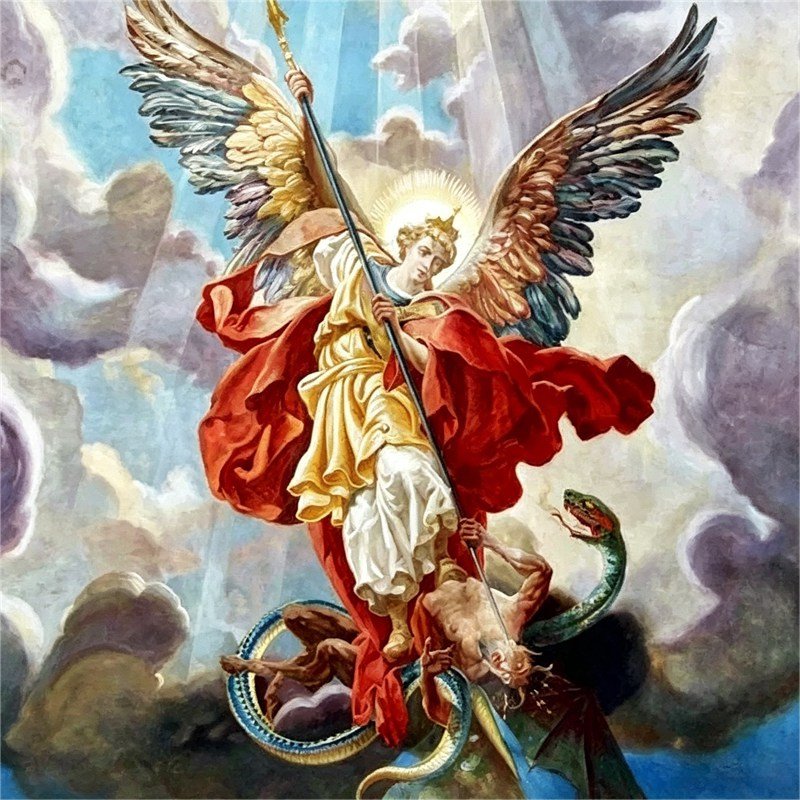
In Catholic, Eastern Orthodox, Anglican, and Lutheran traditions, he is commonly called Saint Michael, Saint Michael the Archangel, or Holy Michael the Archangel. Although these traditions express his role differently, one thing remains constant: Saint Michael stands as one of the most important spiritual symbols of courage, protection, and victory over evil.
In this post, I would like to take you on a journey through 12 of the most famous statues of Saint Michael in the world. Some stand on abbey spires, some crown city gates, and others watch over cathedrals, hills, and sacred caves. Together, they show how deeply Saint Michael has shaped religious art, local identity, and cultural memory across centuries.
Statue of Saint Michael and the Dragon
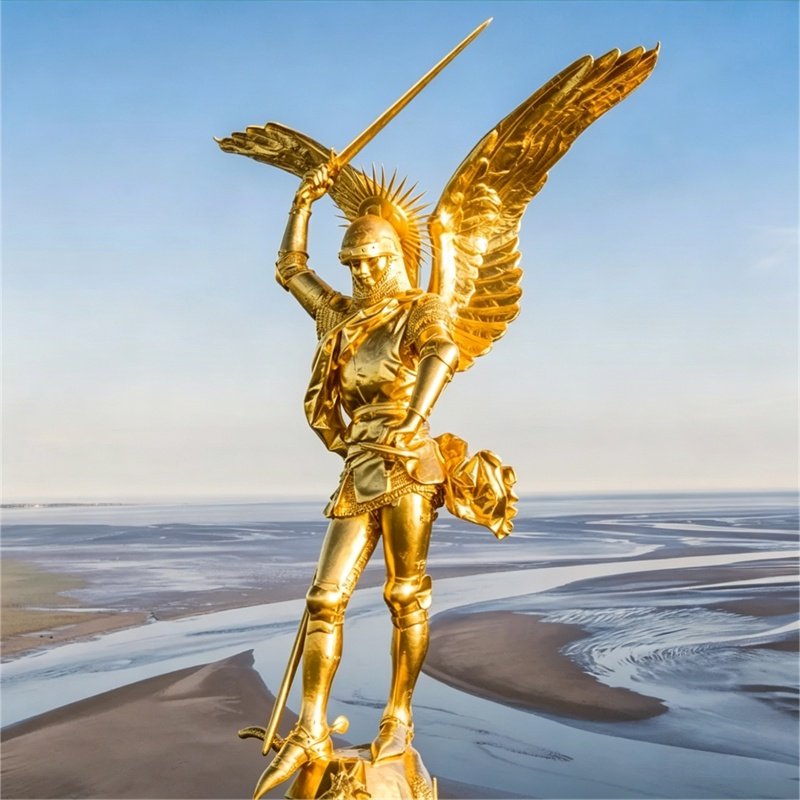
Location: Perched atop the spire of the abbey church of Mont-Saint-Michel Abbey, France.
Material: An iron framework covered with copper plates and finished with gold leaf gilding.
Sculptor: Emmanuel Frémiet, designed in 1894.
Date: Installed in 1897; restored in 1987.
Dimensions: Approximately 2.8 meters high and weighing around 800 kilograms.
History background:
According to legend, the history of Mont-Saint-Michel began in 708, when Saint Michael appeared three times in dreams to Bishop Aubert of Avranches and instructed him to build a sanctuary in his honor on the island called Mont-Tombe. This first oratory became the starting point of what would later develop into Mont-Saint-Michel, one of the most important pilgrimage sites in Western Christianity. Its foundation echoes the earlier sanctuary dedicated to Saint Michael at Monte Gargano in Puglia, Italy, while also reflecting the growing importance of Christianity in the medieval West.
In 966, Richard I, Duke of Normandy, established a Benedictine community on the mount, and the abbey developed over the following centuries.
In 1894, Emmanuel Frémiet was chosen to design the statue that would crown the spire of Mont-Saint-Michel Abbey. By that time, he was already well known for his Jeanne d’Arc statue installed at the Place des Pyramides in Paris in 1874. Frémiet developed a distinctive style of historical realism, combining careful detail with a strong interest in historical accuracy. He favored the severe iconography of the Middle Ages over the more theatrical forms derived from Raphael.
Interestingly, Frémiet’s first version of Saint Michael was a 50 cm statuette created in 1879 for commercial reproduction. Unusually, this small model was later selected and enlarged for the abbey spire. This approach reflected the 19th-century restoration ideals associated with Viollet-le-Duc and his followers, who supported historically grounded architectural reconstruction.
The statue was executed by the Monduit firm, using repoussé copper techniques in which copper plates were hammered in the workshop, mounted on a framework, and riveted together. This method produced a relatively lightweight sculpture, which was essential for installation at the top of the spire. The Monduit firm also made two additional copies: one for the spire of Saint-Michel des Batignolles in Paris, and another for its showroom, now preserved in the Musée d’Orsay.
Appearance: In this statue,the Saint Michael is in a triumphant, battle-ready stance. He stands firmly over the defeated dragon, symbolizing the victory of good over evil. His right hand raises a sword high toward the sky, while his body forms a poised and energetic composition. His wings are fully outstretched, and the gleaming gilded surface enhances the sense of heavenly authority, protection, and glory.
St. Michael Statue on Castel Sant’Angelo
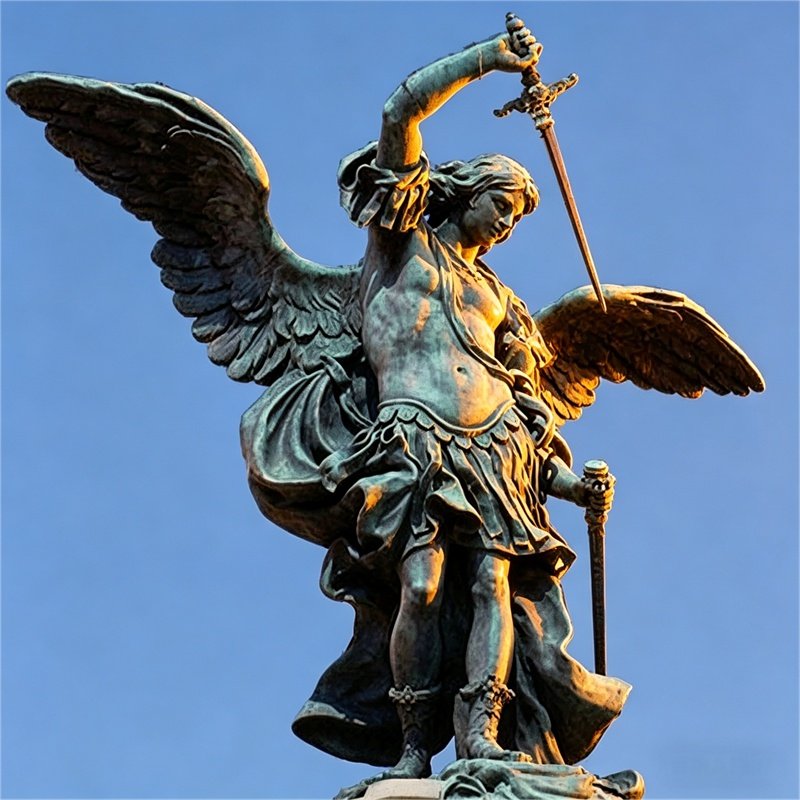
Location:atop Castel Sant’Angelo, Lungotevere Castello, 00186 Rome, Italy
Material: Bronze
Sculptor:Peter Anton von Verschaffelt(8 May 1710 – 5 July 1793),a Flemish sculptor and architect
Date: created in June of 1752
Dimensions: around 4 meters tall
This statue is one of Rome’s most memorable landmarks, standing atop Castel Sant’Angelo and tied to one of the city’s most enduring legends.
History and background
The legend takes us back to 590 AD, when Rome was suffering from a devastating plague during the pontificate of Pope Gregory the Great. As the Pope led a solemn procession through the city, praying for deliverance, he reportedly saw the Archangel Michael appear above Hadrian’s Mausoleum. Michael sheathed his sword, a sign that the plague was coming to an end.
From that moment on, the mausoleum became associated with the angel and eventually took the name Castel Sant’Angelo.
The statue visible today is not the first one placed there. Over the centuries, several earlier versions were destroyed, replaced, or even melted down. A wooden figure was installed in the Middle Ages, then a marble one, then a bronze one that was later melted into cannons in 1527. The present bronze sculpture by Peter Anton von Verschaffelt was installed in 1752.
Appearance
The statue captures Saint Michael in the solemn moment of returning his sword to its sheath. Unlike many more aggressive depictions, this one emphasizes restraint rather than attack. His expression is calm, controlled, and judicial. The bronze surface, now marked by a blue-green patina, adds to its historical gravity. Against the Roman sky, the figure looks less like a warrior in mid-battle and more like a divine messenger announcing that judgment has already been made.
Among Rome’s great sights, Castel Sant’Angelo easily deserves a place near the top of the list. It combines miracle legend, history, architecture, and atmosphere in a way few places can.
Fontaine Saint-Michel
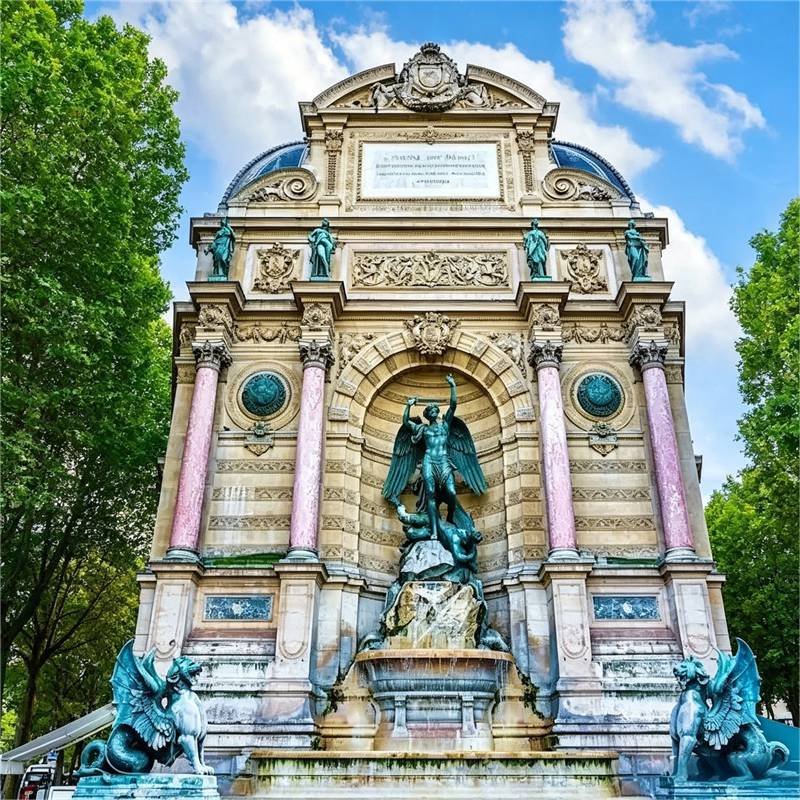
Location:on the Place Saint-Michel in the 5th arrondissement – 75005 Paris,France
Material: stone(fountain background wall and rock base), pink granite((columns, marble and bronze(the group of statues)
Sculptor:Francisque Duret(the group of bronze statue);architect Gabriel Davioud(the fountain)
Date: constructed in 1858–1860
Dimensions: the main statue of St. Michael is around 4 meters tall ; Fountain about 26 meters high and 15 meters wide
Unlike the isolated rooftop monuments of Mont-Saint-Michel or Castel Sant’Angelo, Fontaine Saint-Michel places the archangel in the middle of city life.
History and background
The fountain was built during the massive urban transformation of Paris under Baron Haussmann and Napoleon III. Mid-19th-century Paris was overcrowded, unhealthy, and in urgent need of modern infrastructure. The fountain became part of that redevelopment and marked the beginning of Boulevard Saint-Michel.
Today it is recognized as an important historic monument and remains one of the best-known fountains in Paris.
Appearance
Inspired in part by the tradition of Raphael’s image of Michael slaying the dragon, Francisque Duret created a dramatic bronze group in which Saint Michael stands over the forces of evil. Around him are allegorical figures representing Strength, Prudence, Justice, and Temperance, along with winged chimeras and cascading water.
The result is more than a religious sculpture. It is a public statement that moral order, civic beauty, and divine triumph belong together.
In Paris, even the fountains know how to make an entrance.
Statue of Saint Michael Archangel on Independence Square
Location:atop the Lach Gate (Liadsky Gate)in Independence Square in Kyiv, Ukraine
Material: bronze and gold
Sculptor:Anatoly Kushch (Ukrainian; 1945 – Contemporary)
Date: placed in 2002
Dimensions: unknown
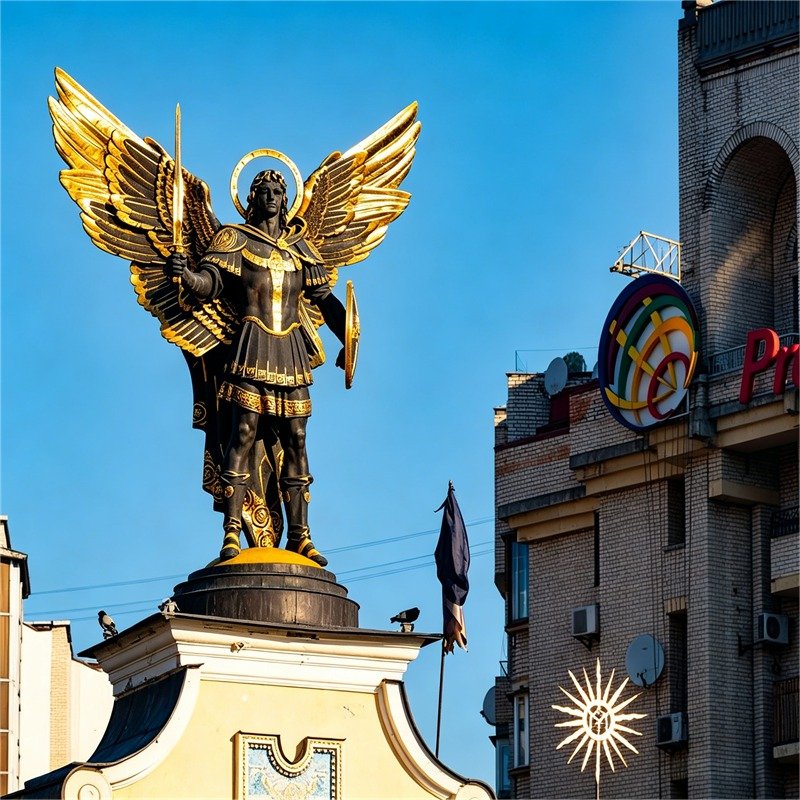
This striking image of Archangel Michael is one of the most recognizable symbols of Kyiv.
History and background
The monument stands on the site of the former Liadsky Gate, one of medieval Kyiv’s historic entrances, first mentioned in 1151. Saint Michael has long been regarded as the protector of Kyiv and has appeared on the city’s coat of arms since the early modern period.
During the Soviet era, his image was removed and replaced by secular symbols. After Ukrainian independence, Michael returned to the city’s heraldry in 1995, and the later installation of this monument became a clear expression of historical memory, religious freedom, and civic identity.
Appearance
The statue presents Michael in a commanding protective pose. His wings spread dramatically behind him, and he holds a golden sword in one hand and a golden shield marked with a cross in the other. A halo crowns his head, reinforcing his role as both warrior and guardian.
More than a religious figure, this monument functions as a civic emblem. In Kyiv, Saint Michael is not only an archangel of heaven—he is also the watchful defender of the city.
Statue of Archangel Michael at the Sanctuary of Monte Sant’Angelo
Location: Sanctuary of Saint Michael the Archangel, Monte Sant’Angelo, Italy
Material: Carrara marble
Sculptor: Andrea Sansovino
Date: 1507
Dimensions: About 4 feet 2 inches high
If Mont-Saint-Michel is one of the most famous places associated with Saint Michael, then Monte Sant’Angelo is one of the oldest and most sacred.
History and background
According to tradition, Saint Michael appeared here to Bishop Lorenzo Maiorano, and the events connected with the site were recorded in the Liber de apparitione Sancti Michaelis. The text tells of a lost bull, a military victory attributed to Michael’s intervention, and the miraculous consecration of the cave itself.
The cave had already been considered sacred before Christianity, linked in Greco-Roman times to older religious practices. Christianity did not erase that sacredness; it transformed it. Later, the Lombards adopted Saint Michael as their patron and made the sanctuary a major spiritual and political center.
By the Middle Ages, Monte Sant’Angelo had become one of the great pilgrimage destinations of Western Christendom. Since 2011, it has also been part of a UNESCO World Heritage listing.
Appearance
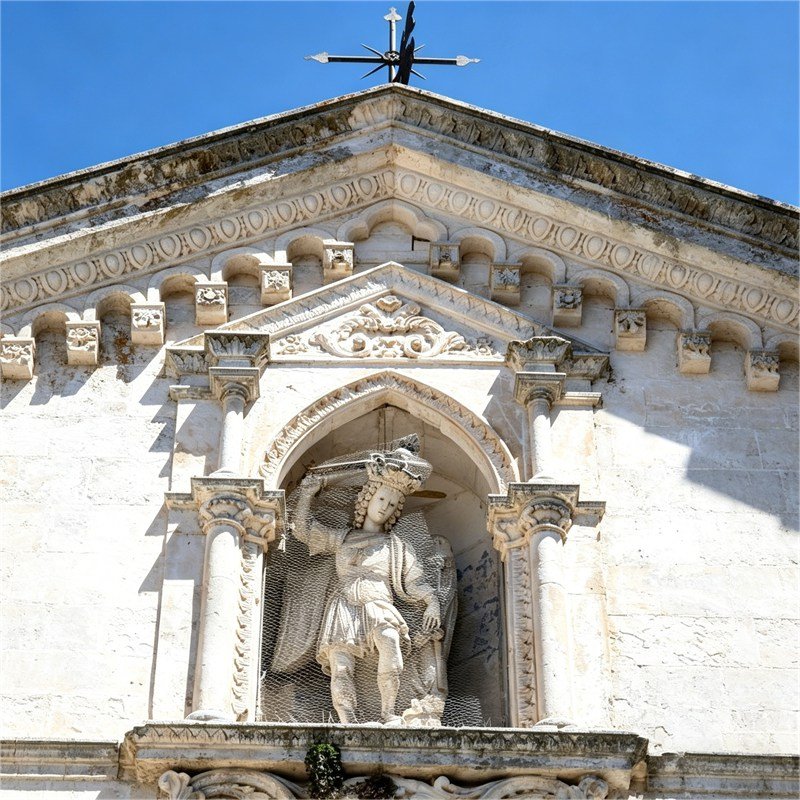
Andrea Sansovino’s marble figure shows Saint Michael as a youthful warrior wearing Roman-style armor and a military cloak. He raises his sword while crushing a grotesque devil beneath his feet. The contrast between his calm poise and the monstrous form below gives the statue a strong dramatic clarity.
There is also a living devotional tradition attached to the sculpture: each year on September 29, the sword is removed and carried in procession through the town. That detail alone says a great deal—this is not just art on display; it is art still woven into ritual life.
Statue of Saint Michael on the Basilique Notre-Dame de Fourvière
Location:at the Notre-Dame de Fourvière basilica in Lyon,France
Material: bronze with patina
Sculptor: Paul-Émile Millefaut (La Roche-de-Glun 1848 – Lyon 1907), French sculptor
Date: build at the end of the 19th century
Dimensions: unknown
High above Lyon, the Basilica of Notre-Dame de Fourvière dominates the skyline, and Saint Michael forms part of its rich religious imagery.
History and background
Built between 1872 and 1884, the basilica was funded largely by private donations in fulfillment of a vow and in thanksgiving for the protection of Lyon during the Franco-Prussian War. Merging Roman-Byzantine and Gothic influences, the basilica stands as one of the city’s most iconic architectural landmarks.
Appearance
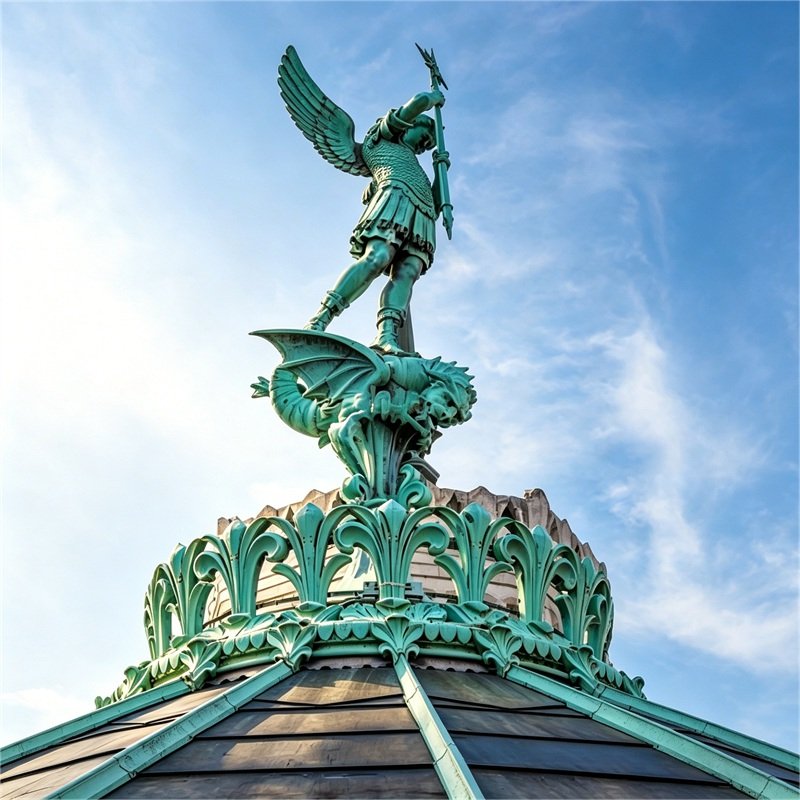
This version of Saint Michael is forceful and direct. He thrusts downward at the devil beneath his feet, who is represented as a hybrid beast. The pose emphasizes determination rather than movement alone: evil is not merely challenged, but decisively driven back.
The sculpture fits perfectly within the basilica’s visual language of protection, vigilance, and sacred triumph.
Statue of Archangel Michael over the Main Gate of St. Michael’s Church
Location:above the main entrance of Sankt Michaelis Church,Quarter of Neustadt, Hamburg, Germany
Material: bronze
Sculptor:August Vogel (1859 – 1932) ,a German sculptor and medalist
Date: Carved in 1908
Dimensions: The statue’s dimensions are not recorded. The clock tower stands at 132 m in height, while the church measures 44 m in width, 52 m in length, and 27 m in height.
Hamburg’s St. Michael’s Church, often simply called “Michel,” is one of the city’s best-known landmarks, and the statue above its entrance is central to its identity.
History and background
St. Michael’s Church is one of Hamburg’s five main Lutheran churches and a major symbol of the city. The current building is the third church on the site, replacing earlier versions destroyed by fire and lightning. The church’s tower has become a familiar marker of Hamburg’s skyline.
The bronze figure of Saint Michael was created by August Vogel for the rebuilt church in the early 20th century.
Appearance
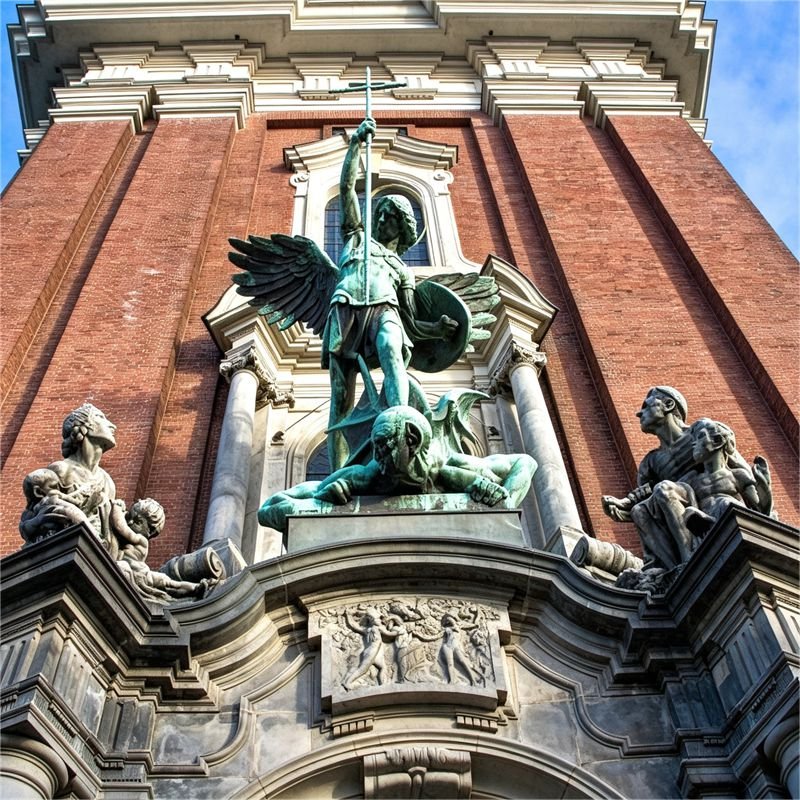
Here Michael stands tall, calm, and fully in control. His wings spread behind him, a spear rises in his hand, and a shield balances the composition. Beneath him lies Satan, shown as a fallen humanoid figure twisted in fear and defeat.
The emotional contrast is especially effective: Michael is composed, while the devil is all panic and collapse. It is a classic image of spiritual order triumphing over chaos.
Archangel Michael Statue at the Cathedral of St. Michael and St. Gudula
Location: Brussels, Belgium
Material: Polychrome gilded wood
Sculptor: Unknown
Date: Probably late 19th or early 20th century for its Neo-Gothic style
This gilded wooden statue shows a different side of Saint Michael—less monumental in scale, but rich in craftsmanship and devotional meaning.
History and background
The Cathedral of St. Michael and St. Gudula is dedicated to two patron saints and occupies a central place in the religious and ceremonial life of Brussels. Saint Michael has long been one of the city’s defining protectors, and his image appears widely in Brussels’ urban symbolism.
After the damage of iconoclasm and religious conflict in the Low Countries, works of sacred art gradually returned to churches such as this one. This statue belongs to that broader story of restoration and continuity.
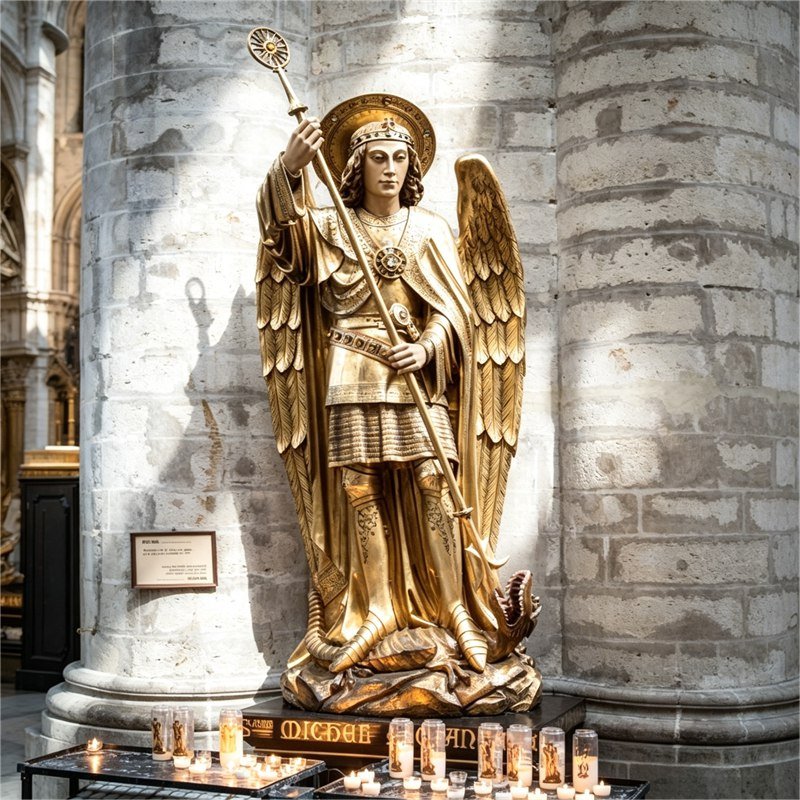
Appearance
The archangel is shown in ornate armor and robes, crowned and haloed, with folded wings behind him. He holds a spear aimed downward at the dragon-like form of evil coiling at his feet.
Because the statue is carved in gilded wood rather than cast in bronze or carved in marble, it has a distinctive warmth. It feels less like a military monument and more like a liturgical presence—regal, luminous, and devotional.
Archangel Michael Statue
Location:Tepeyac Hill, within the Basilica of Our Lady of Guadalupe complex, Mexico City.
Material: White marble
Sculptor: Ernesto Tamariz Galicia (1904 – 1988),Mexican sculptor,
Date: complished in 1957
Dimensions: unknown
Overlooking the great pilgrimage landscape of Tepeyac Hill, this white marble Saint Michael brings together local devotion and national religious imagination.
History and background
The statue was carved by the Mexican sculptor Ernesto Tamariz Galicia in 1957. It is also linked, in devotional tradition, to stories of Saint Michael appearing to a young Indigenous convert named Diego Lázaro in the 17th century, revealing a healing spring and eventually leading to the founding of the shrine of San Miguel del Milagro.
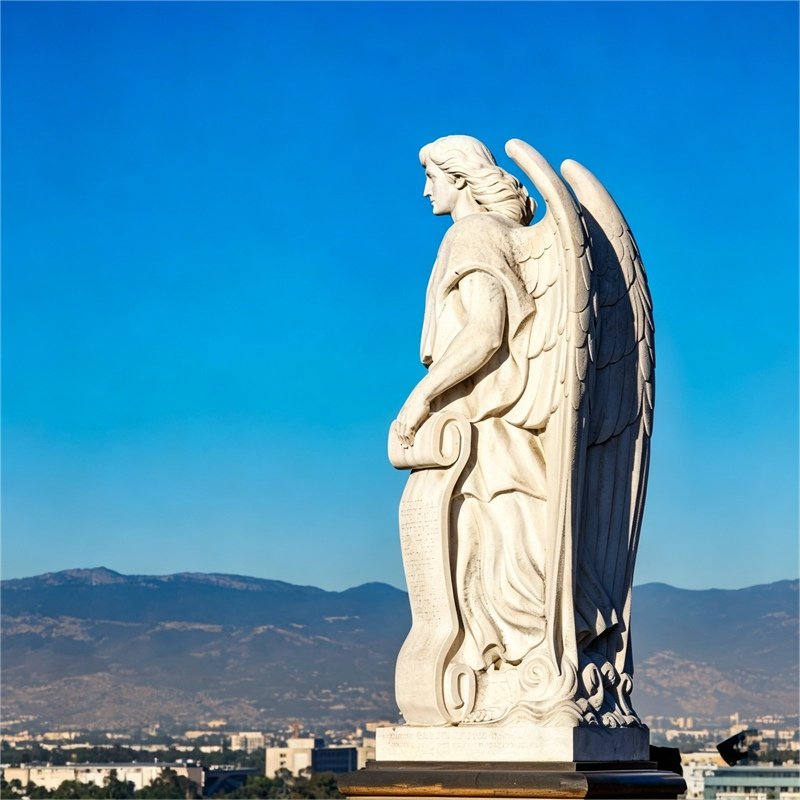
Appearance
Saint Michael stands with wings spread, holding a shield marked with a cross while crushing the serpent of evil beneath his feet. The white marble gives the sculpture a clean, almost radiant character.
Placed above the city, the figure reads as both guardian and witness—one of those statues that feels as though it is watching over more than a single building.
St Michael’s Victory over the Devil
Location:on the south end of the east wall outside of the new Coventry Cathedral
Material: bronze
Sculptor:Jacob Epstein(1880 – 1959)
Date: Created in 1958
Dimensions: The larger-than-life statue stands about 25 ft (7.6 m) tall, with the angel’s wings spanning 23 ft (7.0 m)
Dimensions: About 25 feet high, wingspan around 23 feet
This is one of the most powerful modern interpretations of Saint Michael.
History and background
Created by Jacob Epstein, the sculpture stands outside the new Coventry Cathedral, itself a symbol of postwar rebuilding and reconciliation. Epstein worked on several models before the final bronze was approved. It became one of his last major works before his death in 1959, and it was unveiled in 1961 by his widow.
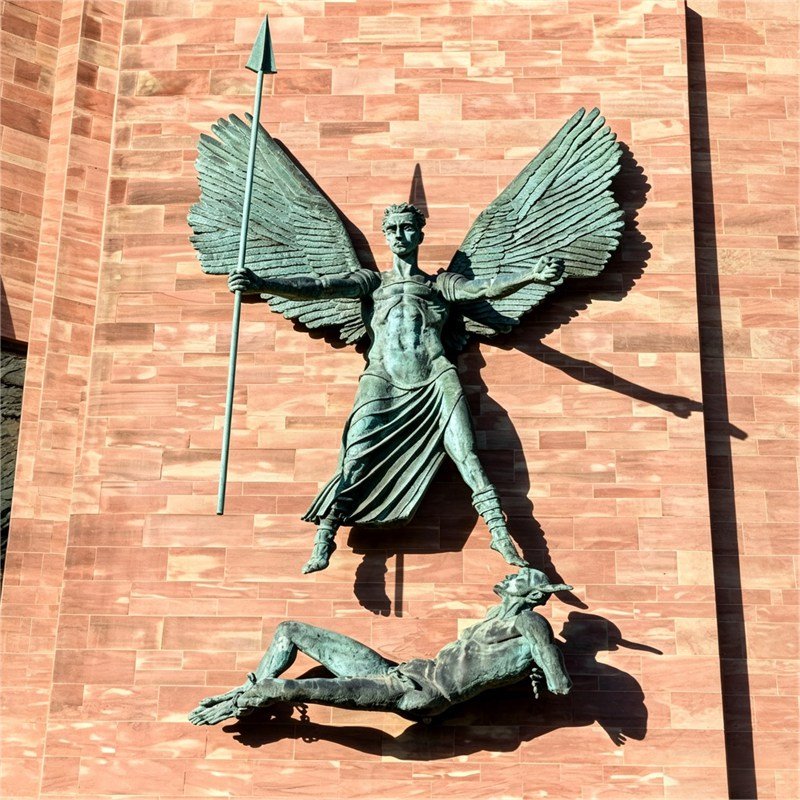
Appearance
Michael stands above the devil with wings spread and spear upright. He does not thrust downward in rage; instead, his posture suggests mastery already achieved. The devil beneath him is especially striking—horned, but otherwise recognizably human.
That choice gives the sculpture unusual depth. Evil here is not simply some distant monster. It is disturbingly close to us. That makes the victory of Saint Michael feel not only cosmic, but moral and inward as well.
Peace Fountain
Location:next to the Cathedral of St. John the Divine in the Morningside Heights section of Manhattan in New York City.
Material: bronze
Sculptor: Greg Wyatt, an American representational sculptor-in-residence at the cathedral
Date: dedicated on May 18, 1985
Dimensions: a 40-foot-high (12 m)
The Peace Fountain is probably the most unconventional Saint Michael work on this list—and perhaps the one most likely to make visitors stop, blink twice, and circle back for another look.
History and background
Located beside the Cathedral of St. John the Divine in Manhattan, the fountain was created by Greg Wyatt and dedicated in 1985. The cathedral itself is one of the largest church buildings in the world and has long embraced art that is ambitious, symbolic, and sometimes controversial.
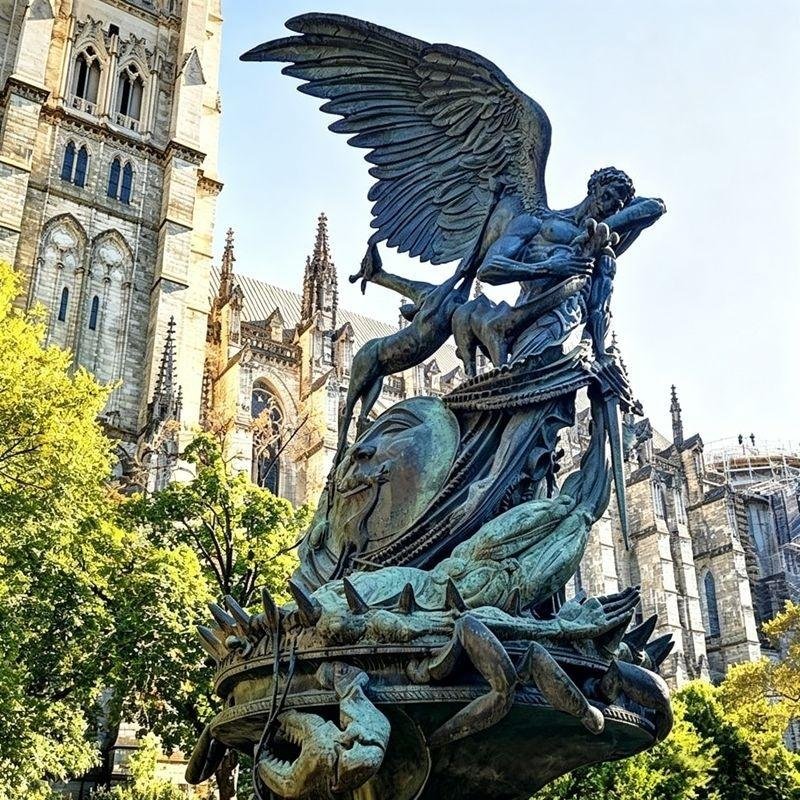
Appearance
The composition mixes biblical motifs, animals, human figures, and even a DNA-like spiral form. At the top, Archangel Michael defeats Satan. Around him are creatures associated with peace, creation, and harmony.
The visual language is not traditional in the way Monte Gargano or Hamburg is traditional. But that is precisely its interest. It tries to place Saint Michael’s victory over evil within a broader meditation on life, creation, conflict, and peace in the modern world.
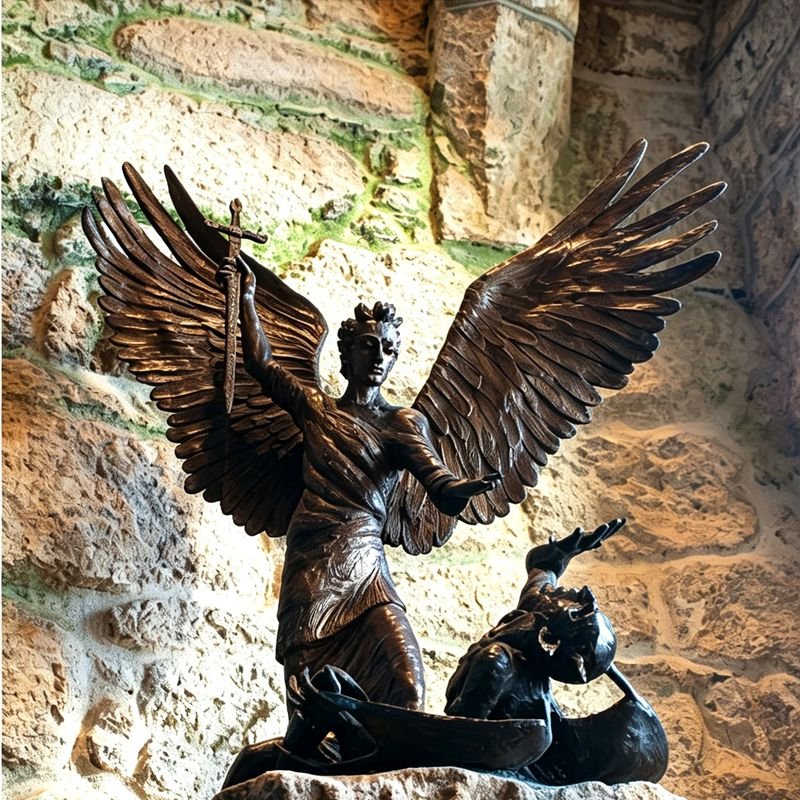
The statue of Archangel Michael
Location: mounted on the wall of the Priory church of St Michael located in the historic island of St Michael`s Mount, Marazion, Cornwall, England.
Material: bronze
Sculptor: unknown
Date: unknown
Dimensions: unknown
This smaller bronze sculpture may not be the most famous on the list, but it has tremendous atmosphere.
History and background
St Michael’s Mount is a tidal island in Cornwall, often described as the English counterpart to Mont-Saint-Michel in France. It has a long history as a monastic and fortified site and was once connected spiritually and institutionally with its Norman counterpart.
The island’s layered history includes prehistoric occupation, medieval pilgrimage, warfare, noble residence, and modern preservation under the National Trust.
Appearance
Mounted on a stone corbel against weathered medieval masonry, the bronze sculpture shows Saint Michael in a vivid moment of triumph over the devil. His sword is raised high, his wings spread wide, and the devil writhes beneath him in defeat.
Its smaller scale is part of its charm. This is not a skyline monument but an intimate encounter—one that rewards close looking. The aged stone setting makes the whole scene feel rooted in centuries of devotion.
It is worth mentioning that I visited St Michael’s Mount before going to Mont‑Saint‑Michel, and I was glad I did. The Cornish tidal island felt like its quieter, more understated counterpart—harder to access, more intimate in scale, and steeped in shifting coastal weather, rainbows, and soft sea light. Both sites are unforgettable, yet each possesses its own distinct spirit and soul.
FAQ
Here are a few common questions that naturally come up when exploring Saint Michael in art and tradition.
What is the St. Michael Sword Line?
The Saint Michael’s Line is a modern name given to a supposed alignment of several important sanctuaries dedicated to Saint Michael across Europe and the Mediterranean, including Skellig Michael, St Michael’s Mount, Mont-Saint-Michel, Sacra di San Michele, Monte Sant’Angelo, and sometimes sites farther east.
Many people see symbolic meaning in this alignment, especially because these sanctuaries are linked to mountains, islands, caves, and places of spiritual struggle. Historically, some of the sites do have ancient and medieval connections, though modern claims about a perfectly precise “line” are often more legendary than scientific.
What does Satan represent in Saint Michael sculptures?
In these sculptures, Satan usually represents evil, pride, rebellion, temptation, sin, or spiritual chaos. But artists interpret that evil in different ways:
- as a dragon
- as a serpent
- as a grotesque hybrid monster
- as a fallen human-like figure
That variation matters. It shows that evil can be imagined as something monstrous and external, but also as something more human and inward.
What is the most famous apparition of Saint Michael in the world?
That depends on tradition, but the most famous are often considered to be:
- Monte Gargano in Italy
- Mont-Saint-Michel in France
- The plague vision of Pope Gregory the Great at Castel Sant’Angelo in Rome
These three have had enormous influence on religious devotion, pilgrimage, and visual culture.
Final Thoughts
Looking at these sculptures together, one thing we become clear: Saint Michael is never just a decorative figure. Whether he appears on a Gothic spire, above a city gate, in a sacred cave, or outside a modern cathedral, he always carries a message. He stands for protection, moral courage, spiritual order, and the hope that evil does not have the final word.
What makes these sculptures so fascinating is not only their beauty, but also their variety. Some show Michael as a fierce warrior. Others present him as a calm judge, a civic guardian, or a symbol of peace after suffering. Each one reflects the culture, history, and faith of the place where it stands.