We have talked a lot about Our Lady of Fatima and Our Lady of Lourdes before. Today, I would like to share something different — the beautiful and mysterious story of Our Lady of Guadalupe.
Among the many titles of the Virgin Mary, Our Lady of Guadalupe holds a very special place, especially for Catholics in Mexico, Latin America, and North America. Her image is not only a religious symbol, but also a symbol of mothering, protection, hope, and cultural identity.
Behind this beloved image, there are many touching stories and meaningful details that are worth knowing.
In this post, I will share what I know about Our Lady of Guadalupe, including her apparition story, the mystery of her image, why she is called the Patroness of the Americas and the Unborn, and how to tell the difference between Our Lady of Guadalupe, Our Lady of Lourdes, and Our Lady of Fatima through religious statues.
Who Is Our Lady of Guadalupe?
Our Lady of Guadalupe, also known as the Virgin of Guadalupe, refers to a 16th-century apparition of the Virgin Mary in Mexico.
According to Catholic tradition, the Blessed Virgin Mary appeared in 1531 to Saint Juan Diego, a humble Indigenous man, on the hill of Tepeyac, near present-day Mexico City.
This apparition took place during a very important time in Mexican history, not long after the Spanish arrival in the Americas. The story of Our Lady of Guadalupe became deeply connected with the faith, culture, and identity of the Mexican people.
What makes her image especially unique is that she appeared with features that the local people could recognize and understand. She was not shown as distant or unreachable. She appeared as a loving mother, close to her children.
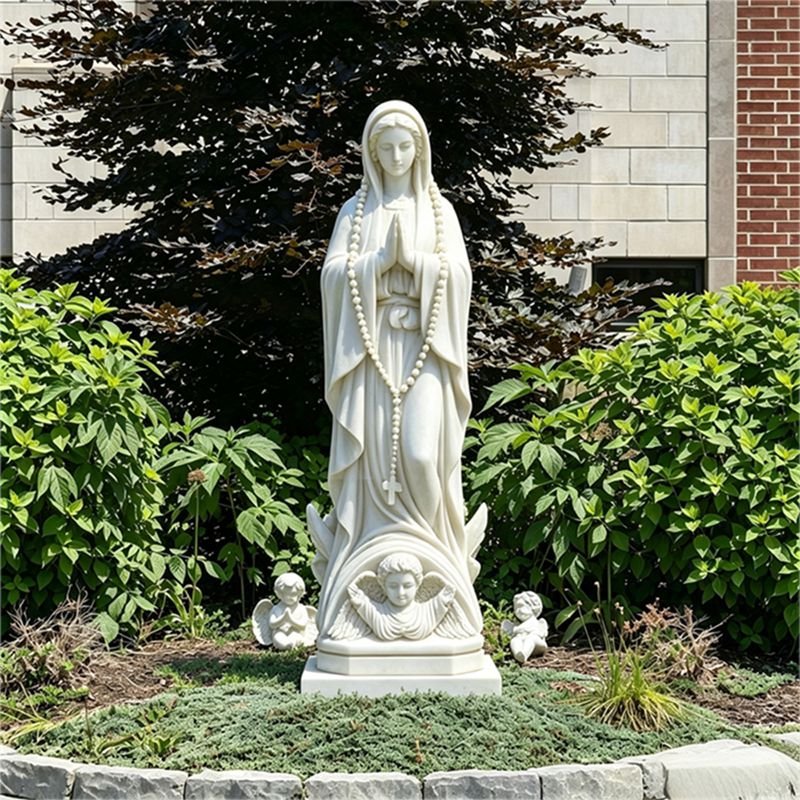
What Is The Image of Our Lady of Guadalupe
The traditional image of Our Lady of Guadalupe is full of symbols.
She is usually depicted wearing:
- A rose-colored tunic;
- A blue-green mantle decorated with stars;
- A radiant sunburst surrounding her body;
- A crescent moon beneath her feet;
- An angel supporting her below.
One of the biggest differences between Our Lady of Guadalupe and images such as Our Lady of Lourdes or Our Lady of Fatima is that Our Lady of Guadalupe is traditionally understood as pregnant.
On her dress, there is a special four-petal flower placed over her womb. This flower is often understood as a symbol of divinity, life, and the presence of God. For many believers, it points to the unborn Christ carried within Mary.
This is one of the reasons why Our Lady of Guadalupe is so closely connected with motherhood, unborn life, and protection.
What Were the Four Apparitions of Our Lady of Guadalupe?
According to Catholic tradition, Our Lady of Guadalupe appeared to Saint Juan Diego four times in December 1531. She also appeared once to his elderly uncle, Juan Bernardino.
Each apparition has its own meaning. Together, they form one of the most beloved Marian stories in the Americas.
The First Apparition: December 9, 1531
The first apparition took place early in the morning on December 9, 1531.
Saint Juan Diego, a humble Indigenous man and a recent convert to Christianity, was walking near the hill of Tepeyac, close to present-day Mexico City. He was on his way to attend Mass and religious instruction.
Suddenly, he heard beautiful music, like birds singing from the top of the hill. Then he heard a gentle voice calling his name:
“Juanito, Juan Dieguito.”
When he climbed the hill, he saw a radiant woman standing there. She spoke to him with tenderness and identified herself as the Mother of the true God.
Our Lady asked Juan Diego to go to the bishop of Mexico and request that a church be built at Tepeyac. She said that in this place, she wanted to show her love, compassion, help, and protection to all people.
This first apparition is very touching because Mary did not appear first to a king, a priest, or a powerful leader. She appeared to a simple man. And she trusted him with a very important message.
The Second Apparition: Later on December 9, 1531
After the first apparition, Juan Diego went to see the bishop, Bishop Juan de Zumárraga.
But the bishop did not immediately believe him. To the bishop, Juan Diego was only a poor Indigenous man with an extraordinary story. So he listened, but asked for more proof.
Juan Diego left disappointed and returned to Tepeyac. There, Our Lady appeared to him again.
Juan Diego told her that the bishop had not believed him. He even humbly suggested that she send someone more important, someone respected, someone with authority.
But Our Lady did not choose another messenger.
She told Juan Diego that he was the one she wanted to send. She asked him to return to the bishop the next day and repeat her request.
This second apparition is very meaningful. It shows that in Mary’s eyes, Juan Diego was not too poor, too simple, or too small for God’s mission.
Sometimes God chooses the people the world does not expect.
The Third Apparition: December 10, 1531
The third apparition took place on December 10, 1531.
Juan Diego returned to Bishop Zumárraga and repeated Our Lady’s request. This time, the bishop asked Juan Diego to bring a sign from the Lady to prove that the message was truly from heaven.
Juan Diego then went back to Tepeyac and met Our Lady again.
She told him to return the next day, and she would give him the sign the bishop had requested.
However, something happened that changed Juan Diego’s plan.
His elderly uncle, Juan Bernardino, became very sick. Juan Diego stayed home to care for him. Because of this, he did not return to Tepeyac the next day as Our Lady had asked.
This third apparition prepares the way for the great miracle. It also shows Juan Diego’s human side. He was not ignoring Mary. He was worried about his family. He was trying to care for someone he loved.
That detail makes the story feel very real.
The Fourth Apparition: December 12, 1531
The fourth apparition is the most famous and miraculous one.
On December 12, 1531, Juan Diego left home early to find a priest for his dying uncle. Because he felt ashamed that he had missed the meeting with Our Lady, he tried to avoid passing the usual place at Tepeyac.
But Our Lady met him on the road.
Like a loving mother, she asked him where he was going.
Juan Diego explained that his uncle was very ill and that he needed to find a priest.
Then Our Lady spoke words that have comforted millions of people for centuries:
“Am I not here, who am your Mother?”
She told Juan Diego not to be afraid. She assured him that his uncle would recover.
Then she asked him to climb the hill and gather flowers.
This was December, and roses should not have been blooming on that rocky hill. But when Juan Diego reached the top, he found fresh Castilian roses. He gathered them in his tilma, his cloak, and brought them back to Our Lady.
Mary arranged the roses in his tilma with her own hands and told him to take them to the bishop as the sign.
When Juan Diego opened his tilma before Bishop Zumárraga, the roses fell to the floor.
And then everyone saw the miracle.
On the tilma appeared the image of the Virgin Mary — the image we now know as Our Lady of Guadalupe.
This fourth apparition gave the bishop the sign he had asked for. But more than that, it gave the people of the Americas an image of Mary as a loving mother, close to the poor, the humble, and the suffering.
The Apparition to Juan Bernardino
Besides the four apparitions to Saint Juan Diego, tradition also says that Our Lady appeared once to his uncle, Juan Bernardino.
While Juan Diego was on his way to the bishop, Our Lady appeared to Juan Bernardino and healed him from his illness.
She also told him her name.
According to tradition, she asked to be known as Santa María de Guadalupe.
This is another important part of the story, because it connects the miracle of the tilma with healing, family, and personal protection.
Juan Diego received the sign for the bishop.
Juan Bernardino received healing.
And the people received a mother.
That is why the story of Our Lady of Guadalupe is not only a story about an image. It is also a story about trust, healing, obedience, and love.
The Miracle of the Roses and the Tilma
Among all the details of the Guadalupe story, the miracle of the roses and the tilma is the most famous.
It was December, a winter season when Castilian roses would not normally bloom on the rocky hill of Tepeyac. But Juan Diego found them there, fresh and beautiful, exactly as Our Lady had told him.
When he carried the roses to the bishop, he probably thought the flowers were the sign.
But the real miracle was even greater.
When the roses fell from his tilma, the image of the Virgin Mary appeared on the cloth. Her hands were joined in prayer, her head gently bowed, and her whole figure was surrounded by light.
For believers, the tilma is not simply a piece of cloth. It is a sacred sign of Mary’s presence and a powerful reminder that God often works through simple people and unexpected moments.
In 2002, Juan Diego was canonized as a saint by Pope John Paul II.
Why Is Our Lady of Guadalupe the Patroness of the Unborn?
One of the most meaningful titles of Our Lady of Guadalupe is Patroness of the Unborn.
This title is closely connected with the way she appears in the traditional image. As mentioned above, Our Lady of Guadalupe is often understood as pregnant.
The special four-petal flower placed over her womb points to the life she carries.
For Christians, this life is Jesus Christ, the Son of God.
In other words, when Our Lady appeared on the hill of Tepeyac in Mexico, she was not only shown as a mother, but as a mother carrying unborn life. This makes her image especially powerful for pregnant women, unborn children, and families praying for protection.
Every mother in the world hopes her child can be conceived, carried, and born peacefully under God’s blessing.
That is why this image brings such deep comfort. Mary is not only the Mother of Jesus.
She is also a mother who understands the hopes, fears, and prayers of all mothers.
Some readers may naturally wonder: how did Mary conceive and give birth to Jesus?
The Gospel of Matthew gives us the most important answer. In Matthew 1:20, the angel tells Joseph:
“The child within her was conceived by the Holy Spirit.”
This tells us that the conception of Jesus was not ordinary, but a divine mystery. Christian tradition has always understood the Incarnation as something surrounded by God’s grace and power.
At the same time, theologians throughout history have reflected on the mystery of Christ’s birth in different ways. For example, St. John of Damascus taught that Christ was born from Mary in a real and natural human way, while still preserving the mystery and holiness of the Virgin Birth. His teaching is often mentioned when discussing the belief that Jesus was truly born of Mary, not in a symbolic or unreal way.
Some modern discussions also raise more speculative ideas, such as whether Christ’s birth could be understood in a miraculous or a divine C-section.
However, for Catholic devotion, the most important truth is not the medical detail. The heart of the belief is this: Jesus was conceived by the Holy Spirit, born of the Virgin Mary, and came into the world under the blessing and protection of God.
This is why Our Lady of Guadalupe is so often loved as the Patroness of the Unborn. In her image, people see Mary carrying Christ before His birth. They see a mother protecting life. They see hope for children who have not yet been born.
So when people pray to Our Lady of Guadalupe for unborn children, pregnant mothers, and families, they are asking for that same loving protection.
For many believers, especially mothers and pro-life communities, Our Lady of Guadalupe is not only a beautiful image. She is a sign that every life is precious, every child is loved, and every mother can be held under God’s care.
Why Is Our Lady of Guadalupe the Patroness of the Americas?
Our Lady of Guadalupe is also known as the Patroness of the Americas.
To explain this, I do not want to only quote many books or theological sources. I also want to share something I personally saw and felt.
Last year, on December 12, the feast day of Our Lady of Guadalupe, I visited one of our clients in Arizona. He had ordered a statue of Our Lady of Guadalupe from our YouFine factory.
When I arrived, I was deeply moved.
Around the statue, many local residents had gathered. Some were praying quietly. Some were looking at the statue with tears in their eyes. It was not just a decoration standing there. It felt like a mother had come to be with her children.
Later, the client told me more about the local devotion.
For many Catholic communities in Arizona, especially among Indigenous and Hispanic families, December 12 is not just a date on the calendar. It is a day of faith, memory, family, procession, music, prayer, and love for the Virgin.
He also mentioned the Tohono O’odham community in Arizona, where Catholic devotion has remained strong for centuries, since the time of Spanish missionaries. In some villages, families prepare for the feast day with nightly novenas and processions, carrying an image or statue of La Virgen from home to home.
When I heard this and saw the people standing around the statue, I understood more clearly why Our Lady of Guadalupe is called the Patroness of the Americas.
She is not only loved in Mexico. She is loved across North America, Central America, and South America.
She connects people across languages, cultures, and generations.
Why Is the Image of Our Lady of Guadalupe So Powerful?
Some people say that the image of Our Lady of Guadalupe helped convert a nation.
I think one reason is that her image speaks without needing many words.
She appears as a mother.
She appears close to the people.
She appears with Indigenous features and symbols people could understand.
She carries Christ.
She stands in light.
She lowers her eyes with tenderness.
For many believers, she is not a distant queen. She is a mother who listens.
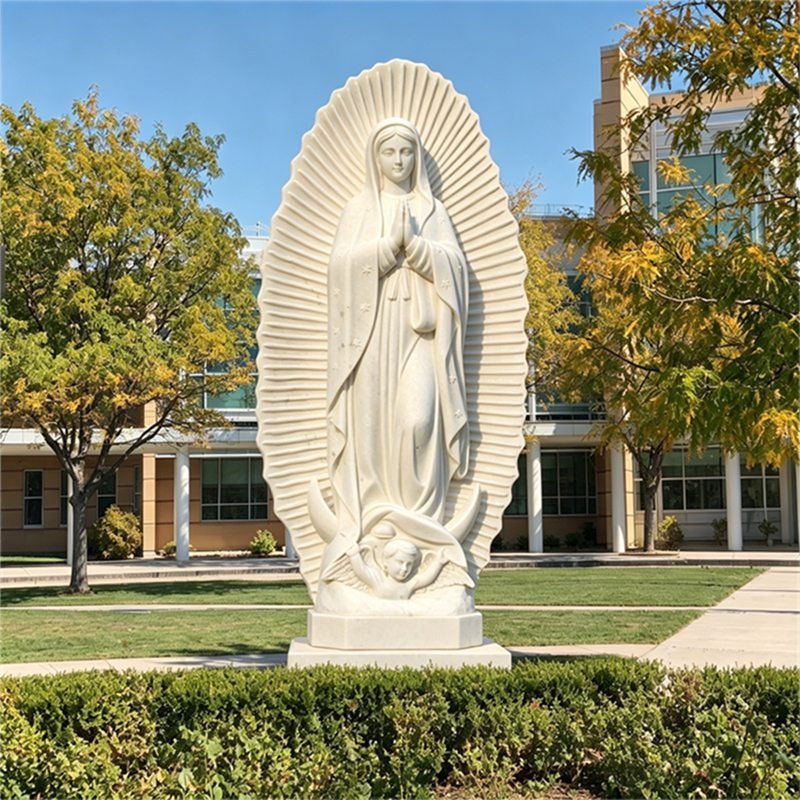
That is why the image of Our Lady of Guadalupe can be found in churches, homes, gardens, hospitals, schools, cemeteries, and public spaces throughout the Americas.
And when this image is made into a statue, especially a marble or bronze religious statue, the details become very important.
The face, the hands, the mantle, the stars, the sun rays, the angel, and the moon all help tell the story.
What Is the Difference Between Our Lady of Lourdes, Our Lady of Fatima, and Our Lady of Guadalupe?
Many customers ask us this question when choosing a religious statue.
Our Lady of Lourdes, Our Lady of Fatima, and Our Lady of Guadalupe are all beloved images of the Virgin Mary, but their statue designs are very different.
At YouFine, we have made many marble religious statues over the past 40 years. Based on our experience and feedback from thousands of clients, I would like to explain the differences in a simple way: from clothing, facial expression, posture, symbols, and patronage.
Our Lady of Lourdes
Our Lady of Lourdes is one of the most classic and widely recognized images of the Virgin Mary.
Main Features
The statue of Our Lady of Lourdes usually shows Mary wearing a simple white robe and veil. Her hands are joined in prayer, and she often holds a rosary.
Her face is peaceful and gentle. Her eyes are often slightly closed or lowered, giving the statue a quiet and prayerful feeling.
The base or lower part of the statue may include rose elements, which remind people of Lourdes and the healing grace connected with the apparition.
Unlike Our Lady of Guadalupe, Our Lady of Lourdes usually does not stand on a crescent moon or have a sunburst behind her.
Key Symbols
- White robe and veil;
- Hands joined in prayer;
- Rosary;
- Peaceful expression;
- Rose or Lourdes-inspired base details.
Our Lady of Lourdes is often connected with healing, prayer, and comfort for the sick.
Our Lady of Fatima
Our Lady of Fatima has a more solemn and richly decorated style.
Main Features
In many statues, Our Lady of Fatima wears a long robe and mantle with more detailed carving. The edges of the cloak may include floral or scroll patterns. Some designs also include a star-shaped decoration at the waist.
She usually holds a rosary, and the cross of the rosary is often more visible.
Her facial expression is solemn and serious, but still full of motherly care. She is often shown standing above a base filled with roses, which connects strongly with the message of praying the Rosary.
Key Symbols
- Decorated mantle;
- Rosary;
- Prominent cross;
- Rose-covered base;
- Solemn and serious expression.
Our Lady of Fatima is often connected with peace, repentance, prayer, and the Rosary.
Our Lady of Guadalupe
Our Lady of Guadalupe has one of the most visually symbolic statue designs.
Main Features
The most recognizable feature is the radiant sunburst behind her. This represents the woman “clothed with the sun,” a powerful biblical and devotional image.
Her mantle is usually decorated with stars. These stars refer to the traditional image on the tilma and are one of the clearest signs that this is Our Lady of Guadalupe.
She stands above a crescent moon, supported by an angel. This is very different from Our Lady of Lourdes and Our Lady of Fatima.
Another clear difference is that Our Lady of Guadalupe usually does not hold a rosary.
Her hands are joined in prayer, her head is gently bowed, and her eyes are lowered. Her expression is tender, humble, and full of compassion.
Key Symbols
- Sunburst background;
- Star-covered mantle;
- Crescent moon;
- Angel beneath her feet;
- No rosary;
- Pregnant image;
- Gentle and compassionate expression.
Our Lady of Guadalupe is especially connected with the Americas, motherhood, unborn life, Indigenous peoples, and protection.
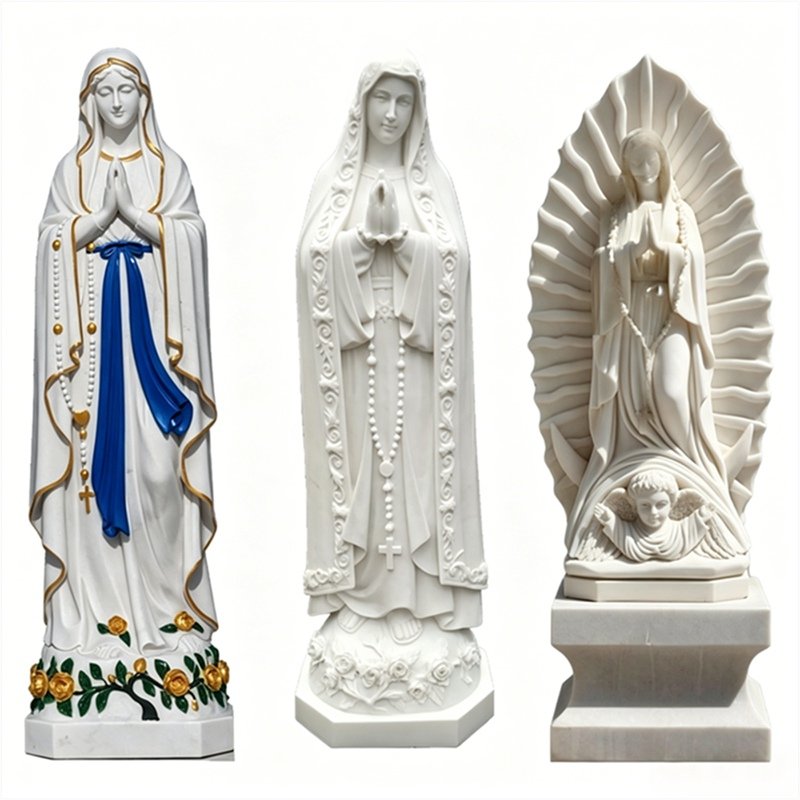
Comparison Table: Our Lady of Lourdes, Fatima, and Guadalupe
Here is a simple table to help you understand the differences more clearly.
| Feature | Our Lady of Lourdes | Our Lady of Fatima | Our Lady of Guadalupe |
|---|---|---|---|
| Origin | Lourdes, France | Fatima, Portugal | Tepeyac, Mexico |
| Main Meaning | Healing and comfort | Rosary, peace, and prayer | Patroness of the Americas and the Unborn |
| Clothing | Simple white robe and veil | More decorated robe and mantle | Star-covered mantle with sunburst |
| Accessories | Rosary | Rosary with visible cross | Usually no rosary |
| Base Design | Simple base, sometimes with roses | Rose-covered base | Angel supporting a crescent moon |
| Facial Expression | Peaceful, eyes lowered or closed | Solemn, often looking forward | Gentle, eyes lowered, compassionate |
| Key Symbols | Rosary, white robe, Lourdes healing grace | Rosary, roses, peace | Sun rays, stars, angel, moon, pregnancy |
Final Thoughts
When we talk about the mystery of Our Lady of Guadalupe, we may think of the tilma, the roses, the stars, the sun rays, or the miracle of the image.
All of these are beautiful and meaningful.
But for me, the deepest mystery is simpler.
Why did Our Lady appear to a humble man?
Why did her image speak so strongly to an entire nation?
Why do people still cry in front of her statue hundreds of years later?
Why does a mother’s image continue to comfort families across the Americas?
Maybe the answer is love.
Our Lady of Guadalupe reminds us that faith is not always far away. Sometimes it appears on a winter hill. Sometimes it appears on a simple cloak. Sometimes it appears in a village procession. Sometimes it appears in front of a marble statue, when people gather, pray, and feel that they are not alone.
For many believers, Our Lady of Guadalupe is more than an image.
She is a mother.
And a mother always knows how to find her children.