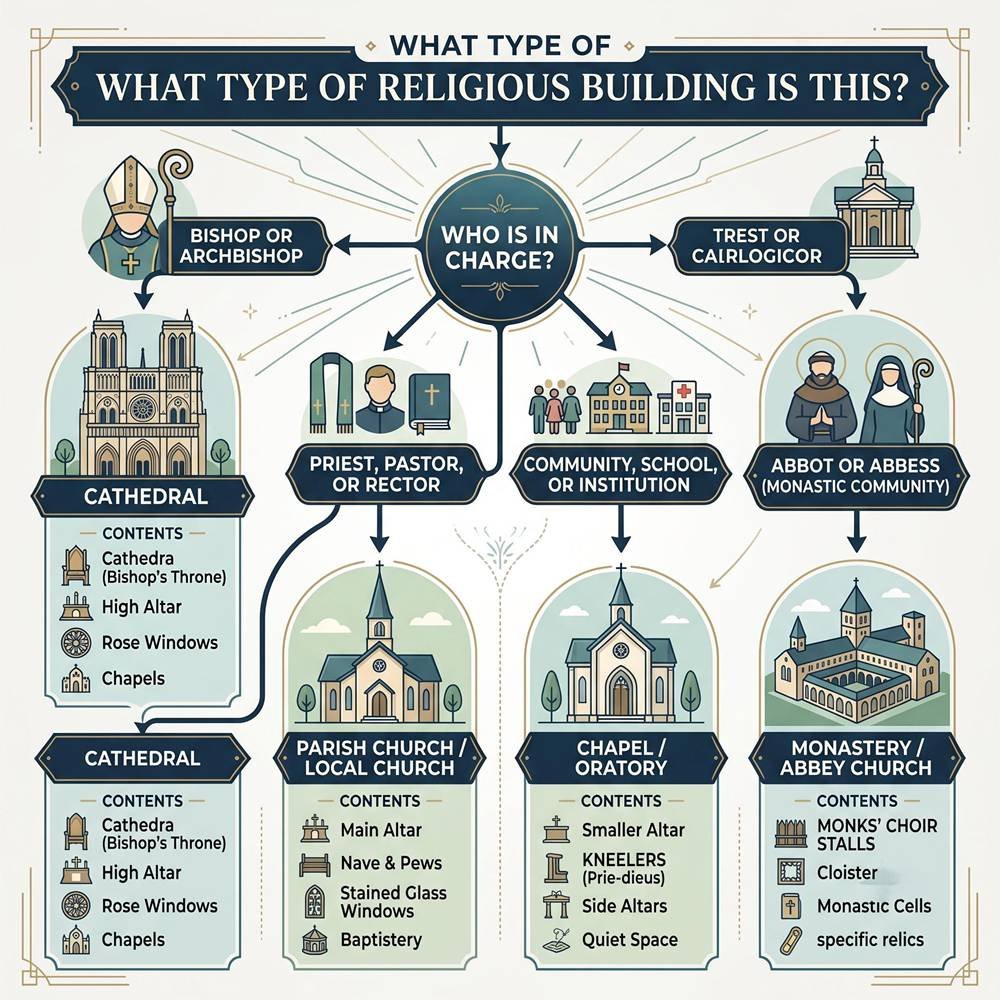
The difference among a church, a chapel, a cathedral, and a basilica is who is in charge — not size, age, or ornament.
For anyone buying religious sculpture and furnishings, this single question decides everything that follows — what belongs inside the building, how it is bought, and how much it costs. That is what this article walks through, step by step.
What Defines the Difference Between a Church, a Chapel, a Cathedral, and a Basilica?
On the evening of 15 April 2019, the world watched Notre-Dame de Paris burn. The spire fell, the roof collapsed, and the news feeds filled with smoke and prayers. But in the days that followed, one quiet question kept surfacing from people who had never thought to ask it before: what kind of building is Notre-Dame, exactly — and what makes it different from the church I pass on my way to work?
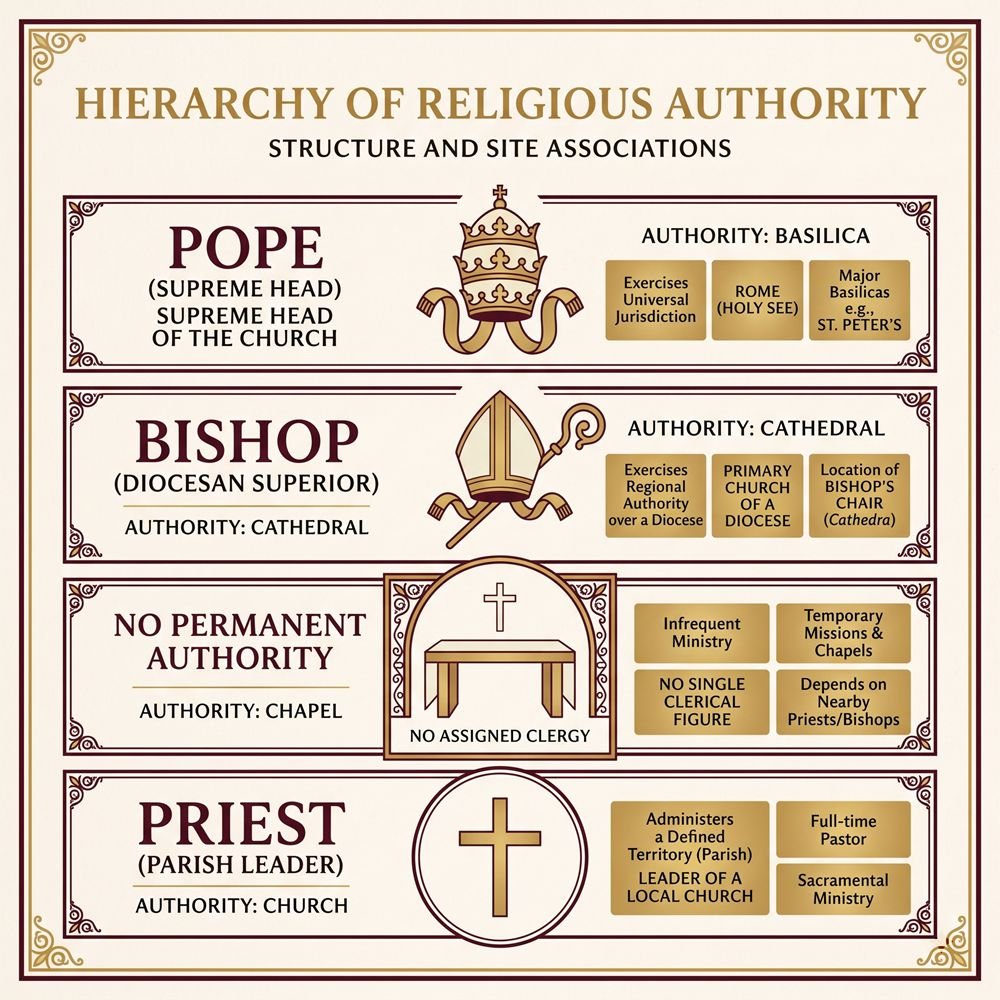
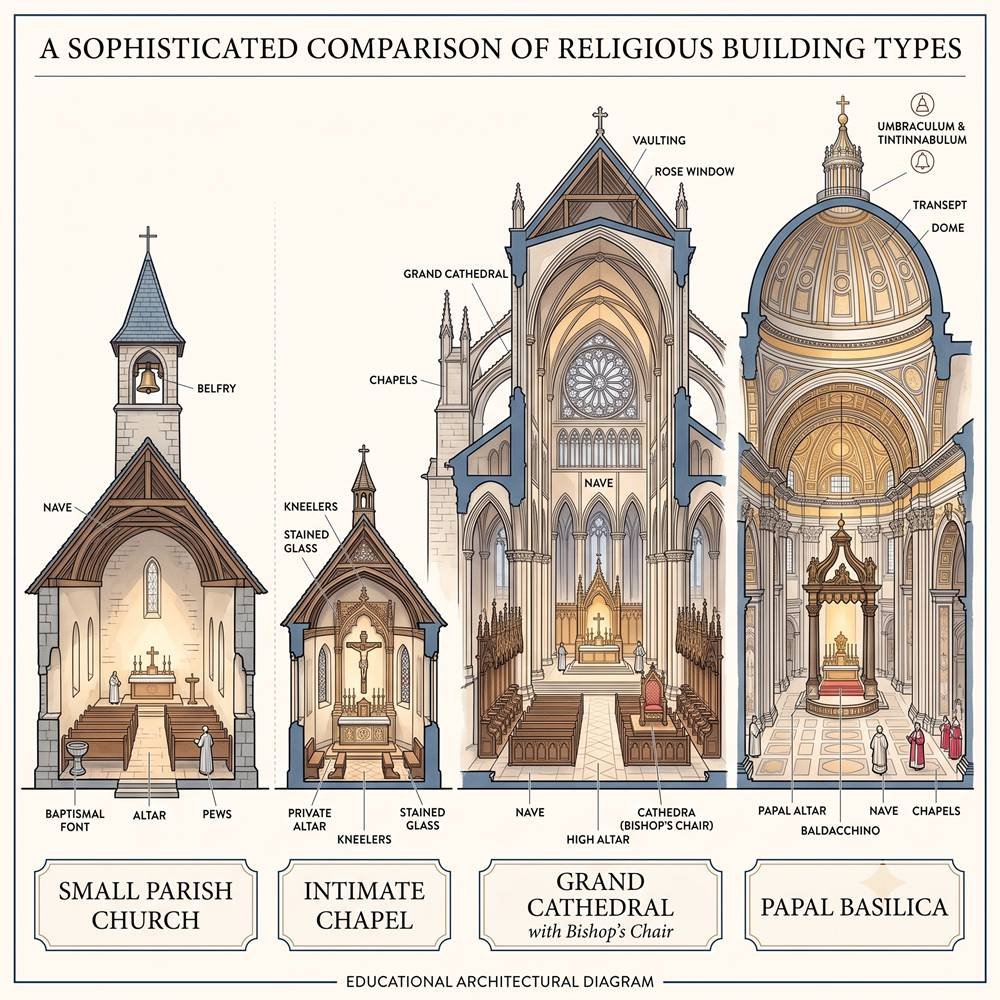
The answer has nothing to do with size, age, or ornament. A tiny stone room with one altar can outrank a vast cathedral in authority — and a building that looks exactly like a cathedral may not be one at all. The type is defined by authority — who is in charge — not by size or ornament.
What Is a Church?
A church is a place of worship with a permanent congregation, run by a resident pastor or priest. It is the everyday building of parish life — St. Mary’s on the corner, St. Joseph’s in the next town.
Chances are, the building near you is a church: it has a priest, a congregation, and a Sunday service.
What Is a Chapel?
A chapel has no pastor and no permanent congregation. It is an attached space — inside a larger church, a university, a hospital, or an airport — and it is all about the physical room.
The most famous example is Sainte-Chapelle in Paris, the jewel-like royal chapel built to house relics of Christ’s Passion: a chapel of kings, not of parishioners.
The same logic applies to the quiet chapel in a hospital corridor or a military base.
No one is “in charge” in the pastoral sense.
What Is a Cathedral?
A cathedral is the principal church of a diocese, named after the cathedra — the chair of the bishop. It is where the bishop sits that makes it a cathedral, nothing else.
Notre-Dame de Paris is the most famous example of all: it became a cathedral not because of its towers or its rose windows, but because the Bishop of Paris has his cathedra there — which is also why the fire, in 2019, felt like an attack on the heart of France.
What Is a Basilica?
A basilica is not a building type at all but an honorary title granted by the Pope — major or minor. It is additive: any church or cathedral can also be a basilica.
St. Peter’s Basilica in Rome is the world’s most famous major basilica — one of the four personal churches of the Pope — yet it is not a cathedral, because Rome’s cathedral is St. John Lateran. Even Sagrada Família in Barcelona, endlessly called “the cathedral,” is actually a minor basilica, consecrated by the Pope in 2010.
And Notre-Dame itself carries all three labels at once: a church, a cathedral, and a minor basilica (a title granted in 1805).
One rule, four answers: priest · no one · bishop · the Pope.
Which Sculptures and Furnishings Are Most Typical Inside Each Type?
Because the authority differs, the contents differ. Walk into each one and the sculptures tell you what you are standing in.
Inside a Chapel
one devotional statue (the Madonna or a patron saint) in a white marble shrine niche stands as the single focus; one small bronze crucifix; bronze candle stands. That is the whole order — a chapel is a room with one voice.
The Sainte-Chapelle in Paris shows the chapel logic perfectly: one upper room, twelve apostles around the walls, and a relic shrine at the east end as the single focus. No congregation, no parish program — just one room built for one shrine, and the sculpture exists to serve it.
Inside a Church
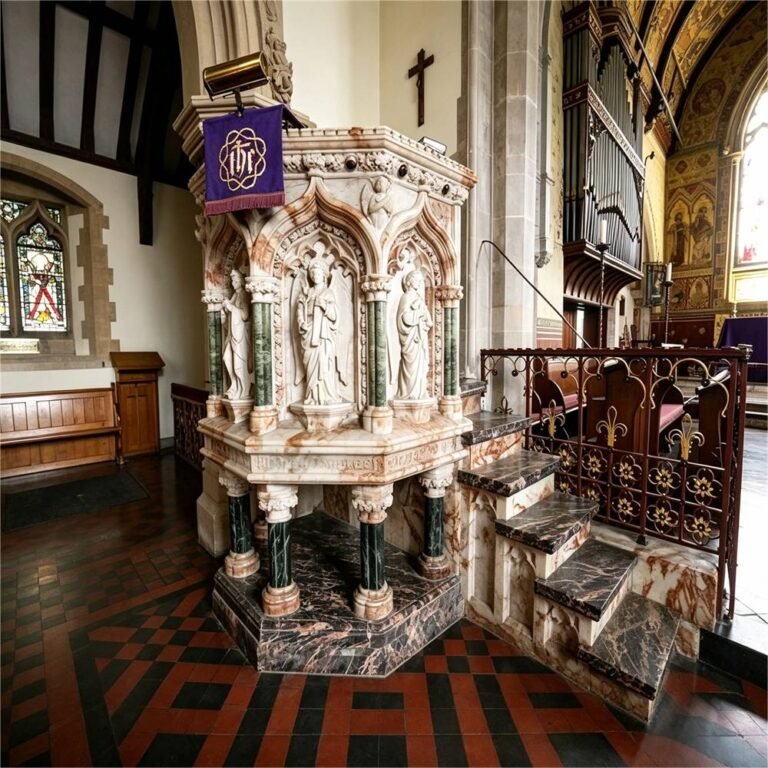
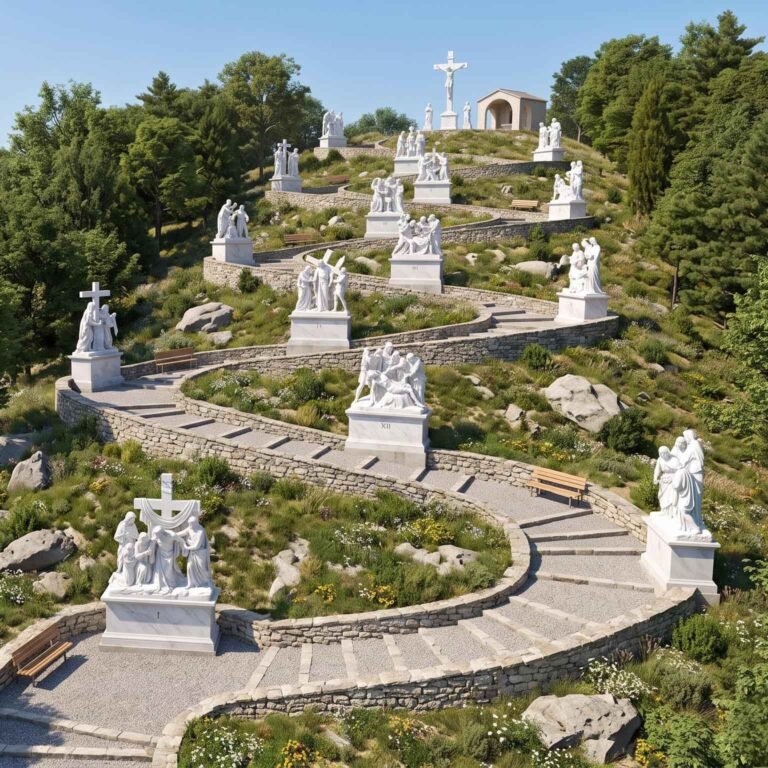
the standard set takes over: a white marble altar and holy-water font form the core; a bronze crucifix hangs above the altar; bronze Stations of the Cross run along the walls; and coordinated marble or bronze statues of the Madonna and the saints fill the side positions.
This is the parish package — repeatable, budget-defined, the backbone of church supply.
Take St. Peter’s Church in Drogheda, Ireland. Walk through the doors and the whole parish order is right there: a white marble altar, the Stations of the Cross running along the aisle walls, and — at the heart of it all — the shrine of St Oliver Plunkett. Nothing about it is exceptional, and that is exactly the point: a parish church wraps its devotional life around its shrine.
Inside a Cathedral
the ensemble widens: a white marble cathedra and ambo anchor the bishop’s zone; marble groups of apostles, evangelists, and local saints line the sanctuary; shrine and relic niches carry the devotional program; and bronze candlesticks and sanctuary lamps mark the ritual points. Cathedrals buy marble-led, with bronze doing the liturgical work.
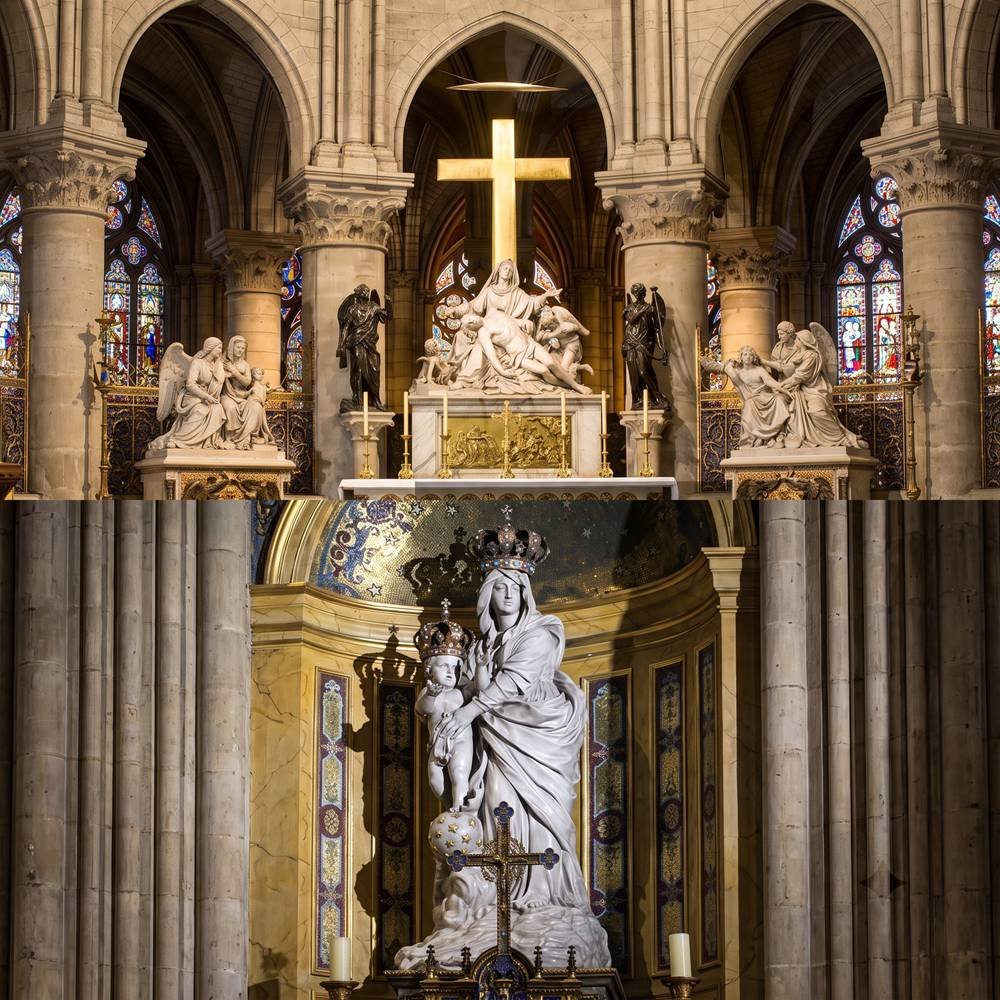
See it in Notre-Dame de Paris: the fourteenth-century marble Virgin and Child on the pillar at the crossing, the bronze crucifix and mourning figures behind the high altar, and the relic shrines in the treasury — marble carrying the surfaces, bronze marking the sacred points.
Inside a Basilica
bronze takes command: a bronze baldachin over the papal altar, monumental bronze saint colossi in the nave, gilded bronze angels and lamps, while white marble supplies the surfaces — altar reverments, inscription bands, the quiet architecture behind the gold.
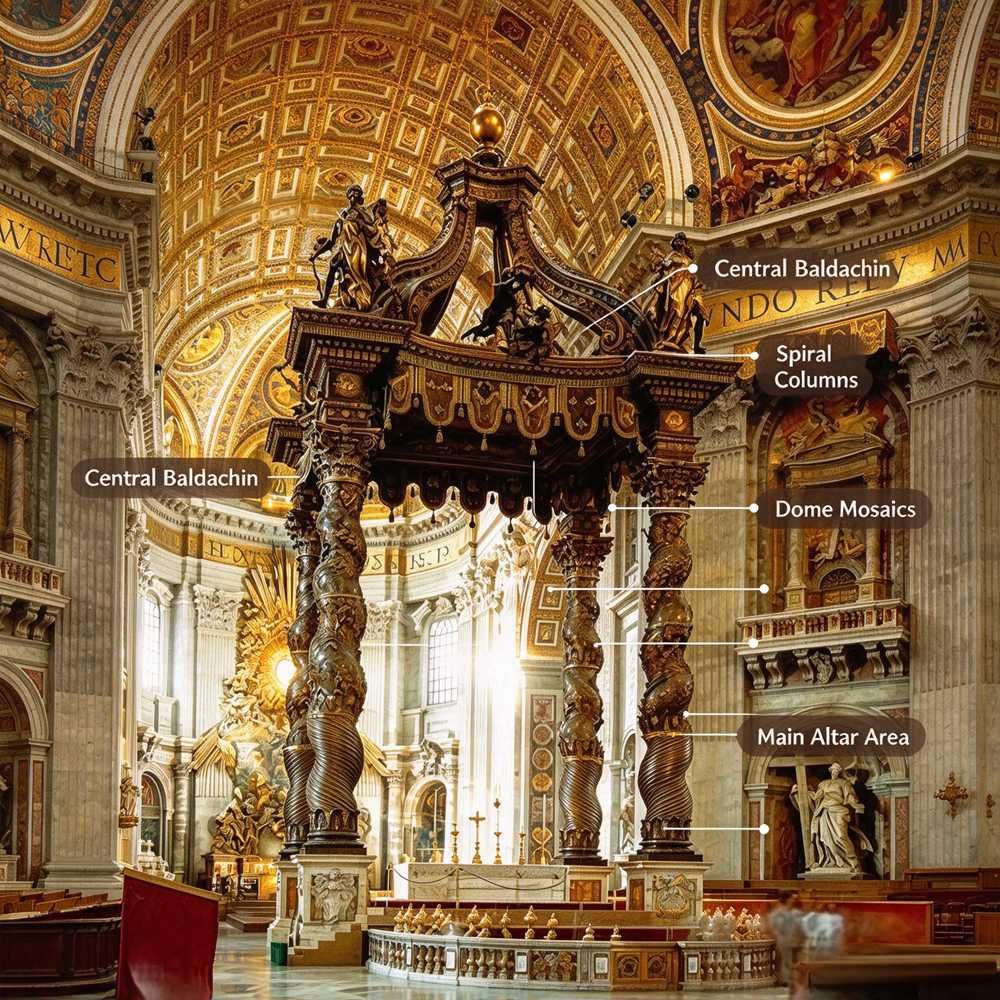
In St. Peter’s Basilica in Rome,Bernini’s bronze baldachin soaring over the papal altar, the bronze Cathedra Petri behind it, and the venerated bronze statue of St Peter in the nave — bronze everywhere you look, marble as the calm behind it.
Which material leads where?
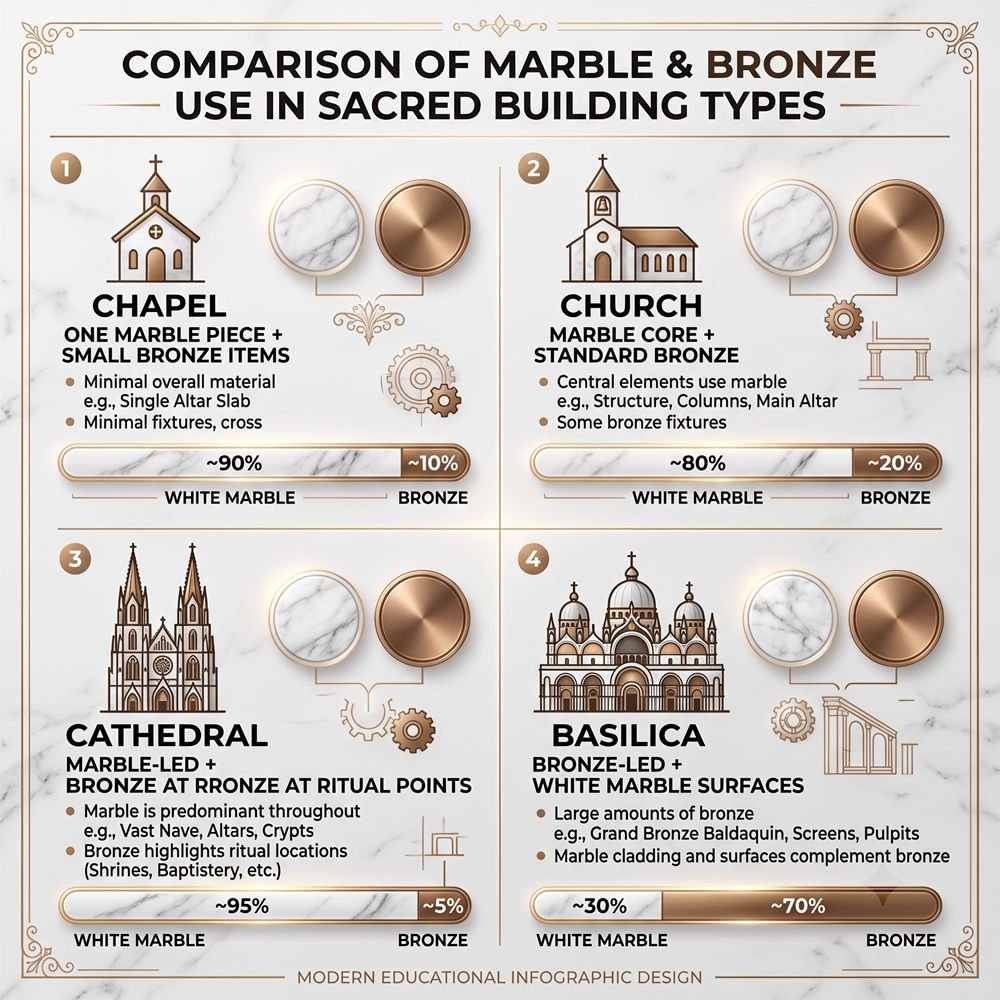
Chapel: one marble piece plus small bronze.
Church: marble core, standard bronze.
Cathedral: marble-led, bronze at the ritual points.
Basilica: bronze-led, white marble surfaces. Follow that ratio and the room will always look right.
How to Choose the Right Sculptures and Furnishings for Your Budget?
Almost no church buys everything at once. Our clients order in batches — the altar this year, the Stations and statues the next, the fonts and pulpit the year after. Budget is not a limit; it is a plan, and the plan is always built in stages.
Step 1 · Set the budget by building type
A chapel is a single-focus order; a parish church is a standard package; a cathedral is a coordinated program; a basilica-scale project is bespoke and long-lead. Match your number to the type and you will not be surprised.
Step 2 · Plan the whole set first — then buy in stages
Before ordering anything, list everything the building will eventually need: altar, font, crucifix, Stations, statues, pulpit. Then let the budget decide the order, not the other way around.
This is how our long-term clients actually work: the Asian cathedral father has returned every year since 2021 — one set of sculptures per year, growing the sanctuary steadily; a North American church client bought a full first set in 2021, then four more sets in 2024 alone.
Our own quotation records show the same pattern — the same client requesting four separate batches over several months before committing.
Buying in stages is not a compromise; it is the professional way to build a church.
Step 3 · Buy the focus piece first
Every room has one voice. In a chapel it is the shrine niche; in a parish church it is the altar; in a cathedral it is the cathedra with the altar on the same axis. When money is tight, the focus piece comes first — it is the piece everyone sees, and it sets the tone everything else will match.
Step 4 · Match material to budget
White marble for the focal pieces; bronze for the devotional and ritual items; gilded finish only for accent points.
Our Singapore church project is the full demonstration: the entire ensemble — statues, altars, pulpits, baptistery, the fourteen Stations — carved in the same high-quality white marble so the whole sanctuary speaks one language.
Step 5 · Specify to control cost
Fix dimensions, surface finish (polished, antique, or gilded), and mounting method early. Standard sizes cost a fraction of bespoke. And when you customize, specify precisely: our Singapore client required every measurement held within 5 mm, and their custom logos on altars and pulpits were carved by hand after design-drawing approval.
Step 6 · Expect the second order — and plan for it.
A church that buys in stages always returns: an American collector started with fourteen marble Stations at 60 cm, then came back for a taller 90 cm set with Roman-numeral bases for public placement; a European parish father ordered once, loved the work, and sent us several more customers. A well-made first batch is the strongest marketing a factory has.
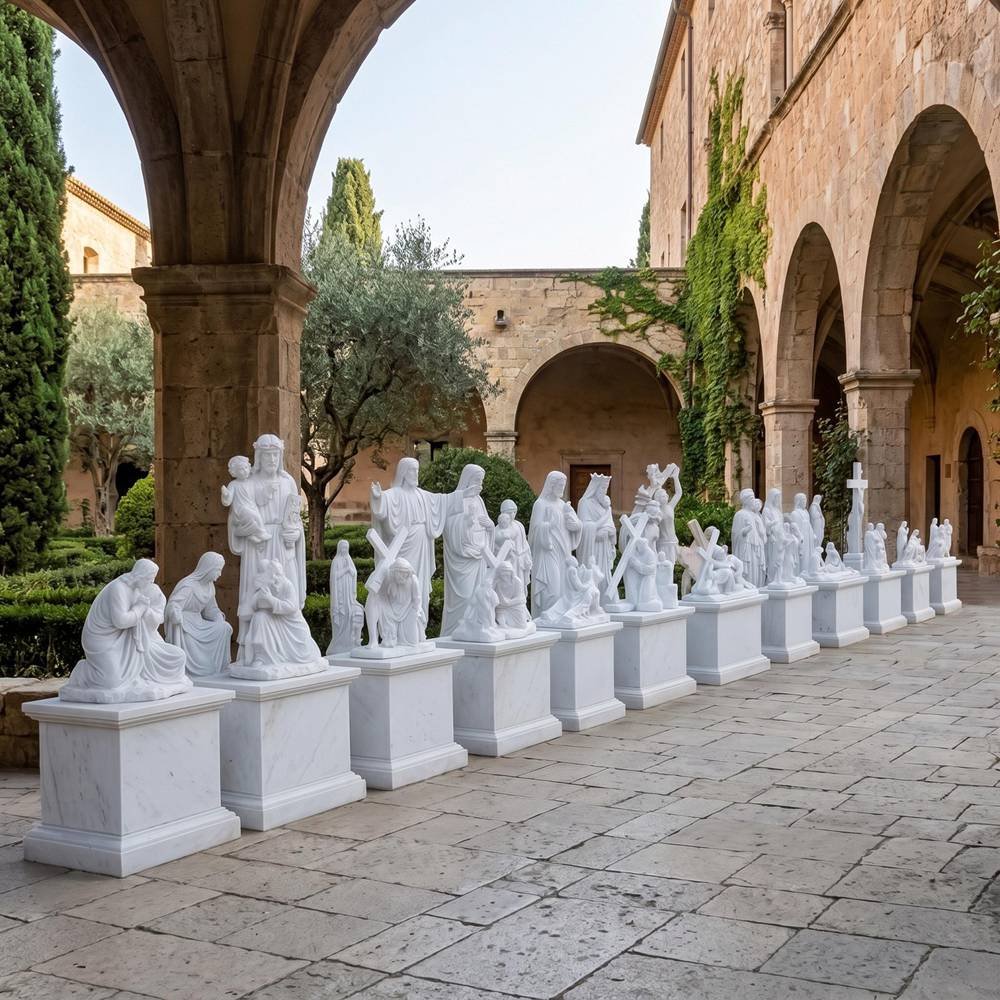
The one rule of church budgeting: decide the complete set, buy the focus piece first, and let each installed batch earn the next.
Projects and Ideas from Our Factory: Real Church Projects We Have Supplied
Every order our factory has ever shipped began with the same question this guide started with — who is in charge?
The answer told us who would choose, who would approve, and what the sanctuary would eventually need. Over the years those answers became the stories below. Some clients we have served once; most keep coming back.
The Renovation That Started from the Center Line — Costa Rica
Our Costa Rica project was a true cathedral renovation — Catedral, Diócesis Ciudad Quesada.
The cathedral is not rebuilt from the walls inward. It is rebuilt from the center line outward — and that is exactly how our client in Ciudad Quesada, Costa Rica, renovated his old cathedral church between 2019 and 2020.
He ordered the cathedra and the altar together, carved as one program in Grade-A white marble and beige marble, because in a cathedral the bishop’s seat and the altar must share one axis. The pulpit came next, carved to the height of the priests who preach from it — a detail he insisted on, and we measured twice for.
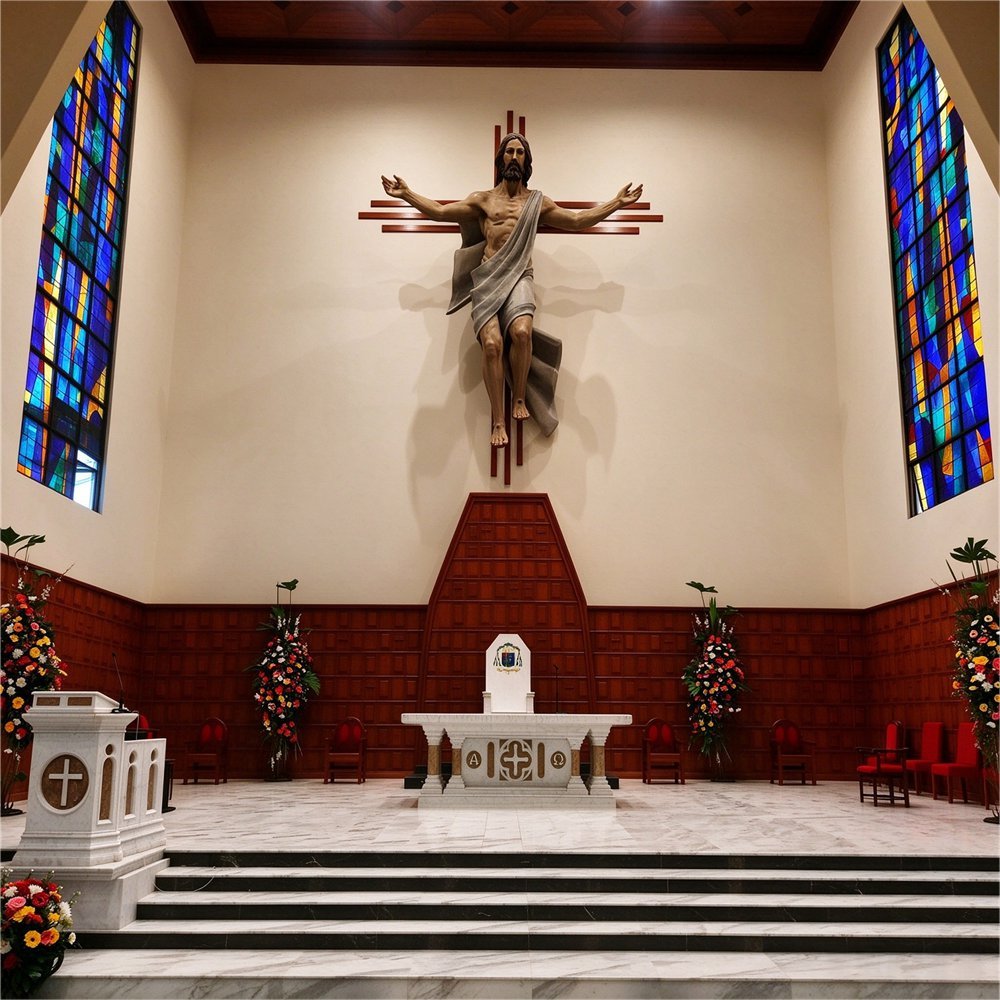
Then came the marble floors, cut from natural stone, laid out and confirmed before shipping, each slab numbered on the back so his workers could install them in order.
When the church reopened in November 2020, he told us our products carried the most exquisite patterns he had ever seen, and that the Virgin Mary looked exactly as he had hoped: with a face of peaceful wisdom.
The Sanctuary Built as One Set — St Joseph’s Church, Singapore
Some churches are not renovated but created in a single sweep.
In December 2017, St Joseph’s Church in Bukit Timah, Singapore, commissioned a complete sanctuary: a Jesus with two angels, Our Lady of Fatima with the three shepherd children, the Virgin Mary and St Joseph, two Corpus statues, two marble pulpits, two marble altars, a marble baptistery, and fourteen Stations of the Cross in marble relief — every piece in the same high-quality white marble, so the whole room speaks one language.
The project ran for six months, and almost all of it happened before a single block was cut.
Every sculpture was first made as a 1:1 clay model, based on photographs and the detailed suggestions of the parish priest. Our artists revised the models until the client approved every angle; the Corpus alone was reworked from their reference pictures until the details matched one hundred percent.
The custom logos on the altars and pulpits were drawn, approved, then hand-carved. Measurements were held within five millimetres. In May 2018, the pieces arrived, and the parish held a grand unveiling; a year later our director visited Singapore at their invitation, walked the completed church with the parish team, and ate durian with old friends.
That is what a one-time order becomes when it is done properly: a congregation that remembers you.
The Father Who Comes Back Every Year — An Asian Cathedral
Then there are the clients for whom one order is never enough.
Our Asian cathedral client is a church-project specialist who runs his own church. He first ordered in 2021, and he has returned every year since — altars, pulpits, baptismal fonts, reliefs, a large carved altar with flowers and animals, an Our Lady of Mount Carmel whose crown our artists designed from the tradition, and in 2024 a Jesus with open arms plus a matching altar, pulpit, and font.
His church is built the way churches are really built: a piece each year, each batch earning the next. His orders range from USD 3,890 to 49,000, and we have watched both his projects and our carving grow together.
How We Work — and Why Clients Come Back
Standard pieces ship fast from stock. Custom work starts with drawings: CAD and 3D designs and effect renders, then a same-scale clay model for approval, then carving, then export packing in iron frames and wooden crates with full insurance. Terms are simple — 40% deposit, 60% before shipment, production 30–40 days.
And this is why our clients buy in batches, year after year: the first delivery proves the standard, and the second order is the proof of the first. A church is not built in a month. Neither is trust.
Final Thoughts
Walk into any church and the sculptures tell you what kind of building you are standing in — because the type was never about size or ornament. It was decided by one question: who is in charge? The priest’s church carries the standard set; the bishop’s cathedral carries the program; the Pope’s basilica carries the bronze. The same question decides the budget — and our clients show every day that a church is not bought in one season. It is planned whole and built in batches: the focus piece first, the devotional set next, the saints and reliefs as each delivery earns the next.
That is how we have worked since 1983 — from a cathedral renovation in Costa Rica that began on the center line, to a Singapore sanctuary carved as one set, to the Asian father who has returned every year since 2021. If you tell us your building type and the budget you have this year, we will tell you which pieces belong in your sanctuary, in white marble and bronze — and which batch to order first. The rest, as the churches above show, comes in time.