Michelangelo’s Pieta is one of the most admired marble sculptures in the world. Created when the artist was only in his early twenties, it combines classical beauty, emotional restraint, and extraordinary technical mastery in a way that still moves viewers more than five centuries later.
But why is Michelangelo’s Pieta so famous?
The answer lies in two lasting qualities: its profound spiritual meaning and its unmatched sculptural craftsmanship. More than a masterpiece of Renaissance art, the Pieta has become a timeless symbol of maternal love, sorrow, purity, and peace. That is why it continues to inspire custom religious sculpture for modern spaces around the world.
What Is Michelangelo’s Pieta?
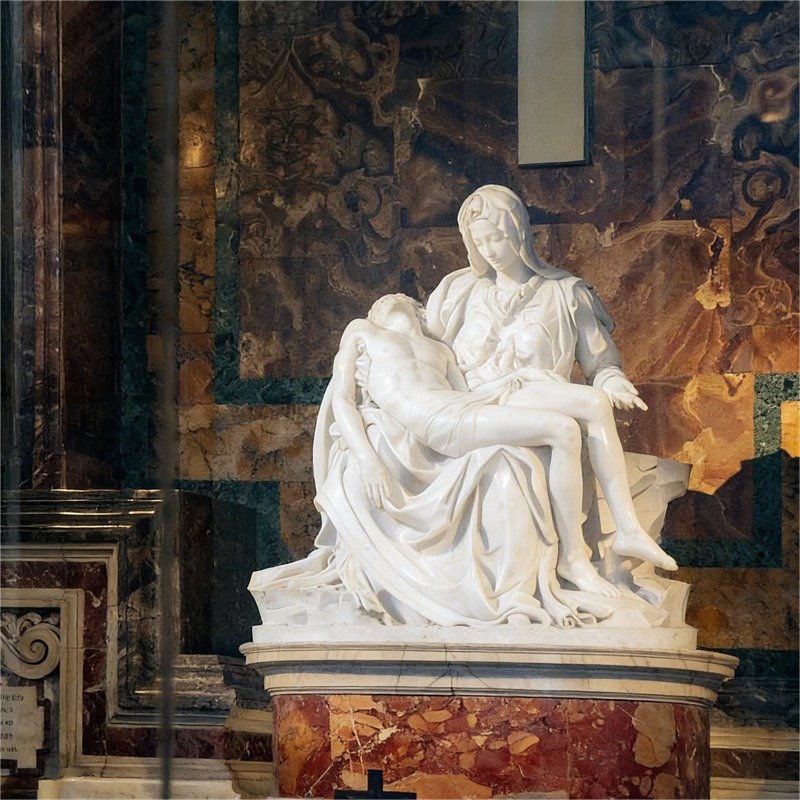
Michelangelo created the Pietà between 1498 and 1499 after receiving a commission from French Cardinal Jean de Bilhères. Carved from a single block of fine Carrara marble, the sculpture was designed as a Catholic funerary monument and is now housed in St. Peter’s Basilica in Vatican City.
The commission came at a pivotal moment in Michelangelo’s early twenties, with the encouragement of a group of cardinals and the assistance of banker Jacopo Galli, who acted as intermediary for the young artist. The Pietà was originally intended to adorn the chapel of Santa Petronilla in the Vatican, honoring Cardinal de Bilhères, then ambassador of the King of France, who would later be laid to rest in the very chapel.
Demonstrating his meticulous approach, Michelangelo personally traveled to the famed Carrara marble quarries to select the perfect block, believing that only the finest material would suffice for his vision. The commission, officially given in 1497, was facilitated by a group of cardinals with the assistance of Jacopo Galli, a prominent banker who acted as intermediary for the young artist. Their goal was to adorn the chapel of Santa Petronilla in the Vatican and honor Cardinal Jean de Bilhères, the French ambassador, who would eventually be interred in the very chapel the Pietà was meant to grace.
Upon completing the sculpture in 1499, Michelangelo signed his name on the sash across the Virgin Mary’s chest—an uncommon gesture for him. The inscription, MICHAEL.A[N]GELVS BONAROTVS FLORENT[INVS] FACIEBAT (“Michelangelo Buonarroti the Florentine made this”), was added after some visitors doubted the work was truly his, marking it as the only sculpture he ever signed.
A New Vision of a Familiar Theme
The sculpture shows Mary holding the body of Jesus after the Crucifixion. It is one of the most iconic images in Christian art and is also famous for being the only work Michelangelo ever signed.
While the theme of the Pietà—Mary cradling the dead Christ—was already well established in 15th-century art, especially through the Vesperbilder (“images of the Vespers”) popular in Northern Europe, Michelangelo’s interpretation brought something entirely new. Earlier versions, often carved from wood, tended to be somber, sharply contrasted, and rigid in form. The German Vesperbilder, for example, depicted the Virgin in a severe, upright posture, with Christ’s body laid stiffly across her lap—a poignant but stark meditation on suffering.
Michelangelo reimagined this tradition with a softer, more harmonious composition. The Vatican Pietà forms a gentle pyramidal structure, suggesting both stability and a subtle upward movement—as if the figures are reaching toward the heavens. Instead of the stark, angular forms of earlier works, Michelangelo’s version is defined by idealized beauty, natural drapery, and an intimate, enveloping connection between Mary and Jesus. Their faces are serene, their poses flowing and lifelike, embodying the Renaissance ideals of grace and human emotion.
Art historians often regard Michelangelo’s Pieta as one of the defining masterpieces of the early High Renaissance. Even at such a young age, Michelangelo demonstrated a remarkable ability to combine the beauty of restraint with deeply human emotion. That balance is one of the main reasons the sculpture remains universally admired today.
Why Is Michelangelo’s Pieta So Famous?
There are many reasons for the fame of Michelangelo’s Pieta, but two stand above the rest.
First, it expresses the holiness of Mary and the purity of mothering in a way that speaks univerally.
Second, it displays a level of marble carving skill that still astonishes artists, collectors, and sculptors today.
These two qualities—spiritual depth and technical perfection—are also exactly why the Pietà remains one of the most requested themes in custom religious sculpture.
A Timeless Symbol of Holiness, Compassion, and Mothering
The first and most powerful reason Michelangelo’s *Pietà* is so famous is its emotional and spiritual meaning.
A Shape of a Pyramid
Many viewers notice that Mary appears larger than Christ. If she were standing, she would seem unusually tall compared to the body of Jesus. This is not a mistake. It is a deliberate artistic solution.
If Michelangelo had carved Christ at full natural scale across Mary’s lap, the composition would likely have appeared awkward and unstable. Instead, he enlarged Mary’s thighs and lap and enveloped her in broad, flowing drapery so that Christ’s body could be encompassed within her form, uniting the two figures in a shape of pyramid.
This design choice does more than solve a technical problem. It transforms Mary into a universal image of mothering. She becomes more than a religious figure—she becomes a vessel of compassion, sorrow, strength, and sacred calm.
Interestingly, Christ’s body is rendered slightly smaller than Mary’s, a subtle decision that may allude to his childhood and the enduring bond between mother and son. In contrast, Mary’s face is intentionally youthful—almost that of a teenager—which, at the time, drew some criticism. Yet Michelangelo’s purpose was to represent her uncorrupted and incorruptible beauty: an imperishable youthfulness that makes her both the mother and the spiritual daughter of her own Holy Son.
This is one reason Michelangelo’s Pieta continues to touch people so deeply. Although Christ is the Son of God, in Mary’s arms he is also still her baby. No matter how great or sacred a son may be, to his mother he remains the child she once held.
That truth gives Michelangelo’s Pieta a universal power beyond religion alone. Even viewers who are not Catholic can feel the emotional depth of the scene.
Mary is Eternal Purity
Michelangelo also chose to show Mary as youthful, even younger in appearance than her thirty-three-year-old son. This too is meaningful. Rather than depicting ordinary age, he represented her eternal purity. Her face reflects serenity and incorruptible grace, which makes the sculpture feel sacred rather than merely realistic.
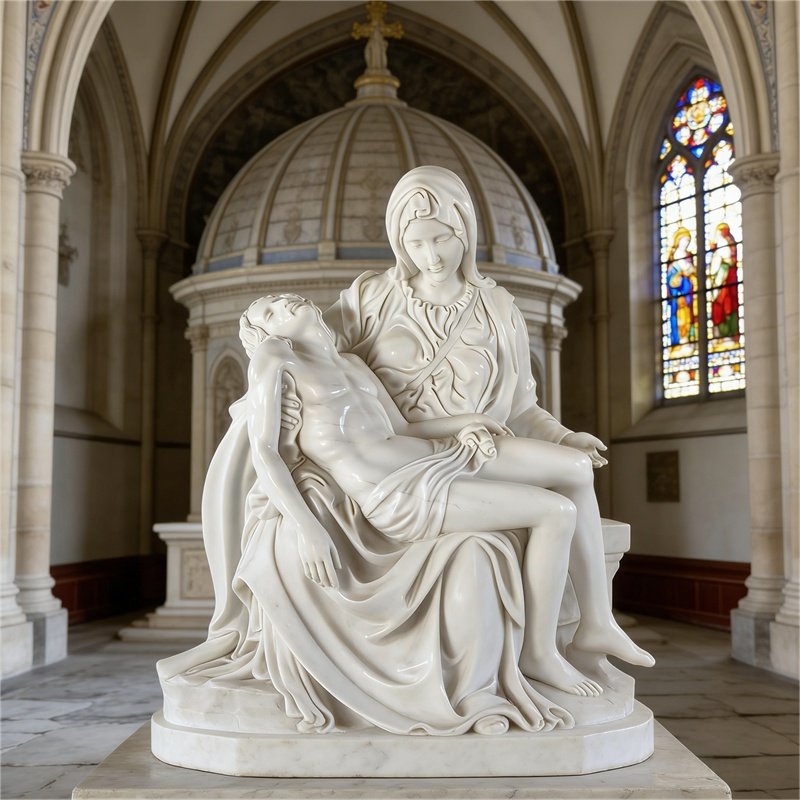
That design choice does more than solve a technical problem. It transforms Mary into a universal image of mothering. She becomes more than a religious figure—she becomes a vessel of compassion, sorrow, strength, and sacred calm.
This is one reason Michelangelo’s Pieta continues to touch people so deeply. Although Christ is the Son of God, in Mary’s arms he is also still her baby. No matter how great or sacred a son may be, to his mother he remains the child she once held.
That truth gives Michelangelo’s Pieta a universal power beyond religion alone. Even viewers who are not Catholic can feel the emotional depth of the scene.
Mary is eternal purity
Michelangelo also chose to show Mary as youthful, even younger in appearance than her thirty-three-year-old son. This too is meaningful. Rather than depicting ordinary age, he represented her eternal purity. Her face reflects serenity and incorruptible grace, which makes the sculpture feel sacred rather than merely realistic.
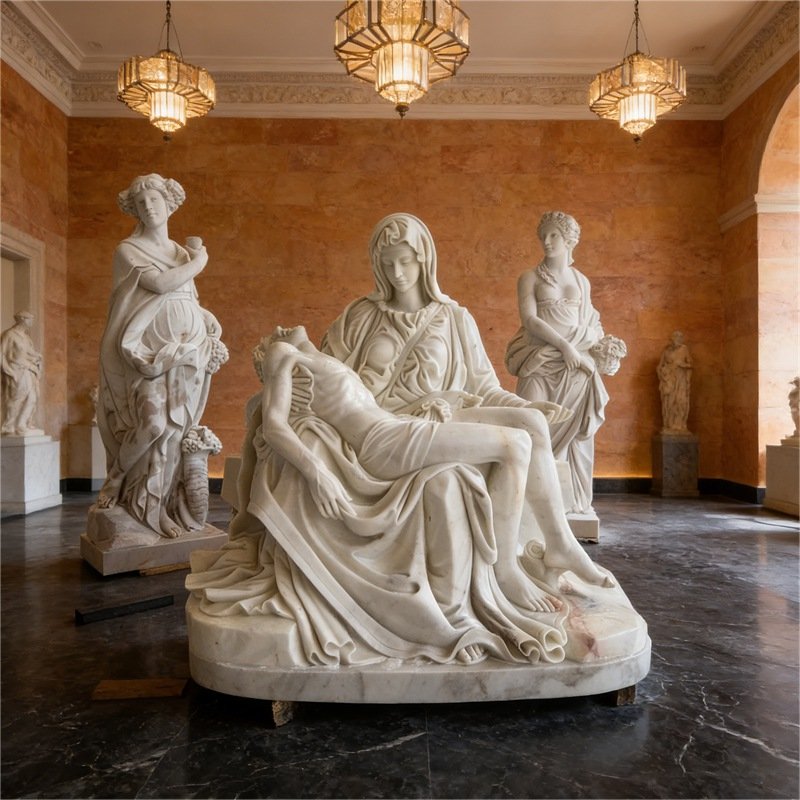
Some viewers also notice the deep carving formed by the folds of Mary’s garment. Symbolically, this space can suggest an empty womb, echoing themes of birth and death, beginning and ending, loss and return. These layers of meaning give the *Pietà* exceptional depth, making it not only a religious sculpture but also a timeless work about love, sacrifice, and human tenderness.
Extraordinary Marble Carving Skill
Another major reason Michelangelo’s Pieta is so famous is the breathtaking quality of its carving.
Christ’s body rests across Mary’s lap with remarkable realism. His torso sinks gently, his limbs fall naturally, and his weight seems light as a feather. The body appears lifeless, yet never crude.
This is one of the greatest achievements of the sculpture: hard marble seems to take on the softness of human real flesh.
Material
The surface of the Carrara marble is equally important. Michelangelo polished it to such refinement that light moves gently across the sculpture, making the surface appear luminous. This subtle glow strengthens the sacred and serene quality of the work.
Equally striking is the extraordinary smoothness achieved in the marble. Michelangelo devoted immense care and time to perfecting the polish—so much so that, when contemplating the face of Mary or the body of Christ, it’s difficult to believe they are carved from stone. The marble appears so smooth and shiny that the figures nearly seem alive, their contours easily visible even in the gentle shadows of the chapel.
This dedication to surface finish not only highlights Michelangelo‘s technical mastery but also ensures the figures radiate a gentle, almost otherworldly presence, drawing the viewer into their quiet grace.
The Treatment of the Face
The emotional expression is also masterful. Mary is not shown in dramatic collapse. She is calm, composed, and inward, yet her sorrow is unmistakable. That restraint is one reason the sculpture feels so profound. Instead of forcing emotion on the viewer, Michelangelo invites the viewer to enter the scene and feel it personally.
Gestural Details
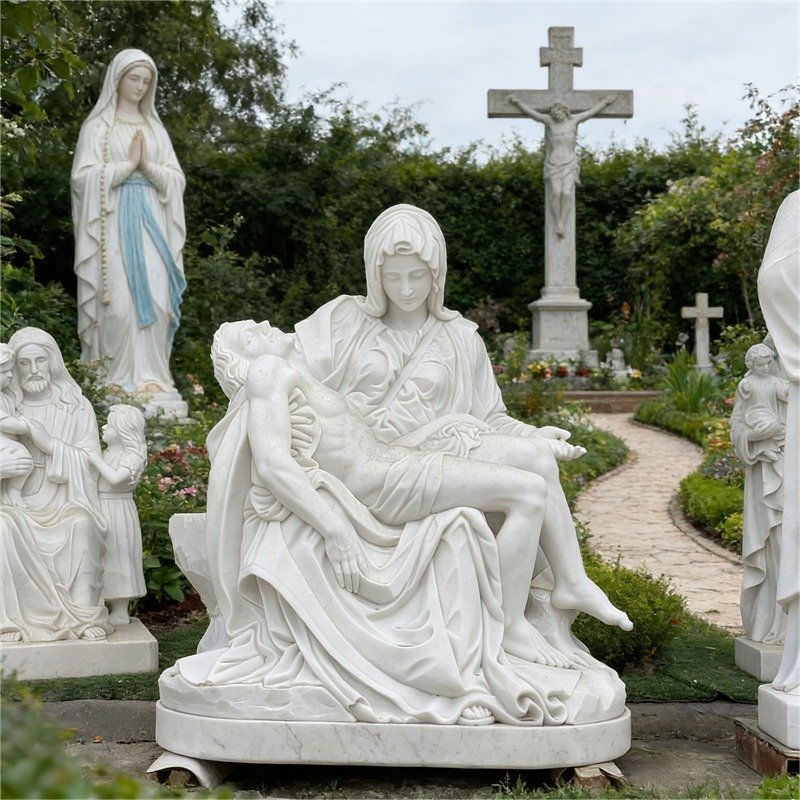
One of the most elegant details is Mary’s left hand. Slightly extended, it can be read as a gesture of offering, acceptance, surrender, or silent questioning. That ambiguity gives the sculpture lasting emotional power.
For today’s buyers of religious sculpture, these qualities still matter. A successful Michelangelo’s Pieta replica is not only about copying a famous artwork. It is about preserving the spiritual atmosphere, the graceful composition, and the emotional balance that make the original so unforgettable.
Why Michelangelo’s Pieta Remains Popular in Churches, Courtyards, and Memorial Spaces
The influence of Michelangelo’s Pieta has never disappeared. On the contrary, it continues to inspire religious sculpture projects around the world.
Today, clients choose the statue of Michelangelo’s Pieta for many kinds of spaces, including:
- Churches
- Chapels
- Catholic schools
- Cemeteries
- Memorial parks
- Prayer gardens
- Monastery grounds
- Private courtyards
Michelangelo’s Pieta sculpture works beautifully in these settings because it carries both visual beauty and spiritual depth. It is a sculpture people do not simply look at—they pause before it, pray beside it, and remember through it.
This is especially important for buyers looking for a religious statue that conveys reverence rather than decoration alone.
What are the differences between Bandini Pietà, Rondanini Pietà and the Vatican Pietà?
Vatican Pietà: Early polished masterpiece with balanced classical forms and restrained beauty.
Bandini Pietà: Made in his 70s for his own tomb. Rough, unfinished surfaces with strong emotional tension. Michelangelo smashed it out of frustration and abandoned the piece.
Rondanini Pietà: His final work, created in his 80s. Elongated, nearly abstract figures with a vertical, ghost-like layout. Rough chisel marks remain, prioritizing the essence of grief over perfect craftsmanship.
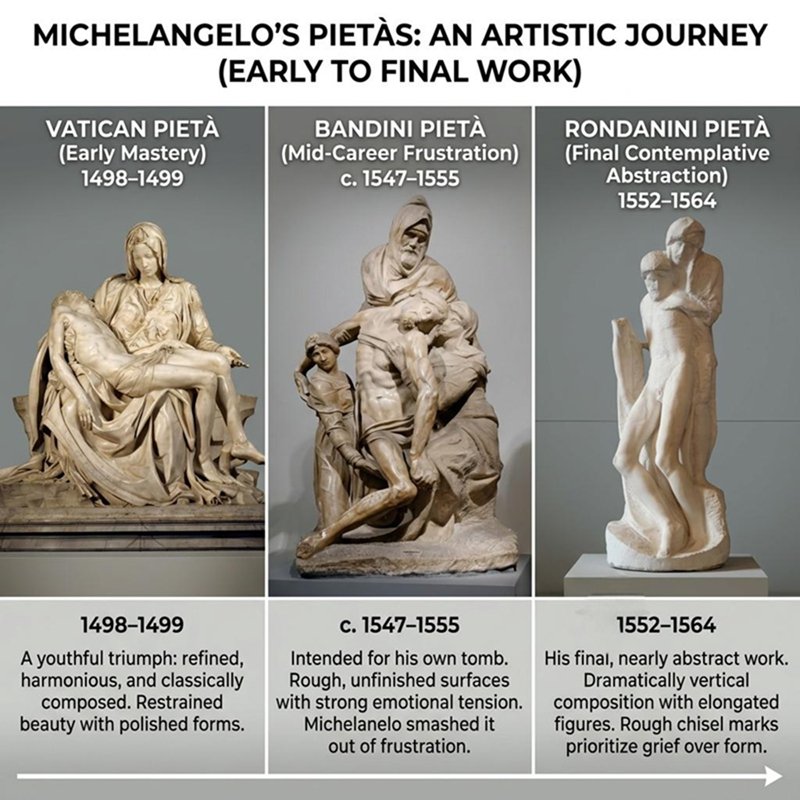
While the Vatican Pietà stands as Michelangelo’s youthful triumph—refined, harmonious, and classically composed—the Bandini Pietà and Rondanini Pietà reflect his later years and evolving artistic mindset. The Bandini Pietà, one of his last major undertakings, was originally intended for Michelangelo’s own tomb. In a moment of deep frustration, he famously struck the marble, breaking it in several places before abandoning the sculpture altogether. Its unfinished quality and raw emotional energy set it apart from the serene perfection of his earlier work.
The Rondanini Pietà, begun when Michelangelo was in his eighties, represents the culmination of his lifelong exploration of form and emotion. Unlike his earlier pieces, this final sculpture features a dramatically vertical composition with elongated, almost ethereal figures. Much of the marble remains roughly hewn, with sketch-like surfaces that reject polish in favor of expressive immediacy. Here, Michelangelo seemed less concerned with technical perfection and more intent on capturing the fleeting, spiritual essence of grief and transcendence.
Together, these three Pietàs trace the arc of Michelangelo’s artistic journey—from youthful mastery through turbulent self-reflection to the contemplative abstraction of his final years.
A Real Example: Why He Chose Michelangelo’s Pieta Sculpture for His Courtyard
Not long ago, one of my clients, Mattia, invited me to visit his new courtyard in Italy. He had ordered a Michelangelo’s Pieta sculpture from our factory and placed it in the garden of his newly completed home.
Before visiting him, I finally had the opportunity to see the original Michelangelo’s Pieta in Rome. Standing before Michelangelo’s masterpiece helped me understand why so many clients still request this subject today.
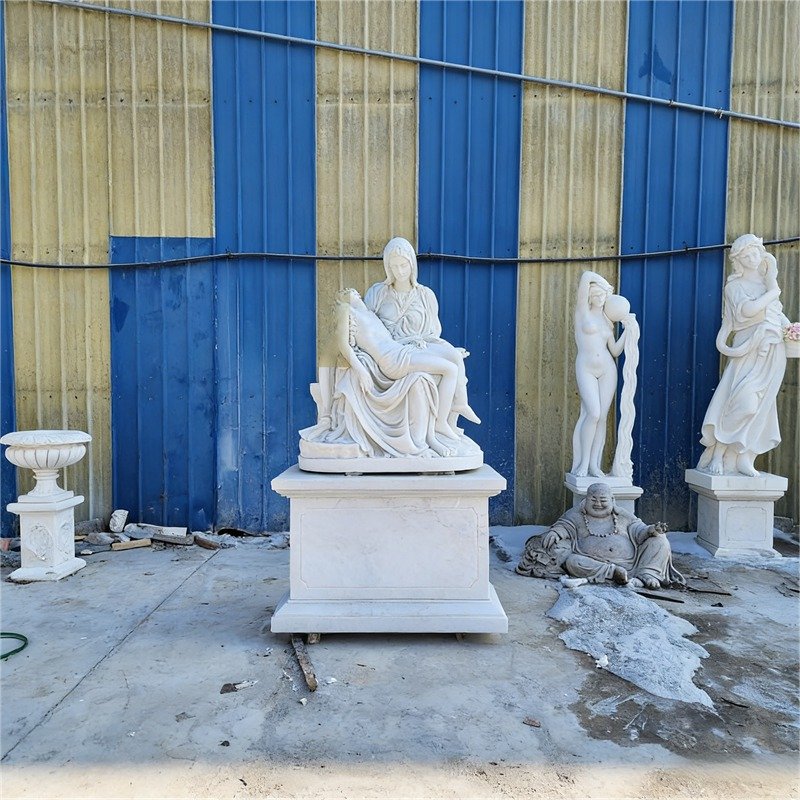
Later, when I shared my thoughts with Mattia, he agreed immediately. For him, Michelangelo’s Pieta was not only a Catholic image. It was also a symbol of compassion, purity, and the dignity of grief. That was exactly why he wanted it in his courtyard.
When I later stood in his garden and saw sunlight fall across the face of Mary in the sculpture we had produced, I understood something very clearly: a well-made Michelangelo’s Pieta replica can bring sacred art into modern life in a deeply personal way.
Final Thoughts
Michelangelo’s Pieta is famous because it unites two extraordinary achievements: a profound expression of holiness, purity, and maternal compassion, and a level of marble carving mastery that still feels almost impossible.
That is why the sculpture has remained relevant for more than hundreds years. It is not only a masterpiece of Renaissance art, but also a timeless image of love, grief, and peace.
And that is also why Michelangelo’s Pieta replicas continue to be chosen for churches, memorials, prayer gardens, cemeteries, and private courtyards today. People are not simply choosing a famous sculpture. They are choosing a work that brings emotional depth, spiritual meaning, and artistic dignity into a space.
If you are looking for a custom Michelangelo’s Pieta statue, a marble religious sculpture, or a meaningful centerpiece for a church, memorial, or courtyard project, a well-crafted Michelangelo’s Pieta remains one of the most powerful choices you can make.
FAQ
How did Michelangelo’s Pietà differ from earlier Northern European Vesperbilder sculptures?
Northern Vesperbilder: Mary stands stiff and upright, sharp angular lines highlight raw, intense sorrow.
Michelangelo’s work: Soft pyramidal composition with natural, graceful figures. Mary has a youthful, serene face full of quiet dignity. Smooth drapery replaces harsh shapes, blending gentle humanity and spiritual transcendence instead of dramatic agony.
What are the differences between Bandini Pietà, Rondanini Pietà and the Vatican Pietà?
Vatican Pietà: Early polished masterpiece with balanced classical forms and restrained beauty.
Bandini Pietà: Made in his 70s for his own tomb. Rough, unfinished surfaces with strong emotional tension. Michelangelo smashed it out of frustration and abandoned the piece.
Rondanini Pietà: His final work created in his 80s. Elongated, nearly abstract figures with a vertical ghost-like layout. Rough chisel marks remain, prioritizing the essence of grief over perfect craftsmanship.
Are there other Pietà sculptures by Michelangelo?
Yes, two more versions: Bandini (Florence) Pietà, now in Museo dell’Opera del Duomo, Florence. Rondanini Pietà, collected in Castello Sforzesco, Milan.
How is the Vatican Pietà protected nowadays?
After the 1972 vandalism attack, it is enclosed behind custom bulletproof glass to avoid accidental or intentional damage.
How was the Pietà restored after the 1972 attack?
The restoration took 9 months. Conservators reattached over 50 broken marble fragments. For missing tiny details, they used a mixture of marble dust and adhesive to reconstruct the Virgin’s features seamlessly to restore its original look.
What happened in the 1972 vandalism and what damage was done?
On Pentecost, a visitor attacked the sculpture with a hammer. Mary’s left arm shattered, fingers broke, and her nose and eyelids were severely ruined. The church held a mourning procession that night. Experts decided to fully restore it rather than keep the scars.