Every marble vein, warm bronze glow and soft hand-painted hue of an Our Lady of Perpetual Help statue whispers an ancient, tender sacred story.
Its true origin stretches back to a precious 14th–15th century wooden tempera icon forged by masters of the Cretan School, now enshrined within Rome’s Sant’Alfonso Church—an icon soaked in miracles, quiet maternal mercy and the quiet foreboding of Christ’s redeeming sacrifice. This is never merely stone or metal ornament; every carved curve, sacred colour, calculated geometric frame and gentle gesture weaves together profound divine truth, wrapped in tangible human warmth.
In this blog, I will guide you step into its sacred language, explore the tender artistry behind these devotional sculptures, clearly distinguish it from the Hodegetria Guide Virgin and the Virgin of Passion), and share gentle practical guidance for you to find a statue that stirs your heart and deepens your private prayer.
Who Is Our Lady of Perpetual Help?
She is not a separate figure from Mary the Mother of Jesus, but a specific, beloved face of her — one shaped by five centuries of devotion, miracles, and quiet endurance. The title “Perpetual Help” was born from an Eastern icon of the Virgin of the Passion lineage: a Mary who already senses the suffering awaiting her Son, and who, rather than turning inward in grief, turns outward — toward you, toward every soul who kneels before her seeking comfort.
This is what makes her different from a purely regal or purely mournful Madonna. She stands at the meeting point between foreknowledge and mercy, between sorrow not yet arrived and help that is already, endlessly, being offered.
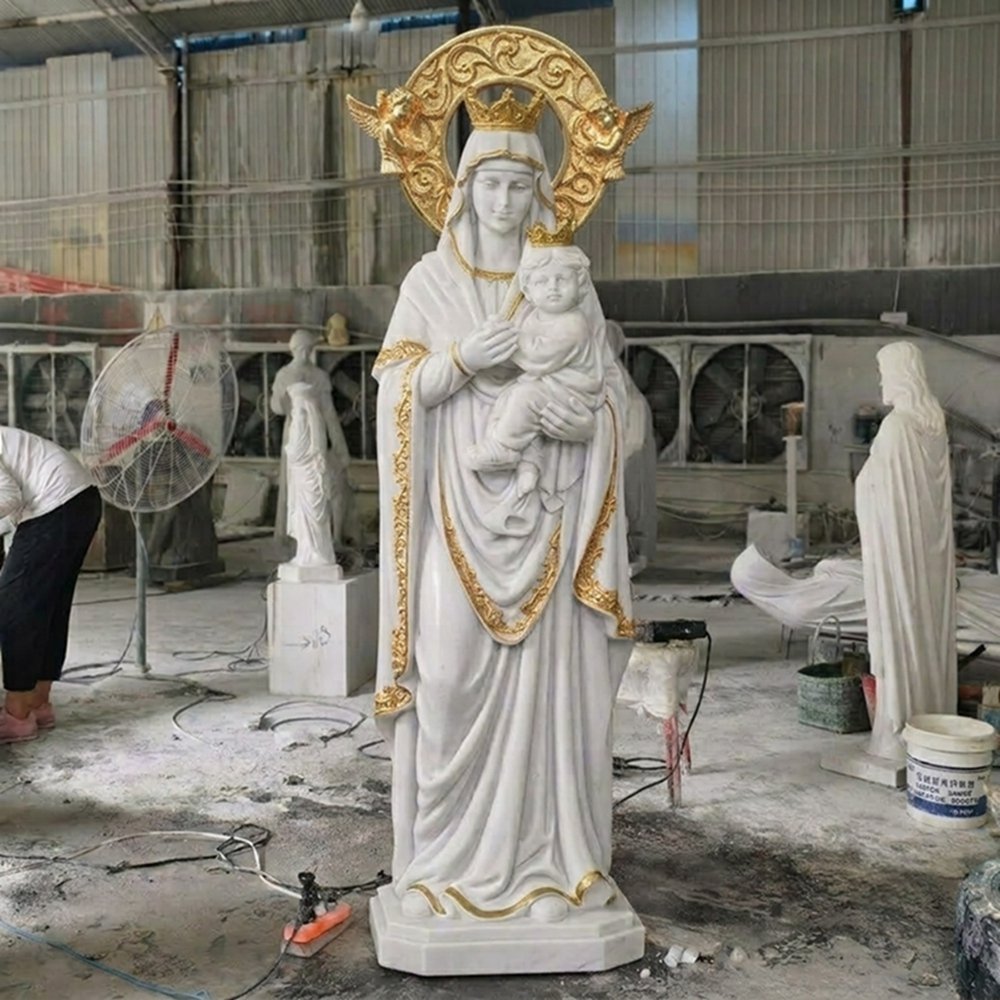
What Is the Original Image of the Our Lady of Perpetual Help Statue?
Every statue you encounter today — whether carved in cool marble or cast in warm, weathered bronze — is, in truth, a translation. Before it was ever a statue, it was a small painted panel.
The original sacred piece is not a statue at all — it is a modest wooden board painting measuring just 54 × 41.5 cm, created by masters of the Cretan School, most closely associated with the artist Andrea Rizo of Candia, working in the late 1300s or early 1400s.
As the icon became renowned for countless miracles, church leaders in 1867 fitted golden crowns and gemstones over the heads of Mary and the Christ Child, as a tribute to its sanctity.
Between 1990 and 1994, Professor Maurizio de Luca led a team of Vatican conservators through a complete scientific restoration of the fragile painting. Carbon dating on the wood confirmed the board was crafted between 1325 and 1480. The team carefully removed the later gold crowns and jewels, and for the first time in over a century, the public could see the original delicate stippled textures of the halos and the fine, aged brushstrokes long hidden beneath the ornamentation.
By studying the paint layers beneath, experts also discovered that the icon had been retouched many times across the centuries — Western painting techniques gradually blending into its original Byzantine-Cretan roots, like two rivers slowly joining into one.
All the statues and copies you see today — carved marble, weatherproof bronze, lightweight resin alike — follow the exact composition, symbolic colour scheme, and gentle poses drawn from this tiny medieval wooden icon. Had this fragile artwork not survived centuries of obscurity, war, and restoration, none of the Our Lady of Perpetual Help figures we now display in homes and churches would exist at all.
What Do the Symbols in the Our Lady of Perpetual Help Statue Mean?
I like to divide the whole statue into three visual parts: the Virgin Mary, the Child Jesus, and the two Archangels. Each carries its own language of colour, gesture, and geometry — and together, they form a complete theological story frozen in a single, quiet moment.
The Virgin Mary
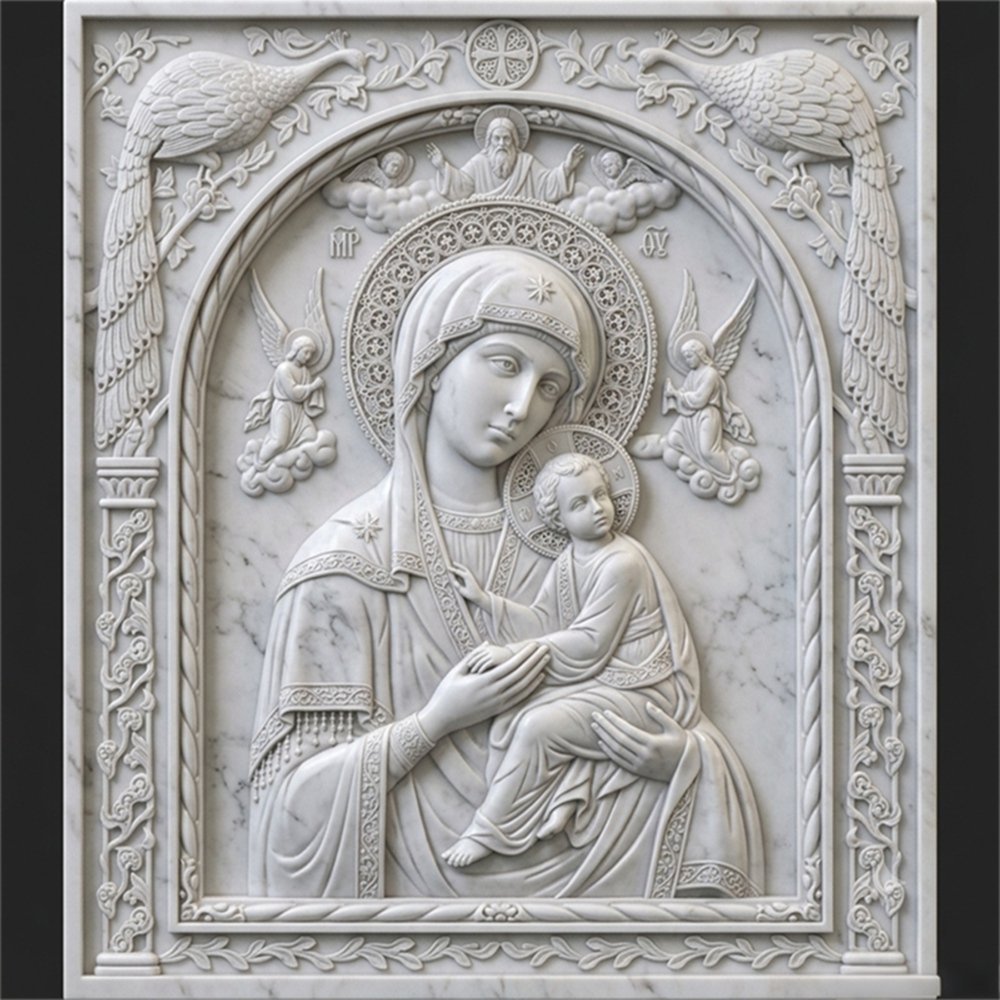
Mary stands upright and serene. She cradles the Christ Child steadily in her left arm, her right palm resting gently over His small hands. Her head tilts faintly toward the infant, yet her soft eyes look calmly outward — toward anyone standing before the statue. Flowing, layered robes fall in natural, gentle folds around her figure, conveying quiet maternal warmth alongside noble holiness. Above her head, an ornate circular halo — sometimes carved with two small angels — pairs with a delicate crown, completing her dignified yet approachable bearing.
- Red inner tunic — Red signifies Mary’s genuine human nature: her earthly life as a flesh-and-blood mother, and her pure virginity. In ancient icon tradition, this warm shade was reserved for holy virgins.
- Deep dark blue mantle (maphorion) — This heavy blue outer cloak marks her singular calling from God. It symbolizes heavenly grace, her sinless soul, and her royal dignity as Mother of God — while also carrying the quiet weight of every human sorrow she shares with us.
- Eight-pointed golden star on her forehead — This star earns her the beloved title Star of the Sea. Just as a star once guided lost sailors safely home, Mary leads every struggling believer toward Christ, the true harbour of salvation.
- Her tender gaze — Mary’s eyes never rest only on her Son. She looks straight out at anyone praying before her. This is a profoundly human touch: she does not remain wrapped in private grief over Jesus’ coming suffering. Instead, she reaches outward — toward you. Her calm solemnity, softened by compassion, gently rejects the cold, distant royal portraiture of older art. This warm, relatable design lets every soul feel truly seen.
The Child Jesus
He wears a soft green tunic, a scarlet waist sash, and a warm reddish-brown outer cloak.
- Both small hands clutch Mary’s thumb — This single gesture holds two feelings at once: fear of the cross ahead, and full trust in His Mother’s protection.
- One sandal slips loose off His foot as He twists away from the vision of suffering. This small detail reveals Jesus’ complete humanity — He feels fear and pain just as we do. Some scholars also connect it to the Book of Ruth, where a discarded sandal signifies the passing on of an inheritance; here, it suggests Jesus willingly accepting the mission of our redemption as His sacred birthright.
- The 45-degree twist — His whole body turns roughly forty-five degrees away from Mary’s chest, His gaze lifting toward the symbols of suffering held above Him. This pose reveals that, even as a small child, He already foresees the agony of Calvary, feeling authentic human fear and sorrow. He clings tightly to Mary’s thumb out of helplessness, seeking shelter in his Mother beneath the shadow of the cross.
This tilted posture is what fully reveals Christ’s true humanity. He is not a distant, untouchable divine figure without emotion — He feels dread just as ordinary people do. This lets every believer connect their own anxiety, pain, and fear to Jesus’ childhood distress, making Mary’s role as perpetual comforter feel immediate and real, rather than abstract. His line of sight points directly toward the instruments of the Passion, quietly preaching that salvation comes through the cross — and that Mary is the refuge who accompanies us through every hardship along the way.
The Two Archangels
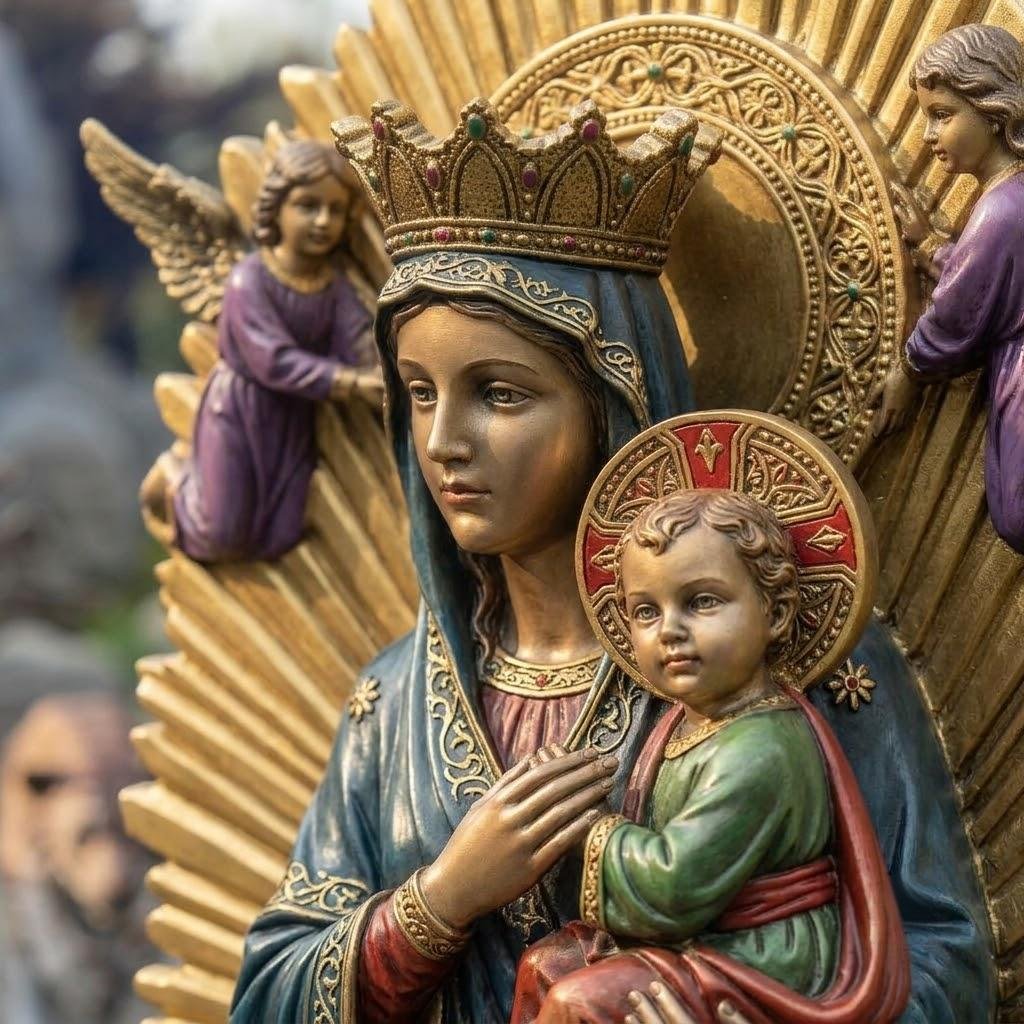
In the upper corners float two archangels — Michael and Gabriel — each holding the sacred instruments of Christ’s crucifixion.
- Archangel Michael (viewer’s left) carries a sharp spear, a reed stick, and a sponge soaked in bitter vinegar — the instruments used to torture Jesus on the cross. His hands are covered with soft veil cloths, a sign of deep reverence before the mystery of redemption.
- Archangel Gabriel (viewer’s right) holds the three-bar cross and the four iron nails that pinned Christ to Calvary’s wood. These are not symbols of pain alone, but trophies of Christ’s victory over sin and death.
The angels do not come to threaten the Child. They reveal His future suffering while quietly testifying that the cross leads toward resurrection glory — and it is precisely their presence that explains why the Christ Child twists away from Mary in the first place: He sees these instruments and feels human fear, clinging tightly to His Mother for shelter.
Golden Greek letters above each angel’s head mark their holy names, a classic hallmark of Cretan Byzantine icon painting. And behind them all, the golden background stands for heaven itself — quiet proof that suffering will, in the end, be overcome by eternal glory.
The Sacred Palette: How Colour Speaks
If you are seeking a hand-painted statue faithful to the original iconology, here is how each colour carries meaning — guidance worth bringing to any artisan or workshop you commission.
The Virgin Mary’s Colours
| Colour | Meaning |
|---|---|
| Burgundy inner tunic | Represents the Precious Blood of Christ, sacrifice, and redemption — Mary, clad in red, fully shares in her Son’s suffering and partners in the work of salvation |
| Dark indigo/navy mantle (maphorion) | The sacred colour of heaven, eternity, and sinlessness — representing her Immaculate Conception and lifelong stainless soul |
| Pale sky-blue veil | Signifies the purity of her soul and gentle heavenly warmth, softening the heaviness of the dark mantle above |
| Gold lines, golden stars & plain halo | Gold symbolizes uncreated heavenly radiance. The eight-pointed star recalls the prophets’ foretelling of Mary; the central cross-shaped star recalls the Star of Bethlehem. Her halo bears no cross — distinguishing her abundant holiness from Christ’s divine nature |
| Warm beige skin tone | Genuine human flesh — Mary shares fully in our human nature, and so deeply understands every pain we carry |
The Christ Child’s Colours
| Colour | Meaning |
|---|---|
| Emerald green inner tunic | Life, creation, and resurrection — Christ as the source of eternal life who conquers death |
| Reddish-brown mantle + scarlet sash | Scarlet foreshadows the blood He will shed at Calvary, even in childhood; the red sash symbolizes wholeness and royal authority |
| Gilded sandals & golden drape outlines | Gold reveals His eternal divine nature; the loose sandal prefigures His feet nailed to the cross, and His crushing of sin underfoot |
| Crossed golden halo + red Greek letters IC XC | Only Christ bears a halo marked with a cross, declaring Him Son of God — the suffering and risen Saviour |
| Fair, rosy skin | Signifies childhood innocence and absolute sinlessness |
The Two Archangels’ Robes
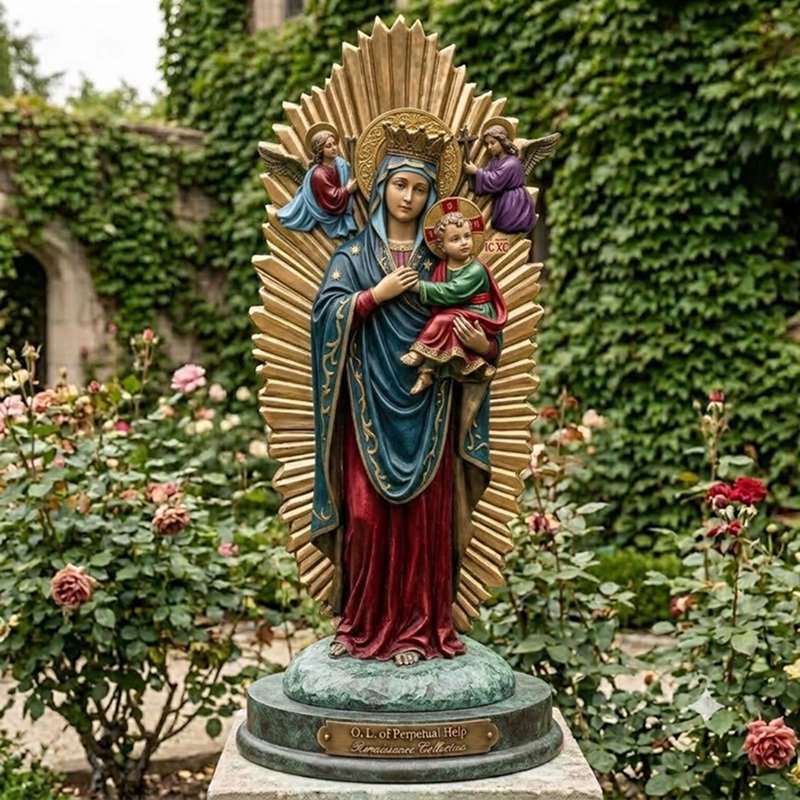
Archangel Gabriel (viewer’s right, holding cross & nails): a violet cloak unites suffering and heavenly triumph — the cross as both instrument of torture and throne of victory. His hands, veiled in white, show holy reverence before what he dares not touch directly.
Archangel Michael (viewer’s left, holding spear & vinegar sponge): a bright red inner robe evokes Christ’s shed blood; a light blue outer mantle brings comfort amid suffering, prefiguring the eternal heaven that follows the Passion.
Shared features: flame-patterned green-gold wings — green for resurrection life, gold for divine light — showing the angels as spirits of burning love, sent to present the tokens of Christ’s saving Passion. Their halos remain small and simple, a quiet reminder that as created beings, their glory is real, but far lesser than that of Mary and her Son.
Three Layers of Marian Tradition: A Gentle, Clear Distinction
Many devotees easily confuse the Hodegetria (Guide Virgin), the broader Virgin of the Passion tradition, and the specific Our Lady of Perpetual Help icon — yet these three sit in a careful relationship of origin, category, and singular fulfillment, each holding its own spiritual weight and sculptural geometry.
Hodegetria — The Guide Virgin
Origins & Core Geometry: The oldest foundational Marian archetype in Byzantine art, dating to the 5th century — the ancestral template upon which every later Marian icon, including the Passion type, would eventually be built. Its composition forms a steady, triangular geometry centred on Mary and the Christ Child.
Unique Traits & Spiritual Tone: Mary holds Jesus on her left arm, her right hand extended in a clear guiding gesture toward her Son. Her title — “She Who Shows the Way” — reveals her singular role: leading every soul to Christ, the only path to salvation. The Infant sits upright, calm and unafraid, His gaze fixed forward toward onlookers, with no outward tilt of head or body. No archangels or Passion instruments appear anywhere in the frame. The mood carries quiet, regal grandeur — focused solely on divine guidance, without any premonition of coming suffering.
Key Divide from the Passion Tradition: Hodegetria is a portrait of calm certainty. It offers no foreshadowing of the cross at all — Mary simply points, and the Child simply blesses. This stillness is precisely what later Cretan-Venetian painters would break open, introducing motion, fear, and foreknowledge into the same basic frame.
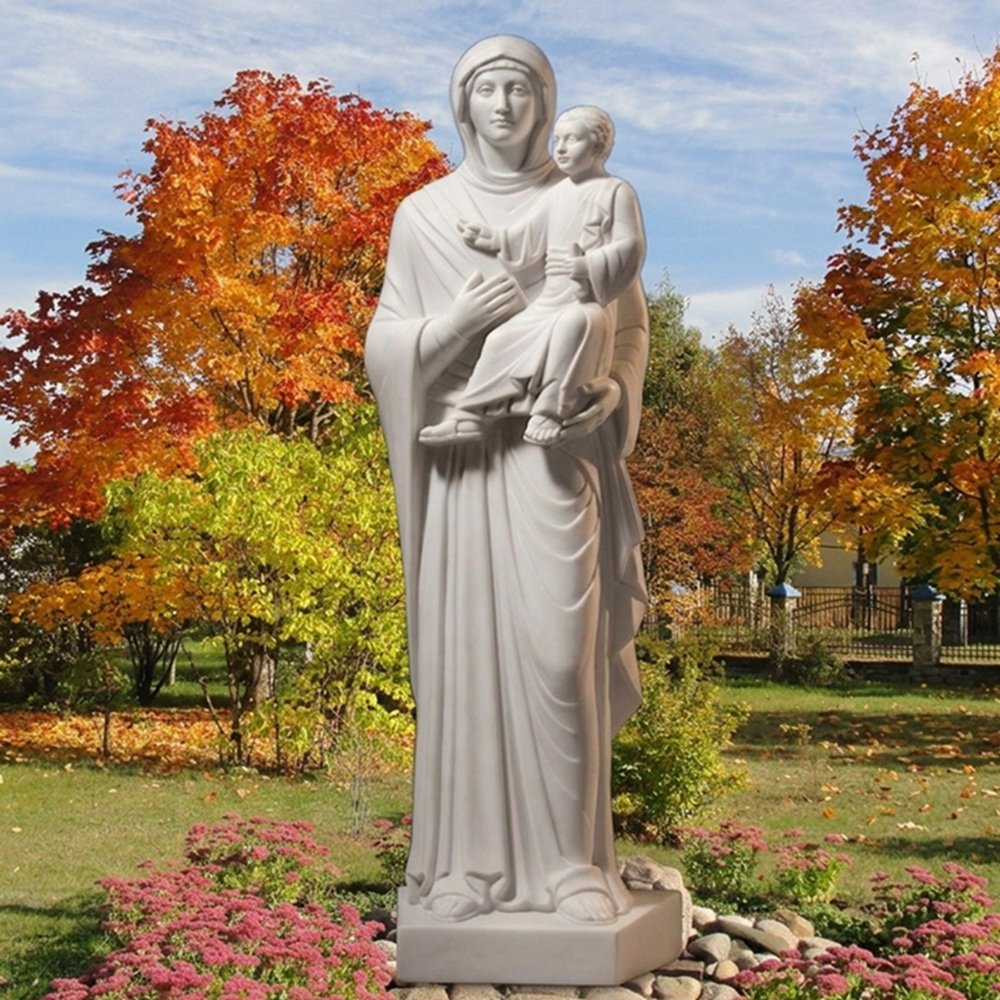
Virgin of the Passion — The Broader Tradition
Origins & Core Geometry: Not a single icon, but an entire iconographic theme that emerged from early frescoes in Cyprus around 1192, then flourished across Cretan-Venetian workshops through the 13th to 15th centuries. Its structure borrows the Hodegetria’s balanced vertical axis but adds two new focal points in the upper corners, reserved for angels bearing instruments of Christ’s Passion.
Unique Traits & Spiritual Tone: Because this is a category rather than one fixed image, many independent icons were painted under this theme across different churches and centuries — each artist choosing slightly different angel placements, instruments, and degrees of the Child’s recoil. What unites them all is the same emotional core: a Mother holding a Child who senses, however faintly, the suffering awaiting Him. This type marks a profound shift — away from purely symbolic Byzantine stillness, toward a more emotionally expressive, almost proto-Renaissance tenderness.
Key Divide from Our Lady of Perpetual Help:
Every Perpetual Help icon belongs to the Virgin of the Passion family — but not every Virgin of the Passion icon is the Perpetual Help icon.
Countless versions of this theme were painted across Crete and Venice; most faded into obscurity, their names and specific stories lost to history.
What makes the Our Lady of Perpetual Help icon extraordinary is that it survives as one specific, singular panel — the very one stolen by a Cretan merchant, hidden for decades in a Roman chapel, rediscovered by a young altar server, and finally elevated by Pope Pius IX into the most venerated example the entire tradition has ever produced.
Our Lady of Perpetual Help
Origins & Core Geometry:
The one specific, historically documented icon that stands as the most famous surviving realization of the Virgin of the Passion theme — a Cretan-Venetian panel from the 14th–15th centuries, structured on balanced vertical and horizontal sacred axes, forming a near-perfect square composition.
Unique Defining Marks:
- Two archangels occupy the upper corners: St. Gabriel bears the three-bar cross and crucifixion nails; St. Michael holds the lance and vinegar sponge — rendered with the exact proportions and Greek inscriptions unique to this particular panel
- The Infant Jesus twists forty-five degrees away from Mary’s breast, alarmed by the vision of His sacrifice, clutching her thumb for shelter and comfort
- One sandal slips loose from His foot, a subtle symbol of His mortal frailty and the sacrifice awaiting Him
- Mary’s soft gaze rests upon anyone who prays before her, embodying her endless readiness to intercede — to rush to our aid in every moment of trial
Core Spiritual Heart:
She unites two graces at once — the Hodegetria’s gift of guiding us to Christ, and the Passion tradition’s honest acknowledgment of coming sorrow.
But unlike any generic Guide Virgin or any of the many now-forgotten Passion icons once scattered across Crete and Venice, this sacred image is a singular survivor — one specific panel with one specific history, elevated by one specific Pope’s command to be “made known throughout the world.”
That unrepeatable history is precisely why she reveals Mary not as an abstract archetype, but as our ever-present mother — standing beside us in our present fear, just as she once sheltered her own Son when He foresaw the agony of Calvary.
Gentle Guidance to Choose a Heart-Stirring Statue
If you long for a marble or bronze Perpetual Help statue that fits your prayer space and nourishes your soul, here is some soft, heartfelt guidance.
Prioritise fidelity to the original Cretan icon’s proportions and symbolic details.
Avoid overly stylised modern sculptures that alter the Child’s forty-five-degree posture, erase the archangels, or distort Mary’s eight-pointed star. These small sacred details carry the icon’s full theological weight — only a faithful reproduction lets its original quiet spiritual power fill your prayer corner.
Choose materials aligned with your devotional space.
- For indoor chapels, bedrooms, gardens, prayer corners, and outdoor spaces in mild climates: polychrome painted marble embodies purity, sacredness, and gentle humanity — a soft presence suited for intimate daily prayer. Alternatively, if you prefer minimalist, ascetic peace, plain white marble will envelop your space in quiet holiness instead.
- For outdoor shrines, church gardens, or courtyard grottos in wet environments or near seasides: choose patinated bronze — weather-resistant and ageless, withstanding wind, rain, and sun.
Select colour tones matching your spiritual temperament.
- For warm, tender intimacy in personal novenas: choose muted, soft polychrome paintwork, with restrained gilding that avoids harsh brightness.
- For solemn, contemplative worship at church altars: lean into deep, rich indigo and scarlet colouring, with distinct golden halo detailing to amplify heavenly transcendence.
Match the scale to your quiet prayer rhythm. Small desktop miniatures (up to 1 ft) bring Our Lady’s gentle presence to your bedside or workspace, perfect for daily personal prayer. Medium table statues (1-3 ft) grace family home altars, fostering shared devotion among loved ones. Large, life-sized marble or bronze pieces (5-6.5 ft) serve as magnificent parish shrine focal points, inviting entire congregations to pause, reflect, and pour out their hearts in communion.
Prioritise delicate, soft facial carving. The soul of this statue lies in Mary’s compassionate eyes and the Child’s vulnerable, tender expression. Steer clear of harsh, stiff facial sculpting — smooth, gentle contours capture the motherly mercy that has made this icon beloved by millions of praying souls across centuries.
Closing Reflection
Carved in enduring marble or cast in timeless bronze, each Our Lady of Perpetual Help statue is far more than art. It is a silent, tangible embrace from our heavenly Mother — where divine majesty meets human frailty, where foretold sorrow meets unending mercy.
The original Cretan icon survived centuries of obscurity before being enshrined in Rome, crowned by the Vatican, and reproduced across every continent by the Redemptorist fathers. Today, these stone and bronze replicas carry that same ancient miracle and gentle promise into every quiet prayer space.
When you kneel before this statue, you do not merely behold a distant heavenly queen. You see a mother who once held a Son trembling at the shadow of the cross — and who will always reach out to hold you too, through every grief, fear, and weariness, offering perpetual, boundless help.