There is a particular kind of silence that falls over someone the moment they decide to bring a St. Joseph statue into their sacred space– a pause before the question, “But which one?” I feel that pause every time a new inquiry lands in my inbox, beccause behind every request for a statue or relief is not just a size or a budget, but a small act of faith reaching toward form.
Recently, a parish coordinator from Freeport, Illinois wrote to us.
She wanted a white marble St. Joseph statue, six feet tall, cradling the Christ Child, resting upon a matching pedestal– a gift she hoped to place, quietly and permanently, inside her home church as an offering of gratitude.
Over the following weeks, as we exchanged photographs and measurements back and forth, I found myself struck by something larger than her request alone: how many souls come to us seeking a St. Joseph statue or relief, each carrying the same hushed devotion, yet shaped by such different needs.
A 90 cm St. Joseph statue destined for a family altar. A 36-inch statue meant to stand watch over a school garden. A six-foot marble statue for a cathedral entrance. And always, quietly beneath the surface, the same unspoken question– bronze or stone, freestanding statue or wall relief, large enough to be seen from the road or small enough to be touched in private prayer.
This guide gathers everything years of walking alongside churches, schools, and individual believers ahev taught us about choosing the right St. Joseph statue or relief– not as a sales page, but as a companion for the discernment ahead of you. Let us begin where every sacred commission should begin: understanding what kind of ST. Joseph statue actually speaks to your purpose.
What Themes Do St. Joseph Statues Come In?
St. Joseph is among the most tenderly honored figures in Catholic devotion, and it is not difficult to understand why.
He is patron of the universal Church, of workers, of fathers, of the dying who seek a peaceful passing.
Yet a St. Joseph statue is never a single fixed design.
Depending on which moment of his quiet, faithful life is being honored, the statue– or relief– carries a different weight of meaning, a different silent sermon.
Drawing from centuries of religious iconography, and from what the faithful most often ask us to carve today, St. Joseph statues tend to gather into four principal themes, befoer we turn to a fifth format worth considering: the relief.
St. Joseph as The Worker
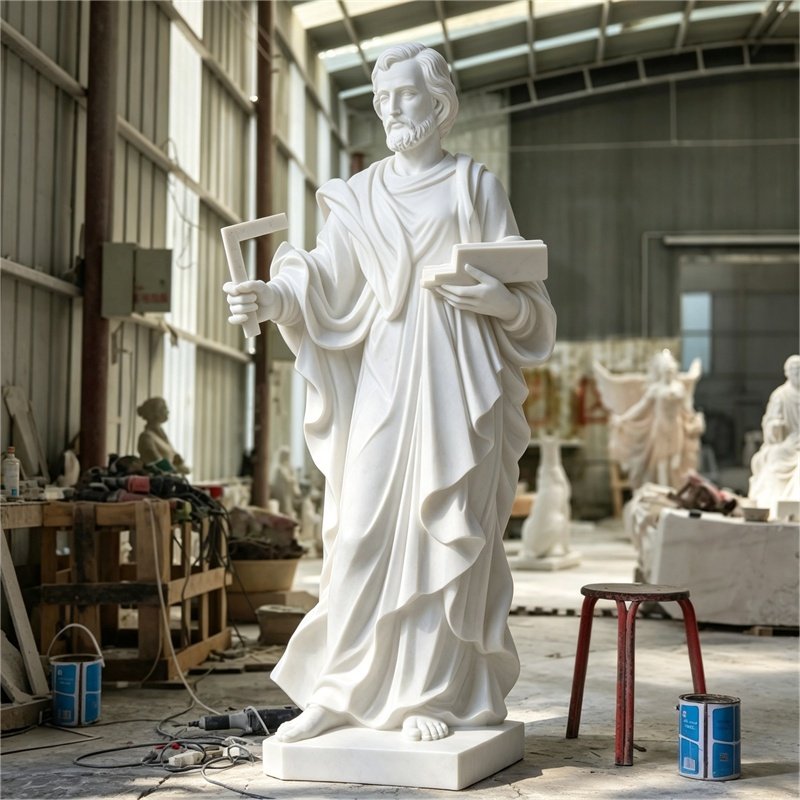
Here Joseph stands as a carpenter– a set square resting in his hand, a saw at his side, sometimes simply beside a humble workbench.
Within our factory, this theme has grown gentle new branches: a bronze St. Joseph statue cradling a basket of bread, a marble St. Joseph statue holding a scripture.
Each variation whispers the smae truth– that holiness is not reserved for the extraordinary. IT lives in labor offered up in prayer, in faith carried quietly through ordinary hours.
This is Joseph not as a distant saint upon a pedestal, but as a man whose calloused hands built shelter for the Holy Family– and who therefore understands the weight of every hand that labors still.
Fittingly, this style of statue finds its home near workshops, trade schools, and parishes wishing to bless the working faithful.
St. Joseph Holding Infant Jesus
This is, without question, the statue most souls ask us to carve– adn rightly so. Joseph here is caught in a moment of tenderness, gazing down at the Child in his arms, a lily often resting in his free hand as a symbol of his purity and unwavering fidelity.
One family recently asked for this exact statue at 150 cm, a size that settles beautifully into both an indoor sanctuary and a sheltered outdoor niche.
There is something quietly overwhelming about this particular statue– it speaks not of distant sainthood, but of guardianship, of a father’s arms made strong enough to hold the weight of Heaven.
It is no surprise that so many choose this design to honor fatherhood, memory, or the guardianship of there own families.
St. Joseph as the Patron of the Church Statue
In this form, Joseph rises into something omre solemn and monumental– standing with quiet authority, sometimes bearing a model of a church building, or a staff crowned with a lily, marking his role as protector of the universal Church.
These statues tend to reach greater heights– 170 to 210 cm is common– and are most often chosen to stand at church entrances or within grand sanctuary settings, where a statue of this scale alone seems to bless all who pass beneath it.
St. Joseph Holy Family
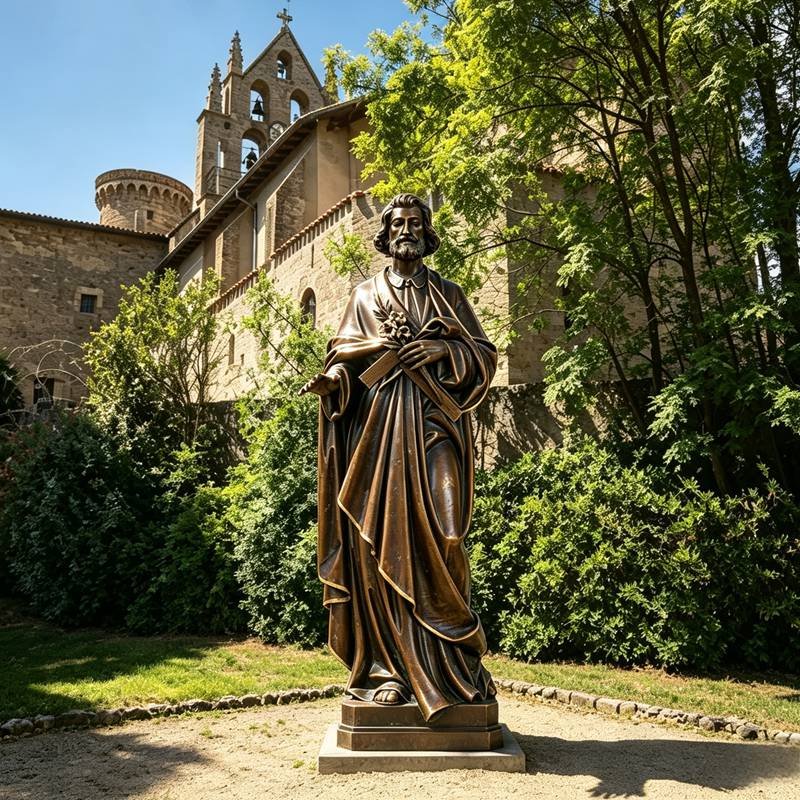
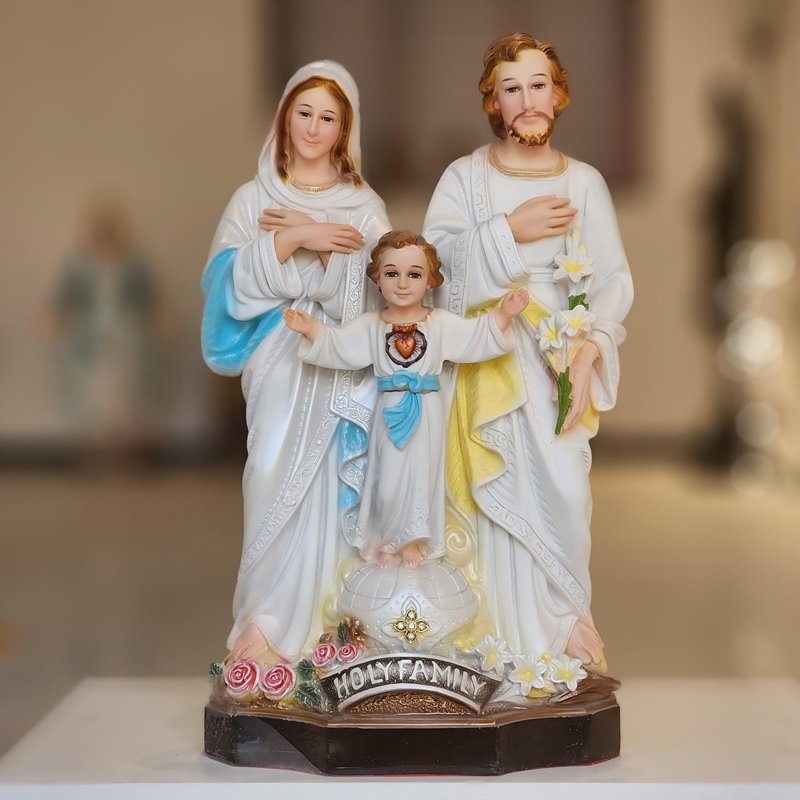
Here Joseph does not stand alone within the statue, but beside Mary and the Christ Child, forming the whole sacred household in a single grouping.
We have recently been entrusted with several such commissions– an 80 cm white marble Holy Family statue bound for a church in Guatemala City, and another, five to six feet in height, meant for a private home.
This is the statue chosen by those who wish to honor not one figure but the entirety of the sacred family– often becoming the quiet centerpiece of a memorial garden or a side altar where a family’s own story is folded gently into a larger, holier one.
A Fifth Format Worth Considering: The St. Joseph Relief
Beyond these four freestanding statue themes lies another format entirely– the bas-relief.
Rather than a statue standing in the round, a relief is carved to emerge gently from a flat panel of marble or stone, as though rising from the wall itself to meet your gaze. Joseph, here, holds the Christ Child in shallow, graceful depth against a quiet background– no longer a freestanding statue, but a sacred image pressed into stone.
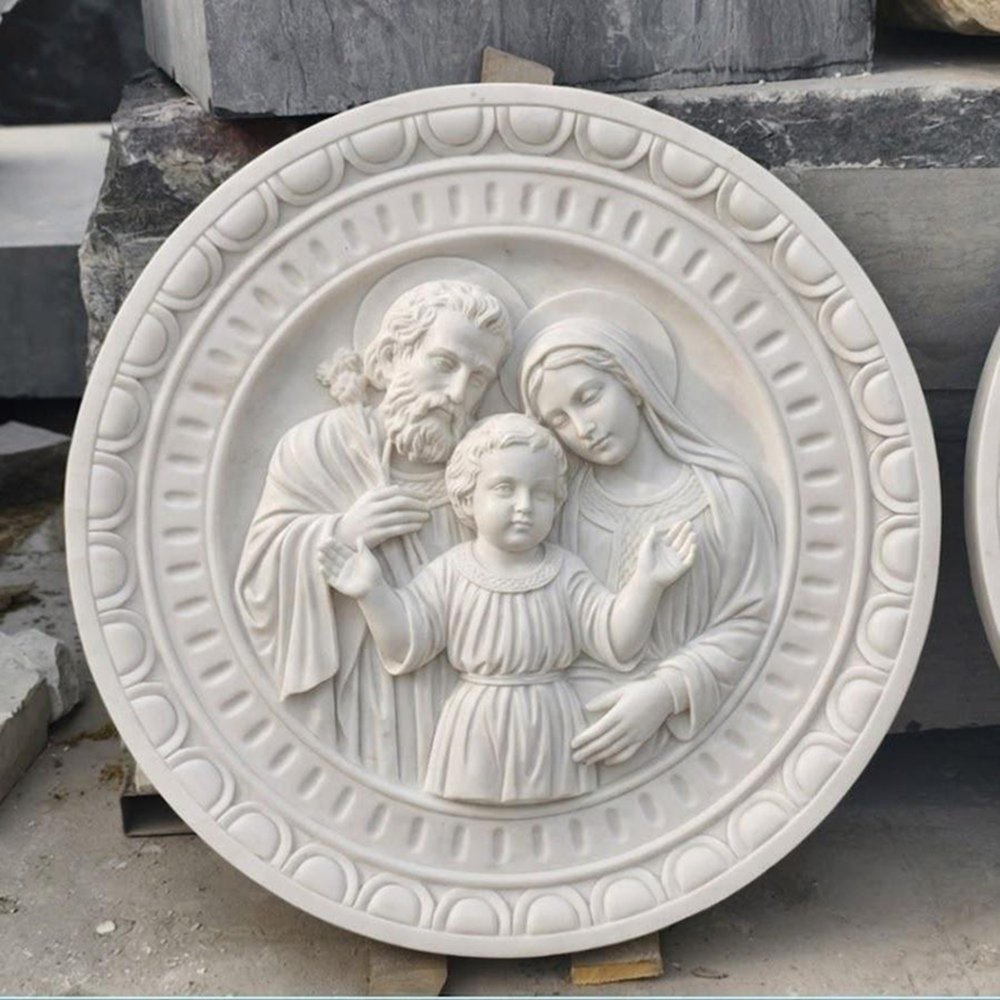
We have carved this very relief for souls who wanted Joseph fixed flush against a wall, or set gently into a niche– an offering rather than a monument. A relief becomes the right choice, over a statue, when:
- Space is limited, and a projecting statue would not rest comfortably within it
- You envision the piece mounted flush against an interior wall or an exterior facade
- You are drawn to something more understated and architectural than a statue– often found gracing cloister walkways, chapel walls, or memorial plaques
- Stewardship of resources matters to you– a relief generally asks for less stone and fewer carving hours than a statue of the same height
If you find yourself uncertain between a statue and a relief, ask only this: will this piece be walked around and beheld from every side, as a statue is meant to be, or is it meant to live quietly against a wall, watching over a single space, as a relief does? That question, more often than not, answers itself.
What Should Guide You in Choosing a St. Joseph Statue or Relief?
Once you know whether a statue or a relief speaks to your purpose, the remaining decisions are practical– but even these, I have come to believe, deserve to be approached with care rather than haste. These are the considerations that surface again and again in the hundreds of conversations we hold each month with churches, schools, and individual believers seeking a St. Joseph statue or relief.
The Purpose Behind Your Statue or Relief
This is always our first question, because everything else– size, material, budget, even how long the journey to your door will take– flows from the answer.
Many who write to us know only that they wish to bring a St. Joseph statue or relief into their space, but remain uncertain of what form or scale would truly belong there. This section exists to walk beside you through taht uncertainity.
For those offering a gift– Many of our clients are individual parishioners donating a statue in memory of someone loved, or as a gift laid quietly at their parish’s feet.
These commissions often carry real emotional weight (we once helped a mother commission a statue in memory of her daughter, Christa, working gently within a modest $1,000 budget).
Such offerings deserve unhurried conversation and careful attention to symbolism above all esle.
For personal, quiet devotion– Smaller statues, twelve to thirty-six inches, destined for home altars, prayer corners, or a family garden.
Here, the faithful care more about intimacy of detail than grandness of scale.
For collections, public or private– Some collectors and galleries seek museum-quality marble or bronze statues where artistic mastery matters as much as devotion itself.
For monumental undertakings– Churches, cathedrals, and Catholic schools commissioning life-size or greater statues– six feet and beyond– for entrances, gardens, or sanctuaries.
These undertakings call for real structural thought: pedestal design, secure anchoring, and at times a companion statue meant to mirror one already standing at the opposite end of a sanctuary.
The Cost of a St. Joseph Statue or Relief
Cost rests on three pillars: size, material, and the depth of detail asked for. As a general compass:
Bronze ones, life-size, typically range from $2,650 to $8,300+.
A smaller 120– 130 cm bronze statue, well-suited to a garden or chapel, generally falls between $2,650–$ 3,850.
A 170 cm statue meant for a church entrance runs closer to $4,100–$ 5,300.
A larger 183 cm statue, fit for a sanctuary or memorial hall, typically reaches $4,700–$ 6,200– while monumental bronze statues of 180– 200+ cm, meant to mark a landmark, can rise to $5,900–$ 8,300 or beyond.
Marble onses vary more widely with size and and the grade of stone chosen.
A smaller 90 cm statue suited to a home altar or small chapel typically costs $900–$ 1,500. A mid-size 160 cm statue for a church entrance runs $1,400–$ 2,500.
Larger 180 cm sanctuary-scale statues range $2,500–$ 3,800, and monumental 210 cm commemorative statues often fall between $4,300–$ 6,700.
Guangxi White Grade A– a premium, vein-free stone especially prized for facial serenity– will typically command a price above these baseline figures.
We also supply Carrara marble from our factory, but pricing requires an individual quotation.
Relief panels, by comparison, generally cost less than a freestanding statue of equivalent height, since they require less raw stone andd fewer carving hours– a meaningful consideration if budget or wall space, rather than open floor space, defines your project.
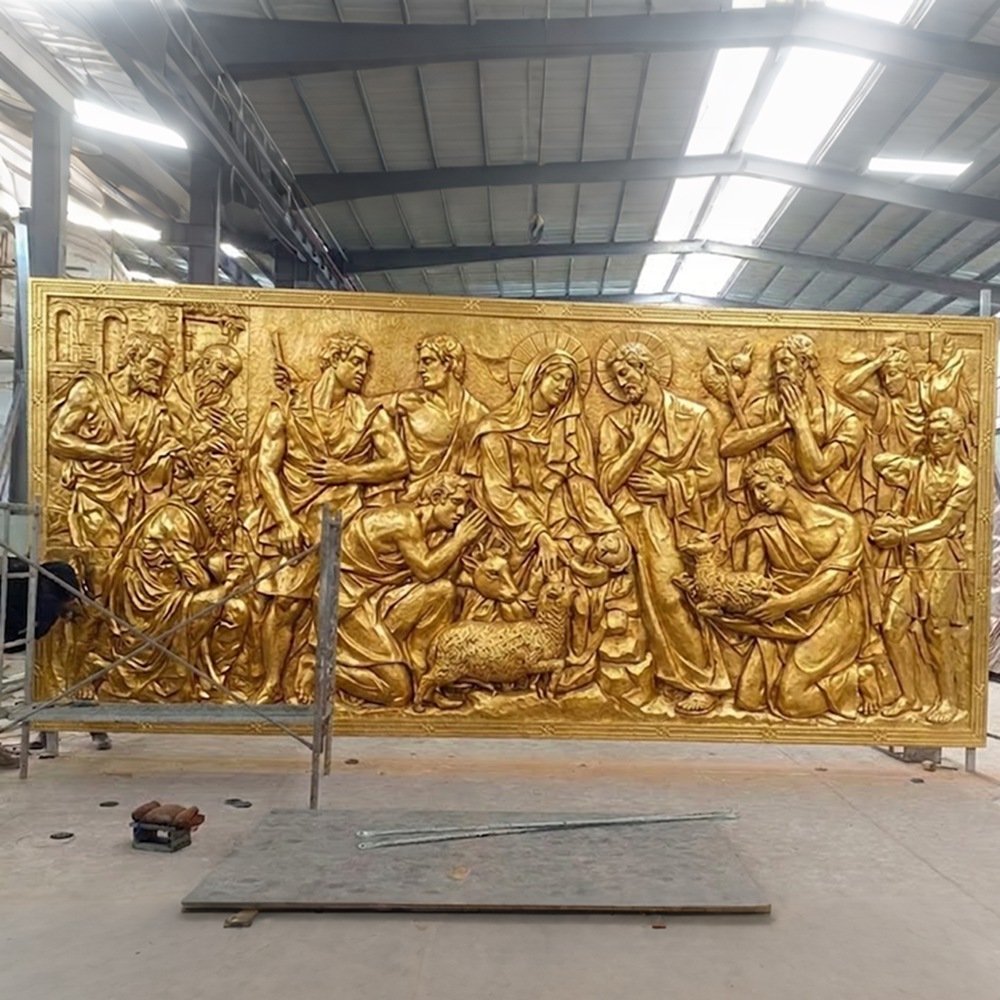
Custom commissions— whether statue or relief– particularly those requiring a clay model for approval before carving begins, carry additional cost. But this extra step exists solely to ensure the finished piece matches the vision you carried into htis journey.
Always ask for a complete breakdown: base price, pedestal if your statue requires one, packaging, and– this matters greatly– shipping. One wise inquirer once asked us for a total DDP (Delivered Duty Paid) price, bundling shipping and every associated fee, so no surprise would greet the statue at delivery.
And if your resources are modest, do not hesitate to ask about fiberglass– a faithful likeness of marble at a fraction of its weight and cost, which we have gently recommended to those building memorial gardens on limited means.
Where Your Statue or Relief Will Stand
The place a statue or relief is meant to inhabit shapes its ideal proportions, drawn from what we have seen chosen again and again:
- Church entrances and outdoor gardens– a 3– 4 foot statue is the common standard, though many parishes choose full life-size (5– 6 feet) or monumental scale (7 feet and beyond) to let the statue’s presence be felt from a distance.
- School gardens and courtyards– a 30– 36 inch statue is most frequently requested, substantial enough to anchor the space without overwhelming it.
- Indoor side altars and niches– a 60– 90 cm statue, or a modestly sized relief, settles naturally into architectural recesses.
- Home altars and and private devotion– a 12– 20 inch statue suits the intimacy of most family settings.
- Interior walls and facades– this is where a relief, rather than a statue, most often belongs, sized to the wall or archway it is meant to inhabit.
Measure your intended location carefully– the clearance for a statue’s base or pedestal, the wall space a relief will occupy, and the distance from which it will be beheld– before the size is finally chosen.
Marble or Bronze– Which Statue Speaks to Your Setting
This question arrives in nearly every conversation, and each material carries its own quiet strength, whether shaping a statue or a relief.
Marble offers a timeless, luminous grace– tjhe traditional choice for a Catholic statue.
Every piece from our factory is carved from natural marble, never composite stone dust pressed into form, which is part of why our pricing reflects real, enduring stone rather than a lesser substitute.
What’s more,some who commission a statue ask for a painted finish– St. Joseph is most often rendered in gentle greens and warm browns, though any color your heart or setting calls for can be arranged.
Hand-carved and never machine-replicated, a marble statue carries weight, permanence, and a classical beauty suited to both sheltered sanctuaries and covered outdoor settings.
Bronze, by contrast, endures where weather is unkind– resistant to storm, salt air, and relentless sun, and often the wiser choice for a statue placed in gardens, seaside chapels, or public spaces touched by every season. Bronze also allows for a living patina that deepens with age like a quiet blessing settling over time; golden tones are most commonly chosen, though the patina, too, can be shaped to your own vision.
If uncertainty remains, let your climate decide: a marble statue flourishes under cover or in gentler air, while a bronze statue stands unshaken through rain, snow, and years of open sky.
The Craftsmanship Behind Your Statue or Relief
This is the moment a block of stone becomes something closer to sacred art than to decoration– and the standard by which craftsmanship is judged shifts slightly depending on whether you are commissioning a freestanding statue or a relief.
For a freestanding statue, look closely at:
- The face– is there warmth in Joseph’s gaze, a stillness that feels almost like being seen in return?
- Vein-free stone in visible areas, especially the face, so nothing distracts from serenity
- Hand-carving versus machine-cutting– a hand-finished polish carries a human warmth no machine can replicate
- The fall adn fold of the robes– fabric that seems to move, even in stillness, is the clearest signature of a sculptor’s true skill
For a relief, the measure of mastery shifts, since the piece is met from one side rather than walked around:
- Depth of carving– a gifted hand does not merely trace an outline into the panel, but builds genuine volume, so that face, hands, and robe rise with real presence rather than lying flat
- Visibility from afar– because true depth is carved rather than merely suggested, Joseph’s expression and the texture of his robe remain legible even when the relief is raised high on a facade or viewed from across a courtyard
- The meeting of edge and background– where the raised figure parts cleanly from the flat stone behind it, revealing a sculptor who understands both the chisel and the composition
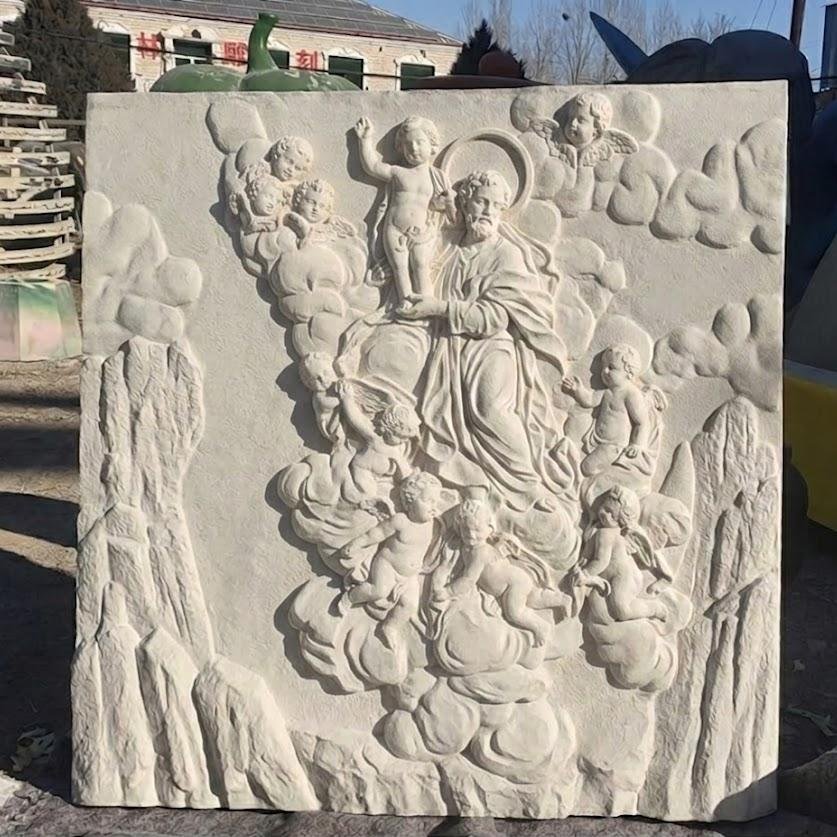
Whichever you choose, statue or relief, if the undertaking is significant– a monumental statue or a large relief panel– always ask whether the workshop willk offer a clay model for your approval before the marble is touched. This step asks for patience, but it spares you the far greater cost of a finished statue or relief tyhat does not yet feel like home.
A Closing Word
Choosing a St. Joseph statue or relief is never merely a purchase. It is an act of memory, of gratitude, of hope laid quietly into stone or bronze. Whether you are honoring a parent who has gone before you, completing a garden meant to tell the story of Scripture, or simply giving your parish a quiet corner in whlch to kneel, take the time to let theme, size, material, and craftsmanship align with what your heart is truly asking for. Do this, and whatever finally takes shape– a statue standing free, or a relief rising gently from a wall, in marble or in bronze– will remain long after you, a lasting presence of faith for every generation still to come.