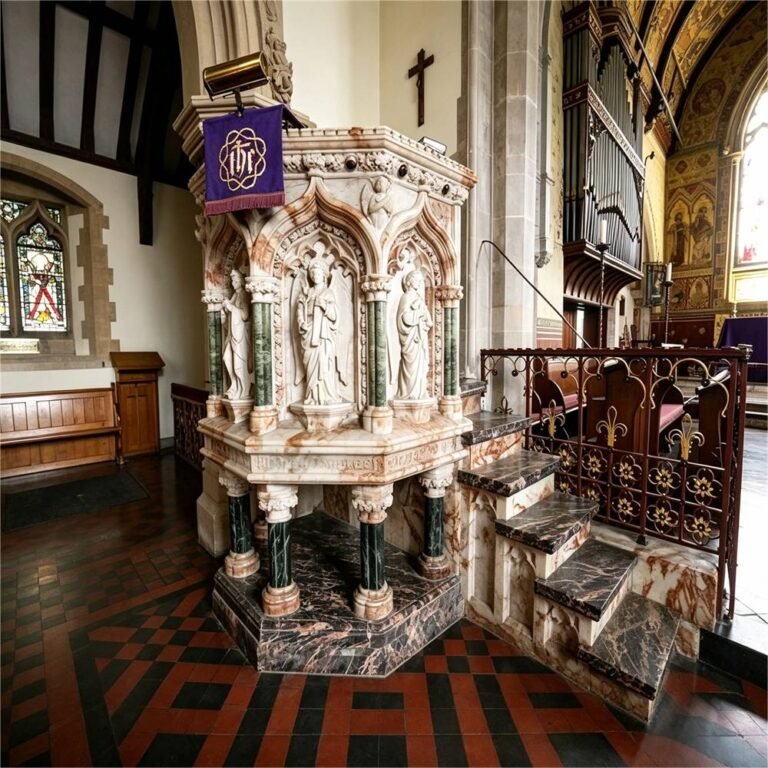
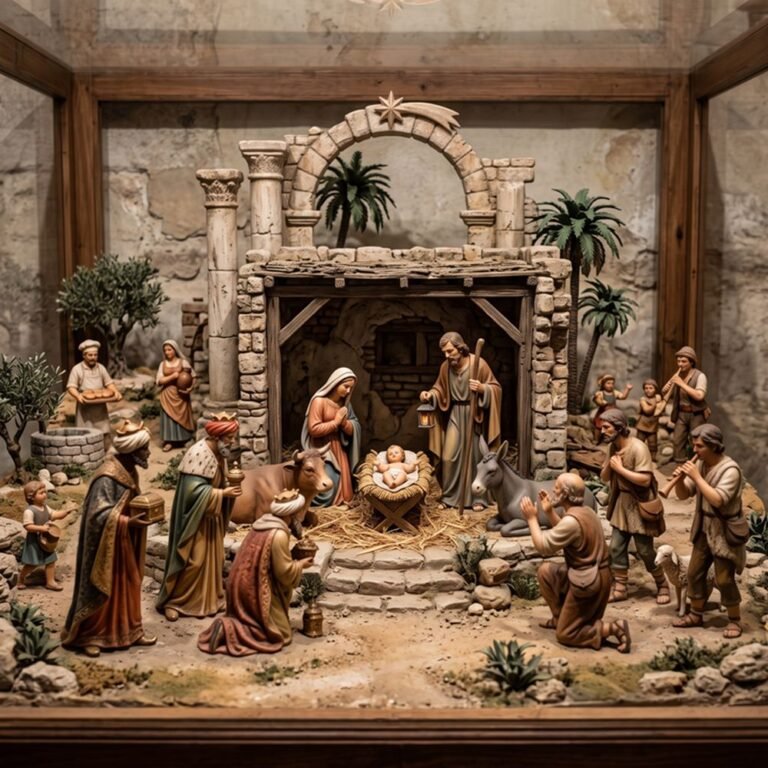
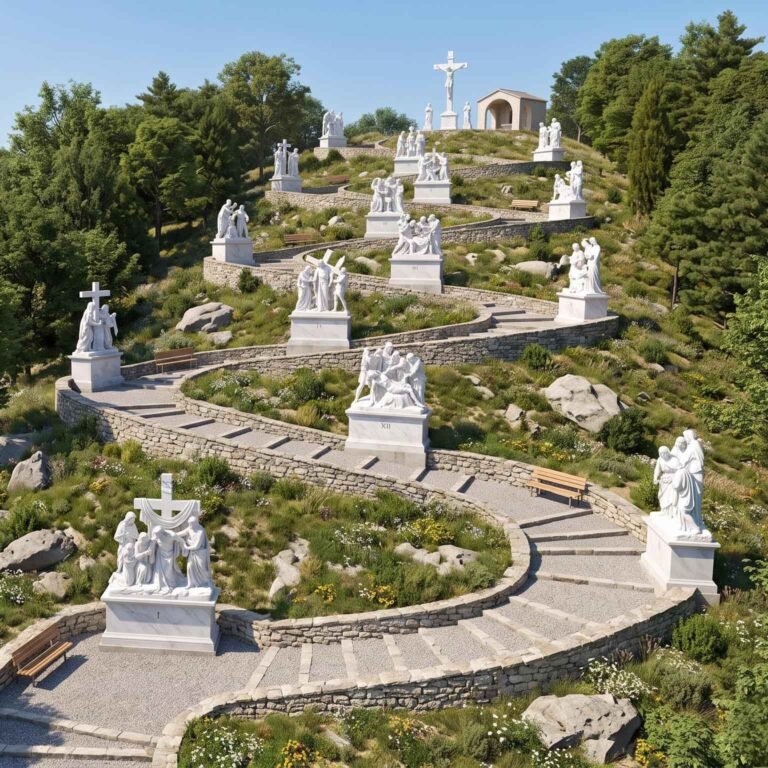
I serve as a religious sculpture consultant for YouFine Religious Art Factory. My days unfold within the workshop, where I stand beside master craftsmen as they carve marble and pour bronze into sacred forms.
For many years, I have touched, studied, and watched these sacred symbols take shape before my eyes, and through this long communion with them, I have grasped a profound truth:
The divide between a cross and a crucifix on religious art sculpture is never merely a matter of image. It is a divide rooted in the sacred meaning of divine revelation, two distinct vessels bearing separate layers of the Gospel’s eternal truth.
The cross is an abstract holy sign. It declares Christ’s victory over sin and death without the tangible image of His suffering flesh.
The crucifix is a unique sacred carrier exclusive to Christ’s redemptive crucifixion. This term was born solely for Jesus’ unparalleled saving death, an event unlike any mortal execution. Carved in marble, bronze or wood, it presents the Redeemer’s flesh nailed to timber, revealing the real agony of His atonement before praying souls.
What Does a Cross Sculpture Represent?
The unadorned cross— no carved figure of Christ nailed to its beams– stands as the oldest universal Christian sacred sign.
A cross sculpture does not fix our gaze on the hour of Christ’s agony.
It proclaims the eternal fruit that bloomed after Golgotha’s darkness: resurrection, triumph over sin and the grave.
As an abstract sacred icon, it veils the weight of suffering to reveal the Father’s glorious victory. Its vertical beam stretches unbroken from earth to heaven, binding finite humanity to the boundless divine Son.
Its horizontal arm extends wide to embrace all people, embodying Christ’s boundless agape that unites every soul as one family in Him.
This two-beam emblem carries the ancient vision Constantine witnessed before battle: In hoc signo vinces— By this sign you shall conquer.
The cross belongs equally to resurrection and crucifixion.
It bears witness to the empty tomb, declaring death was never the end of Christ’s story, merely the turning point of mankind’s redemption.
This is why it crowns church spires, marks consecrated sacred ground, adorns royal crowns and national banners.
It is a living declaration: this building, this soul, this congregation belongs to the Risen King who trampled death underfoot.
To this day, the cross remains the shared banner of global Protestantism.
You will find it standing alone in Baptist, Presbyterian and nearly all evangelical sanctuaries.
It does not call us to linger over pain; it invites us to meditate on the unshakable victory of our risen Lord.
What Does a Crucifix Sculpture Represent?
The crucifix is fundamentally distinct from an empty cross, for it confronts viewers with a truth the blank cross lets us overlook: the raw, unvarnished agony Christ endured on Calvary’s timber.
The early Church did not create or venerate crucifixes.
It was a brutal Roman execution instrument, a mark of public disgrace, so Christ’s followers naturally avoided openly displaying it.
Catacomb believers relied on subtle, hidden emblems that escaped Roman persecution: the ichthys fish monogram, chi-rho cipher, and anchor of hope. The empty cross entered devotional art much later; the crucifix– a cross bearing the carved body of Christ– emerged generations after that.
The earliest surviving crucifixion artworks depict a Christ untouched by torment.
Sixth-century frescoes in Rome’s San Clemente Basilica portray Him standing upright on a footrest, arms stretched wide with a calm, serene face and draped in a long seamless robe.
No nails pierce His palms, no spear wound gapes open in His side, and no crown of thorns presses into His brow.
He resembles a reigning monarch receiving pilgrims, not a condemned criminal facing execution.

And from this frescoes, we can know that the early Church prioritized Christ’s royal triumph over the torment of His passion.
Artistic details of suffering were gradually added over centuries, creating diverse sculptural forms of the crucifix we see today.
Some crucifix sculptures feature Christ standing upright on a supporting footrest, bound to the cross with ropes, with separate feet pierced by four distinct iron nails.
Another mainstream design, the most widely adopted form for modern crucifix statues, shows His crossed feet secured by a single nail, leaving three nail marks in total.
Details including a full beard, the spear gash in His ribcage, and the thorny crown were gradually introduced in the 13th and 14th centuries.
Some sculptures crown Christ with a royal diadem, while others surround His head with a luminous golden halo, referencing the Latin inscription Pilate ordered to be nailed above the cross: INRI, short for Iesus Nazarenus, Rex Iudaeorum– Jesus of Nazareth, King of the Jews.
In ancient script, the letters I and J were interchangeable, and R stands for “Rex” (King).
Nearly all modern crucifix sculptures bear this four-letter plaque. Some artists replace INRI with the monogram IHS, derived from Iesus Hominum Salvator, meaning “Jesus, Saviour of Mankind.”
A uniquely striking antique crucifix is preserved inside Venice’s historic Patriarchal Basilica: Christ is fully wrapped in a long flowing robe, with a dark-toned facial carving that delivers an intense, haunting visual impact.
Furthormore, some crucifix sculptures feature a carved skull and crossed bones at the base of the timber, bearing two layers of sacred symbolism: Christ’s victory over death, and how His sacrifice crushed the power of mortality for all humanity.
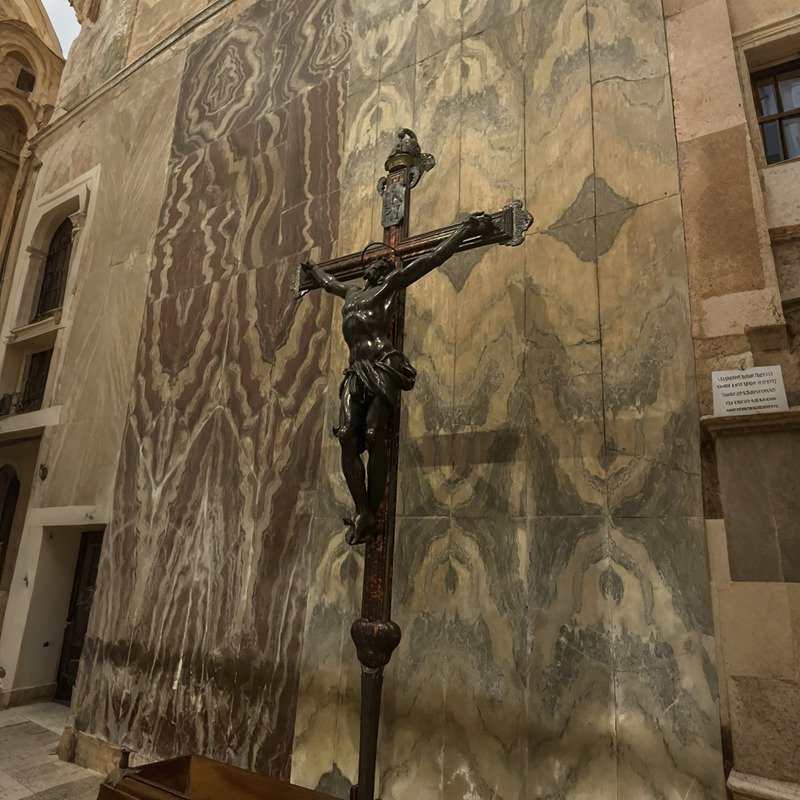
An empty cross invites us to contemplate salvation in broad, abstract terms: the victory of divine grace, the promise of resurrection, the grand arc of human redemption.
A crucifix rejects this distant, generalized reflection. It places a tangible, suffering human form before our eyes, frozen at one specific, agonizing historical moment, and whispers a quiet, unshakable truth: this was the cost of your salvation. Iron nails pierce fragile palms; thorns sink deep into sacred flesh; the full weight of the Savior’s body drags against fixed timber, enduring hours of unrelenting torment.
This is the core of what theologians name the theologia crucis— contrasted against the theology of glory.
The theology of glory draws hearts toward resurrection joy, heavenly triumph, and unbroken light. The theology of the cross compels us to linger at Golgotha a little longer.
Suffering itself is never the gospel’s central message, yet Christ’s suffering is utterly real.
A faith that rushes past Calvary to celebrate Easter without pause will never fully grasp the mercy it rejoices in.
Crucifixes stand as the central liturgical treasure of Roman Catholic worship, a tradition born of profound sacred logic.
Every Catholic center altar must display a crucifix; every Catholic church, hospital, school, and domestic prayer altar features one.
Words alone often fail to convey the weight of atonement, yet a crucifix bridges this gap: it turns abstract theological doctrine into tangible, personal truth, laying the full cost of redemption directly before every soul who receives Christ’s saving grace.
A crucifix never exists in isolation from the resurrection.
Every authentic crucifix points forward to the empty tomb, for the humiliation of Calvary is eternally vindicated by Christ’s rising.
Yet it demands believers walk through the grief of Good Friday before reaching the joy of Easter morning. It will not let us skip past suffering to grasp glory.
What’ the difference meaning between cross and crucifix on religious sculpture?
To improve readability, I have organized the content in a table for a clearer explanation of this topic.
Symbolic Difference Between Cross Sculpture & Crucifix Sculpture (Catholic Standard).
| Comparison Dimension | Plain Empty Cross (No Christ Figure) | Crucifix (Carved with Suffering Christ) |
|---|---|---|
| Basic Definition | Abstract vertical & horizontal beams, no human carving; may be decorated with vines/stars, no figurative imagery | Cross bearing full carved Christ’s crucified body; matched with supporting symbols: crown of thorns, spear wound, skull & Adam’s bones, chalice. |
| Core Theological Meaning | Full redemption in abstract form: Christ’s triumph over death, covering crucifixion, resurrection, ascension and Second Coming. Vertical beam = Heaven-earth communion; horizontal beam = fraternal unity of all people |
Narrative-focused atonement: visualizes Christ’s pain and substitutionary sacrifice on Calvary. Skull at base = Adam, Christ’s sacrifice erases original sin; highlights divine mercy and intercession. |
| Spiritual Metaphor for Believers | Taking up one’s cross: lifelong self-denial, enduring hardships to follow Christ; focuses on lifelong devotion and final glory | Meditation on Christ’s Passion: stirs repentance, humility and gratitude; guides believers to reflect deeply on the price of mankind’s sin. |
| Core Liturgical Usage Scenarios | Church spires, domes, cemetery monuments (symbol of church & Christ’s universal sovereignty). Bishop crozier tops, royal crown ornaments. Abstract hand gesture: Sign of the Cross. Stained glass, church textile decorations. Distant outdoor landmark monuments |
Mandatory central altar ornament for all Catholic churches (core of Mass liturgy). Giant processional sculpture for pilgrimages & Stations of the Cross. Small pendants/ desktop statues for daily personal prayer. Hollow reliquary to store saint relics. Held by sick & dying believers for comfort. |
| Folk Traditional Symbolism | Represents peace, unity and eternity; erected on land boundaries to mark God’s protection of families, without heavy suffering connotation | Sacred talisman relying on Christ’s precious blood; folk tradition believes it wards off disease, disasters and evil spirits, full of sacrificial suffering imagery. |
| Applicable Devotional Occasions | Daily mass, public testimony, memorial ceremonies, public declaration of faith | Lent, Stations of the Cross, confession, visiting the terminally ill, deep introspective spiritual practice. |
| Core Feature Summary | Abstract, macroscopic, highlights resurrection and eternal victory; general universal symbol of Christian faith | Figurative, narrative, focuses on the pain of Calvary; exclusive core liturgical artifact unique to Catholic devotion. |
Extra Cross-Cultural Evolution Brief
Early Church (1– 5 AD): Plain cross only secret internal symbol due to Jewish ban on carved figures; crucifix appeared after the 5th century for illiterate laymen’s visual gospel teaching.
Medieval Catholicism (5– 15 AD): Both symbols combine theology and folk customs; crucifix became amulet and symbol of church dual authority.
16th Century Reformation: Protestants only retain plain cross, regard crucifix as idolatry; the two symbols become distinct identity markers of denominations.
Colonial Global Mission: Catholic crucifix is easy to be localized and fused with indigenous worship culture; Protestant plain cross remains abstract and hard for idol-worshipping tribes to accept.
Modern Secular Society: Plain cross is widely de-theologized as a universal memorial/medical symbol; crucifix is limited to Catholic circles or subculture art, easily offensive in strict monotheistic regions.
Cross vs. Crucifix: How to Choose for Your Space?
The choice between a cross and a crucifix is not primarily an aesthetic decision.
It is a theological one– and it should be made with the same seriousness that you would bring to any other decision about what you place in a sacred space. That said, once the theological question is settled, the practical questions of scale, material, and placement are real and worth thinking through carefully.
Consider the Room’s Purpose.
The purpose of the space should be the first question, because the cross and the crucifix serve different devotional functions– and placing the wrong one in a given context is not a minor error.
It is a mismatch between the object and the intention.
A cross belongs in spaces oriented toward proclamation, community, and celebration: the main sanctuary of a church where the congregation gathers for worship, the entrance hall of a school or institution, the top of a spire or a garden gate.
It announces. It declares. It is the symbol of the faith held in common, the sign under which a community gathers.
It is also the appropriate choice for any space that will be used by people of different Christian traditions– the cross is the one symbol that crosses denominational lines without carrying the specific theological freight of any single tradition.
A crucifix belongs in spaces oriented toward personal prayer, contemplation, and penitence: the home altar, the hospital chapel, the confessional, the bedside of the sick and dying.
It is an object for sustained individual encounter, not communal proclamation.
It is the symbol that the Catholic tradition places at the center of the altar precisely because the Mass is understood as a re-presentation of the sacrifice of Calvary– and the crucifix keeps that sacrifice visible throughout.
For a space where people come to pray privately, to examine their conscience, to sit with grief or fear or gratitude, the crucifix is the more demanding and more rewarding choice.
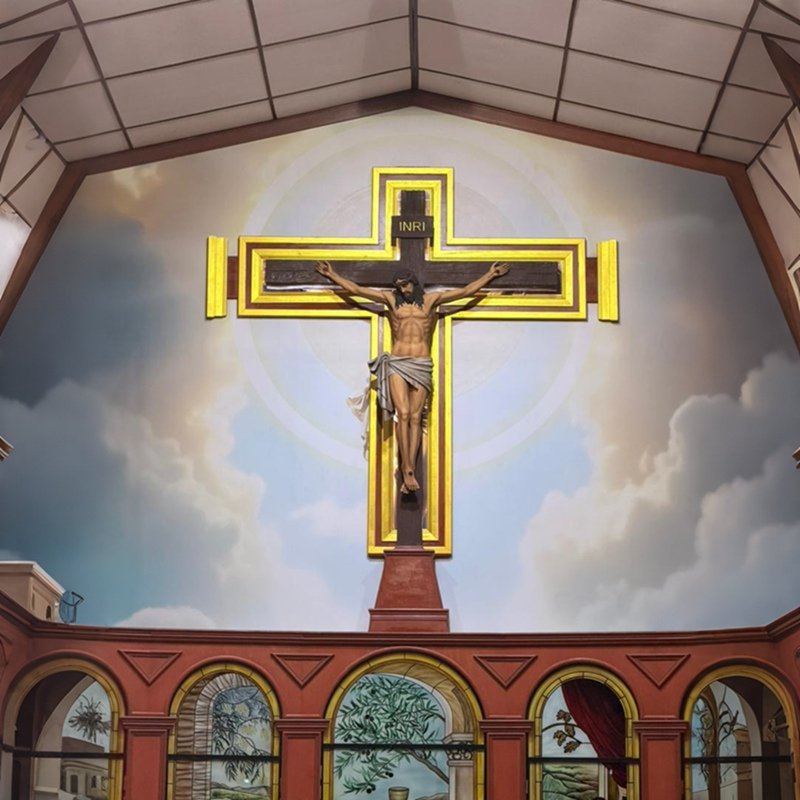
Scale and Proportions
Scale is rooted in spiritual function, not personal taste.
A sculpture too small to clearly reveal its sacred message from where believers stand or kneel fails its divine purpose– this truth holds doubly true for crucifixes, where every wound, every line of agony carries vital theological meaning.
- Home prayer corner/ domestic altar: 1– 2 ft tall. The minimum usable size is 1 ft, and the ideal full-detail specification is 1.6– 2 ft. Sized to let the praying eye rest upon Christ’s face and nail wounds at seated eye level, for unhurried intimate reflection.
- Church chapel wall niche: 2.6– 4 ft carved crucifix; free-standing altar sculptures can be made larger than 4 ft. The minimum legible dimension is 2.6 ft, and the balanced full-detail standard is 3.3– 4 ft. All sacred details must be legible from kneeling pews. A crucifix that reduces Christ’s suffering to faint decorative lines abandons its sacred calling.
- Garden shrine/ semi-outdoor devotional space: Enlarge scale to match viewing distance. Delicate carved facial features will blur when viewers are more than 33 ft away across open garden ground; viewing distance ≤ 10 ft requires crucifixes at least 2 ft tall; viewing distance between 10– 26 ft requires crucifixes no shorter than 4 ft; any installation viewed beyond 33 ft should adopt plain bronze or granite crosses instead of crucifixes. For large outdoor installations, an empty bronze or granite cross often carries greater spiritual impact, as its abstract silhouette cuts across wide landscapes far more clearly than figurative carvings.
- Monumental hilltop landmark calvary sites: The great global sacred mountain shrines use oversized plain crosses (minimum height 10 ft, standard monument height 16– 49 ft) as their primary landmark silhouette, while close-range viewing stations adopt 2.6– 5 ft crucifix sculptures, reserving detailed crucifix carvings for close-up pilgrim encounter.
Material and Aesthetic.
The stone, metal or timber we choose is never a surface detail– each material carries its own sacred testimony to the gospel truth carved within it.
Years spent alongside workshop craftsmen, carving marble and casting bronze, have taught me the same sacred design reborn in two mediums becomes two entirely distinct spiritual witnesses.
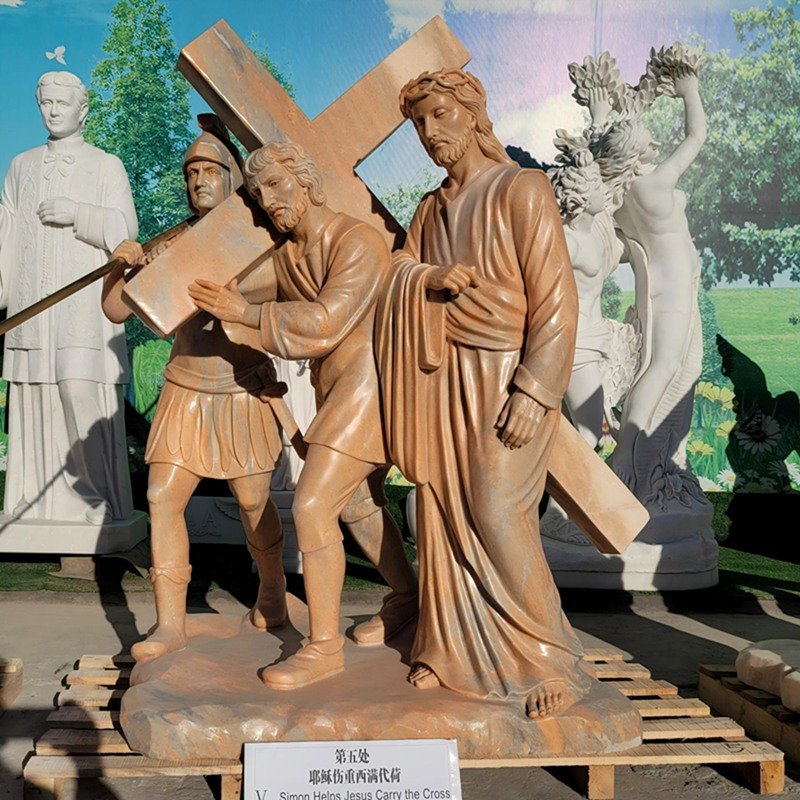
White Marble
The timeless choice for indoor devotional sacred sculpture. Its soft translucency glows gently beneath candlelight, mirroring the luminous holiness of sacred divine visions.
Its fine, tight grain captures every delicate carving detail: loincloth folds, the tender texture of thorn wounds, subtle streaks of sacred blood, with unmatched precision.
A marble crucifix is not a fleeting purchase; it is a sacred inheritance to bless generations for a hundred years and more.
Cast Bronze
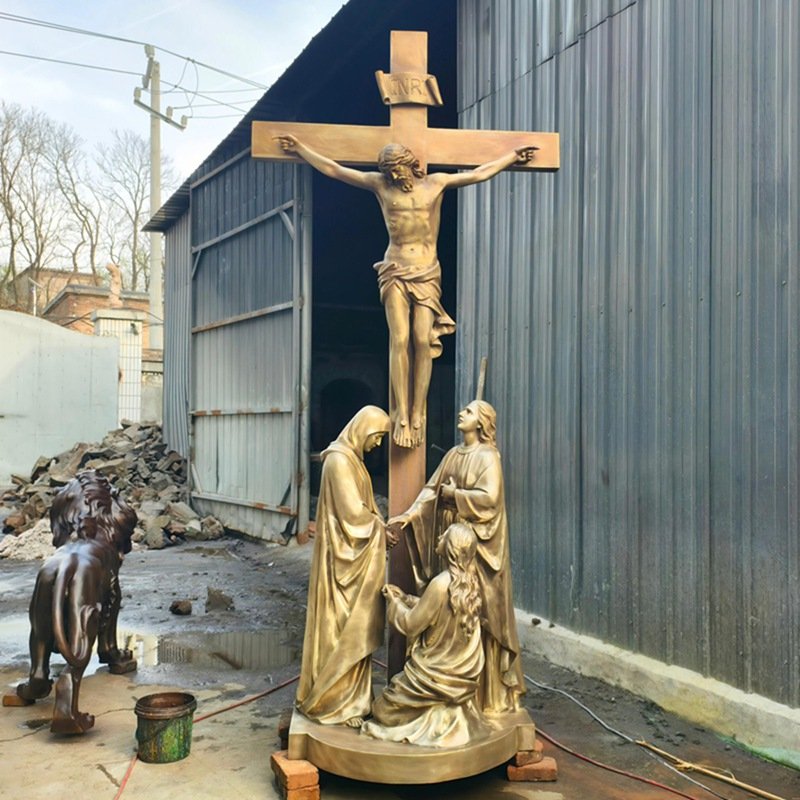
The medium of eternal outdoor witness.
As bronze weathers, it blooms into rich layered patina that deepens its solemn sacred presence instead of fading.
For garden shrines, cemetery memorials and all weather-exposed sacred installations, lost-wax cast bronze stands unchanging for fifty years, while lightweight resin will degrade quickly under wind and rain.
Indoor vs. Outdoor Sacred Placement
The divide between indoor and outdoor placement extends far beyond visual style– it touches structural durability, material selection and core theological witness.
Indoors
Stable temperature, sheltered from frost, UV rays and damp decay opens wide our material choices.
We may lean into delicate marble’s translucency or natural wood’s soft warmth, lit to draw out every subtle sacred carving detail. Indoor crucifixes are made for close, unrushed personal prayer, intimate face-to-face communion with the wounded Savior.
Outdoors
Sacred sculptures must endure every harsh twist of climate: freeze-thaw cycles, scorching sunlight, damp mold growth and seasonal frost.
For outdoor marble monuments, select ultra-dense stone, apply penetrating stone consolidant and weatherproof sealing compound, and set foundations beneath local frost lines– site climate demands are not afterthoughts, but foundational commission requirements from our very first workshop consultation.
For wide open outdoor grounds where fine figurative carving fades into distance, a solid bronze or granite plain cross often delivers stronger sacred witness.
Its bold abstract silhouette rises against sky and hillside to draw pilgrims’ eyes from far away, a truth all famous European and American hilltop calvary monuments embody: they function first as landmarks calling souls to draw near, second as devotional pieces, their power rooted in unmissable silhouette rather than tiny carved facial detail.
Final Thoughts
The cross and crucifix can never be swapped as interchangeable decor.
They are not minor variations of one sacred symbol– they are two distinct divine proclamations, two unique invitations to prayer, two separate spiritual calls laid before every soul who welcomes them into holy space.
The cross whispers to us: He is risen. Death is fully defeated. This is the banner of unending heavenly victory.
The crucifix murmurs to our hearts: This is the full price of your redemption. Pause here a little longer. Do not turn away from His suffering.
Both truths are wholly sacred, both utterly necessary to complete our faith.
We must prayerfully discern which heavenly message our sacred space is called to bear, and which truth we seek to dwell beside each passing day.