If you are a parish priest or a donor considering a custom statue of Mary, you may already know exactly which devotional image you want. What often remains unclear is something more practical: which size or height is right for your church, one that satisfies both the liturgical requirements of the space and the visual effect you are hoping to achieve.
The right size comes down to three numbers: the height of the figure, the height of the pedestal, and the installed height your congregation actually sees. Below are the sizes we quote most often, then the checks that decide which row applies to your church.
What Determines the Right Size for a Marble Mary Statue?
Two rules settle almost every case.
Rule one: installed height = figure height + pedestal height + anything above the head. A 110 cm figure on a 50 cm pedestal with a 10 cm crown stands 170 cm tall in the room, not 110 cm.
Rule two: Mary’s face should land close to the eye level of the person at the main viewing point. A visitor kneeling at a kneeler has an eye level around 1.15 m, someone seated in a pew around 1.20 m, someone standing around 1.60–1.65 m. Aim for the face 10–30 cm above that line. Higher than 60 cm above it and the viewer starts looking at the underside of the chin.
表格
| Where the statue stands | Figure height | Pedestal | Installed height | Face level (approx.) |
|---|---|---|---|---|
| Side chapel, kneeler 1–1.5 m away | 90–110 cm | 45–60 cm | 135–170 cm | 125–150 cm |
| Lady altar or small chapel, viewed from 3–5 m | 120–140 cm | 50–70 cm | 170–210 cm | 155–190 cm |
| Parish nave, viewed from 6–8 m | 150–180 cm | 60–90 cm | 210–270 cm | 195–245 cm |
| Outdoor shrine or grotto, first seen at 10–15 m | 160–200 cm | 60–90 cm | 220–290 cm | 200–260 cm |
| Facade or plaza, seen from 20–40 m | 250–350 cm | 60–120 cm | 310–470 cm | — |
Face level is calculated as roughly 0.88 × figure height + pedestal height. For a crowned figure, subtract the crown before doing the sum, since the crown sits above the face, not on it.
Where Will People See the Statue From?
Distance decides which of those rows you need. The figure stays readable at about six times its height and turns into a silhouette at ten to twelve times.
- Kneeler, 1–1.5 m: 90–110 cm. At that distance a 100 cm figure fills the view, the lowered gaze meets the visitor almost straight on, and the modeling of the face and hands is the first thing seen.
- Pews, 3–5 m: 120–140 cm. The face still reads as a face, the gesture of the hands still registers.
- Aisle or nave, 6–8 m: 150–180 cm. A 150 cm figure at 7 m and a 180 cm figure at 8 m read about the same; below 150 cm the features flatten into a pale oval.
- Courtyard, 10–15 m: 160–200 cm on a plinth. At 15 m, a 160 cm figure is a veil, a posture and a pair of hands; that is enough to draw someone across the yard, and the face only does its work when they arrive.
- Plaza or facade, 20–40 m: 250–350 cm. Below 250 cm the figure disappears against walls and trees.
The angle matters as much as the distance. A face at 2.6 m seen from a kneeler 1.2 m away sits 50 degrees above the eye, and the chin and brow foreshorten into a shape. The same face at 1.5 m sits 17 degrees above the eye and reads cleanly. Both cases are decided by the pedestal, not by the carving.
How Does the Pedestal Change the Way the Statue Looks?
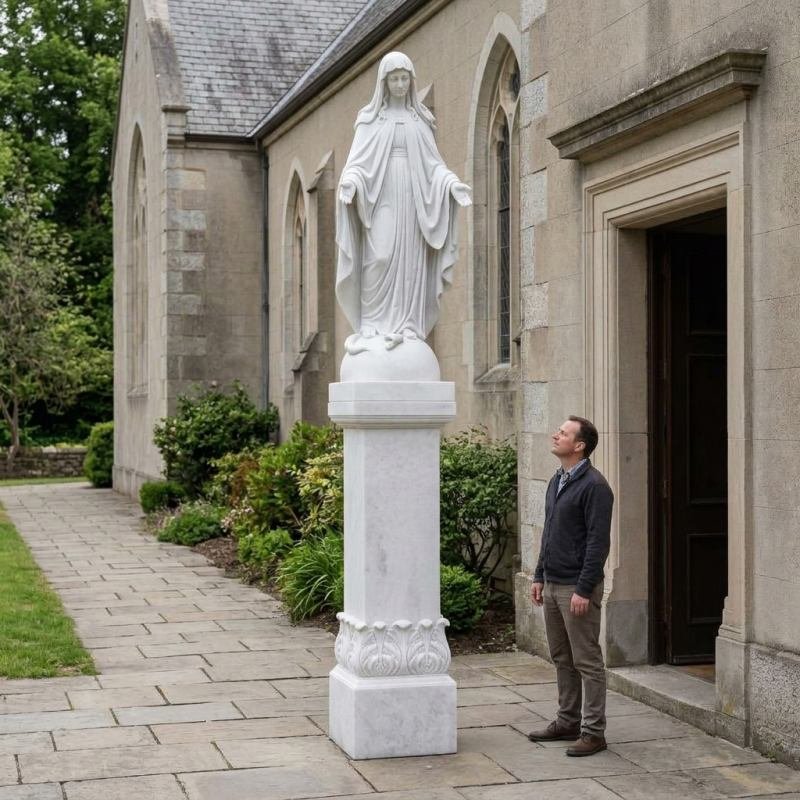
For a chapel statue, the pedestal is usually 0.4–0.5 times the figure height. For a nave statue, 0.5–0.6 times. Outdoors, 0.4–0.6 times, plus enough height to keep the marble above shrubs and standing water.
Three worked cases show what those ratios do:
- 110 cm figure + 50 cm pedestal = 160 cm installed. Face at about 145 cm. A visitor kneeling at 1.15 m looks up 30 cm from 1.2 m away, about 14 degrees. Comfortable, and Mary appears to look back.
- 160 cm figure + 80 cm pedestal = 240 cm installed. Face at about 220 cm. A person seated at 1.20 m, 6 m back in the nave, looks up 100 cm across 6 m, about 9.5 degrees. Correct for the assembly, too steep for the individual at the rail.
- 160 cm figure + 120 cm pedestal = 280 cm installed. Face at about 260 cm. A visitor at the kneeler 1.2 m away now looks up 145 cm, about 50 degrees. The same statue that worked in the nave has become unreadable at prayer.
The pedestal is also the one part that can still be changed late, at modest cost, without touching the marble. And it is usually the part the parish already owns: an existing plinth has a fixed top surface, a fixed height, often a fixed anchor point, and each of those limits the size that can sit on it. A new pedestal can be drawn to suit the figure and the face level you want.
So fix the pedestal height first, then choose the figure height that puts the face where people can see it. If the committee wants to see the difference, ask for two drawings of the same statue on two pedestals, both viewed from the kneeler.
What Should the Parish Confirm Before Approving the Size?
Confirm the location in writing before approving the drawing. Walk the site with the rector, the building committee or the facilities manager and agree on the exact spot. Placement near the sanctuary deserves the most care: a statue there changes the balance of the whole chancel, and in many dioceses the placement falls under liturgical or building guidance the parish, not the supplier, is responsible for applying. Where a faculty, permit or diocesan approval is needed, settle it before carving begins.
Then judge the figure against what is already in the room: the altar, so the statue neither competes with it nor appears to belong to it; the crucifix, which should stay the dominant image; and the other devotional images, so a pair or a group keeps one scale. A 150 cm Mary beside a 120 cm crucifix will read as the principal image, whether or not that was the intention.
Finally, approve a dimensioned drawing rather than a description, showing the figure, the carved base, the separate pedestal and the installed height, with the floor line marked. Ask who signs: the rector, the committee, and, if the statue is a gift, the donor as well. A gift should not set the size on its own.
Which Details Affect the Space and Access You Need?
Add these to the table before the size is fixed.
Crown or halo: 10–30 cm above the head. A 110 cm figure with a 20 cm crown needs 130 cm of clear height, not 110 cm.
Widest point: a figure with clasped hands is about 0.35 times its height across; the same figure with open arms reaches 1.2–1.5 times its height across the hands. A 160 cm open-armed Mary can span 190–240 cm, which decides both niche width and doorway passage.
Depth: a mantle falling away at the back adds 20–35 cm behind the shoulders, and the carved base usually extends 10–20 cm beyond the figure on each side, so the pedestal top has to be larger than the figure’s footprint.
Weight: marble runs about 2.7 tonnes per cubic meter. A 100 cm figure is typically 120–180 kg with its base, a 150 cm figure 300–450 kg, a 200 cm figure 600–850 kg. That number decides the lifting method long before the statue reaches the plinth.
Route: a 90 cm doorway passes a statue up to about 80 cm across. Measure the doorways, the stair turns, the sanctuary step and the last few meters of carpeted aisle, and have the installer confirm how the block will be moved, set and anchored. These checks are cheap while the drawing can still change.
How Do You Choose the Right Size for Each Church Setting?
Three settings cover most commissions, and each has a default that works.
What Size Works for a Side Chapel or Prayer Area?
For most side chapels, we quote a 100 cm figure on a 45–50 cm pedestal, installed at 145–150 cm. That puts the face around 135–140 cm, roughly 20–25 cm above the eye of someone kneeling a meter away.
If the kneeler is further back, 1.5 m or more, move up to 110–120 cm and a 55–60 cm pedestal. If the chapel is also used for small weekday Masses and people look from 4–5 m, go to 130–140 cm.
Build the mockup with the pedestal included. Mark its top, the top of the statue and the face level, and have the committee look from the kneeler. A difference of 15 cm that is invisible on paper shows up within a minute in the room.
Will the Statue Fit an Existing Wall Niche?
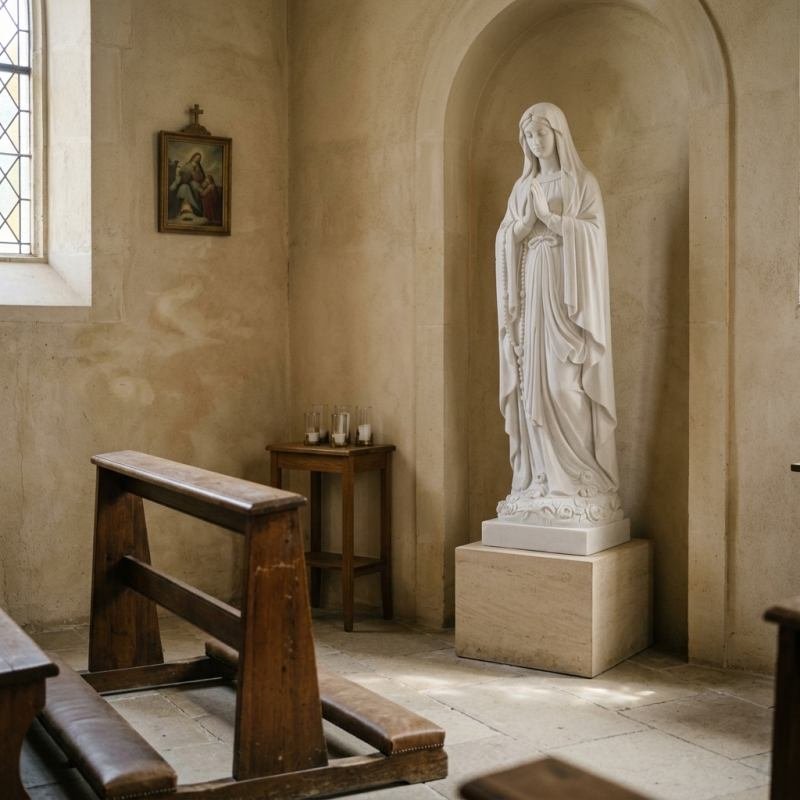
The formula is simple: figure height + crown + base ≤ clear niche height − 5 cm.
A niche 150 cm clear takes a 130 cm figure with a 15 cm crown. A niche 120 cm clear takes a 100 cm figure with a 15 cm crown, or a 90 cm figure if the crown runs to 25 cm. Width is checked at the arch springing, not at the widest point of the opening, and depth from the back wall to the front edge of the sill.
The crowned Our Lady of Mount Carmel we carved for an Asian church project shows why the crown belongs on the dimensioned drawing: it adds height exactly where an arched opening has the least width to give. If the niche sits high on the wall, look up from the aisle or the pews as well, because a figure that fits inside can still sit so far back that the face is lost from below.
Leave 5–8 cm around the widest point. Not for appearance, but for the lifting straps, the final setting and the cleaning access the parish will want later.
How Tall Should the Statue Be for an Outdoor Shrine, Grotto, or Courtyard?
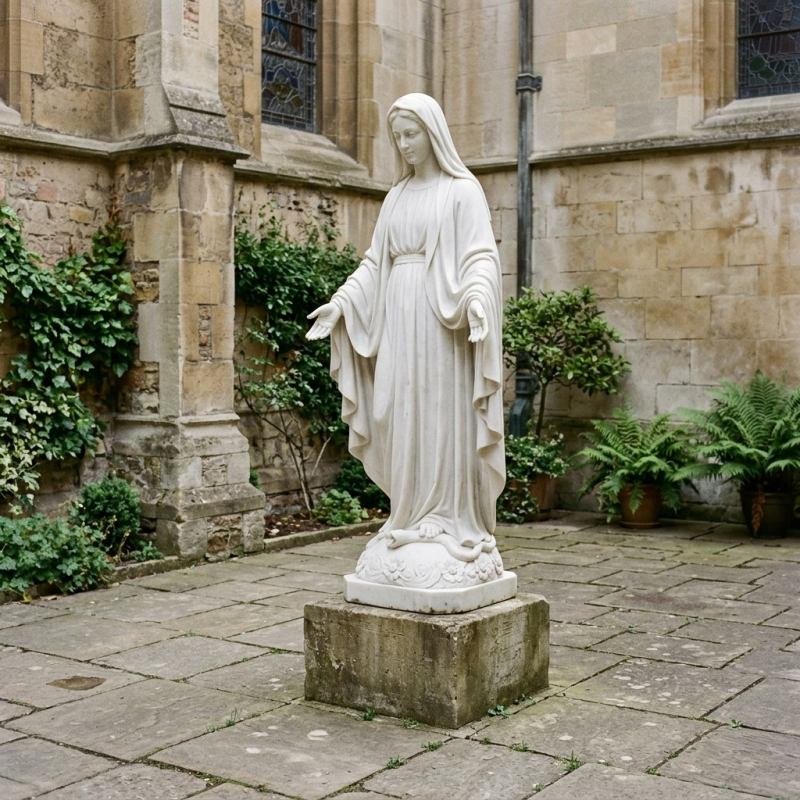
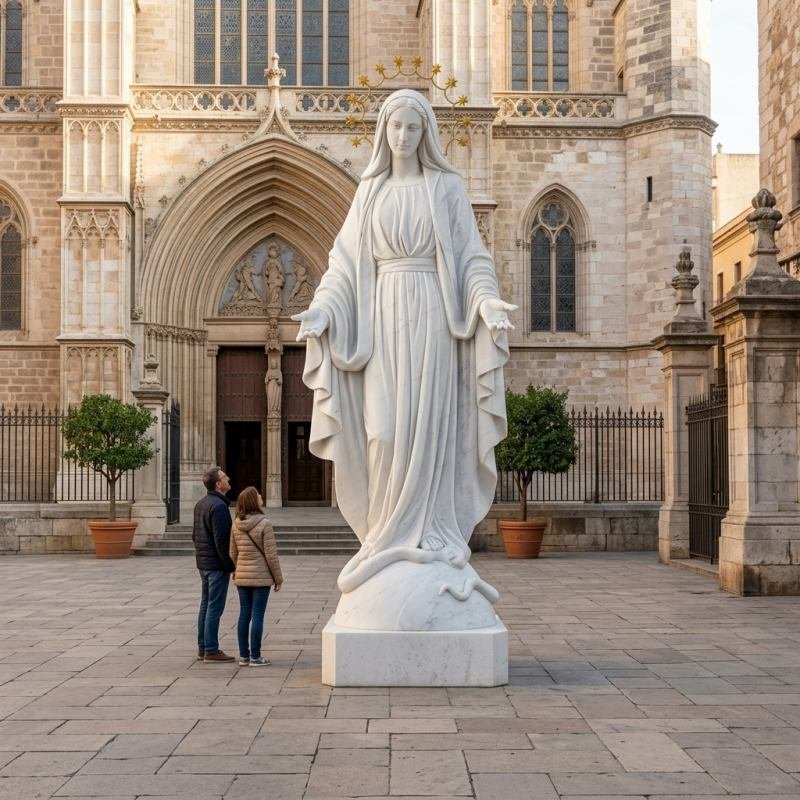
For a shrine first seen from 10–15 m along a path, use 160–180 cm on a 60–80 cm plinth, installed at 220–260 cm. For a courtyard where the first view is 15–20 m, or the statue must hold its own against trees and walls, use 180–200 cm.
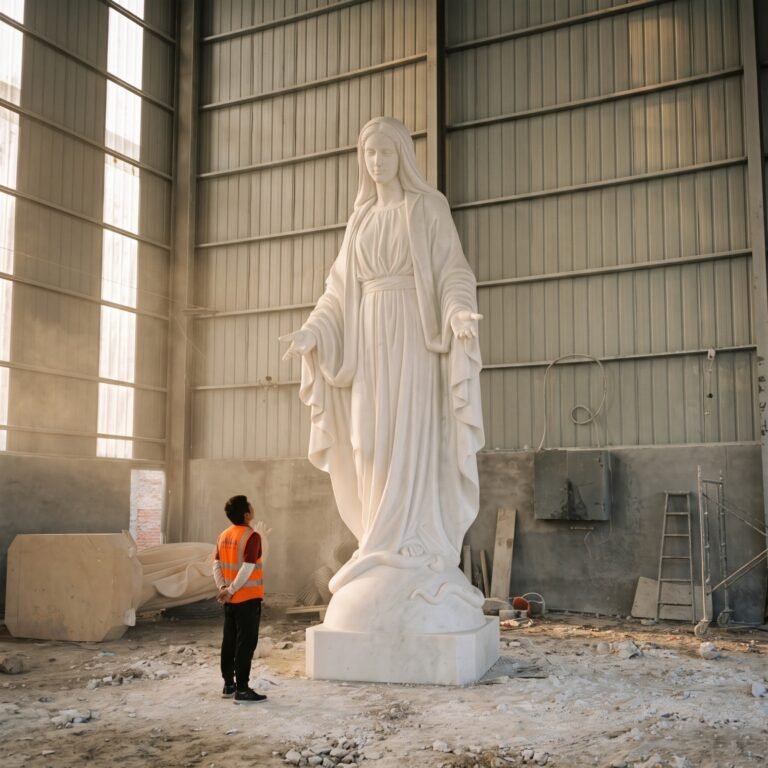
In 2022 we carved a white marble Our Lady of Lourdes, listed at 160 cm (about 5 ft 3 in), for a church in the United States, as part of a group of devotional sculptures. The workshop photos show the figure and its carved base from several angles; on site, a customer photo shows the same statue on its pedestal beside the walkway, where its scale can be read against the walls and the paving. For your own project, ask the two questions the project record cannot answer: whether the quoted 160 cm includes the carved base, and what the installed height will be with your plinth.
Photo placement: pair one workshop photo of the Lourdes statue with one customer photo showing the pedestal and walkway.
For a North American religious center we carved a large marble Mary with both hands extended. That pose changes the numbers: the span across the hands, the ground taken by the base and the width that must pass the delivery route all matter more than the height. Two statues of the same height can need very different amounts of space.
What Should You Send Us for a Custom Size Recommendation?
If the parish has already chosen a Marian devotion, send the reference image and show us where the statue will go. You do not need a survey: phone photos, a tape measure and a short sketch are enough for us to price two or three sizes side by side.
- Photos of the location. A front view, a side view, and a wider photo from the main viewing point.
- Height, width and depth. Measure from the surface that will support the statue. If the opening is arched, mark where it begins to narrow.
- Pedestal dimensions. Height, plus the width and depth of the top surface. Tell us whether it is already in place.
- Viewing distance. How far away people will stand, sit or kneel, and at what eye level.
- The chosen design. The devotion, the pose, the marble or finish, and any crown, halo or other detail.
- The setting and access route. Indoors or outdoors, plus any doorway, stair or delivery restriction you know about.
With that, we return a dimensioned elevation with the figure height, pedestal height, installed height and face level stated, for the parish to review before anything is carved. Our guide on how to order a custom religious statue for your church covers the next steps.
FAQ
Does the Listed Statue Height Include the Base?
It depends on the supplier, and the gap can be 20–60 cm. Ask for a drawing that measures from the underside of the carved base to the highest point of the design. Have any separate pedestal listed as its own line, and confirm the installed height the parish will actually see.
How Much Clearance Should a Mary Statue Have Inside a Niche?
Allow 5–8 cm around the widest point, measured at the crown, hands and mantle rather than the shoulders, plus 15–25 cm of headroom for a crown or halo under the arch. The clearance is also working room: it is the space needed to lower the marble, set it and clean it.
Can a Pedestal Make a Smaller Mary Statue Work in a Large Church?
Only when the problem is height, not presence. A raised 120 cm figure is easier to see from the back of the nave, but it is not easier to read. Keep the face below about 2.6–2.8 m indoors. If the features still vanish from where people pray, compare a larger figure on a lower pedestal: 150–180 cm on a 60–80 cm base usually beats 120 cm on a 120 cm base.
Should Paired Church Statues Be the Same Height?
Compare installed heights and poses, not just the figures. A crowned standing Mary and a seated figure holding the Child can measure the same overall while their faces sit 20–30 cm apart. If they flank the same feature, ask for both elevations side by side with their pedestals, and keep the base design consistent.
Can a Marble Mary Statue Be Carved to Fit an Existing Niche?
Yes. Accurate measurements plus front and side photos of the niche are enough for a dimensioned drawing that shows whether the chosen pose fits, and where the sculptor can adjust the base, the mantle width or the position of the hands. Review those changes with the parish so the details that identify the devotion survive the adjustment.