Two month ago I received an order for a St. Thérèse of Lisieux statue from a customer based in Normandy, France. When I check the finished sculpture, her whole life story flooded into my mind, filling me with profound inspiration. — and it inspired me deeply. St.Therese of Lisieus let us know:
as an ordinary person, you do not need extraordinary talent, harsh penance, or great achievement to become a saint. You simply stay humble like a child, trust in God’s endless mercy, and offer every tiny moment, every struggle, and every loving action to Him.
God will always be beside you and bless you. This is what St. Thérèse of Lisieux lived in her entirety — and it is also what we receive when we read her writings and pray before her statue: the holy strength of Faith, Love, and Suffering.
Who Is St. Thérèse of the Little Flower?
Saint Thérèse of Lisieux, known affectionately as the Little Flower, was born Marie-Françoise-Thérèse Martin in Normandy, France, in 1873.
Her parents, Louis and Zélie — both later canonized saints — once hoped to enter religious life but chose marriage to follow God’s will.
Raised in a devout Norman household, she lost her mother to cancer at the age of four and moved to her uncle’s town of Lisieux. A miraculous healing attributed to the Virgin Mary cured her severe childhood illness.
At fifteen, after personally pleading with the Pope for special permission, she entered the local Discalced Carmelite convent, where two of her sisters already lived. She spent nine years in the cloister and died of tuberculosis at only twenty-four.
Though the convent community had many imperfections and she endured unfair treatment, Thérèse practiced her signature teaching — the Little Way of Spiritual Childhood.
She wrote the autobiography The Story of a Soul, expressing her belief that people become holy through childlike trust in God and small, loving daily sacrifices, rather than through extreme penance or grand deeds. Canonized in 1925, she is the patroness of missionaries and of France.
Why Is Thérèse Called “The Little Flower”?
Many people give a one-sentence answer: she viewed herself as a humble wildflower in God’s garden. While that core truth is correct, this nickname carries far richer meaning woven from her personal writings, family memories, convent life, prophetic words, Catholic tradition, and global legacy. Here is the full story behind this beloved title.
Core Self-Identity: A Tiny Wild Bloom in God’s Garden
This is the foundational reason, rooted directly in her autobiography The Story of a Soul. Thérèse saw herself as a quiet, overlooked wildflower growing wherever God planted her — with no desire for praise, grand spiritual feats, or worldly fame.
Her life matched this metaphor perfectly: she was the youngest daughter in a quiet Norman Catholic family, and she spent nine hidden years inside a small Lisieux Carmelite cloister, quietly burying herself in the mission of God. She firmly wrote that God loves small, unassuming souls just as much as outstanding saints — and that simple, steady love from an ordinary “little flower” holds infinite value in His eyes.
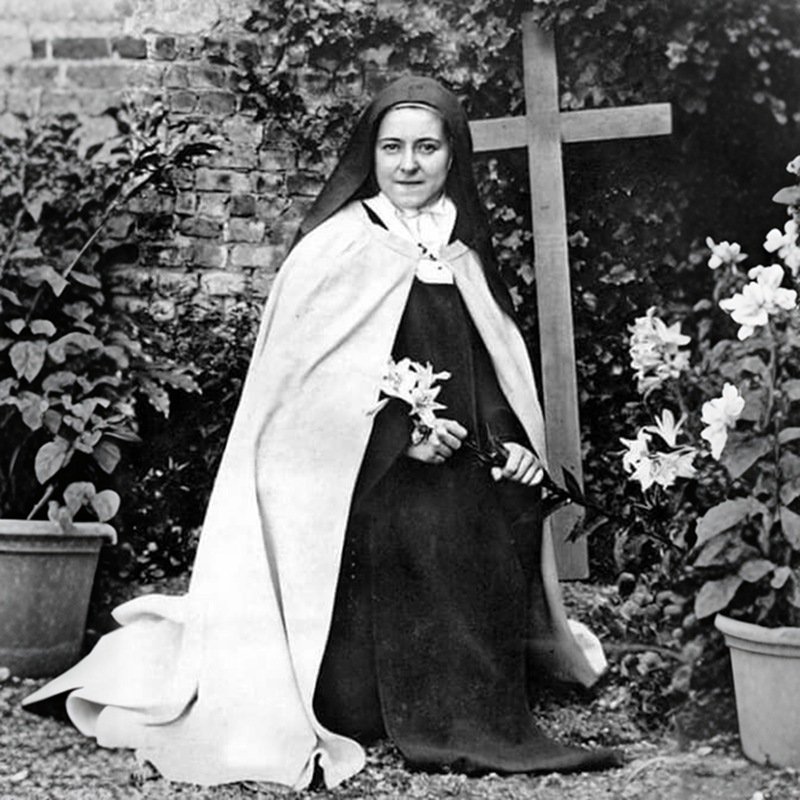
The Iconic “Shower of Roses” Deathbed Prophecy
This is the most recognizable origin of the flower nickname. As Thérèse lay dying of tuberculosis, she shared her famous promise:
“After my death, I will let fall a shower of roses. I will spend all eternity doing good upon earth.”
For her, every tiny daily sacrifice counted as one rose: patient endurance of difficult convent sisters, silent self-denial, quiet prayers for sinners and missionaries, and every small act of hidden charity.
She vowed to send endless graces, comfort, and answered prayers to people all over the world — like falling rose petals.
After her passing, countless testimonies of spiritual favors emerged, dubbed the “Rain of Roses” — cementing the flower label forever.
She also loved decorating the Child Jesus statue with fresh rose petals and scattering them before the Blessed Sacrament, making roses her lifelong sacred symbol.
Her Religious Name: Thérèse of the Child Jesus
“The Little Flower” is inseparable from her official Carmelite religious title, which perfectly aligns with her signature Little Way of Spiritual Childhood.
Her entire spiritual path revolves around living as a weak, trusting child before a loving Father God, rather than striving for holiness through harsh self-mortification or heroic deeds.
A fragile, delicate wildflower is the perfect visual parallel to this childlike humility.
She saw herself as a tiny blossom belonging to the Infant Christ — fully dependent on His grace to grow, with no inherent beauty or merit of her own.
The flower nickname is a tangible reflection of the gentle, child-centered spirituality she spent her whole life teaching.
A Childhood Floral Gift from Her Father, Louis Martin
There is a tender, formative memory that planted this flower metaphor deep in Thérèse’s heart.
When she told her father she longed to enter the Carmel convent at a shockingly young age, Louis plucked a small white wildflower and handed it to her.
He told her that God would transplant this delicate little bloom into His own garden — the cloister — to bloom under His gentle care. This sweet paternal image stayed with her into adulthood and shaped how she understood her place in God’s plan.
In short, “the Little Flower” is far more than a surface nickname. It grows from her own humble self-perception as an unnoticed wildflower, her famous shower-of-roses prophecy, her childlike spirituality tied to the Child Jesus, a meaningful childhood memory with her father, a practical way to distinguish her from St. Teresa of Ávila, and the global spiritual movement that bloomed after her canonization.
Every petal of this title points back to her core message: you do not need grand deeds to love God deeply — only small, trusting love offered each day.
The Historical Source and Iconography of the St. Thérèse Statue
If articles and books tell us the biography and thoughts of St. Thérèse the Little Flower, a three-dimensional statue helps us honor a holy life, focus our prayers, and create a reverent space that inspires faith and devotion.
That is to say, when we honor St. Thérèse of Lisieux through her statue, we do not honor the stone or bronze itself — we honor the spirit of this saint.
A faithfully restored St. Thérèse of Lisieux statue can encourage us to throw ourselves fully onto the path of the soul. That is precisely why religious art sculpture exists.
The Habit and Veil
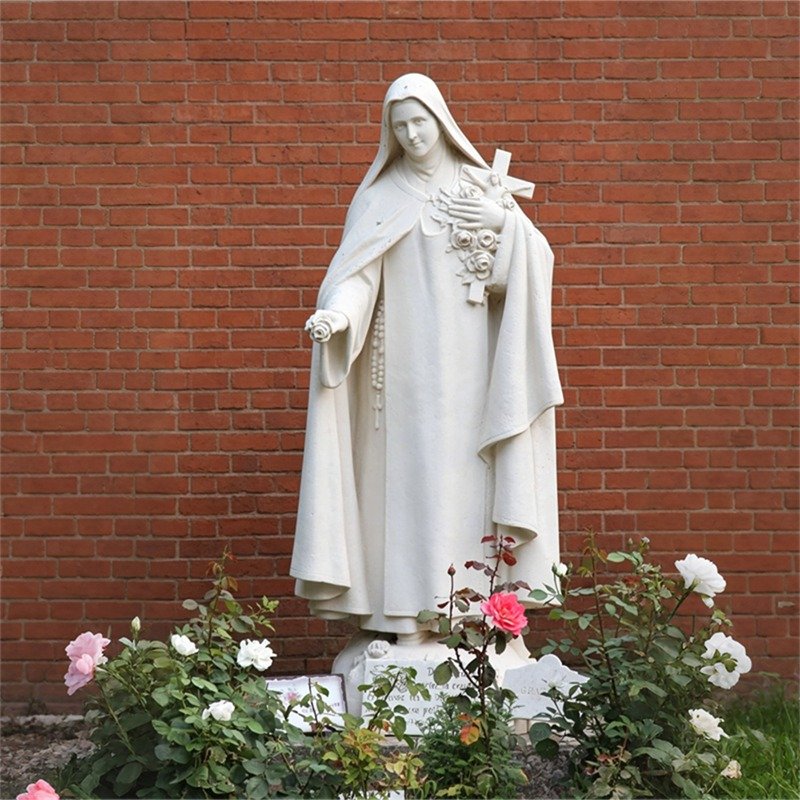
The image of St. Thérèse the Little Flower is traditionally depicted wearing the complete traditional Discalced Carmelite nun’s habit.
A tight under-veil frames her face, while a soft, wide outer mantle veil drapes over her crown, falling loosely down both shoulders in deep, natural folds.
The Face
If you look carefully, you will be guided by her calm, mild, humble, and serene facial expression — with downcast, soft eyes, a signature detail of all classic Little Flower statuary, representing quiet, childlike inward prayer.
Her features are youthful and delicate, modeled after the original authentic photographs taken by her sister Céline Martin inside the Lisieux Carmelite convent: gentle rounded cheeks, a small closed mouth with a faint peaceful expression, and a simple, unadorned brow.
The Rosary
A thin rosary chain is faintly carved along her left side, tucked into the folds of her cloak — a quiet reference to her devotion to the Virgin Mary.
The Roses and Crucifix
Her two hands are positioned centrally at mid-chest, cupped together to cradle a full bouquet of fully bloomed roses — her defining symbol as the “Little Flower,” standardized in all replicas from the 1934 landmark marble prototype by sculptor Louis Castex:
The roses reference her famous deathbed prophecy that after death she would “shower roses” of heavenly graces and mercies across all humanity for eternity.
The small crucifix honors her lifelong devotion to the Holy Face of Jesus Christ — the foundation of her Little Way teaching of embracing quiet suffering with childlike trust.
In short, all symbolic elements carved onto the statue draw directly from Thérèse’s autobiographical writings and prophecies, expressing her gentle, mild, suffering, and humble soul.
What a St. Thérèse Statue Brings to Us?
A St. Teresa the Little Flower Statue is far more than decorative sacred art.
It delivers multi-layered spiritual comfort, visual reminders, and prayerful companionship for believers.
Based on relevant material and my own experience, I believe a St. Thérèse the Little Flower statue serves our spiritual path in three key ways.
A Constant Visible Reminder of the Little Way of Spiritual Childhood
The statue’s plain, modest Carmelite robes and soft, humble facial features instantly anchor our minds to Thérèse’s core teaching.
Unlike grand statues of famous mystics or reformers, this gentle, youthful figure reminds us that holiness does not demand dramatic sacrifices, extraordinary talents, or public fame.
It preaches childlike trust in God’s loving mercy rather than harsh self-punishment.
Every glance at St. Thérèse the Little Flower calls us back to seek sanctity through small, unseen daily acts: patience with others, silent forbearance, tiny self-denials, and quiet love for those around us.
For anyone weighed down by the pressure to “achieve perfection,” this statue can restore gentle peace and hope — the reassurance that ordinary lives are enough to draw close to God.
An Intimate Spiritual Companion for Personal Prayer
Based on decades of experience in religious consultation, I have found that buyers of this statue are not only churches and organizations, but also many private individuals.
They typically display the statue in their home garden, backyard, entrance, or home niche. Why? Because St. Thérèse’s humble, mild, and ordinary way of drawing close to God resonates deeply with everyday life.
Many clients see St. Teresa the Little Flower Statue as a spiritual companion. It conveys a reassuring truth: true holiness flourishes in obscure, unnoticed lives. Just as Thérèse lived nine unknown years inside a small cloister before becoming a globally venerated saint, this unadorned sculpture comforts people who feel insignificant by worldly standards — telling them that spiritual greatness lies in unseen devotion rather than fame, wealth, or public praise.
A Tangible Promise of Heavenly Grace
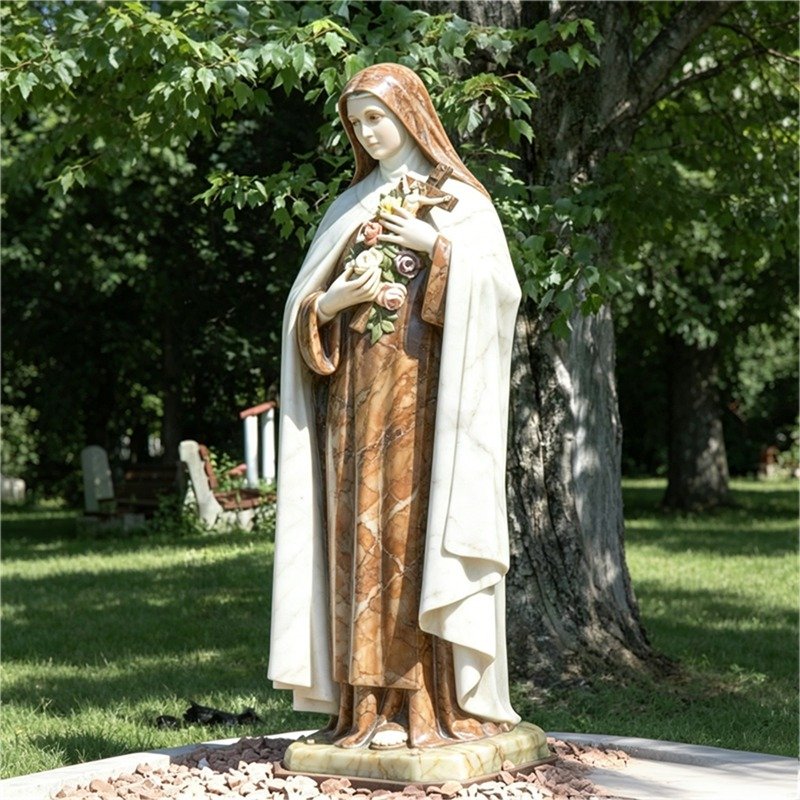
The bouquet of roses cupped in her hands, paired with the miniature crucifix hidden among the blooms, is the statue’s most powerful visual language, rooted in Thérèse’s deathbed prophecy.
The roses stand for two truths: every hidden small sacrifice Thérèse offered to Christ during her nine quiet cloistered years, and her eternal vow to “shower roses” of graces, comfort, healing, and answered prayers on all who turn to her. When we kneel before the statue, the roses act as a permanent, visible promise that she hears our worries and intercedes for us in heaven.
Furthermore, the tiny crucifix represents her devotion to the Holy Face of Jesus. It teaches us to unite our own suffering, illness, grief, and unfair hardships with Christ’s pain on the cross. The statue gives quiet strength to anyone enduring trials, reminding us that suffering offered in love becomes precious in God’s sight.
Where Can I Buy a St. Thérèse the Little Flower Statue?
If you want a small, handy, or tabletop statue — regardless of material — I highly recommend visiting your local religious art store first.
If you want a life-size statue, or something larger in premium materials such as marble, bronze, or basalt, I suggest conducting a thorough comparison both online and offline. Whatever you buy, the golden rule is: use reasonable money to buy the best product. A statue is not a test of faith — it is a companion for life.
The online channel offers more choices but also more complexity. You may ask: Is there a practical guide to help me choose well? Here is a concise, step-by-step guide — using YouFine (religionstatue.com) as a real-world example.
A Practical Buying Guide (Using Our YouFine Art Sculpture as an Example)
Step 1 — Seize the Basic Information First
Before you get swept away by a beautiful product photo or an exciting article, pause. Visit the company or factory’s official website and carefully browse their Home, About Us, and Projects pages.
What to look for with YouFine:
YouFine has been operating since 1983 — over 40 years of dedicated religious sculpture manufacturing.
Our “About Us” page clearly states that “all artists are devout Catholics” and that many senior artists have devoted their entire lives to conveying the sacred consciousness of God through sculpture.
This tells you our team understands the spiritual weight of what they make — not just the technical craft.
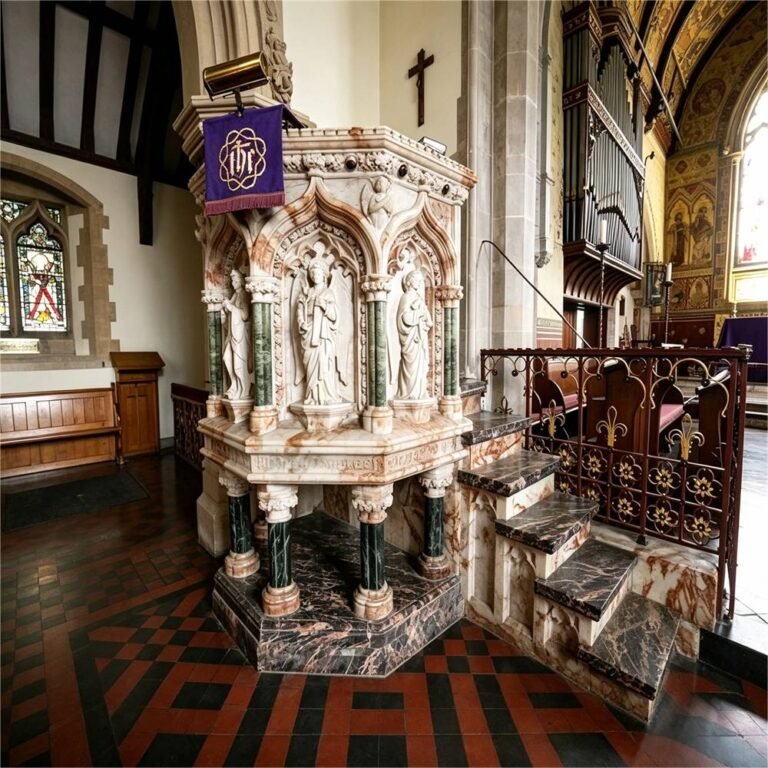
What’s more, Our YouFine Art home section showcases completed church installations across Southeast Asia, Europe, and the United States, including full marble altars, pulpits, and baptismal fonts — giving you a concrete sense of their scale and capability.
This first step helps you quickly assess whether a supplier has the history, technical skill, and spiritual seriousness your order deserves.
Step 2 — Use AI to Conduct a Background Search
Once you have gathered the basic information and identified the statue you want, use an AI assistant — Monica, Claude, Gemini, or others — to run a background check.
In the age of AI, information is increasingly transparent. AI can help you cross-reference company history, identify red flags, and summarize customer feedback from multiple sources, saving you hours of research and helping you avoid unnecessary risk.
Step 3 — Scrutinize Official Import and Export Customs Data
Customs bill-of-lading records serve as the most credible, unalterable proof of a manufacturer’s genuine trading track record, delivering objective, verifiable evidence far beyond self-promotional brochures or website claims.
We recommend ImportYeti, a free, user-friendly platform that aggregates official U.S. CBP customs shipment manifests sourced under public record laws. You may directly access the dedicated supplier page for this sculpture factory via the link: https://www.importyeti.com/supplier/you-fine-art-sculpture
The authentica data are following:
US Region Export Analysis Report
| Category | Share | Value ($K) | YoY |
|---|---|---|---|
| Marble Sculpture | 34% | $1,639 | ↑ +22% |
| Bronze / Metal Sculpture | 26% | $1,253 | ↑ +15% |
| Fountain / Water Feature | 18% | $868 | ↑ +31% |
| Religious / Figure Statue | 12% | $578 | ↓ −4% |
| Animal Sculpture | 6% | $289 | ↑ +8% |
| Custom / Other | 4% | $193 | ↑ +3% |
- ▸ Marble sculpture leads at 34% share, driven by high-end residential & landscape projects in CA, TX, and FL.
- ▸ Fountain & water features posted the fastest growth at +31%, fueled by US commercial real estate upgrades.
- ▸ Bronze sculpture orders remain robust; large public art installations account for 42% of the bronze category.
- ▸ Religious / figure statues dipped −4%, impacted by regional procurement policy adjustments.
- ▸ Q4 2025 (Oct–Dec) was peak season, contributing ~38% of the 10-month total.
- ▸ Average lead time reduced to 45 days — a 12% improvement over the prior year.
- ▸ US client repeat purchase rate reached 61%, reflecting strong brand loyalty.
- ▸ Oversized custom orders (>2m) rose to 29% of total volume, with notable premium margins.
- ▸ US tariff policy fluctuations continue to pressure stone product cost structures.
- ▸ Ocean freight rates rebounded in early 2026, squeezing margins on smaller orders.
- ▸ Rising competition from Vietnam and India in the budget stone segment.
- ▸ Expand fountain & water feature promotions through US commercial landscape design channels.
- ▸ Deepen custom service capabilities targeting high-net-worth residential designers.
- ▸ Optimize inventory planning to front-load Q3–Q4 peak-season fulfillment cycles.
In short,whatever channel you choose, always verify the supplier’s history, artist credentials, and customs records before committing to a large order.
Final thoughts
St. Thérèse the Little Flower never climbed a mountain, led an army, or performed miracles in public view.
She swept floors, endured difficult personalities in a small cloister, coughed through cold nights, and quietly loved God in the dark — and that was enough to make her one of the most beloved saints in history.
A statue of St. Thérèse Little Flower is not merely a decorative object or a religious keepsake.
It is a daily invitation. Every time you pass it in your garden, pause at your home niche, or kneel before it in prayer, it whispers the same message she wrote in The Story of a Soul: you are already enough, exactly where you are, doing exactly what you are doing — as long as you do it with love.