What is the History of Mary Garden?
The tradition of Mary Gardens has deep medieval roots in European Christianity, particularly flourishing during the Middle Ages when devotion to the Virgin Mary reached its height.
Medieval Origins (12th–15th centuries)
During the Middle Ages, monks and nuns cultivated monastery gardens filled with flowers and herbs, each plant carrying symbolic meaning tied to the life and virtues of the Virgin Mary. These “Mary’s flowers” were not merely decorative—they served as visual prayers and teaching tools.
Illiterate peasants learned Bible stories and Marian devotion through the symbolic language of flowers. Legends grew around common plants: the white lily became Mary’s purity, the rose her joys and sorrows, and rosemary turned blue when Baby Jesus’ garments touched it during the Flight into Egypt. In those days, a garden was not just a place of beauty—it was a living book of faith.
Renaissance & Baroque Period
As Marian devotion intensified, formal Mary Gardens began appearing in church courtyards, convent cloisters, and wealthy Catholic estates. Grottos modeled after the Lourdes apparition site became especially popular after 1858, combining natural stone formations with Marian statuary and symbolic plantings. Walking through these gardens, believers felt they were stepping into sacred space, where every bloom whispered a prayer.
Modern Revival (20th Century)
The Mary Garden tradition experienced a significant revival in the 1930s–1950s, particularly in the United States. Catholic parishes, schools, and private homes began creating dedicated Mary Gardens as outdoor prayer spaces. The tradition spread to Anglican and Lutheran communities that maintained high Marian devotion.
Today, Mary Gardens range from elaborate church installations to simple container gardens on apartment balconies—even on small Hong Kong balconies where space is precious but devotion is abundant. The ancient tradition has adapted beautifully to modern urban life, proving that you don’t need acres of land to create a sacred space; you just need a willing heart and a small corner to call holy.
Why is a Mary Statue Necessary for a Mary Garden?
The statue of the Virgin Mary serves as the essential focal point and spiritual heart of a Mary Garden. Here’s why it is considered necessary:
Visual Center of Devotion
The statue provides a tangible focus for prayer and meditation. Just as icons serve in Eastern Christianity, the Marian statue helps believers direct their hearts and minds toward Mary’s intercession and example. It transforms a simple flower bed into a sacred devotional space. When you kneel before that statue surrounded by blooms, you’re not just gardening—you’re praying with your hands in the soil.
Embodiment of Marian Virtues
The statue visually represents the virtues Catholics and other Christians seek to emulate: Mary’s purity, humility, faithfulness, and maternal love. Different statue poses—Mary holding the Infant Jesus, praying, or as Our Lady of Lourdes—emphasize different aspects of her role in salvation history. Each gesture tells a story; each fold of her robe speaks of grace.
Distinction from Ordinary Gardens
Without the statue, the space would simply be a flower garden. The Marian figure sanctifies the space, marking it as a place set apart for spiritual purposes. It signals to visitors that this is a place for prayer, not merely aesthetic enjoyment. The statue is the difference between a pretty garden and a portal to heaven.
Connection to Marian Apparitions
Many Mary Garden statues depict specific apparitions—Our Lady of Lourdes, Fatima, or Guadalupe—connecting the garden to these important moments in Catholic devotional history and providing a focus for specific forms of Marian prayer. When you place Our Lady of Lourdes in your garden, you’re bringing a piece of that French grotto into your own backyard.
Teaching Tool
The statue, combined with symbolic flowers, creates a “living catechism.” Each element teaches something about Mary’s life and virtues, making the garden an outdoor classroom for faith formation, especially for children. I’ve watched children learn to pray by planting marigolds—”Mary’s gold”—at the feet of her statue, their small hands patting the earth as they whisper their hopes.
How to Pick a Suitable Mary Statue for Your Mary Garden?
Choosing the right statue depends on your devotional focus, available space, and the garden style you envision. Here’s a comprehensive guide:
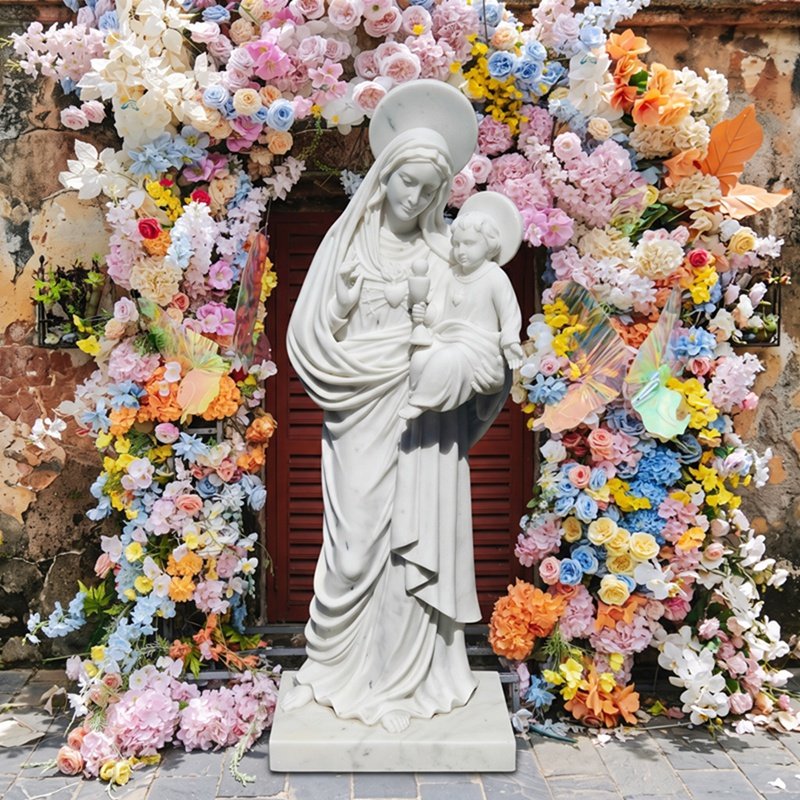
Our Lady Holding the Infant Jesus
Appearance: Mary crowned, holding Baby Jesus, often standing on a globe or crescent moon.
Devotional Focus: Mary as Mother and Queen; celebrates her maternal love and royal dignity.
Recommended Symbolic Flowers:
Lily (purity), white rose (joy), red rose (sorrow), daisy (bloomed beside the manger), sweet woodruff (manger bedstraw), daffodil (Mary’s star), cornflower (Mary’s crown)
Best Garden Styles:
- Classic ground-planted Mary Garden with arched backdrop
- Wall-side simple garden for church dedication ceremonies
- Works beautifully on raised stone plinths against building walls
Ideal For: Church courtyards, parish schools, traditional home gardens
Our Lady of the Rosary
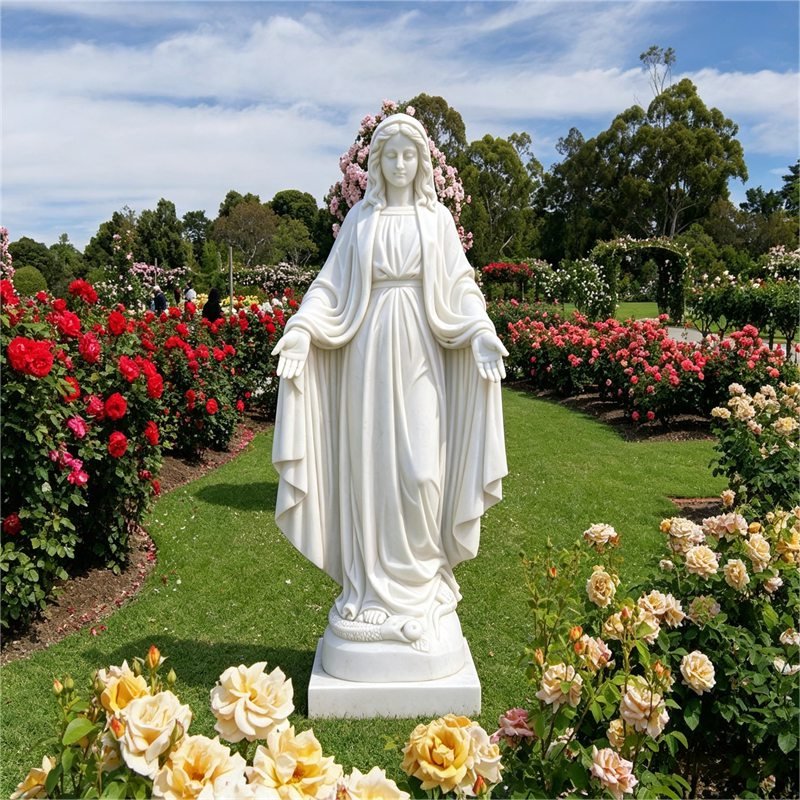
Appearance: Mary holding or wearing a rosary, hands in prayer or extended in blessing.
Devotional Focus: Rosary prayer, meditation on the mysteries of Christ’s life.
Recommended Symbolic Flowers:
Rose (Mystical Rose—central to rosary devotion), lily, gladiolus (sword leaves for sorrows), larkspur/lily of the valley (Mary’s tears), ivy (faithfulness)
Best Garden Styles:
- Community open-air Marian shrine
- Parish public prayer grounds with sturdy masonry pedestal
- Side platforms for potted flower offerings
Ideal For: Rosary prayer groups, parish grounds, Catholic school campuses
Our Lady of Lourdes
Appearance: Mary as she appeared to St. Bernadette—hands joined in prayer, rosary on arm, often with blue sash.
Devotional Focus: Healing, conversion, prayer for the sick; commemorates the Lourdes apparitions.
Recommended Symbolic Flowers:
Blue iris (fidelity), blue columbine (Our Lady’s slipper), periwinkle (Virgin’s blue flower), marigold (Mary’s gold), lavender (swaddling clothes)
Best Garden Styles:
- Marian Grotto (stone cave-style shrine—most traditional)
- Container-style patio garden
- Gazebo-pavilion tourist garden (lavender farms, retreat estates)
- Works beautifully in rustic stone settings or elegant gazebos
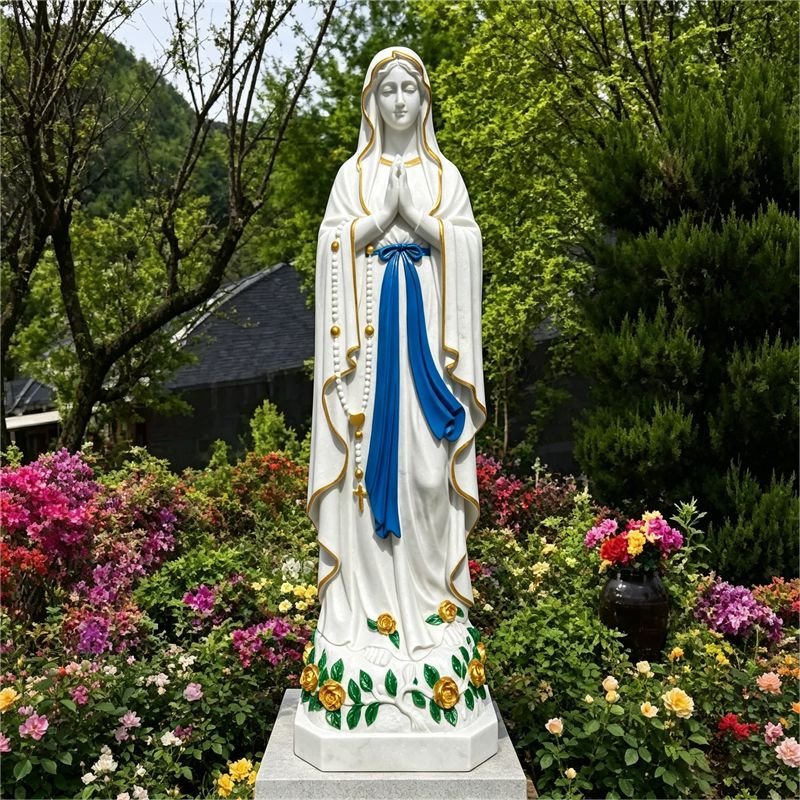
Ideal For: Healing ministries, retreat centers, scenic gardens, private patios, balconies
Our Lady of Fatima
Appearance: Mary as she appeared to the three shepherd children—simple white robes, hands in prayer.
Devotional Focus: Peace, conversion of sinners, prayer (especially the rosary), the sorrowful mysteries.
Recommended Symbolic Flowers:
Red rose (sorrows), gladiolus, violet (humility), baby’s breath (innocence), thistle (Our Lady’s thistle)
Best Garden Styles:
- Community open-air shrine
- Parish outdoor prayer space
- Open-air setting (no enclosed cave needed)
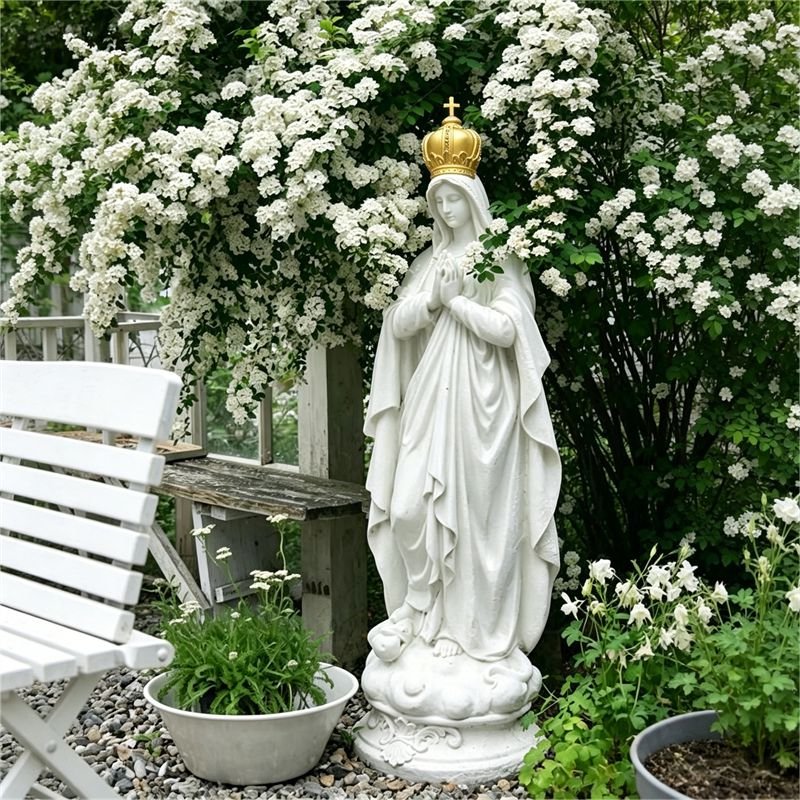
Ideal For: Peace prayer groups, parish grounds, memorial gardens
Our Lady of Guadalupe
Appearance: Mary as she appeared to St. Juan Diego—standing on crescent moon, surrounded by rays, iconic tilma image.
Devotional Focus: Patroness of the Americas; themes of dignity, justice, maternal protection.
Recommended Symbolic Flowers:
Marigold (“Mary’s gold”—culturally significant), rose, violet, ivy, hosta “Assumption Lilies”
Best Garden Styles:
- Devotional shrine-garden with circular flower bed
- Community public garden
- Cultural heritage garden
Ideal For: Hispanic communities, multicultural parishes, public shrine gardens
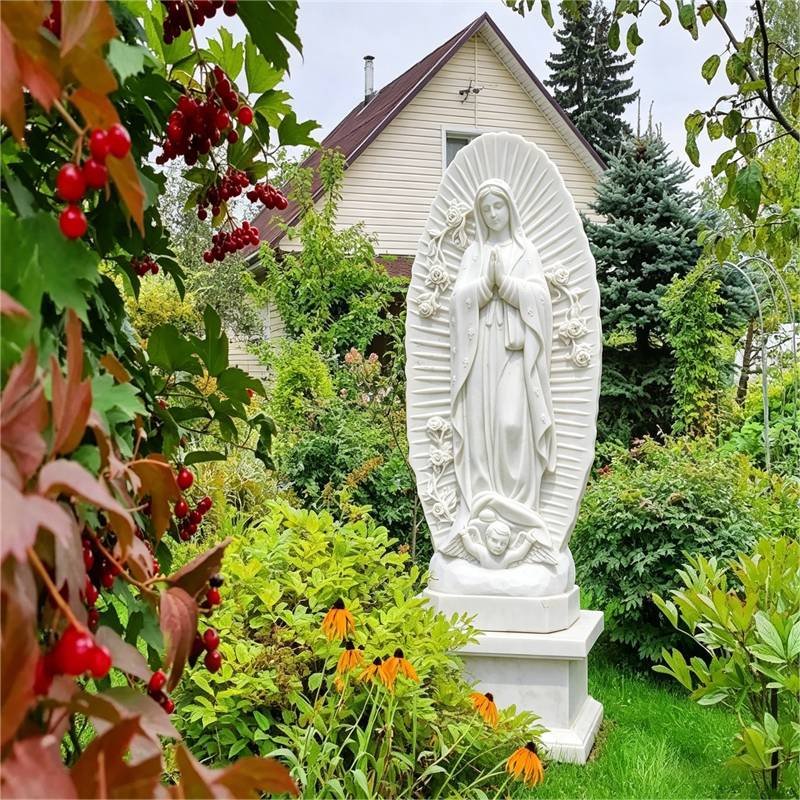
Praying Virgin or Pietà (Lamentation of Christ)
Appearance:
- Praying Virgin: Mary with hands folded in prayer, contemplative pose
- Pietà: Mary holding the body of the crucified Christ
Devotional Focus: Sorrow, meditation, grief, Mary’s suffering at the foot of the cross.
Recommended Symbolic Flowers:
Red rose (sorrows), gladiolus, bleeding heart (Heart of Mary), larkspur/lily of the valley (Mary’s tears), violet, forget-me-not (Mary’s eyes)
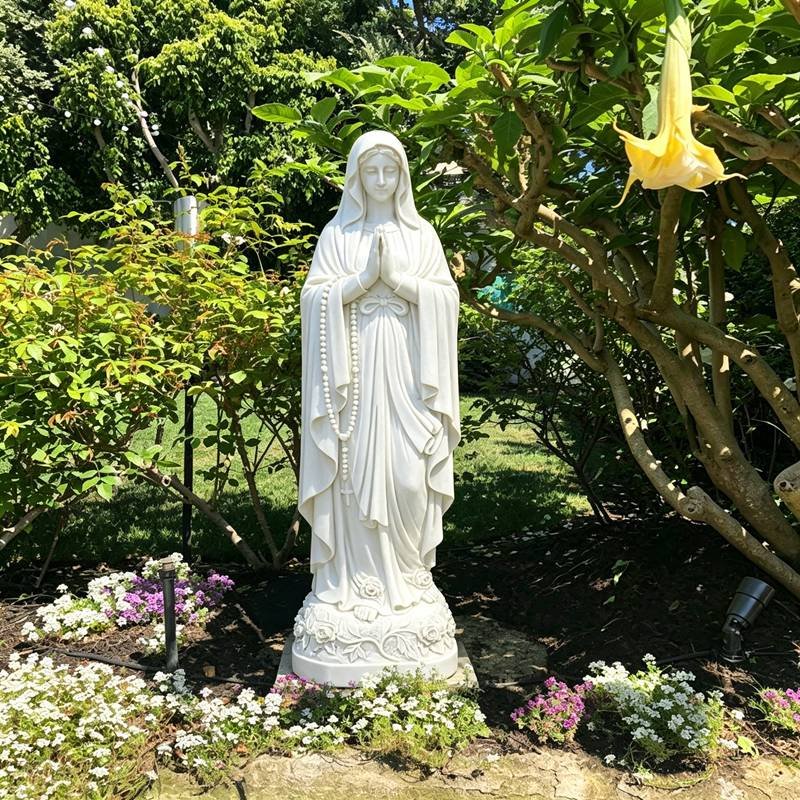
Best Garden Styles:
- Private patio Pietà garden (most suitable)
- Quiet backyard corner
- Courtyard meditation spot
- Keep atmosphere solemn and contemplative
Ideal For: Private reflection, grief ministry, personal prayer spaces (better for intimate settings than large public celebrations)
Why Choose Marble for Your Mary Statue?
For Mary Gardens, marble statues are the most popular choice, and for good reason. Marble embodies the sacred qualities that make a Mary Garden truly special:
- Sacred Purity: The pure white or soft cream tones of marble naturally evoke Mary’s holiness and purity. When sunlight falls on a marble statue, it seems to glow with an inner light—a visual reminder of Mary’s role as the bearer of the Light of the World.
- Timeless Elegance: Marble has been the material of choice for religious sculpture for millennia. From Michelangelo’s Pietà to countless church statues, marble carries a sense of sacred tradition and artistic reverence that no other material can match.
- Harmony with Nature: Marble statues blend beautifully with the natural elements of a garden. The soft, natural stone complements the organic beauty of flowers, herbs, and greenery. A marble Mary seems to belong among the lilies and roses—as if she herself grew from the earth.
- Serene Presence: The smooth, cool surface of marble creates a sense of peace and contemplation. When you touch a marble statue in prayer, there’s a tactile connection to centuries of devotion—countless hands have reached out to marble Madonnas in moments of need.
- Weather Grace: Quality marble, when properly maintained, weathers beautifully over time. It develops a gentle patina that only adds to its sacred character, making the statue look like it has been blessed by years of prayers.
Whether you’re creating a grand church grotto or a small balcony shrine, a marble Mary statue brings an unmistakable sense of the sacred. It’s not just a decoration—it’s a presence, a companion in prayer, a mother watching over her garden children.
Practical Selection Considerations
Size & Scale:
- Large church grounds: 4–6 feet tall statues on substantial plinths
- Home gardens: 2–3 feet statues on modest pedestals
- Balcony/patio: 12–24 inch statues in container settings (perfect for Hong Kong-style balcony gardens!)
- Tabletop miniature: 6–8 inch statues for terrarium gardens
Climate Considerations:
- Coastal areas: Sealed marble works well; the stone’s natural density resists salt air
- Cold climates: Quality marble can withstand freezing with proper sealing and drainage
- Hot, sunny climates: Marble’s light color stays cooler than dark materials; provides comfortable touch even in heat
- Humid tropical climates: Marble breathes naturally and develops a beautiful aged patina in moisture
Some Inspirations Based on Real Cases for Beautiful Mary Gardens
Here are proven garden styles based on successful real-world Mary Garden installations. Each one tells a story of faith made visible:
Classic Ground-Planted Mary Garden
Design Elements:
- Arched trellis or metal frame as backdrop
- Madonna-and-Child marble statue on stone plinth (3–4 feet tall)
- In-ground flower beds in semicircle or horseshoe layout
- Brick or stone edging
Plant Palette:
White lilies, white and red roses, blue irises, daisies, baby’s breath
Perennial herbs: rosemary, lavender, sage
Best For: Parish churches, Catholic schools, monastery courtyards
Maintenance: Moderate; seasonal replanting of annuals
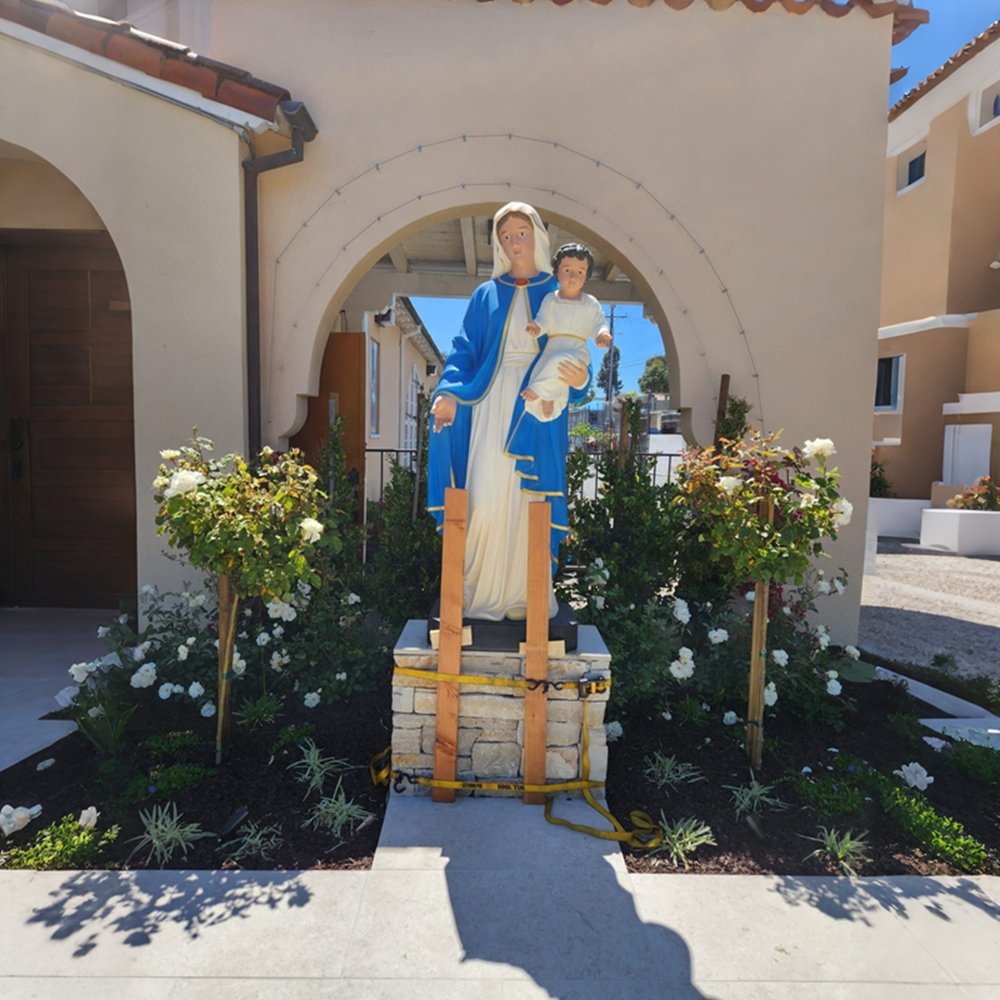
Real Story: I once visited a parish in California where the elderly gardener had tended the Mary Garden for thirty years. He told me he planted white roses on feast days and red roses during Lent. “Mary knows the seasons of my heart,” he said, pruning with hands gnarled by decades of devotion.
Wall-Side Simple Mary Garden
Design Elements:
- Existing building wall as backdrop (no arch or grotto construction needed)
- Marble statue on draped pedestal against wall
- Seasonal cut flowers in vases
- Small border plantings or container pots
Plant Palette:
Flexible—use seasonal flowers: tulips (spring), roses (summer), chrysanthemums (fall)
Potted lilies and marigolds
Best For: Quick installation for feast-day celebrations, dedication ceremonies, rental properties
Maintenance: Low; easily changed for different liturgical seasons
Why This Works: This is perfect for renters or those who can’t make permanent changes. One family I know moves their wall-side Mary Garden each time they relocate—Mary travels with them, a constant in their changing addresses.
Marian Grotto (Lourdes-Style Stone Cave Shrine)
Design Elements:
- Rustic rock-simulated cave niche (natural stone or concrete formed to look like cave)
- Our Lady of Lourdes marble statue placed in alcove
- Blue-themed flower plantings
- Often includes a small water feature or holy water font
Plant Palette:
Blue columbine, blue iris, periwinkle, lavender, blue hydrangea
Ferns and hostas for cave-like shade planting
Best For: Traditional parishes, pilgrimage sites, healing ministries
Maintenance: Moderate; grotto structure is permanent; plantings need seasonal care
Note: This is the most recognizable traditional Mary Garden form, inspired by the Lourdes apparition site.
Sacred Atmosphere: There’s something about a grotto that invites whispered prayers. The cool stone, the blue flowers, the sound of trickling water—it’s like stepping into Lourdes itself, wherever you are in the world.
Community Open-Air Marian Shrine
Design Elements:
- Masonry raised stone altar/platform
- Side stone ledges for potted flower offerings from parishioners
- Open-air setting (no roof or enclosure)
- Benches or kneelers for prayer
Statue Options:
Our Lady of the Rosary, Our Lady of Fatima, Our Lady of Guadalupe (marble)
Plant Palette:
Mix of in-ground perennials and rotating potted flowers
Roses, marigolds, gladiolus, ivy ground cover
Best For: Parish school grounds, neighborhood parks, community centers
Maintenance: Low to moderate; public-oriented and accessible
Community Heart: These gardens become gathering places. I’ve seen children do their homework on the benches, elderly couples pray the rosary at sunset, and young mothers bring their babies to Mary’s feet for blessings.
Gazebo-Pavilion Tourist-Style Mary Garden
Design Elements:
- Ornamental gazebo or pavilion structure
- Marble statue inside gazebo as centerpiece
- Flower boxes attached to gazebo railings
- Combines devotional purpose with scenic beauty
Statue Options:
Our Lady of Lourdes (most popular for this style), Madonna and Child
Plant Palette:
Lavender (very popular), hydrangea, iris, roses
Climbing roses or clematis on gazebo posts
Best For: Lavender farms, retreat estates, wedding venues, tourist attractions with religious heritage
Maintenance: Moderate; requires gazebo upkeep plus plantings
Special Appeal: Highly photogenic; attracts both pilgrims and tourists
Beauty and Prayer: These gardens prove that the sacred and the beautiful aren’t opposites—they’re partners. Visitors come for the lavender and stay for the prayer.
Private Backyard/Patio Mary Garden
Design Elements:
- Corner spot of residential yard
- Simple square or round plinth
- Entirely container-based or small in-ground bed
- Wood fence or house wall as backdrop
- Optional: small bench, solar lantern, bird bath
Statue Options:
Madonna and Child (for family devotion), Pietà (for quiet meditation and grief processing), Our Lady of Lourdes (for healing prayer) — all in beautiful marble
Plant Palette:
Mix of potted perennials and annuals
Roses, lilies, violets, bleeding heart, forget-me-nots
Herbs: rosemary, lavender, sage
Best For: Private family prayer, personal devotion, grief ministry
Maintenance: Low to moderate; fully customizable to your schedule
Note: Pietà gardens work especially well in private settings where the solemn, contemplative atmosphere can be maintained.
Personal Sanctuary: Your backyard Mary Garden becomes your outdoor chapel. One woman told me she brings her morning coffee to her garden bench every day—”Mary and I have our morning conversation,” she said with a smile.
Miniature Container/Balcony Mary Garden
Design Elements:
- Everything in planters, pots, or window boxes
- No permanent construction required
- Small marble statue (12–18 inches)
- Can be moved indoors during harsh weather
Statue Options:
Our Lady of Lourdes small marble statue (most popular for compact spaces), Praying Virgin
Plant Palette:
Compact plants: periwinkle, violet, baby’s breath, dwarf marigold
Herbs: small rosemary, thyme, parsley
Even a glass terrarium tabletop mini Mary Garden is possible
Best For: Apartments, condos, rooftops, small terraces, dorm rooms, balconies
Maintenance: Very low; perfect for urban dwellers with limited space
Special Appeal: Makes Marian devotion accessible to everyone, regardless of property size
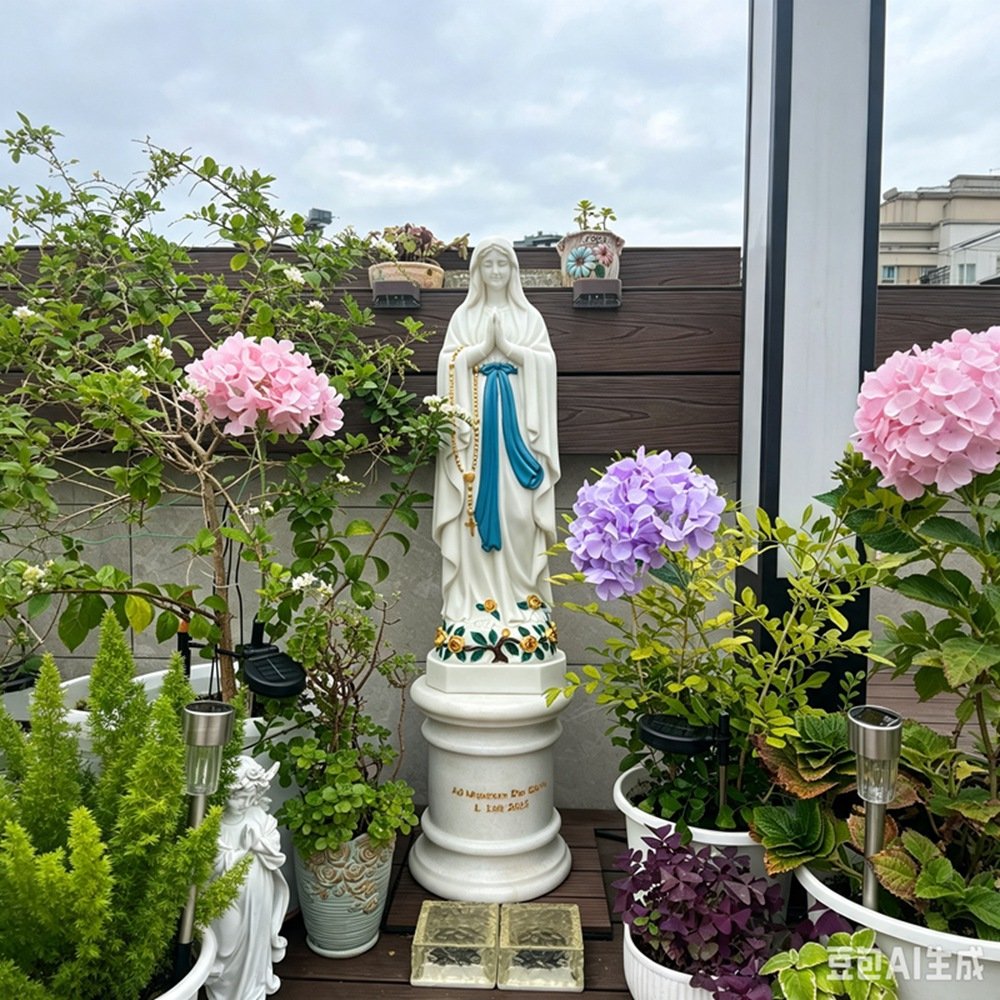
Real Hong Kong Story: We recently worked with a client in Hong Kong who created a stunning balcony Mary Garden in a high-rise apartment. Her balcony was only about 6 feet by 4 feet, but she transformed it into a sacred oasis. She chose an 18-inch marble Our Lady of Lourdes statue and surrounded it with potted lavender, blue iris, and periwinkle in beautiful ceramic planters. She told us, “In this crowded city, my balcony is my Lourdes. I step out here after work, and the city noise fades. It’s just me, Mary, and the flowers.” She even installed a small solar lantern that glows softly at night, making her little shrine visible from inside her apartment—a constant reminder of Mary’s presence.
Urban Faith: You don’t need a sprawling estate to create sacred space. A Hong Kong balcony, a New York fire escape, a Tokyo apartment terrace—Mary meets us where we are, in the space we have.
Step-by-Step: Building Your Mary Garden
Let me walk you through this like I’m helping a friend create their first Mary Garden. We’ll take it step by step, and before you know it, you’ll have your own sacred space.
Step 1: Select Your Location
- Choose a spot with appropriate sunlight for your chosen flowers
- Can be against a wall, corner of yard, inside grotto/gazebo, or even a balcony
- Ensure the statue focal point is clearly visible
- Consider accessibility for prayer and maintenance
Tip: Stand in the spot at different times of day. Where does the morning light fall? Where would you naturally pause to pray? Let the space speak to you.
Step 2: Prepare the Pedestal/Plinth
- Choose stone, brick, concrete, or sturdy decorative plinth
- Height elevates the statue as visual and spiritual center
- Ensure stability for outdoor weather conditions
Practical Note: For balcony gardens, a simple sturdy plant stand or small decorative table works beautifully—no masonry required!
Step 3: Place Your Chosen Marble Mary Statue
- Secure statue firmly (use adhesive, anchors, or weight for stability)
- Position facing the main viewing/prayer direction
- Consider backdrop (wall, arch, grotto, or open sky)
Sacred Moment: When you place your statue for the first time, say a prayer. This is the moment your garden becomes a Mary Garden—the moment it becomes holy ground.
Step 4: Arrange Your Plants
For ground gardens:
- Prepare soil with good drainage
- Plant mixed symbolic flowers and herbs around the plinth
- Use taller plants (gladiolus, lilies) toward back, shorter (violets, baby’s breath) in front
For container/balcony gardens:
- Use quality potting soil in pots and planter boxes
- Group potted symbolic plants surrounding the statue
- Vary heights with plant stands or stacked containers
Planting as Prayer: As you plant each flower, think about its meaning. When you plant a lily, think of Mary’s purity. When you plant a rose, think of her joys and sorrows. Your hands in the soil become hands folded in prayer.
Step 5: Add Finishing Details
- Stone edging or brick border
- Solar lanterns or pathway lights
- Small bench or kneeler for prayer
- Space to leave cut-flower offerings
- Optional: small plaque with prayer or garden dedication
Step 6: Seasonal Care
- Replace seasonal bloomers (spring bulbs, summer annuals, fall mums)
- Trim herbs and perennials
- Keep devotional space neat and welcoming
- Refresh mulch or decorative stone
- Clean statue periodically (gentle soap and water for marble)
Ongoing Devotion: Caring for your Mary Garden is itself a form of prayer. Every time you water, weed, or deadhead spent blooms, you’re tending not just a garden but a relationship.
Symbolic Flowers & Herbs: Quick Reference Guide
Each plant in a Mary Garden tells a story. Here’s your guide to the language of Mary’s flowers:
| Plant | Marian Meaning & Legend |
|---|---|
| Lily | Mary’s purity; golden stamens represent Jesus or Mary’s holiness |
| Rose (white/red/yellow) | Mystical Rose. White = joys; red = sorrows; yellow = glories |
| Blue Iris | Mary’s fidelity; blade-shaped leaves for her sorrows; fleur-de-lis symbol |
| Gladiolus | Sword-shaped leaves stand for Mary’s sorrows (Latin “gladius” = sword) |
| Baby’s Breath | Mary’s innocence, purity, breath of the Holy Spirit |
| Ivy (evergreen) | Mary’s constant faithfulness |
| Violet | Mary’s humility; bloomed when Mary accepted the angel’s message |
| Blue Columbine | “Our Lady’s slipper”; sprung where Mary stepped visiting Elizabeth |
| Marigold | “Mary’s gold”; simplicity, domestic life; legend of Flight into Egypt |
| Rosemary | “Rose of Mary”; turned blue when Baby Jesus’ garments touched it |
| Thistle | Our Lady’s thistle; spotted leaves from drops of Mary’s milk |
| Lavender | Reminds of Jesus’ swaddling clothes |
| Bleeding Heart | Heart of Mary; her maternal sorrow |
| Forget-me-not | Mary’s eyes |
| Daisy | Bloomed beside the manger; star guiding the wise men |
| Hosta “Assumption Lilies” | Tall late-summer stalk symbolizes the Assumption of Mary |
| Cornflower | Mary’s crown |
| Periwinkle (blue) | The Virgin’s flower |
| Larkspur, Lily of the Valley | Mary’s tears |
| Daffodil | Mary’s star |
| Sweet Woodruff | Our Lady’s bedstraw; straw lining of the manger |
Final Tips from the Heart
Start Small: Even a miniature potted Mary Garden on your balcony or patio carries the same devotional meaning as a large church shrine. Begin with what your space and budget allow. Our Hong Kong client started with just one statue and three pots—and she says it changed her spiritual life.
Visit for Inspiration: Tour existing Mary Gardens at local parishes, monasteries, or Catholic institutions. Take photos and notes on what appeals to you. Let other gardens teach you what speaks to your heart.
Personalize Your Devotion: Choose statue and flowers that resonate with your personal Marian devotion—whether that’s the rosary, a specific apparition, or Mary’s maternal care. This is your conversation with Mary; make it authentically yours.
Involve Community: If building for a parish or school, involve volunteers in planting days. This builds ownership and ensures ongoing care. Some of the most beautiful Mary Gardens I’ve seen were planted by children’s hands—a little crooked, perfectly imperfect, and deeply loved.
Pray as You Plant: The act of creating a Mary Garden is itself a prayer. Offer each plant as a meditation on Mary’s virtues. Your garden grows in two directions—roots down into the earth, prayers up to heaven.
Maintain Reverence: Keep the space clean, well-tended, and beautiful. A neglected Mary Garden loses its devotional impact. But don’t stress about perfection—Mary understands wilted roses and weeds. She was a mother; she knows about messes and second chances.
A Living Prayer
A Mary Garden is more than beautiful landscaping—it’s a living prayer, a visual catechism, and a sanctuary where heaven and earth meet through flowers, stone, and the loving gaze of the Mother of God. Whether grand or modest, whether in a church courtyard or on a Hong Kong balcony, your Mary Garden becomes a sacred space where you and others can encounter Mary’s intercession and example in the beauty of God’s creation.
The white marble statue stands serene among the blooms. The lilies open their faces to the sun. The roses—white for joy, red for sorrow—nod in the breeze. And Mary, carved in timeless stone, watches over it all with a mother’s patient love.
You don’t need acres. You don’t need a fortune. You just need a willing heart, a small space, and the desire to make room for the sacred in your daily life. Start today. Plant one flower. Place one statue. Say one prayer.
Your Mary Garden is waiting to be born.
— St. Bonaventure