For centuries, the image of the Blessed Virgin Mary has been a beacon of grace, comfort, and intercession for the faithful. Her statues grace churches, garden grottos, home altars, and other sacred spaces worldwide.
Choosing the right Mary statue is both spiritual and practical: it means understanding her titles, picking the right material, and finding the ideal place for it.
Drawing on decades of experience, we’ve found most clients order different titles of marble or bronze Marian statues between 0.7 ft and 8 ft, sized to fit their space and purpose.
In this guide, we’ll cover the most popular styles, materials, prices, and placement tips—based on our consulting experience and global client orders.
What Are the Most Popular images of Mary Statues?
The Catholic tradition honors Mary under many titles, each reflecting a different aspect of her role in salvation history.
At YouFine, every statue we create is carved based on authentic religious iconology—but it’s more than technical accuracy.
Most of our artists are Catholics themselves, and they pour their devotion into every chisel stroke, every polished surface.
These aren’t just products. They’re prayers in stone.
Here are the most sought-after styles, drawn from years of client orders, installation photos, and heartfelt testimonials:
Our Lady of Grace
This is the most popular style of Mary statue from our factory.
This statue often appears in two primary forms:
The first form is the “Miraculous Medal” Pose (Rue du Bac): Mary’s arms are extended downward, palms open, with rays of light streaming from her hands. She stands on a globe, crushing a serpent beneath her feet.
The second is the Mother and Child Version: Mary holds the infant Jesus, both dressed in blue and white robes—the more traditional “Our Lady of Grace” that predates the Miraculous Medal apparition.
We have carved both forms for clients from three continents.
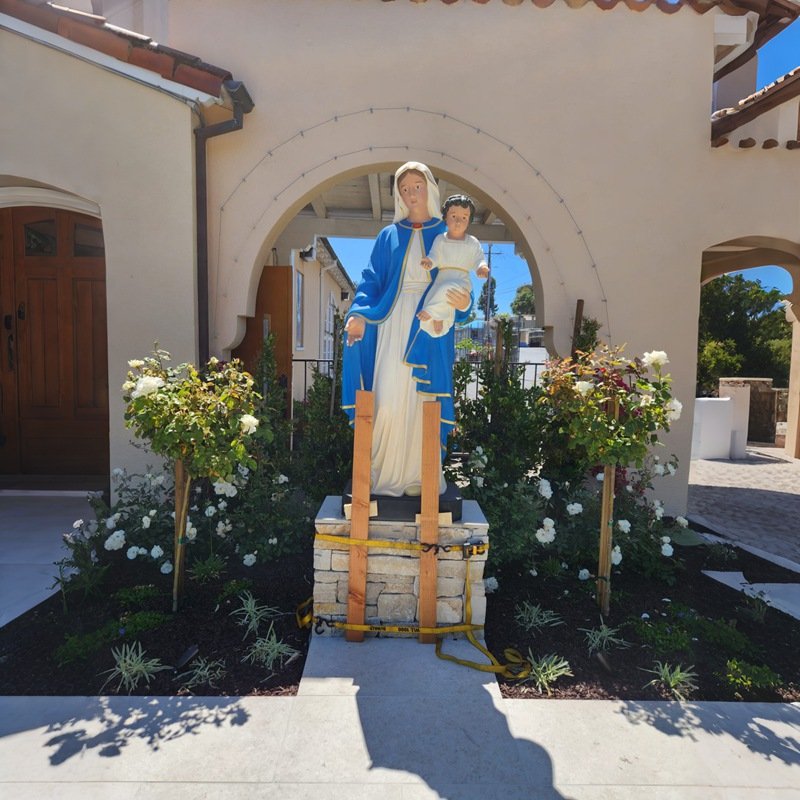
We created a beautiful Mother-and-Child version for a client in Santa Clara County—right in the heart of Silicon Valley.
The outdoor painted statue, with Mary’s blue mantle and tender embrace of Jesus, now graces their garden.
In a place obsessed with innovation and disruption, she stands as a counterbalance: the most important thing is still love. The most important relationship is still mother and child.
Another client from Canada installed the classic “arms extended” version of Our Lady of Grace in their manicured front garden.
The statue—white robes, palms open, serpent crushed beneath her feet—stands welcoming visitors. Our client told me this is a statement: This is who we are. This is who we’ve always been. We’re not hiding.
What’s more, one of my Irish clients placed the “arms extended” statue in his home altar.
I think this is what living faith looks like.
This is where the family prays together.
Where children learn to fold their hands and close their eyes.
Where teenagers come when they’re heartbroken.
Where parents light a candle when they’re worried.
Where grandparents’ photos sit, because they’re still part of the family, still prayed for, still loved.
Our Lady of Guadalupe
This is one of our most popular styles—we create her in marble, in bronze, in sizes ranging from intimate home altars to monumental church installations.
In this image, Mary stands on a crescent moon, supported by an angel, hands clasped in prayer, surrounded by a radiant sunburst halo. Her mantle is adorned with stars—each element rich with Nahuatl symbolism and Catholic theology beautifully intertwined, just as she appeared to Saint Juan Diego in 1531.
This statue is deeply meaningful to Latin American communities and is widely venerated across North, Central, and South America. But for many of our clients who come from Hispanic backgrounds, she carries an additional layer of meaning—a nostalgia that brings back memories of grandmother’s altar, the family shrine in childhood homes, the smell of candles and prayers whispered in Spanish.
One of my clients placed this statue in his church’s Holy Family Garden as a special tribute to the Hispanic population at their church. He told me:
“Our Priest and all of the people watching the placement of the statue were amazed at the beauty of Our Lady of Guadalupe!”
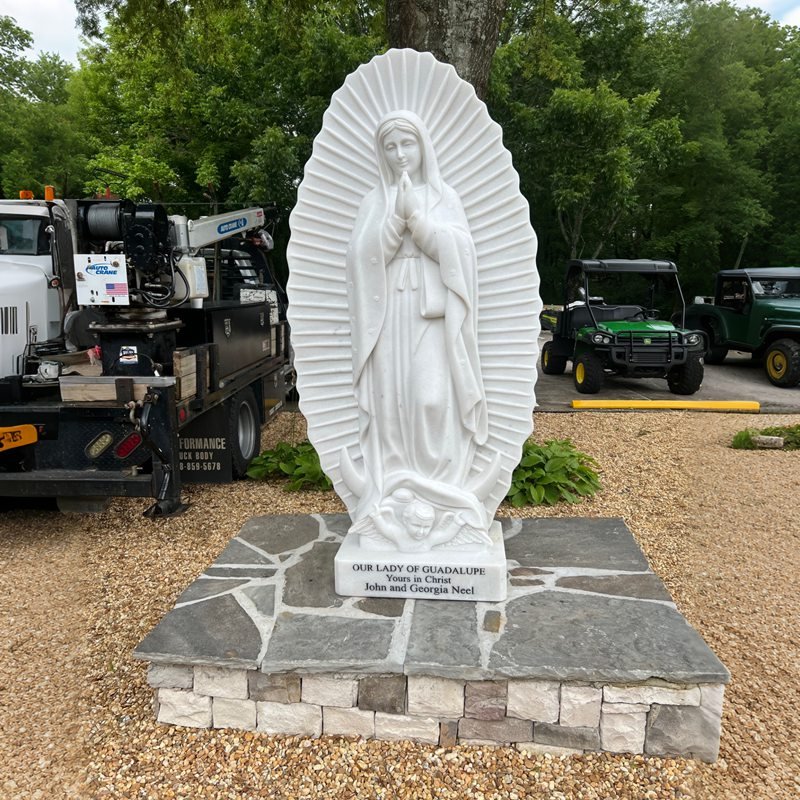
160cm (w/ crown): $1680-$1798 | 180cm: $2350-$2480
“Everyone was amazed by the statue’s exquisite beauty.” — Customer
Our Lady of Fatima
Commemorating the 1917 apparitions in Portugal, this statue shows Mary in a white robe and veil, often with a golden crown and holding a rosary.
She is associated with peace, penance, and the conversion of sinners.
The crown is the key feature of this statue.
Our Lady of Fatima wears a crown symbolizing her identity as “Queen of Heaven“—this is what distinguishes her most clearly from Our Lady of Lourdes, who appears simple and unadorned.
Fatima is regal.
Her message was urgent: Pray the rosary. Do penance. Consecrate Russia to my Immaculate Heart.
We’ve shipped Fatima statues to St. Lucia, where she’s deeply beloved in Catholic communities. One of our clients placed her in their parish church, where she stands as a reminder that Mary reigns as Queen, interceding for a world desperately in need of peace.
In Latin America, too, the crowned figure of Fatima is a powerful presence—not just gentle mother, but sovereign protector.
Our Lady of Lourdes
Depicted with hands clasped in prayer, wearing a simple white veil and blue sash, the image of Our Lady of Lourdes statue recalls the 1858 apparition in France.
A rosary hangs from her hands, and roses often adorn the base.
She is the mother of healing and hope, making her a beloved choice for prayer rooms, chapels, and garden grottos.
She has no crown or elaborate ornament—just hands folded in prayer, white robe, blue sash, rosary beads.
Her power is in her simplicity—she’s not trying to impress anyone. She’s just there, praying, waiting for you to join her.
We once carved an Our Lady of Lourdes statue for St. Louis de Montfort Academy in Pennsylvania—hands clasped in prayer, rosary hanging, white robes glowing.
At night, the grotto is illuminated, visible from across campus—a glowing reminder that you are not alone, you are not forgotten, there is a Mother who prays for you always.
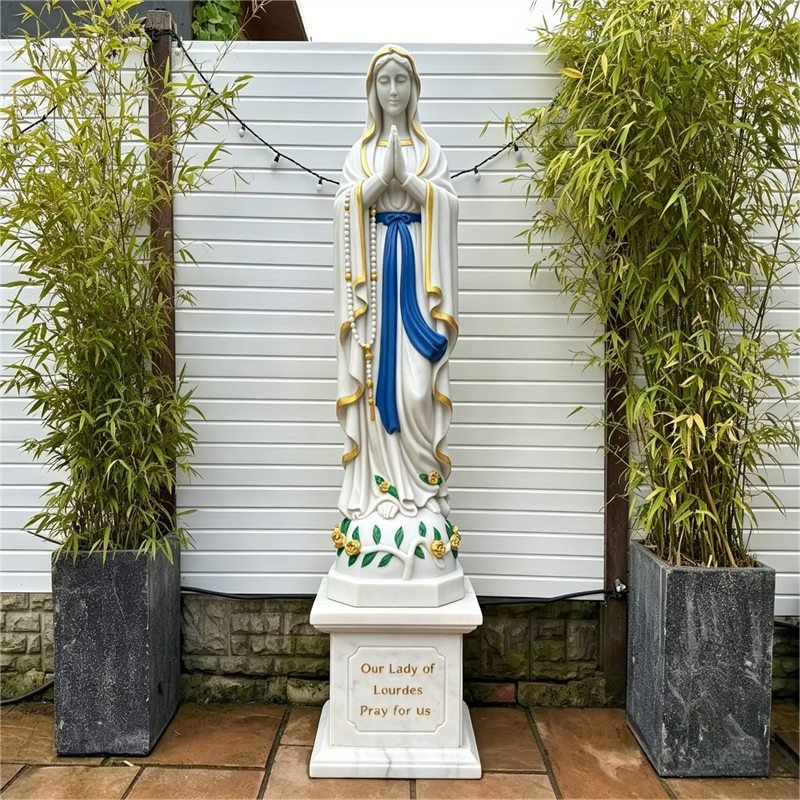
Prices (USD): 160cm $1,680–$1,800 / 180cm $2,350–$2,500
Our Lady of the Immaculate Conception
In this style, Mary stands atop a globe or serpent, with hands folded in prayer or extended in blessing.
This statue celebrates the dogma that Mary was conceived without original sin. It is a symbol of purity and divine favor.
We created a custom marble statue with fine detailing and hand-painted finish for a client in Ireland. It now stands in their private prayer space, a reminder that Mary was preserved from sin from the first moment of her existence, prepared to be the spotless vessel for the Incarnation.
Our Lady of Peace
The Our Lady of Peace statue is often depicted with the Christ Child, sometimes holding an olive branch or with a dove. Her expression is serene, her posture gentle.
We’ve created custom Our Lady of Peace statues for clients in Austria.
The clients placed it in their church courtyard, inviting passersby to pause and pray.
In places where the memory of war still lives in old stones, she whispers: Be still. Peace is possible.
Our Lady of the Rosary
Mary is depicted holding the rosary, often with the Christ Child in her arms.
This image emphasizes her role as the Queen of the Holy Rosary and is a powerful reminder of the importance of this prayer in Catholic devotion.
One of our clients commissioned this statue for his castle garden, hoping to memorialize his late wife and pray for her soul, trusting that Mary would bring her into heaven.
Our Lady of Knock
Commemorating the 1879 apparition in Ireland, this image shows Mary in silent prayer, often accompanied by St. Joseph and St. John the Evangelist, with a lamb and cross on an altar behind them.
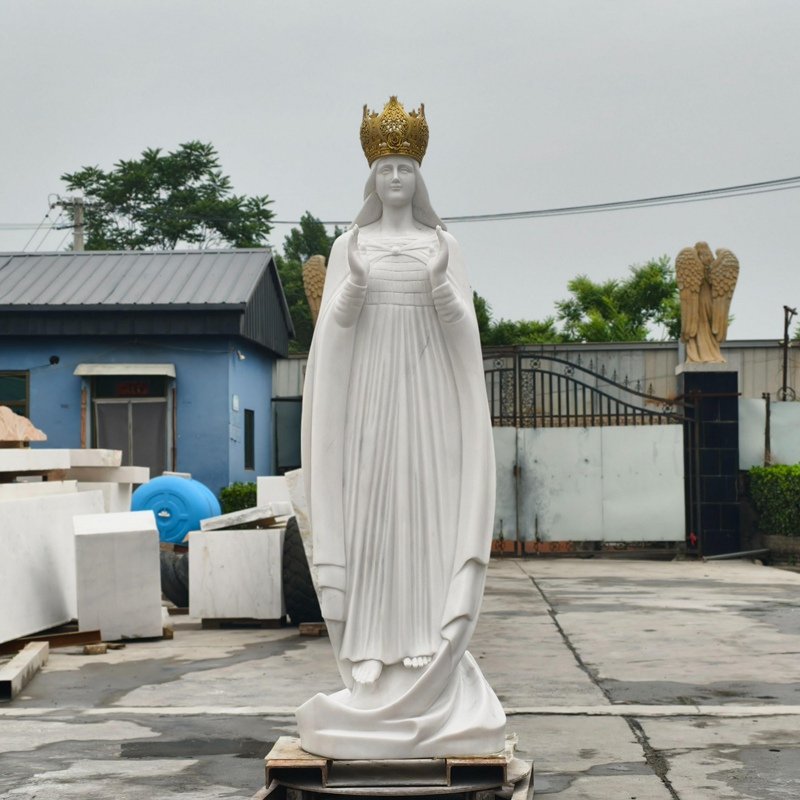
Sizes (with crown): 160cm $1,680–$1,830 | 180cm $2,280–$2,480
Our Lady of Sorrows (Mater Dolorosa)
Depicted with seven swords piercing her heart, the Our Lady of Sorrows statue captures Mary’s suffering at the foot of the cross.
It is a profound meditation on her compassion and co-redemptive role in Christ’s Passion.
Our Lady of Mount Carmel
This image is often shown with Mary holding the Christ Child and a scapular. She is the patroness of the Carmelite Order and a symbol of protection and devotion to the Sacred Heart.
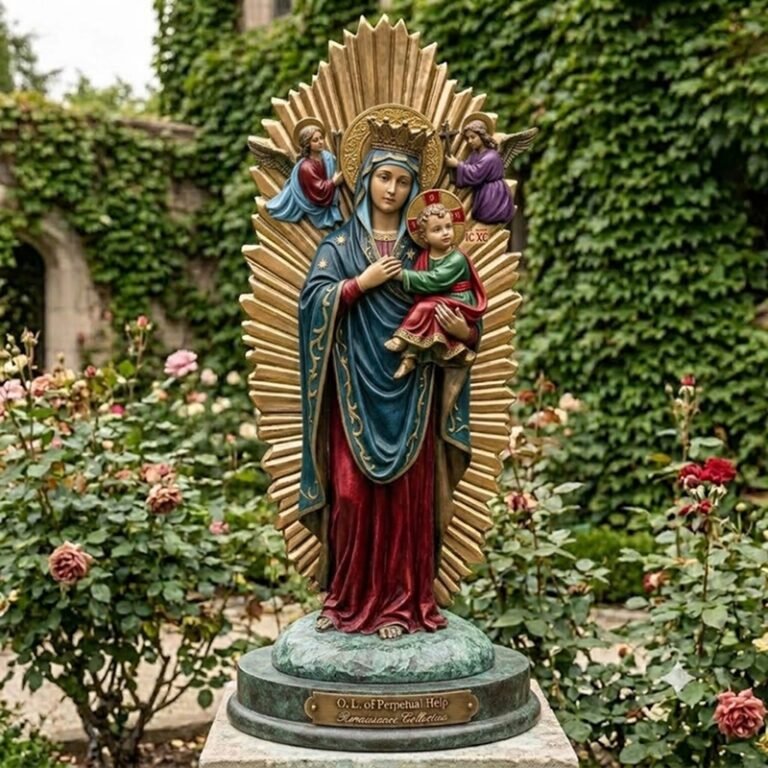
Our Lady of Perpetual Help
This image shows an icon-style image of Mary holding the Christ Child, who gazes at the instruments of the Passion held by angels. This image is a reminder of her constant intercession and maternal care.
Our Lady of Czestochowa (Black Madonna)
A revered icon from Poland, this image shows Mary with the Christ Child, both with darkened faces. She is a symbol of national identity and spiritual resilience.
Our Lady of La Vang
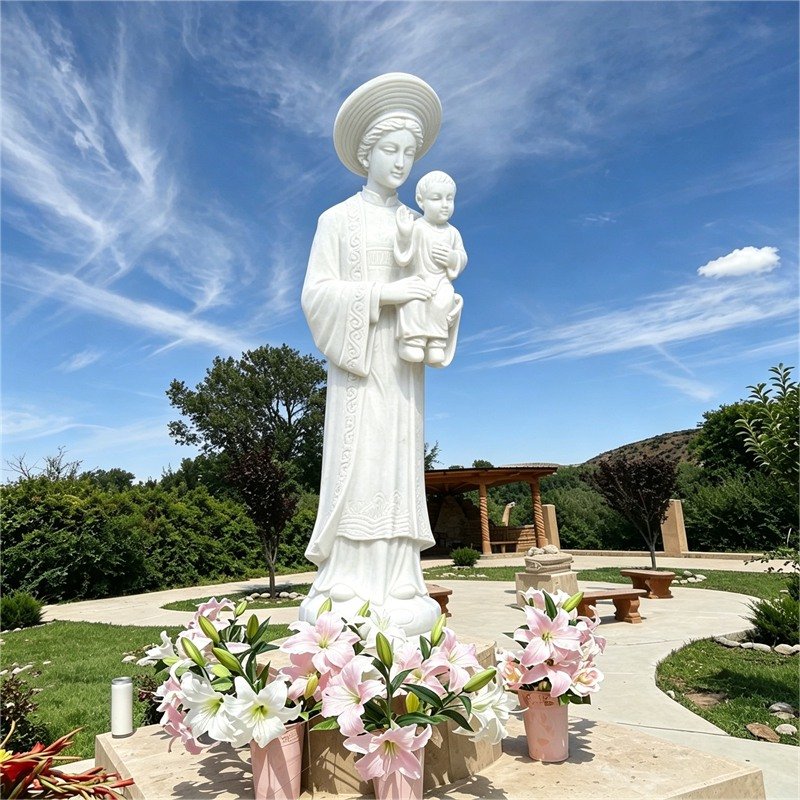
This is a new title of Our Lady for us. I want to thank our Vietnamese clients—especially a Vietnamese Catholic priest—for his custom order. Thanks to him, we now know this beautiful image of the Virgin Mary.
In this statue, you can see Our Lady wearing a traditional Vietnamese áo dài dress and khăn đống hat. She looks like a Eurasian mother and holds the Baby Christ tenderly.
She is a symbol of hope and protection for Vietnamese Catholics around the world, as she is the patroness of Vietnam, protecting and interceding for Vietnamese Catholics everywhere.
Where These Statues Find Their Home?
Over the years, we’ve learned that where people place these statues is as meaningful as the statues themselves. Here’s what we’ve observed:
Church & Parish Installations
- Outdoor memorial plazas (especially Our Lady of Guadalupe in Texas parishes)
- Stone grottos (Our Lady of Lourdes in Pennsylvania schools, parish gardens)
- Church courtyards and gardens (Our Lady of Peace in Austria and Germany, Our Lady of Fatima in Caribbean parishes)
- Parking lot shrines (Our Lady of Guadalupe throughout the American South)
Private Home Settings
- Front yard gardens (Our Lady of Grace in Quebec, California)
- Home altars (Our Lady of Grace in Irish homes, often as the centerpiece of family prayer spaces)
- Private prayer rooms (Our Lady of the Immaculate Conception in Ireland)
- Lavender fields and manor gardens (Our Lady of Lourdes in American estates)
Institutional Spaces
- Catholic schools (Lourdes grottos in boarding schools like St. Louis de Montfort Academy)
- Monastery gardens (Our Lady of Peace in Central European religious communities)
- Hospital chapels (Our Lady of Perpetual Help, Our Lady of Lourdes)
Cultural & Regional Patterns
- Texas & American Southwest: Our Lady of Guadalupe dominates—she’s the heart of Hispanic Catholic identity
- Caribbean & Latin America: Our Lady of Fatima, crowned and regal
- Ireland: Home altars with Our Lady of Grace, Our Lady of the Immaculate Conception
- Quebec/French Canada: Front-yard installations of Our Lady of Grace—public expressions of Catholic identity
- Central Europe: Our Lady of Peace in church courtyards
- Vietnamese diaspora communities: Our Lady of La Vang in homes and parishes worldwide
- Poland: Our Lady of Czestochowa as national symbol
What Materials Are Used for Mary Statues?
Based on our clients’ purchasing records, the overwhelming majority choose marble or bronze for their Marian statues. This choice follows both Catholic tradition and personal spiritual devotion to Mary.
What Is the Tradition of Marble and Bronze in Religious Statuary?
Both marble and bronze have been the materials of choice for religious art for centuries. Once the first Catholic cathedrals rose above the European skyline, human beings were already reaching for these two materials to give form to the sacred: marble and bronze.
Why Choose Marble for a Mary Statue?
Marble’s relationship with the sacred is as old as Western civilization itself. Its use in statue art dates back to the Greeks, who carved their gods from the finest white stone available to the ancient world. These were not decorative objects. They were understood to be the literal dwelling places of the divine: the god inhabited the statue, and the statue made the god present to the worshipping community.
As time moved to Rome, the Romans used this material to build the famous Santa Maria Maggiore. And do you still remember Michelangelo’s Pietà I wrote about in my previous post? It can be seen as the first great Mary statue made of marble. Throughout the Medieval and Renaissance periods, marble remained a classical material for religious statuary.
What’s more, the purity and high quality of marble give it a timeless aesthetic appeal that has endured for hundreds of years. This material was born with the sacred, showing the pure faith we offer to Mary and echoing her title of the Immaculate Conception.
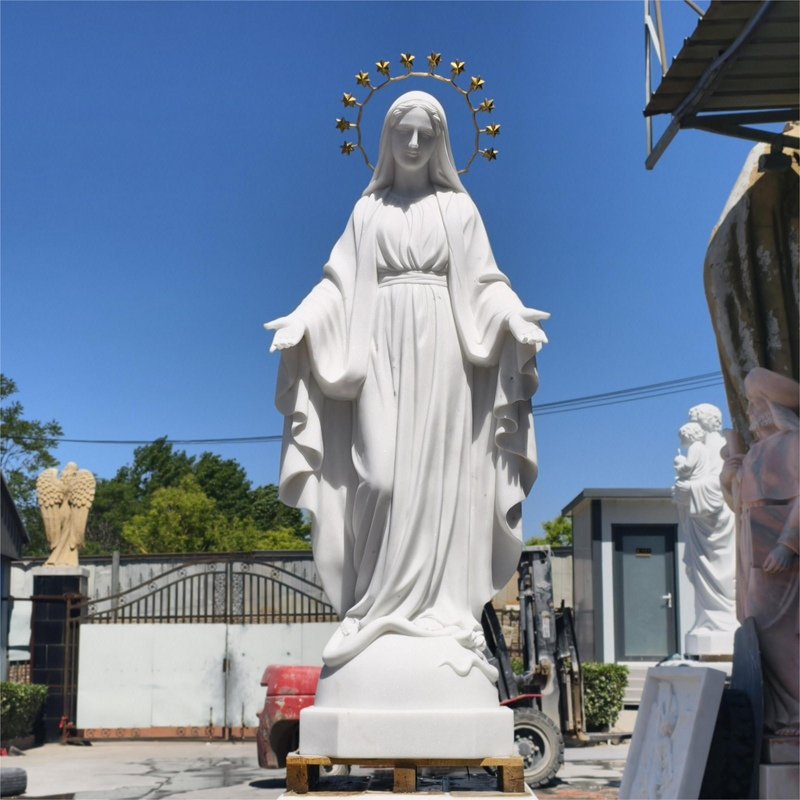
Sizes & Prices (including crown): 5.25 ft ($1,850–$1,980) / 5.91 ft ($2,450–$2,650)
Why Choose Bronze for a Mary Statue?
If marble is the material of light and purity, bronze is the material of endurance and authority.
As the first metal alloy mastered by human civilization—and almost immediately, it was put to sacred use.
The great bronze doors of the Pantheon—repurposed as the entrance to a Christian church—set a precedent that was followed across the medieval world.
The bronze doors of Saint Peter’s Basilica, cast in the fifteenth century by Antonio Filarete, depicted scenes from the lives of Christ and the apostles in a medium that was understood to be as permanent as the faith it represented.
Medieval Europe produced an extraordinary tradition of bronze religious objects: reliquaries, altar crosses, baptismal fonts, and monumental tomb effigies.
The Renaissance brought bronze to the same heights it brought marble.
Lorenzo Ghiberti’s bronze doors for the Florence Baptistery—what Michelangelo called the Gates of Paradise—are among the greatest works of art ever produced in any medium.
In the centuries that followed, bronze became the preferred material for monumental outdoor religious statuary—for the simple reason that it survives.
A marble statue exposed to centuries of rain, frost, and pollution will eventually erode.
A properly cast and maintained bronze statue will not.
The great outdoor Marian statues of Europe—the Immaculata columns in Rome, Vienna, and Munich; the monumental Our Lady of Fatima at the Cova da Iria—are bronze precisely because they were built to last not for a generation, but forever.
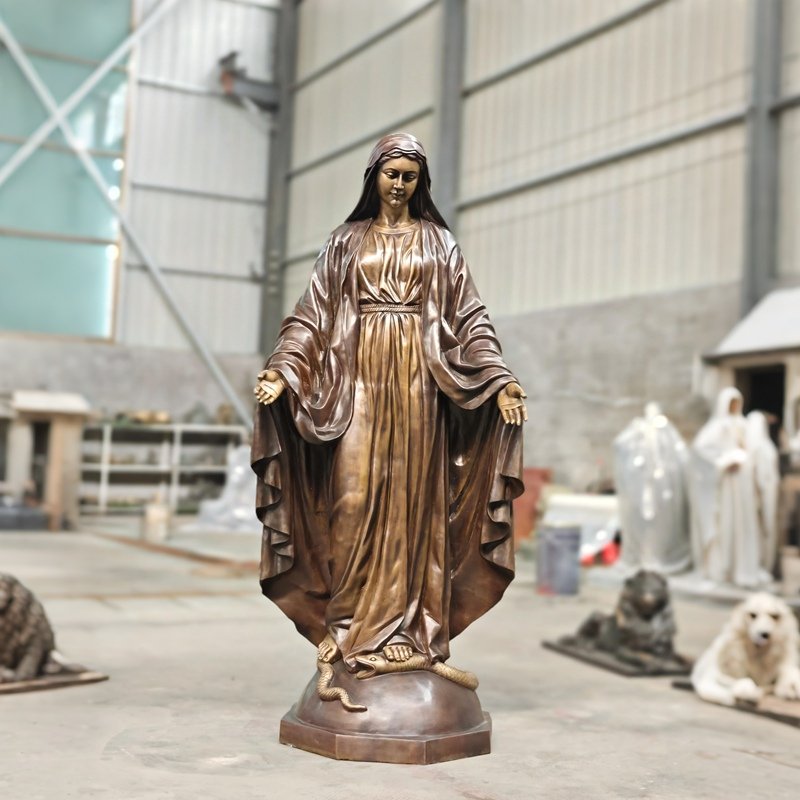
Price: $3,100–$3,450 USD
How to Choose the Material for Your Mary Statue
We should understand that marble and bronze are not in a competitive relationship.
The history of religious art is not a competition between marble and bronze—it is a conversation.
The two materials have always coexisted, each serving the purposes for which it is best suited.
The choice of material depends on your budget, aesthetic preferences, and placement surroundings
. If you’re in a dilemma, I suggest you ask an expert for help—just like we do at YouFine!
How Much Does a Mary Statue Cost?
The price depends on several factors: style, material, size, and—if you’re ordering internationally—shipping and customs.
As an experienced consultant, I’ve summarized the prices for the most common styles and sizes our clients order. Here’s a realistic guide based on our catalog:
| Height | Material | Price Range (USD) |
|---|---|---|
| 160 cm (5.25 ft) | Natural White Marble | $1,485 – $1,980 |
| 180 cm (5.91 ft) | Natural White Marble | $2,130 – $2,650 |
| 135 cm (4.43 ft) | Cast Bronze | $1,780 – $1,980 |
| 170–183 cm (5.58–6.00 ft) | Cast Bronze | $3,150 – $4,130 |
What’s more, we’ve also created a search catalog for you—it won’t collect any of your personal information, and you can use it freely to explore options and get a sense of what’s available.
Where Can I Buy a Mary Statue?
You have options.
You can visit a local workshop or religious goods supplier—there’s something to be said for seeing the statue in person, for running your hand along the marble, for standing in front of it and asking yourself: Is this the one?
You can also shop online, where the world opens up: more styles, more materials, more possibilities.
But here’s the thing—not all suppliers are created equal.
If you’re looking for the combination of quality, authenticity, and value—allow me to make a case for Our YouFine.
We’ve been doing this for 43 years.
We’ve shipped statues to over 50 countries—from small parish churches in rural Ireland to grand cathedrals in Latin America, from private prayer gardens in California to monastery courtyards in Austria.
We’ve seen what works.
We’ve learned what matters.
Here’s what sets us apart:
Factory-Direct Pricing
We’re not middlemen.
We’re the makers.
That means you get factory pricing—no markups, no hidden fees. Just honest value for sacred art.
Artists Who Pray
Most of our sculptors are Catholics themselves.
They don’t just carve statues—they carve prayers.
They understand the iconography.
They know why the angle of Mary’s hands matters, why the folds of her veil carry meaning.
This isn’t assembly-line work. It’s devotion made visible.
Not sure which title of Mary is right for your space?
Wondering whether marble or bronze is better for your climate?
We have professional religious art consultants who can guide you—not to upsell, but to help you find the statue that will become a cornerstone of prayer for generations.
One-Stop Service
From design consultation to custom carving, from crating to international shipping, from installation advice to after-sales care—we handle it all.
You don’t need to coordinate between five different vendors. You work with us, and we take care of everything.
Decades of Trust
We’ve been entrusted with some of the most sacred commissions imaginable: statues for churches, schools, hospitals, private chapels.
We don’t take that lightly.
Every statue that leaves our workshop carries our reputation—and more importantly, it carries the faith of the person who ordered it.
So yes, you can buy a Mary statue anywhere.
But if you want one that will last forever, that honors both tradition and craftsmanship, that comes from a place of faith and not just commerce—we’d be honored to create it for you.
That’s not a sales pitch. That’s just the truth.
Final Thoughts
A statue of the Blessed Virgin Mary is not an object to be chosen lightly. It is a legacy piece—something that will be passed down through generations, a silent witness to countless prayers, tears, and moments of grace.
When choosing your statue, ask yourself:
- What title of Mary speaks most deeply to my heart?
- Where will this statue live, and what will it witness?
- What material best honors both the space and the devotion?
Whether you choose the serene beauty of marble or the enduring strength of bronze, whether you place her in a church sanctuary or a quiet garden corner, remember this:
A statue of Mary is a visual prayer.
It is a reminder that we are never alone, that grace is always available, and that a mother’s love never ends.
May your chosen statue become a source of comfort, a focal point for prayer, and a testament to the enduring presence of Our Lady in your life.
That’s what YouFine does. That’s what we send out into the world.
Not just statues.
Encounters. Thin places. Doorways.