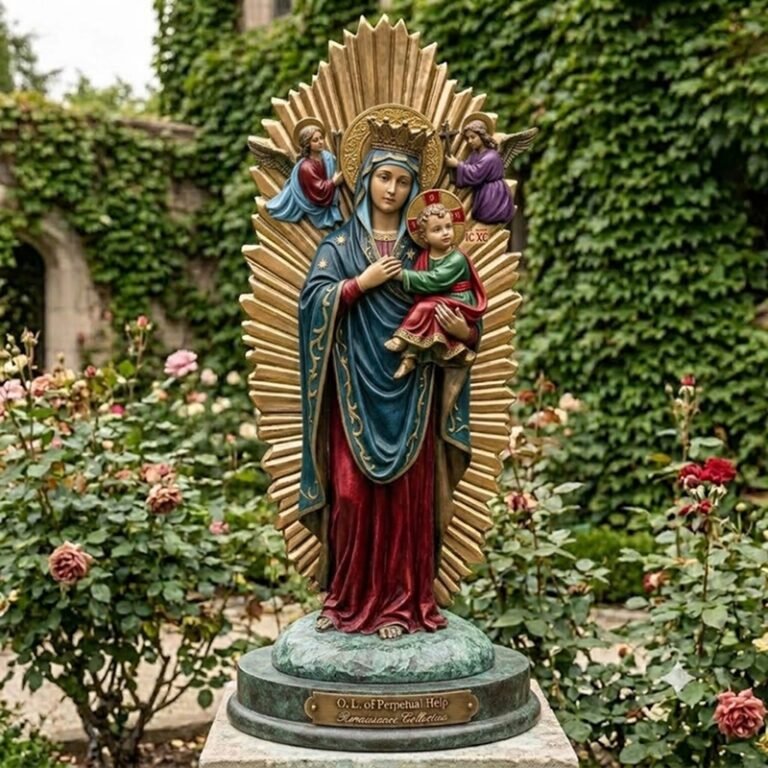
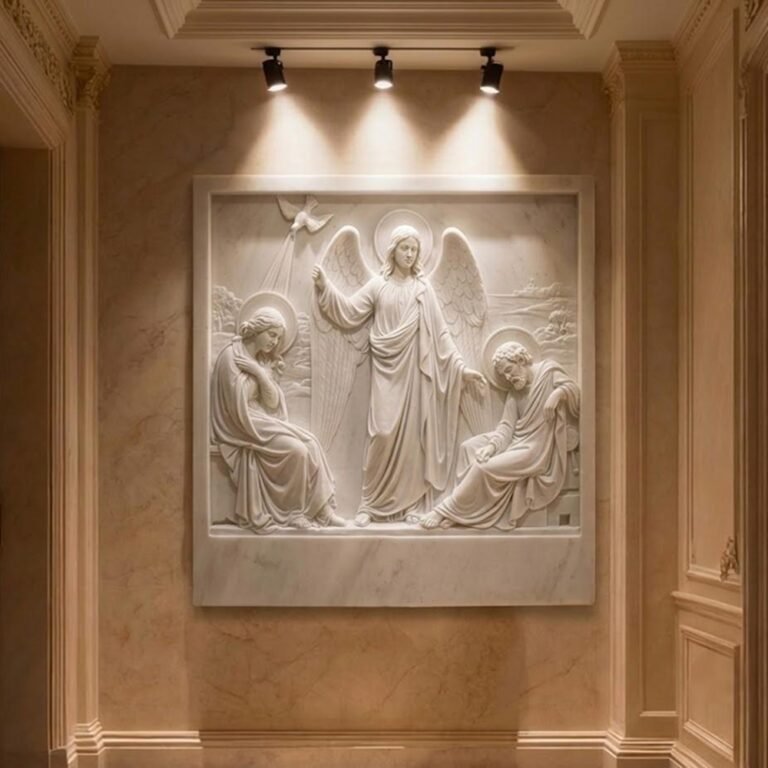
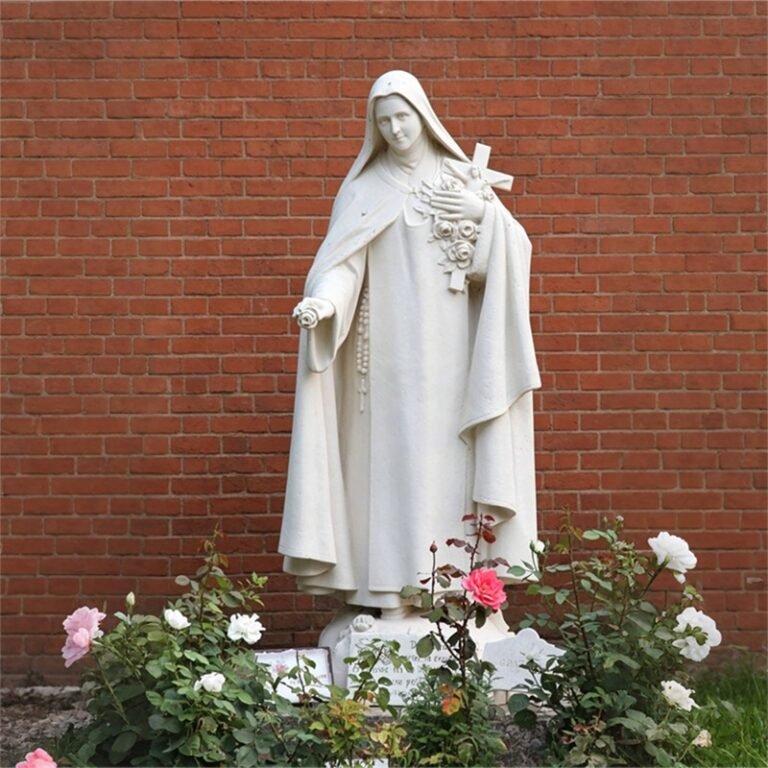
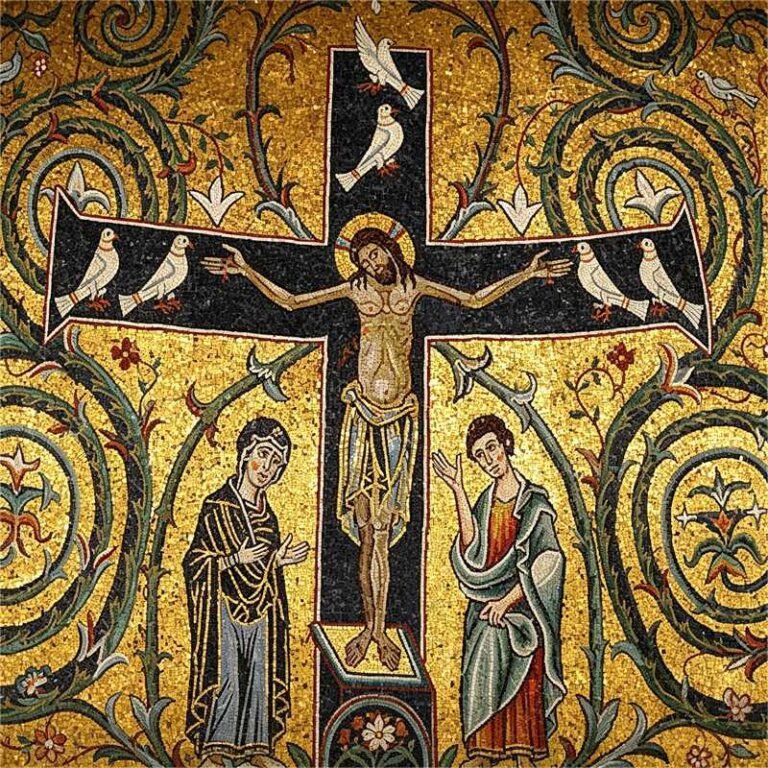
Our Lady of Knock is the title given to the Blessed Virgin Mary as she appeared on the evening of August 21, 1879, at the gable wall of the Parish Church of Saint John the Baptist in Knock, County Mayo, Ireland.
Whatever her apparition and statues reveal to us, they all converge upon the same three paths of self-redemption through goodwill: loving your family, might rooted in silence, and keeping faith at all times.
In this post, I will share the story of Our Lady of Knock — what her apparition means, and how to choose a statue worthy of venerating her. May it give a hand to everyone who feels drawn to this image.
What Is the Apparition of Our Lady of Knock?
It was a rain-soaked Thursday evening — August 21, 1879 — in the west of Ireland. Something happened that the Catholic Church would spend the next century trying to fully understand.
It was not a private vision.
It was not a single message whispered to a child.
It was a silent, luminous tableau — witnessed by fifteen souls of all ages, standing in the pouring rain for two hours — that has drawn millions of pilgrims to a small village in County Mayo ever since.
The Virgin did not speak.
She did not deliver a message in words.
She simply appeared — radiant, deep in prayer, eyes lifted to heaven — and let the image itself become the word.
She was not alone.
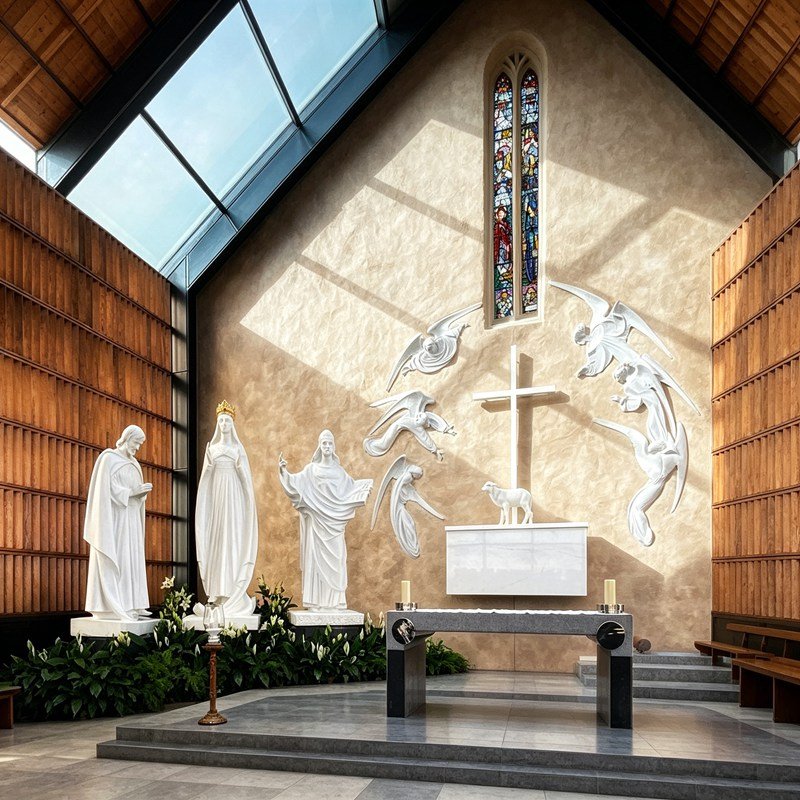
Flanking her were Saint Joseph on her right and Saint John the Evangelist on her left — the Beloved Disciple dressed in episcopal vestments, holding an open book, his right hand raised in blessing.
Behind them stood a plain altar bearing a Lamb with a Cross, surrounded by hovering angels and encircled by golden stars.
The entire gable wall blazed with a brilliant light visible from a great distance — a light that did not flicker, did not fade, and cast no shadow on the rain-soaked ground beneath.
The fifteen witnesses ranged in age from five to seventy-four. They stood in driving rain for nearly two hours, reciting the Rosary. Not a single drop of rain fell upon the gable wall or the figures.
This is the whole scene of the Knock apparition.
Silence is its central theme. But silence, rightly received, is more fruitful than all speech — and the meaning behind this apparition does not announce itself. It asks us to contemplate.
The apparition came at one of the darkest moments in Irish history.
The Land League had just been founded. Evictions were rampant.
Famine still haunted living memory.
Our Lady of Knock appeared to a people who had almost nothing — and gave them something no landlord could ever take away: the certainty of heaven’s attention.
The shrine that grew from that evening now welcomes over 1.5 million pilgrims annually.
What Is the Knock Apparition Saying to Us?
The Knock apparition is unlike any other Marian apparition — such as Lourdes or Fatima — in the Catholic tradition, precisely because it said nothing at all.
No secrets.
No warnings.
No requests.
And yet it may be the most theologically dense vision in the entire history of Marian devotion.
The apparition was not Mary alone. The Lamb, Saint Joseph, Saint John the Evangelist — every figure present carries meaning.
Yet I hold that the true depth of this vision cannot be reached by analyzing each element in isolation.
The whole scene — what we behold and feel as one — is the revelation.
In my view, the core of this silent apparition points toward three paths of self-redemption through goodwill.
I. Loving Your Family
In this apparition, we behold the Holy Family. The Lamb of God stands upon the altar of sacrifice.
Mary stands beside Him, deep in prayer, her gaze lifted to heaven. Saint Joseph stands at her right, equally still, equally faithful.
In the moment of Christ’s sacrifice — no crying, no struggle.
The mother and father simply pray as guardians, bearing witness in love. This is the power of a united family: not loud, not dramatic, but unbreakable.
Mary’s silent presence at Knock embodies precisely this.
She simply remains — beside the altar, beside the Lamb, beside Joseph — modeling the quiet fidelity that holds a family together when everything else is falling apart. Her intercession at Knock was, at its root, a maternal act: a mother staying present for her children in their darkest hour.
Pope John Paul II, who made family love a cornerstone of his pontificate, wrote in Familiaris Consortio:
“The future of humanity passes by way of the family.”
— Familiaris Consortio, §86, Pope John Paul II, 1981
In traditional Chinese humanistic philosophy, the same conviction runs deep.
The ancient ideal of cultivating oneself, regulating one’s family, ordering the state, and bringing peace to the world — drawn from the Great Learning — places family harmony as the very foundation of all moral progress.
East and West, the conviction is the same: begin with those you love.
The silent apparition of Our Lady of Knock bridges both wisdoms, and leads every heart back to that same first calling.
II. Might Rooted in Silence
Mary and Saint Joseph were Jesus’ earthly guardians throughout His mortal life — His steadfast protectors who prepared the ground for His sacred mission.
Much of their contribution came not from words or visible deeds, but from enduring, faithful silence.
Their quiet obedience and hidden guardianship created a shelter within which the Redeemer could grow, and work, and give Himself fully to the world.
This silence was not passivity. It was a form of power — the power of those who have surrendered their own will entirely to God’s.
Mary’s fiat at the Annunciation — “Be it done unto me according to thy word” (Luke 1:38) — was spoken once, in words.
Everything that followed was lived in silence. At the foot of the Cross. At the gable wall of a church in County Mayo. Always present. Always praying. Never demanding to be heard.
“Silence is God’s first language; everything else is a poor translation.”
— St. John of the Cross, The Ascent of Mount Carmel
Prayer fuels inner strength.
Silence opens space for genuine self-redemption.
Following the example of the Holy Family, we learn an essential path to self-perfection: to pause in quiet reflection, to examine our faults without excuse, to let silence strip away impetuosity and vanity — and in that stillness, to mend what is broken and nurture what is good.
Silence is not weakness.
It is the posture of those who are strong enough to listen.
III. Keep Faith at All Times
Look again at the figures who appeared at Knock in 1879.
They did not appear in glory, in a cathedral, or before a crowd of thousands.
They appeared on the rain-soaked gable wall of a small parish church in one of the poorest counties in Ireland — in silence, in the dark, in the rain.
That choice of setting was not incidental.
It was the message.
Mary stood at the center, clothed in white, her hands raised and joined in prayer, her eyes lifted to heaven. She wore a brilliant crown. She said nothing.
But those who knew her story understood what that silence contained.
She had watched her Son be condemned, flogged, and crucified. She had stood at the foot of the Cross without flinching, without fleeing, without demanding that God explain Himself.
The raised hands, the upturned eyes: this was not a new prayer. It was the same prayer she had always been praying.
Still interceding.
Still faithful.
Still present.
Joseph stood to her right — bowed slightly, his head inclined toward Mary in a gesture of reverence and quiet deference.
He spoke no word.
He had lived his entire vocation in hiddenness.
He received no vision of the Resurrection.
He left no written word.
And yet he stayed — beside Mary, beside the child, beside the mystery he could not fully understand.
His faithfulness was not heroic in the way the world measures heroism. It was something quieter and harder: the daily, unglamorous decision to remain present to what God had placed in his hands.
At Knock, that same faithfulness appeared one final time — not in action, but in posture.
A man, standing beside his wife, bowing his head. Decades after his earthly death, still at her side. Still faithful.
The apparition asked nothing more of Joseph than it had always asked: be present, and remain.
Saint John the Evangelist stood to Mary’s left .
He was dressed in episcopal vestments, holding the open Book of the Gospels in his left hand, his right hand raised in the gesture of preaching, as though mid-homily.
The witnesses noted that he seemed to be speaking — though no sound reached them.
And at the center of the altar stood the Lamb — silent, still, surrounded by adoring angels, bearing the marks of slaughter and yet alive.
Behind Him rose the Cross. Around Him, golden stars hovered in the brilliant light.
The Book of Revelation names Him “the Lamb who was slain from the foundation of the world” (Revelation 13:8).
His faithfulness is not a response to circumstances. It is His nature.
The Cross behind Him was not a reminder of defeat.
It was the proof that suffering, received in faith, becomes the axis around which all of creation turns.
Mary. Joseph. John. The Lamb. Each one, in their own way, had already lived this definition to its fullest — long before they appeared together on that gable wall in County Mayo.
And then there were the fifteen witnesses — the ones standing in the rain.
They had no theological training.
No advance warning.
No instruction on what to do.
They ranged in age from five to seventy-four.
They were farmers, laborers, and villagers — people who had already lost more than most people in the Western world will ever be asked to lose.
They simply looked — and stayed.
For nearly two hours, in driving rain, they stood and recited the Rosary.
Not one of them walked away.
They received what was given — a silent tableau of faithful figures, gathered around the Lamb — and they gave back the only thing they had: their presence.
That is faith in its most unadorned form.
Not the faith of the theologian parsing definitions, but the faith of the soaked and the grieving, standing in the dark before something they cannot explain, choosing to remain.
That is the witness of Knock — not that faith removes hardship, but that faith transforms it.
The shrine that grew from that evening now draws over 1.5 million pilgrims a year, each one carrying their own rain, their own darkness, their own reason to stay.
Our Lady of Knock did not come to explain suffering.
She came to stand in it — silently, faithfully, and without end.
That is the invitation she extends to each of us still.
What Does an Our Lady of Knock Statue Mean for You?
The apparition has passed into history.
But a statue holds that moment in permanence — a fixed point of grace in the flow of ordinary days.
An Our Lady of Knock statue is a devoted reminder: a call to self-redemption, a quiet summons to keep your benevolence alive in this earthly life.
And the people who make these statues carry that same calling in their own hands.
Our director Dora holds a deep personal devotion to Our Lady of Knock.
When she stands before the statue, she feels a calling — to stay humble, to learn in silence, to love without noise.
That love moves outward in concentric circles: first to her family, then to her country, then to her life’s work of carrying Chinese craftsmanship into the world.
“All love is ordered love — beginning with those nearest, and extending outward to the whole of creation.”
— St. Augustine, The City of God, Book XV
Dora loves her family first. From that root, she loves her country.
From that love of country, she carries Chinese craftsmanship — its discipline, its precision, its quiet pride — into the service of the world’s sacred spaces. The Second Vatican Council affirmed that this kind of labor is itself a participation in the divine creative act.
She keeps the quality.
She keeps the standard.
She keeps the faith in what her hands — and the hands of those she leads — are capable of making. And she has succeeded, not despite the silence, but because of it.
That is the strength of faith and effort working as one.
The same spirit dwells in our sculptors.
Many of our master carvers are devout Catholics themselves.
Before they lift a chisel, they study — the iconographic texts, the theological records, the witness accounts of the apparition itself.
They do not simply copy a form.
They inhabit it.
In the silence of the workshop, they read the scriptures, contemplate the image, and let the meaning of what they are making settle into their hands before it settles into the stone.
The result is not a product.
It is a practice — and it shows in every fold of the veil, every angle of the crown, every expression rendered with the precision that only comes from someone who genuinely understands what the image means.
What the Images of Our Lady of Knock Statue ?
Because the Knock apparition left no spoken message, the image itself became the devotion.
Every element of the traditional depiction carries theological weight — and every statue or artwork of Our Lady of Knock is, in effect, a visual catechism carved in stone or cast in bronze.
| Element | Symbolic Meaning |
|---|---|
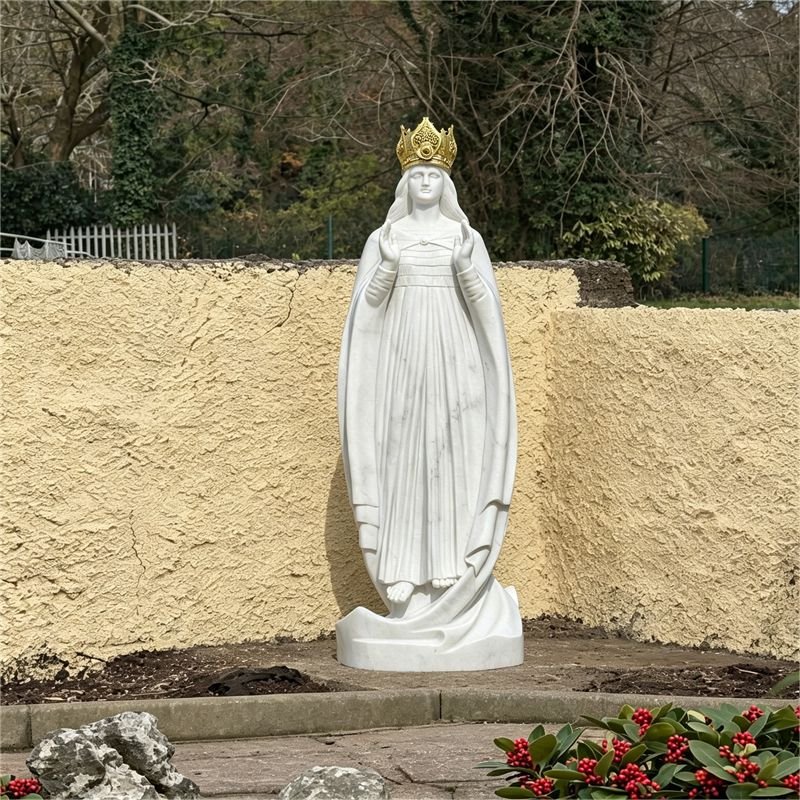
| White gown & veil | Purity, the Immaculate Conception, and Mary’s total consecration to God. In white marble, this luminosity reaches its fullest expression — echoing the witnesses’ description of Our Lady as almost iridescent, a figure of light made tangible in stone. |
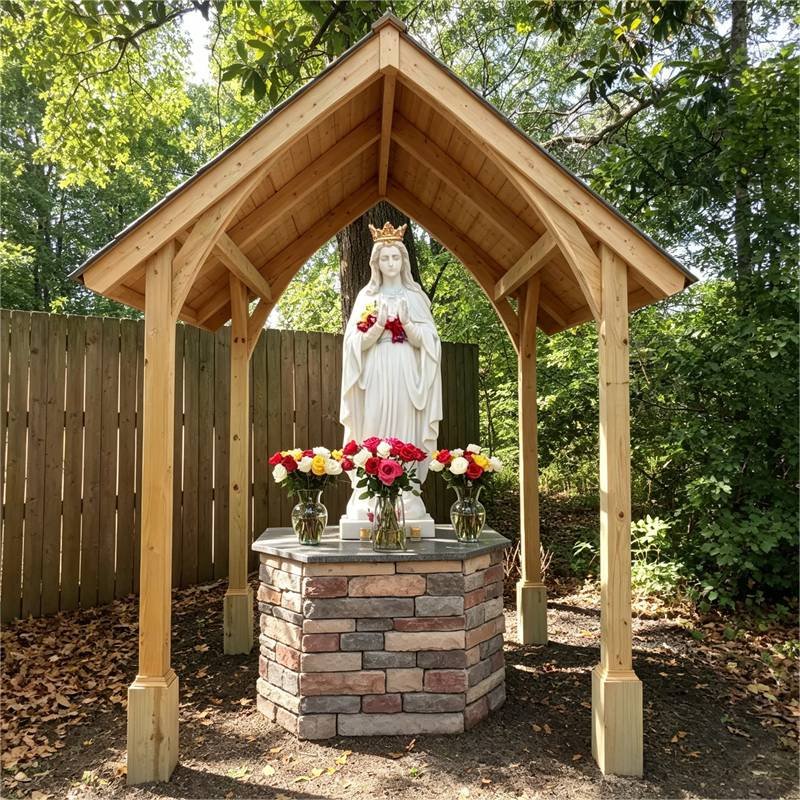
| Gold crown | Mary as Queen of Heaven and Queen of Ireland — her royal dignity as Mother of the King of Kings. In our gilded-crown garden statue, the crown is a separate openwork gold piece set atop the white marble figure, creating a striking visual contrast of white stone and gold that reads with quiet majesty in outdoor light. |
| Gold rose between crown and veil | The Mystical Rose — one of Mary’s most ancient titles. Beauty, love, and the flowering of grace in a world that had nearly forgotten both. |
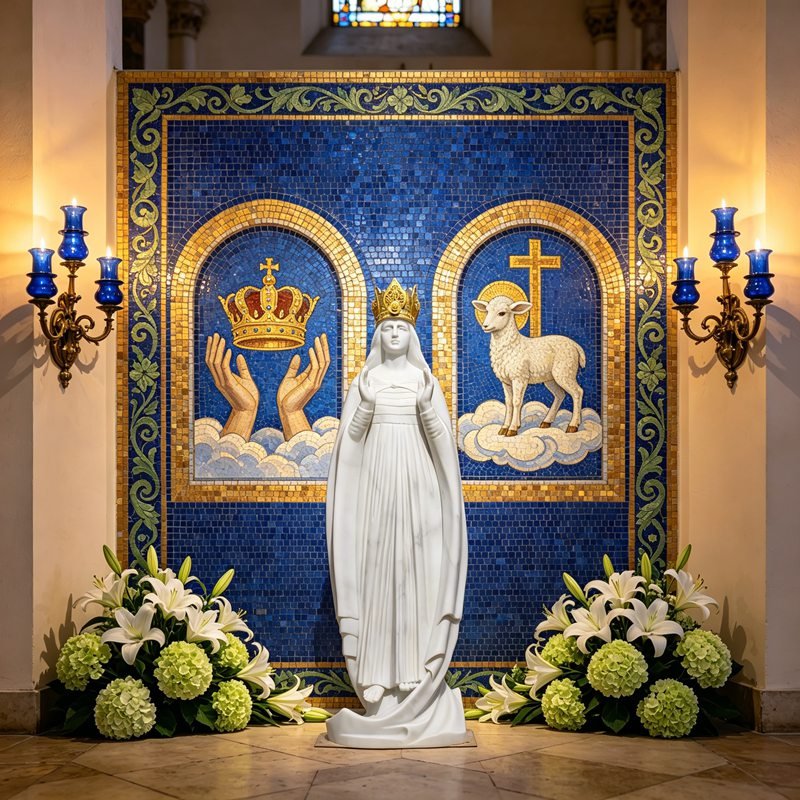
| Hands joined in prayer, eyes to heaven | The posture of intercession — Mary as perpetual advocate before the throne of God, faithful to her children long after the vision faded. Strictly preserved from the 1879 witness accounts. In our artistic customized version, the outer robe wraps inward to embrace the body — a flowing, contemplative interpretation of this same prayerful stillness, rendered for intimate indoor spaces. |
| Bare feet | Humility and holiness — the mark of one who stands on holy ground. This detail is faithfully preserved across every version we produce, from the garden quantity piece to the full-scene replica. |
| The Lamb on the altar | Christ the Lamb of God; the Eucharistic sacrifice; the Mass as the living heart of Catholic life. Present in our full-scene group sculpture, faithfully reproduced from the 1879 apparition as rendered by Italian sculptor Lorenzo Ferri for the Knock Shrine in 1960. |
| Saint Joseph & Saint John the Evangelist | The Holy Family and the Beloved Disciple — the Church gathered in silence around the altar of sacrifice. Both figures appear in our full-scene Carrara marble group replica: Saint Joseph to the left of Mary, Saint John to the right, with six flying angel reliefs surrounding the outer composition in faithful correspondence to the original vision. |
| Angels | The heavenly court bearing witness to the sacrifice of the Lamb — hovering, adoring, encircling the altar in golden light. Present as companion angel sculptures in our garden and cemetery combination pieces, extending the sacred scene into the landscape around them. |
| The Cross | The instrument of redemption, standing behind the Lamb on the altar — the axis of all Christian hope. Featured prominently in our cemetery cross combination piece, designed for Irish and European outdoor memorial gardens where the Cross must speak plainly to those who grieve. |
How to Choose Your Our Lady of Knock Statue
Choosing a statue of Our Lady of Knock is not simply a matter of aesthetics. It is a matter of fidelity — to the image, to the tradition, and to the sacred space where the statue will stand for generations.
Material: Marble or Bronze?
For any statue that will occupy a permanent sacred space — indoors or outdoors — the choice comes down to two materials. Everything else is a compromise.
| Material | Best For | Character |
|---|---|---|
| Bronze | Outdoor shrines, parish gardens, memorial courtyards, cemetery installations, exposed niches — anywhere the elements are unforgiving | Endures all climates without compromise; deepens with age, developing a venerable patina that speaks of permanence and devotion. The gold standard for outdoor religious sculpture. Our bronze Knock statues are cast from certified virgin bronze ingots using the traditional lost-wax method — never recycled metal, never a shortcut. |
| White Marble | Church interiors, sheltered chapel niches, formal indoor altars, private oratories, high-end religious residences, basilica sanctuaries | Unmatched luminosity — particularly fitting for Our Lady of Knock, whose apparition was described as almost iridescent. The white marble echoes her white gown and veil with a fidelity no other material can match. Our premium Carrara marble is hand-carved by sculptors who study the iconographic tradition before they touch the stone. |
A note on white marble specifically: the witnesses at Knock described Our Lady as wearing a white gown so luminous she appeared “almost iridescent.”
A white marble statue — especially in a sheltered chapel setting with natural or candlelight — captures that quality of radiant whiteness more faithfully than any other material.
For an indoor shrine to Our Lady of Knock, white marble is not merely a good choice.
It is the right choice.
Size: Matching the Statue to the Space
| Size | Ideal Placement | Effect |
|---|---|---|
| 60–120 cm (2–4 ft) | Small chapel niche, garden focal point, hospital corridor, school oratory | A devotional presence that anchors the space without overwhelming it. |
| Life-size: 150–180 cm (5–6 ft) | Church entrance, parish garden, memorial courtyard, cemetery focal point | Commanding and reverential — draws the eye, stills the step, and invites approach. |
| Over-life-size: 180 cm+ | Outdoor shrine, basilica forecourt, hilltop memorial, large pilgrimage garden | Monumental — a landmark of faith that speaks before you reach it. |
Placement Taboos
A statue of Our Lady of Knock is a sacred object.
Where it is placed communicates something — about the space, the community, and the faith of those who put it there. A few principles worth holding to:
- Never place her facing away from the primary approach. Our Lady of Knock’s posture — hands joined in prayer, eyes lifted to heaven — is meant to be encountered face-on. A statue positioned with its back to those who enter defeats the entire purpose of the image.
- Avoid direct, harsh overhead lighting. The apparition at Knock was bathed in soft, brilliant light — not a spotlight, but a radiance. Harsh overhead lighting flattens the sculpture and kills the sense of luminosity. Soft, angled light — natural or artificial — always serves the image better.
- Do not place her in a purely decorative context. Our Lady of Knock is not garden décor. She belongs in a space that signals sacred intent: a defined prayer garden, a chapel niche, a shrine area with kneelers or a prayer card holder nearby. The space around the statue should invite pause, not passage.
- Avoid placement near noise or distraction. The silence of the Knock apparition is not incidental — it is the message. A statue placed near a busy road, a playground, or a commercial entrance loses the contemplative quality that makes the image powerful. She belongs where people can stop, and be still.
- For outdoor bronze: ensure proper anchoring. A life-size bronze statue requires a proper foundation and anchoring system. This is not optional — it is a structural and safety requirement, and any reputable foundry will provide full engineering specifications as part of the commission.
Final thoughts
Our Lady of Knock came to a people who had almost nothing — and gave them the one thing that cannot be taken away: the certainty that heaven sees, and heaven cares.
A statue in her honor is not a decoration. It is a declaration — made in stone or bronze, placed in the world to draw people toward something larger than themselves, for generations to come.
Whether you choose a gilded-crown garden piece for a parish courtyard in Ireland, a full-scene Carrara marble group for a basilica, an artistic customized figure for a private chapel, or a cemetery cross combination for a memorial garden — the image is the same at its heart: a mother, silent, praying, faithful.
Eyes lifted.
Hands joined.
Present.
Commission it with the same seriousness with which she appeared — silently, faithfully, and for the long term.