I apologize for introducing this title so late in our series on Our Lady Mary. Among the hundreds of beloved titles given to the Blessed Virgin Mary, “Our Lady of Grace” is one of the most ancient, tender, and universally cherished. This title allows us to see her through the lens of God’s most generous gift to humanity: grace.
She is not a different Mary; she is the same eternal Mother, viewed through the perspective of grace itself. In this sense, Our Lady of Grace embodies the New Eve, demonstrating selfless, motherly love as heaven pours its unconditional and unlimited love upon our earthly existence.
What is The Story Behind Our lady of Grace?
If you have read my other three posts about the Virgin Mary, you will find a truth: Every apparition of Mary occurs before ordinary people, even those on the margins of society. For example, Our Lady of Lourdes appeared to St. Bernadette, Our Lady of Fatima to three shepherd children, and Our Lady of Guadalupe to impoverished farmers. The story of the apparition of Our Lady of Grace also begins in an ordinary yet miraculous moment.
It starts in Rome, in the year 1610, inside the monastery church of Maria della Scala.
A Discalced Carmelite priest named Venerable Dominic of Jesus-Mary was inspecting an old, broken-down house he hoped to convert into a monastery. By some twist of fate, he walked toward a pile of rubbish near the entrance and discovered an oil painting of the Blessed Virgin Mary, covered in dust and debris, torn and forgotten.
Grieved, he carried the painting back to his cell, carefully cleaned it, and had it restored. He placed it on the shelf above his prayer corner and began pouring out his heart before it, praying for the souls of those who came to him in affliction, sorrow, and need.
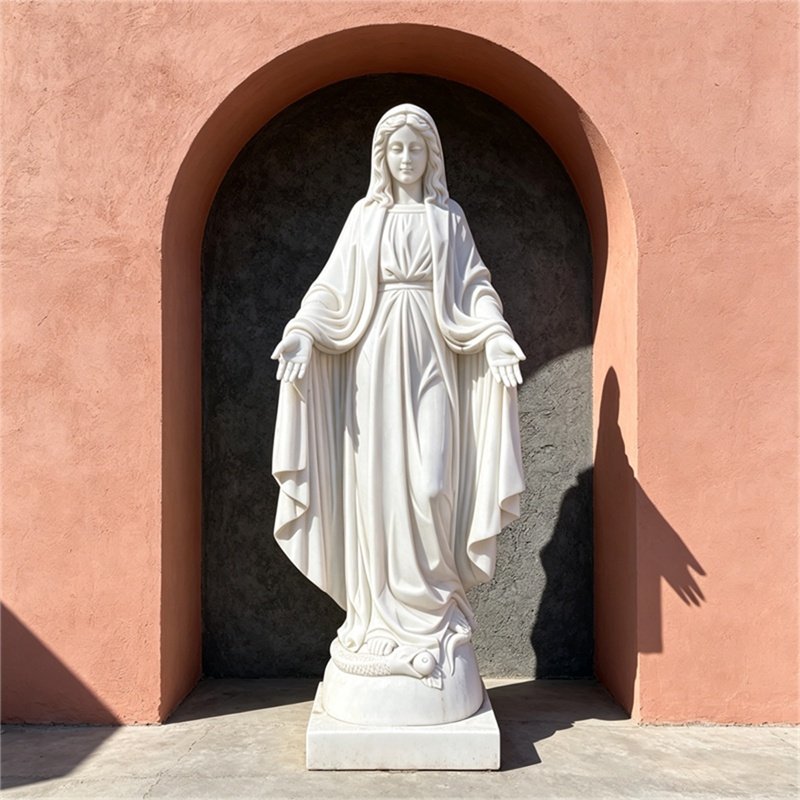
Then came the night that changed everything.
One evening, Dominic noticed a thin layer of dust had settled on the image again. He took a coarse woolen handkerchief and dusted the painting, whispering his apology:
Then, a miraculous thing happened: Our Lady smiled at him and bowed her head. This action represented acknowledgment and love, which is why Our Lady of Grace is also known as Our Lady of the Bowed Head.
After Dominic’s death, the original painting traveled from Rome to Munich, then to Emperor Ferdinand II of Austria and his wife Eleanore.
On September 27, 1931 — the 300th anniversary of its arrival in Vienna — it was solemnly crowned by Pope Pius XI.
Today it rests in the monastery church of Vienna Döbling, still bowing her head toward those who come to her.
But this is only one thread in a much older tapestry.
What Does Our Lady of Grace Represent?
The title “Our Lady of Grace” is not simply a poetic name.
It is a theological statement — one that reaches back to the very first words the Archangel Gabriel spoke to Mary: “Hail, full of grace.”
That single phrase, kecharitomene in the Greek, shaped centuries of Catholic devotion and became the very foundation of Augustinian Marian theology — the oldest Marian devotion of the Augustinian Order, first mentioned as early as 1282.
The Channel of Grace
In Catholic theology, grace is a free and unmerited gift from God, available only through Jesus Christ.
In this sense, Our Lady of Grace does not possess grace itself. Instead, she is the model who is fully endowed with grace after her conception.
What does this mean?
According John 16:15, Jesus said:“All that the Father has is mine”
Christ, the Son, is eternally begotten of the Father and receives His divine nature from Him.
He receives all that He has in His divinity from the Father.
Likewise, in His humanity, mirroring and reflecting His divinity, He receives all that He has in His humanity from His mother.
In this sense, Our Lady is like a channel, even an ark, who gives birth to Jesus and makes the grace of God through the life, death, and resurrection of Jesus flow freely into our world.
She is the one who leads us to Him, intercedes for us before Him, and opens the floodgates of His mercy when we are too weak or too broken to knock on the door ourselves.
The New Eve
Saint Augustine, whose Order carries this devotion as its oldest, wrote beautifully of Mary as the New Eve — the woman through whom Life was born into the world, just as death had entered through the first Eve. The union of the Word and human flesh, Augustine described as a nuptial union, with the womb of the Virgin as the bridal chamber. This is the mystery of the Incarnation itself, and Our Lady of Grace stands at its very center.
The Universal Mother
She is the patroness of the grieving, the lost, the burdened, and the forgotten — not only of those who sail physical seas, but of those who navigate the darker, interior oceans of suffering, doubt, and longing. Her open arms say what words sometimes cannot: You are not alone. Come.
What The Miracles of Our Lady of Grace
Grace, by its nature, leaves marks. And the history of Our Lady of Grace is woven through with moments where heaven visibly touched earth.
The Bowed Head of Vienna
The most intimate miracle is the one already told — the living smile, the bowing head, the soul lifted from Purgatory. It happened in a small cell, between a humble priest and a dusty painting. And yet it changed the world’s devotion.
The Shepherd Boy of Montenero
In 1345, near the foot of Monte Nero in Livorno, Italy, a poor crippled shepherd boy was tending his flock when a brilliant light appeared and a heavenly fragrance filled the air. A voice asked him to carry a sacred image of the Blessed Mother to the top of the mountain. Despite his crippled leg, he made the climb — and at the summit, he felt a strange sensation, as though his leg had been untied. He bounded back down the mountain, waving his crutch in the air, weeping with gratitude. A shrine was built on that site, and many healings and graces followed in the years after.
The Miraculous Medal
The devotion to Our Lady of Grace took on a new and universal form in 1830, when the Blessed Virgin appeared to a young Parisian nun named St. Catherine Labouré. In this apparition, Mary stood with her hands extended, rays of brilliant light streaming from her rings — each ray representing a grace she wished to give to those who asked. She instructed Catherine to have a medal struck in her image. That medal became the Miraculous Medal, and the image upon it — hands open, light flowing, standing on the globe — is the very image we know today as Our Lady of Grace.
How Can We Venerate Our Lady of Grace?
Devotion to Our Lady of Grace is not a complicated or exclusive thing. It is, at its heart, simply the act of a child turning toward a mother. Here are the most beautiful ways to honor her.
Wear the Miraculous Medal
To wear it is to carry Mary’s image close to your heart — a quiet, daily act of trust in her maternal protection. St. Catherine Labouré reported that Mary herself said: “All who wear it will receive great graces.”
Pray the Rosary
The Rosary is Mary’s own prayer — the one she has asked for again and again across centuries of apparitions. To pray it in honor of Our Lady of Grace is to meditate on the life of Christ through her eyes, to walk the mysteries of salvation at her side.
Celebrate Her Feast Days
The feast day of Our Lady of Grace is celebrated on February 7th. Other Marian feasts — the Assumption, the Immaculate Conception, the Feast of Our Lady Mother of Divine Grace on July 23rd — are all beautiful occasions to honor her with Mass, novenas, and quiet prayer.
Worship with Our Lady of Grace Statue
Of all the ways we honor Our Lady of Grace, perhaps none is more enduring—or more visually rich—than the statue. For centuries, Catholic homes, churches, shrines, and gardens have been graced by her image: hands open, light streaming, standing serene above the chaos of the world.
An Our Lady of Grace statue is like a 3D icon. I have mentioned the reason why Catholics can place statues of Mary, Jesus, or the saints in our sacred spaces. We do not honor the marble, bronze, or whatever material the statue is made of; we worship the saint whose image has been passed down through the centuries.
Thus, a statue is not merely decoration. It is a focal point for the soul—a place where the eyes can rest, the heart can open, and prayer can begin.
What are the typical elements of an Our Lady of Grace statue?
As an experienced religious statue consultant, I feel very comfortable discussing this topic. Among our more than 100 artists, half of them are devoted Catholics. Thanks to this, our company is known for perfectly capturing the expressions of mercy found in the saints for our clients.
After consulting with clients about where they may place the statue, I have compiled the following table, which summarizes all the typical elements of an Our Lady of Grace statue for your reference. I have divided them into three styles: Classic Miraculous Medal Style, Montenero Style, and Crowned Style.
| Statue Style | Key Visual Features | Spiritual Meaning | Best For |
|---|---|---|---|
| Classic Miraculous Medal Style | Hands extended downward,Head gently inclined standing on a globe, crescent moon at feet, serpent underfoot,serene and intimate expression, Carmelite-influenced style, no crown |
Mary as Mediatrix of Grace; Globe – her queenship over all creation Serpent-the symbol of New Eva |
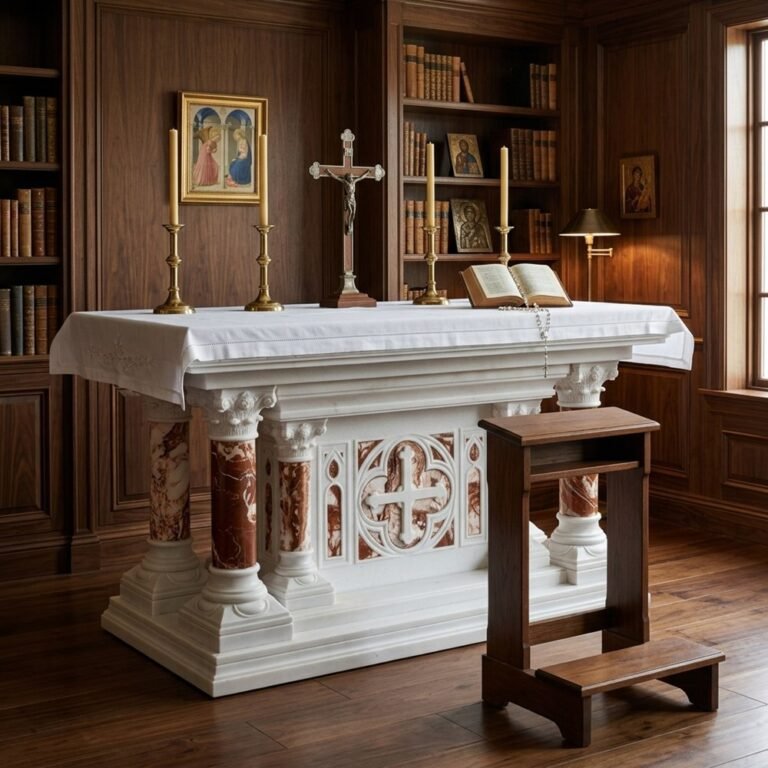
Home altars, Church Sanctuaries, Shrines, Gardens,Cemeteries,Entryways or Foyers,Prayer corners,monastery churches, chapels |
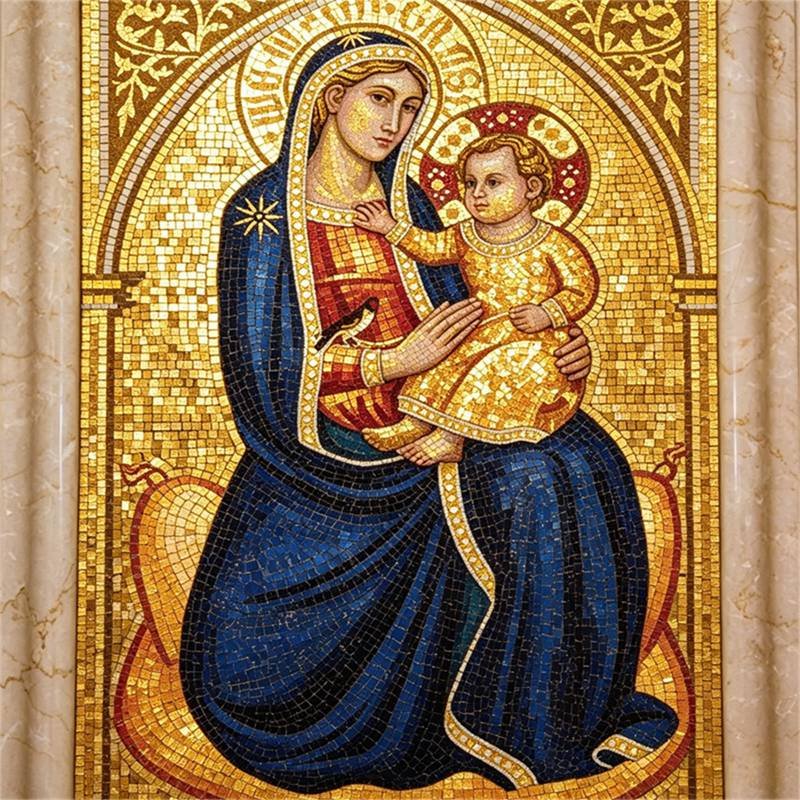
| Montenero style | “Tender touch” motif; unusually large ears on Mother and Child; Finch perched on arm; Child holding a cord | Heaven leaning in to hear us; the soul held in God’s hands; the Passion foreshadowed through the Finch symbol | Shrines, churches, schools, spaces of healing and intercession |
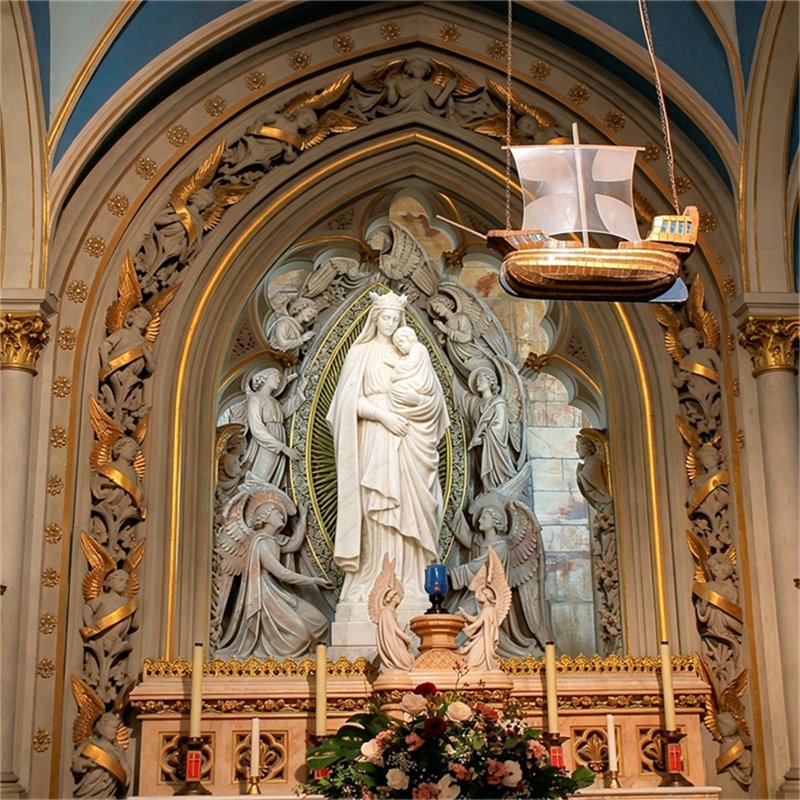
| Crowned Style | Crown, scepter or lily, Child Jesus on arm |
Crown-Mary as Queen of Heaven; |
Church sanctuaries, large chapel niches, formal religious institutions |
Final Thoughts
There is something quietly extraordinary about the origin of this devotion. It did not begin with a grand apparition on a mountaintop, or a message delivered to a crowd. It began with a priest, alone in his cell, apologizing to a painting for having nothing better than a worn-out handkerchief.
And Mary bowed her head.
This is who Our Lady of Grace is. She is not distant. She is not reserved for the extraordinary or the spiritually advanced. She bows her head toward the humble offering — the coarse handkerchief, the stumbling prayer, the candle lit with trembling hands. She is the mother who sees the good will behind the imperfect gesture and smiles.
To venerate her — whether through a whispered prayer, a worn Miraculous Medal, or a statue placed quietly in your home — is to open a door. And on the other side of that door, grace is already waiting.
FAQ
Where is the most famous Our lady of grace statue in the world?
It is the Miraculous Medal statue, located in the Chapel of Our Lady of the Miraculous Medal in Paris, France.
Which style is most popular among our clients?
Among our clients, the Classic Miraculous Medal Style is the priority choice when purchasing an Our Lady of Grace statue.
Which material is the best for me to choose?
The best materials for Our Lady of Grace statues often include marble, or bronze, depending on the desired aesthetic and durability.
Can YouFine factctory have the custiomed service?
Yes, YouFine factory offers customized services for religious statues, allowing clients to create unique pieces tailored to their preferences.