Look at the figure: Jesus stands with wide‑open welcoming arms, rays of mercy flowing forth from his pierced Sacred Heart. You may have seen this striking image, whether high upon a church sanctuary altar or resting quietly in a private home prayer nook. This is the Divine Mercy statue.
Simply put, a Divine Mercy statue is more than decorative religious art. It is a tangible symbol of God’s boundless, costly mercy, calling every weary soul to place their trust in Christ.
What Is the Divine Mercy?
Divine Mercy — one of the most widely venerated devotions in the Catholic Church, rooted in the mystical visions of a Polish nun named Saint Faustina Kowalska in the early 1930s. It began as a single painting, sketched under her direction in a small art studio in Vilnius, has since grown into a global devotion.
But to truly understand what this image represents — and why millions continue to kneel before it nearly a century later — we need to start at the beginning.
What’s the History Behind the Origins of the Divine Mercy Image?
The Night of February 22, 1931
The story begins in 1925, when a young Polish woman named Faustina Kowalska entered the Congregation of the Sisters of Our Lady of Mercy in Warsaw.
There, she began recording a series of visions and conversations with Jesus in a diary — later published as Diary: Divine Mercy in My Soul.
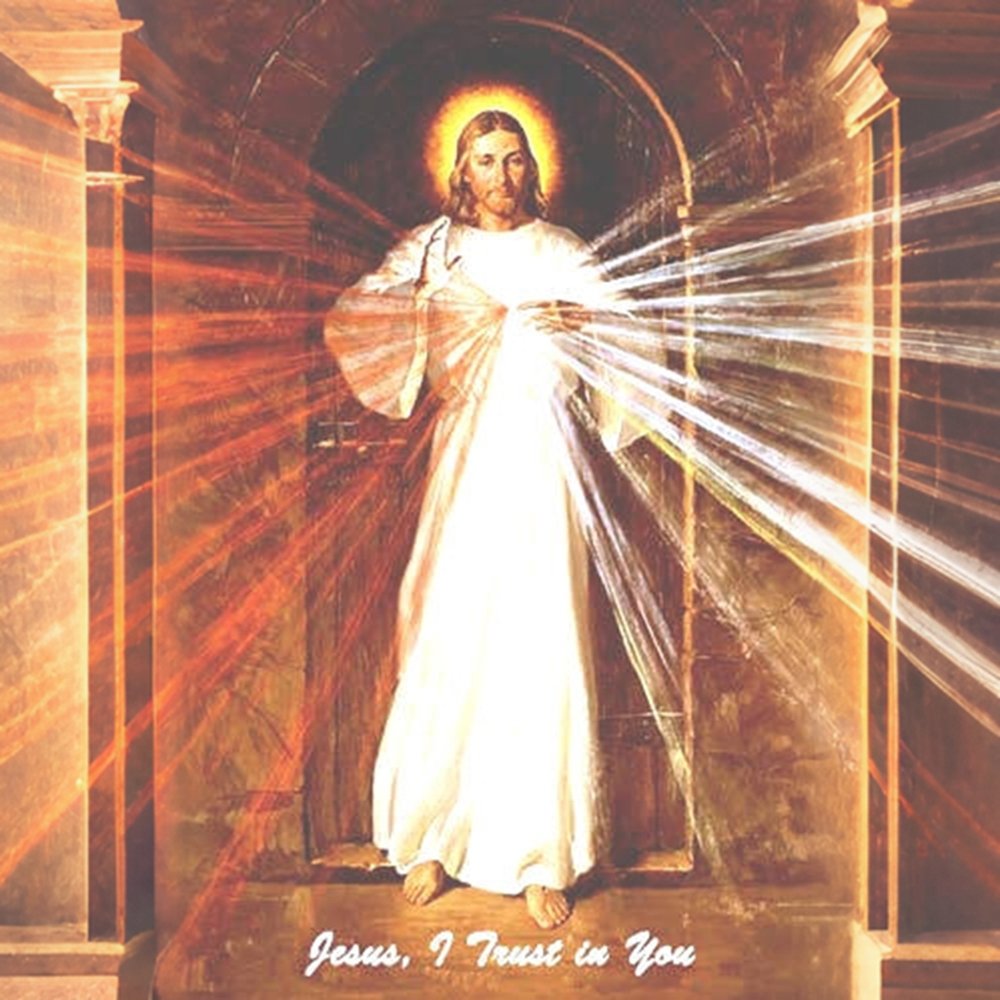
In 1930, Kowalska was sent to the convent in Płock. According to her account, on the night of Sunday, February 22, 1931, Jesus appeared to her in her cell as the “King of Divine Mercy,” clothed in a white garment. She wrote that His right hand was raised in blessing, while His other hand touched His garment near His breast — and from beneath it, two great rays poured forth: one red, one pale and nearly translucent.
This vision was not merely a private, interior experience. Another nun, Sister Christine, later testified that unusual light was visible through the window that night — light bright enough to catch the attention of passersby on the street outside. This detail suggests the experience carried a tangible, almost physical dimension, rather than being purely a matter of inner sight.
Christ’s Instruction: “Paint an Image”
In her diary (Notebook 1, items 47–48), Kowalska recorded Jesus’s words to her:
“Paint an image according to the pattern you see, with the signature: ‘Jesus, I trust in You’. I desire that this image be venerated, first in your chapel, and then throughout the world. I promise that the soul that will venerate this image will not perish.”
There was just one problem: Kowalska had no training in art. She approached other sisters at the convent for help but received none. She tried sketching the image herself in charcoal, without success. In her diary, she wrote that Jesus assured her that “visible help” would come to complete the task.
From Canvas to Church — and Into Exile
In 1933, Kowalska was transferred to the convent in Vilnius to work as a gardener. There she met her new spiritual director, Father Michael Sopoćko, a theology professor at the University of Vilnius. Sopoćko not only supported her but introduced her to Eugeniusz Kazimirowski, a professor of art at the same university. Sopoćko himself posed in a white robe as a model, and both he and Kowalska regularly visited the studio to oversee the painting’s progress.
The image was completed in 1934.
In April 1935, it was publicly displayed for the first time at the Church of the Gate of Dawn in Vilnius. By 1937, on the Sunday after Easter — later established as Divine Mercy Sunday — the painting was placed beside the main altar of St. Michael’s Church.
But history soon delivered a near-fatal test.
In 1948, Soviet authorities closed St. Michael’s Church, and the painting was left abandoned inside the disused building for years. In 1951, two laywomen from Vilnius — Bronė Miniotaitė and Janina Rodzevič — purchased the canvas from a guard and hid it in an attic for several years before quietly passing it to a parish priest for safekeeping. The painting was later moved to a church in Nova Ruda, Belarus, where — even after Soviet authorities converted the building into a warehouse — local parishioners continued to venerate it in secret. It wasn’t until 1986 that the original was smuggled back to the Church of the Holy Spirit in Vilnius, and in 2003 it was professionally restored to its original appearance.
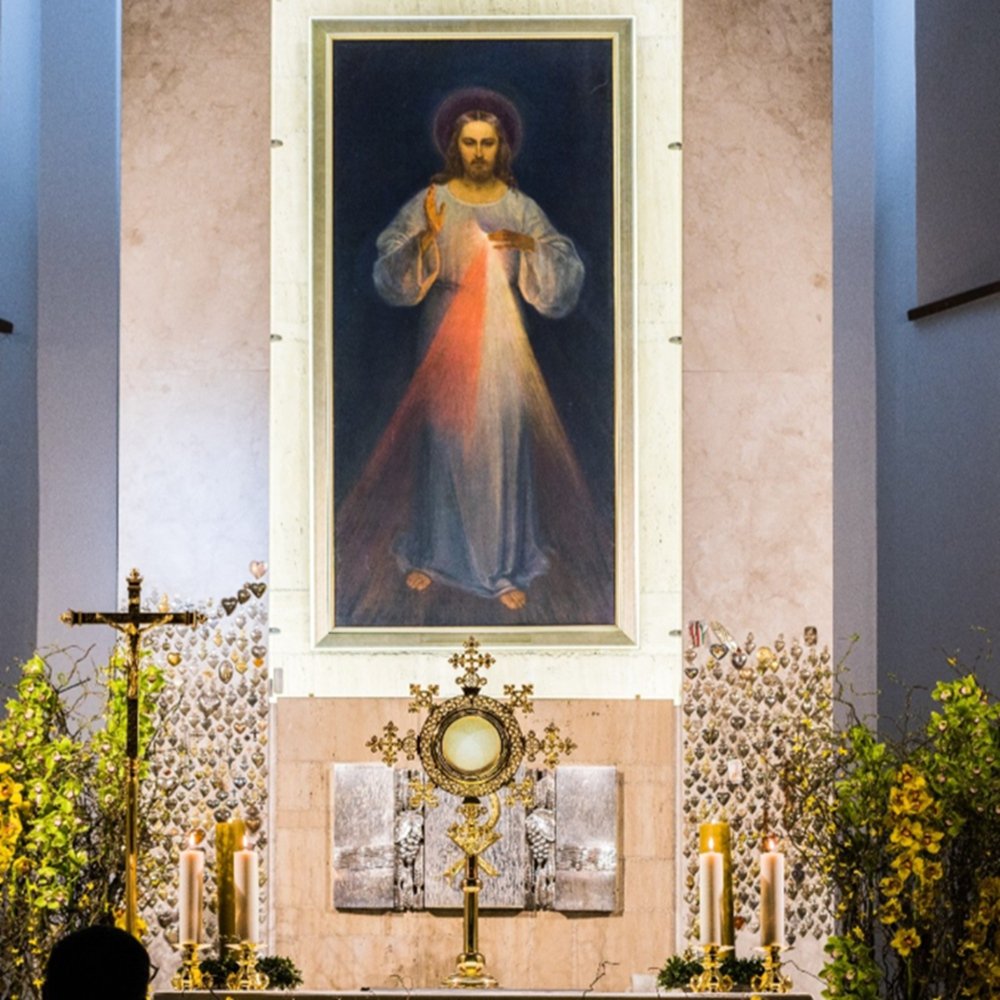
From Painting to Statue: A Devotion Goes Global
After Kowalska’s death, more artists reinterpreted the image, and it gradually moved from flat canvas into three-dimensional form — statues began appearing in churches, convents, and hospice chapels around the world.
Yet the path to global recognition was far from smooth. In 1959, the Vatican banned the image and its associated devotion — partly because some Polish bishops questioned t
he authenticity of Kowalska’s visions, and partly out of concern that the red-and-white rays too closely resembled the colors of the Polish flag, risking a nationalist rather than purely spiritual interpretation.
The ban lasted nearly two decades. It was only lifted in 1978, after Karol Wojtyła — then Archbishop of Kraków, and just six months away from being elected Pope John Paul II — lobbied Pope Paul VI on the devotion’s behalf.
In 2000, Kowalska was canonized by Pope John Paul II, and devotion to the Divine Mercy experienced an unprecedented revival. By 2010, scholars estimated that more than 100 million Catholics worldwide followed this devotion.
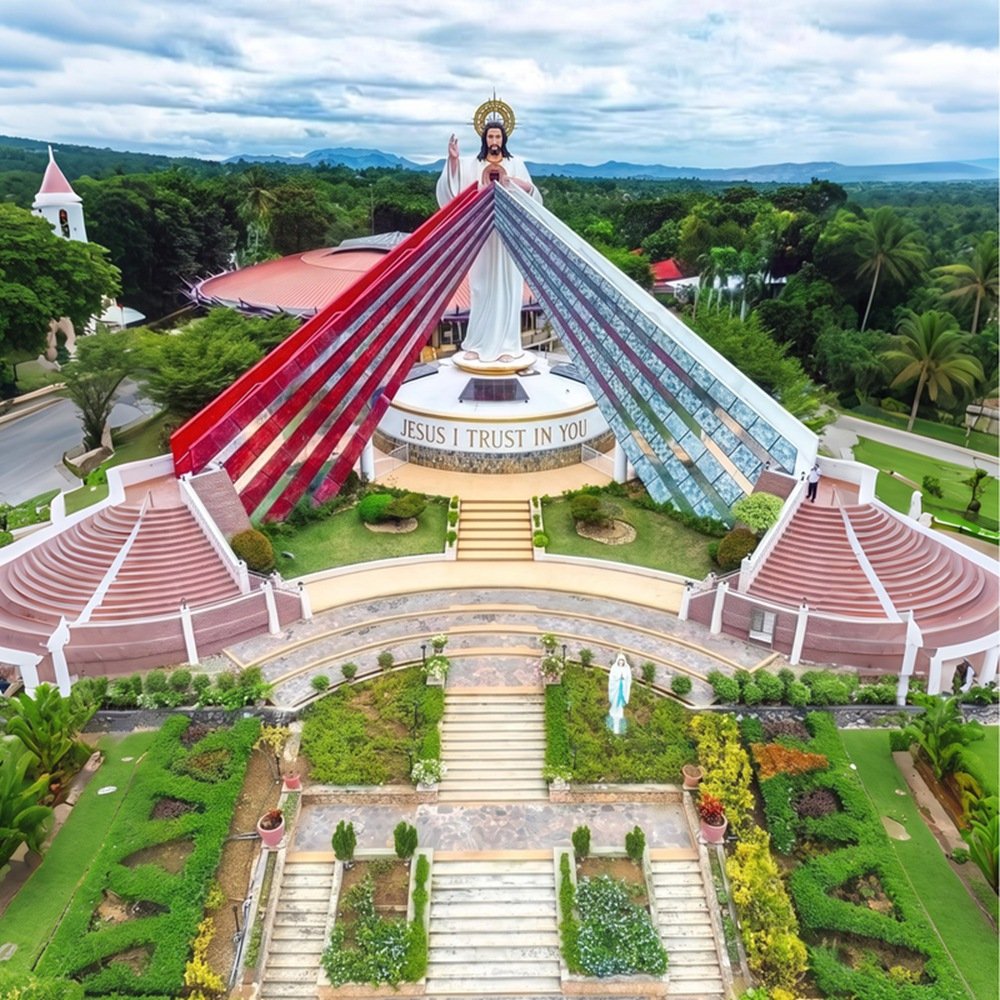
The world’s largest Divine Mercy Statue is located at Divine Mercy Hills, El Salvador City, Philippines, overlooking Macajalar Bay. Finished in 2008, the 50‑foot (15‑meter) monument features the signature red and pale‑blue rays streaming from Jesus’ heart. Its expansive terraced grounds host mass communal worship, making it a key Asian Catholic pilgrimage site.
What’s the Symbolism of the Divine Mercy Statue?
To understand the symbolism of the Divine Mercy statue, it helps to know a fact often overlooked: the image venerated around the world today isn’t a single, fixed depiction — it has evolved and been reinterpreted across nearly a century.
Different Versions of Divine Mercy Images and Statues
The Original Version: Imperfect, Yet Closest to the Vision
In 1934, under the supervision of Kowalska and Father Sopoćko, artist Eugeniusz Kazimirowski completed the first Divine Mercy painting — the only version Kowalska personally witnessed and confirmed.
Interestingly, neither Kowalska nor Sopoćko were entirely satisfied with the result. The Christ depicted appeared solemn, even somewhat distant — not as immediately warm as later renditions would become. Yet Kowalska recorded Jesus’s own words of reassurance:
“Not in the beauty of the colour, nor of the brush lies the greatness of this image, but in My grace.”
This single line established the core principle underlying the entire devotion: this was never meant to be judged as ordinary art. What matters is not aesthetic beauty, but the grace the image carries.
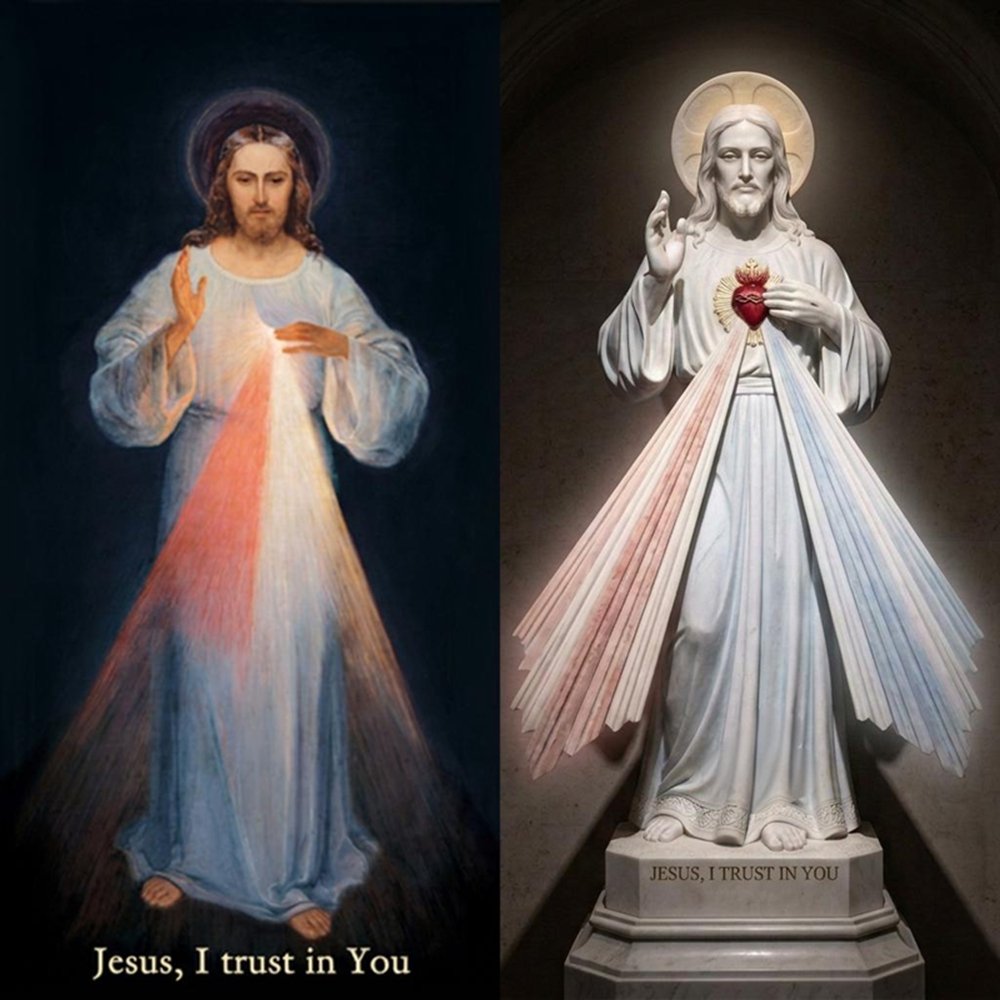
Later Interpretations: From “Distant King” to “Approaching Healer”
After Kowalska’s death, more painters took up the subject. The most widely reproduced version came from Polish artist Adolf Hyła, painted after World War II as a votive offering in gratitude for his family’s survival.
Hyła’s Christ is no longer a distant, static King, but a Divine Physician — appearing to walk toward the viewer, right hand raised high in blessing, eyes meeting the gaze of anyone who looks upon Him. Known as the “Kraków Image,” it remains housed at the Divine Mercy Sanctuary in Kraków and is the most widely reproduced version worldwide.
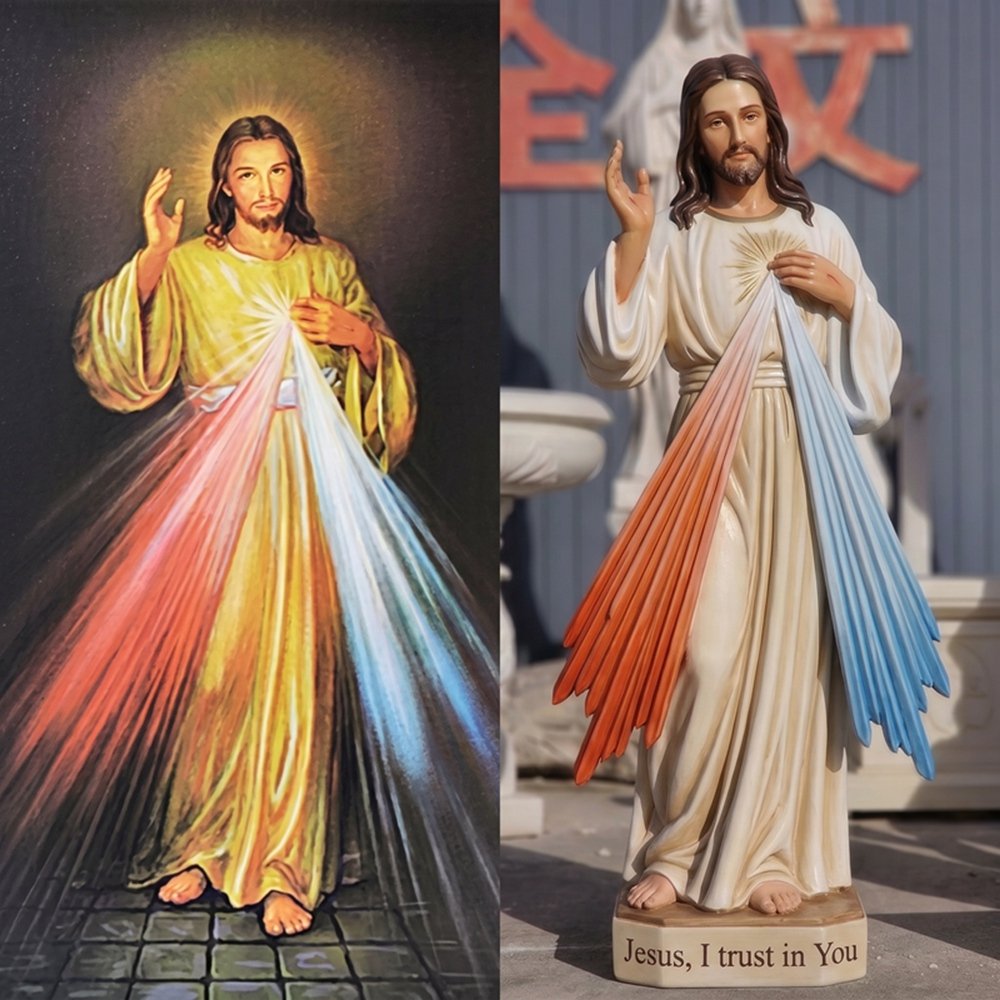
In 1982, American artist Robert Skemp created a third interpretation, drawing on both earlier works — Christ standing in a doorway, a bright halo above His head. Commissioned by the Marian Fathers, this version became especially popular in the Philippines.
The vitality of this devotion has even inspired remarkable architecture which I have mentioned before.
The Meaning of the Rays
Regardless of the version, the theological meaning of the two rays flowing from the Sacred Heart — one red, one pale — has never changed.
Kowalska recorded Jesus’s words in her diary (Notebook 1, item 299):
This directly echoes the mystery described in 2 Corinthians 5:21: the One who never sinned was “made to be sin” — bearing suffering that was never rightfully His. He did not stand at a distance, passing judgment on our brokenness; He entered fully into it, carrying the weight of every sinner in His own flesh.
And for those of us who gaze upon this image or statue, one truth cannot be avoided: we are all sinners. Acknowledging this isn’t meant to induce shame — it’s the starting point for understanding why this mercy is so precious. Precisely because He could have remained a distant judge, yet chose to bear the burden Himself, this invitation carries such profound weight.
The Meaning of the Inscription: A Vessel for Grace
The words at the statue’s base — “Jesus, I trust in You” — are far more than decorative. Kowalska recorded Jesus explaining the image’s purpose in her diary (Notebook 1, item 327):
This metaphor of a “vessel” reveals why this image — and the statues that followed — have been venerated for nearly a century: it has never been merely a piece of art to admire, but a vessel that believers place in their daily lives to continually draw grace from.
Whether it’s a solemn marble statue at the front of a church or a small figure resting on a home desk, what it carries remains the same — a whisper etched in stone and in the human heart: “Jesus, I trust in You.”
What’s The Inspiration of the Divine Mercy Statue
To truly understand the Divine Mercy statue, we need to look beyond secular assumptions and return to the meaning found within Scripture and Catholic theological teaching.
What Is Sin?
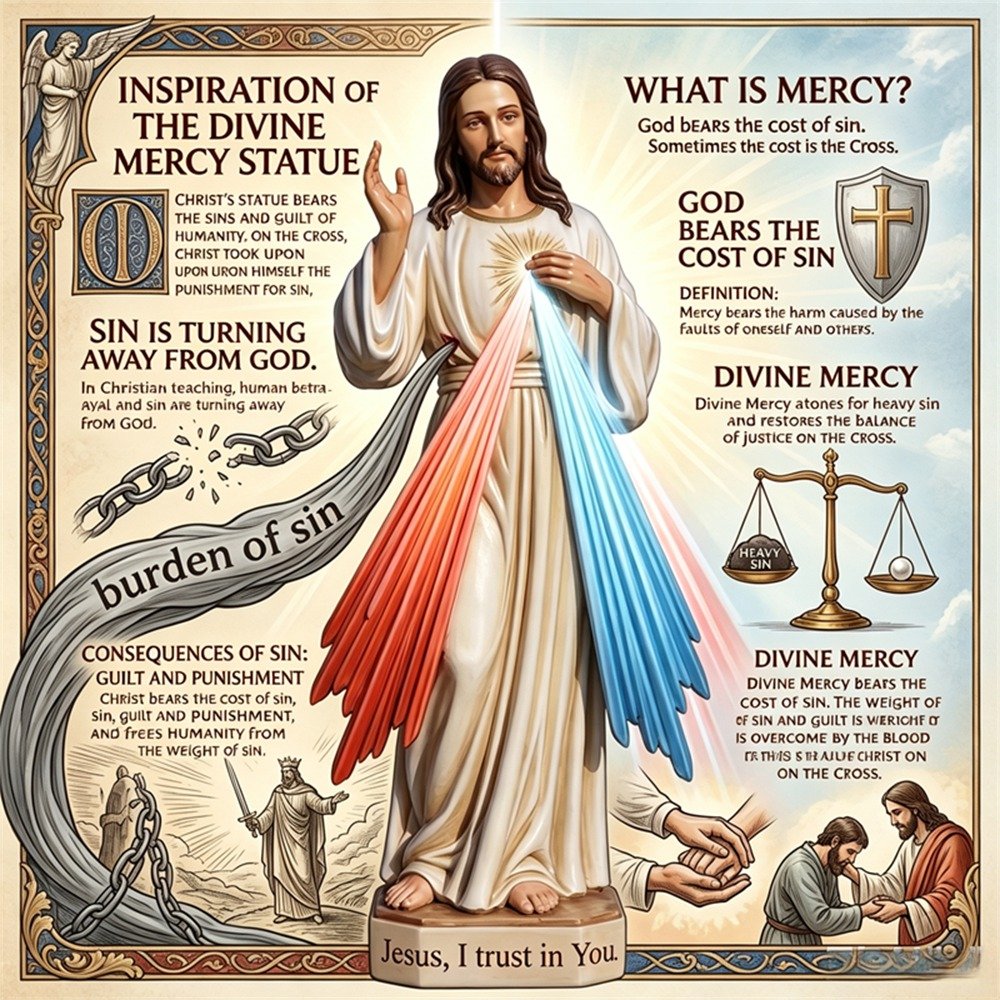
In Scripture, sin means far more than simply breaking rules or behaving badly. Sin is turning away from God — breaking the loving covenant bond between God, ourselves, and others.
Sin brings a twofold consequence: the wrongful act itself, and guilt — an inner remorse and a separation from God. Under divine justice, sin deserves just punishment.
Many people carry a secular image in their minds: God standing far away, watching human wrongdoing and handing down punishment from a distance. But the vision behind the Divine Mercy image reveals a different truth. God does not remain a distant judge. Instead, He steps directly into the painful consequences caused by sin.
Christ was entirely sinless, yet He freely took upon Himself the sin and guilt of all humanity. He endured unjust suffering, bearing punishment that was never His to bear. He was no distant bystander — He carried the full weight of sin in His own flesh. This doesn’t mean Jesus became an evildoer; rather, He took on the full consequences of human guilt.
What Is Mercy?
The word “mercy” comes from the Latin misericordia — built from miser (wretched, suffering) and cor (heart). Literally: a heart that beats for those in misery.
Mercy is not simple, soft-hearted leniency that ignores evil. It can be understood in two dimensions:
Divine Mercy — the central theme our marble Divine Mercy statue is meant to embody. Divine mercy does not erase sin or pretend it never happened; evil cannot simply be overlooked — it must be confronted. God’s mercy isn’t “letting sinners go unpunished.” It means God Himself bears the cost of sin. Human justice follows the rule that whoever sins must bear the penalty. Divine mercy works differently: sinful humanity is set free, as the sinless Christ bears the penalty in our place, restoring our broken relationship with God.
As this vision reveals, God’s mercy reaches its fullest expression in Christ’s Passion. God doesn’t merely forgive us from a distance — He goes further, carrying our sins upon Himself. Our marble Divine Mercy statue makes this mystery visible: the pure white marble symbolizes Christ’s sinless holiness, while His outstretched arms and wounded Sacred Heart show how He voluntarily took on humanity’s sin and suffering, pouring out unearned mercy for all.
Human Mercy — the mercy we extend to one another. Because we first receive God’s mercy, we’re called to pass it on. Human mercy doesn’t turn a blind eye to wrongdoing, but it rejects vengeance — it is heartfelt compassion for another’s hardship, paired with a willingness to forgive those who have hurt us. It unfolds on two levels: an inward, visceral compassion, and outward acts known as the works of mercy.
The Relationship Between Mercy and Sin
Sin creates the very need for mercy. Without brokenness, forgiveness would have no reason to exist. Mercy doesn’t approve of sin — yet it rescues those trapped by it. God hates sin but loves the sinner; He rejects the act while desiring to save the person who committed it.
Mercy doesn’t operate by pretending sin isn’t real. It defeats sin through the suffering of the Cross — the sinless Christ bears sin’s burden, overcoming its power so that sinners may be justified and receive new life. Having received God’s free mercy, we too are called to extend it to others — we can forgive precisely because we have first been forgiven.
Why and How to Pray Before the Divine Mercy Statue
When we stand before this type of Jesus statue, we are drawn into a mystery: the cost of Christ’s mercy. The open arms, the wounded Sacred Heart, and the streaming rays recall 2 Corinthians 5:21 — the sinless Savior took on our guilt upon the Cross. Mercy here was never cheap or distant; it came at the price of His Passion. So our prayer begins not with effort, but with gazing — fixing our eyes on what Christ has already accomplished, not on our own imperfect merits.
From that gaze flows trust. The inscription at the statue’s base — “Jesus, I trust in You” — is, according to Saint Faustina’s revelations, the primary condition for receiving divine grace. As we kneel before the figure, we surrender our guilt, fear, and weariness, admitting simply that we cannot save ourselves. And from there, our prayer widens beyond us: Saint Faustina recorded that Jesus invited souls to plead mercy not only for themselves, but for sinners, family, the suffering, and all humanity — turning private petition into intercession for the world.
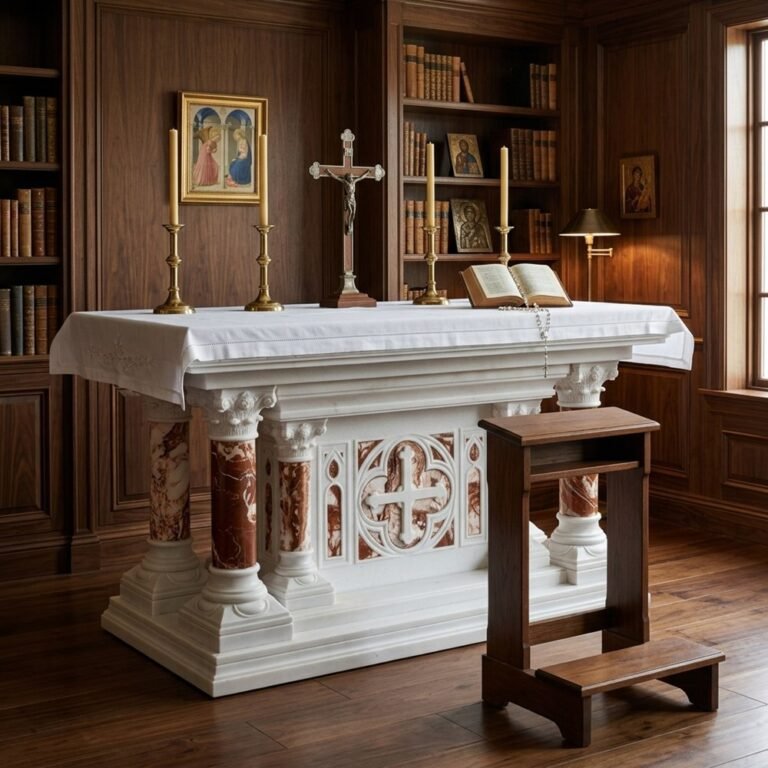
Mercy we receive is never meant to stay contained. As Christ has forgiven us, we too must forgive — carrying this grace into the works of mercy we practice each day. This is why many of us keep a Divine Mercy statue at home — not as decoration, but as a quiet anchor amid distraction. No grand liturgy is needed; a simple glance is often enough to reorient our hearts.
In practice, we need no long or complicated words. We kneel or stand before the statue, make the Sign of the Cross, and quiet our minds — reflecting, I come not because I am perfect, but because I need mercy. Then we recite slowly: “Jesus, I trust in You,” offering our burdens and hopes in our own words. We let our eyes rest on the open arms welcoming sinners, the pierced Heart pouring forth blood and water, and hold this mystery in a minute of silent contemplation.
For deeper devotion, we may also pray the Chaplet of Divine Mercy (especially at 3 p.m., the “Hour of Great Mercy”), the Novena of Divine Mercy leading to Divine Mercy Sunday, or simply the aspiration: “O Blood and Water, which gushed forth from the Heart of Jesus as a fountain of mercy for us, I trust in You.” We close with one small resolve — to show mercy to someone today — and a word of thanksgiving.
No fixed hour or place is required. Whether it’s a large marble monument outdoors or a small statue on our desk, each serves the same purpose: drawing our hearts toward Christ. This is why, when choosing a statue for our home, we often look for lasting materials and craftsmanship — a piece meant to be gazed upon for a lifetime, and passed down through generations. In the end, we need no beads or books — silent gazing, paired with “Jesus, I trust in You,” is enough.
Final Thoughts
From a quiet convent cell in Poland on a February night in 1931, to statues standing in churches, hospices, and home prayer corners across the world today — the story of the Divine Mercy image is a story of survival against forgetting, suppression, and time itself.
Christ, through suffering He never deserved, revealed just how costly mercy truly is. And the statue itself — whether towering fifty feet above a Philippine shrine or resting quietly on a bedside table — remains a silent prayer: an invitation to hope and redemption, extended to anyone still wrestling with doubt, guilt, or the ache of feeling unworthy of love.
Whatever form this trust takes in your own life — a whispered prayer, an act of kindness, or simply a statue standing quietly in your home — may it become the light you look to in your hardest moments.
Jesus, I trust in You.