Gardens occupy a meaningful place in the biblical story of redemption. Humanity’s exile begins in Eden. In Gethsemane, Christ willingly submits to the Father’s saving purpose. Gethsemane is therefore a quiet and decisive moment within it. Here, Christ brings His anguish honestly before the Father and chooses the costly path of obedience that leads to the cross and, ultimately, to the empty tomb.
A Garden of Gethsemane is more than a collection of trees, rocks, pathways, and religious statues. It is a sacred outdoor space created for prayer, lament, vigilance, surrender, and hope. For churches, monasteries, retreat centers, Christian schools, and pilgrimage sites, it can provide a peaceful setting for Lenten reflection, Holy Week gatherings, communal worship, biblical education, and personal spiritual care.
This guide explains how to design a Garden of Gethsemane that is both spiritually meaningful and practically suited to the theology, climate, available space, and ministry needs of a particular Christian community.
What Is the Garden of Gethsemane?
The name Gethsemane is commonly understood to mean “oil press,” reflecting its association with an olive grove at the foot of the Mount of Olives, outside the walls of ancient Jerusalem.
John’s Gospel indicates that Jesus often met there with His disciples, suggesting that it was a familiar place of retreat and fellowship (John 18:2). After the Last Supper, Jesus entered the garden with His disciples on the night before His crucifixion.
What Happened in the Garden of Gethsemane?
According to Matthew and Mark, Jesus took Peter, James, and John farther into the garden and told them that His soul was overwhelmed with sorrow. He then went a little farther, fell to the ground, and prayed:
“My Father, if it is possible, may this cup be taken from me. Yet not as I will, but as you will.”
— Matthew 26:39 NIV
Again and again Jesus returned to the three disciples, only to find them asleep. Grieved by their frailty, He recognised how heavy their flesh had grown with weariness and urged them to watch and pray. No word of absolution was spoken within the garden that night; forgiveness would dawn only later, in the hours after the resurrection.
Luke preserves a detail found nowhere else in the Gospels: as Jesus laboured in terrible anguish of prayer, an angel appeared to strengthen Him (Luke 22:43‑44).
The Gospel of John draws our attention to another layer of this night: Jesus knew every trial that was drawing near. Fully conscious of all that was about to happen, He stepped forward to face the crowd who had come for Him (John 18:4).
Soon Judas moved through the shadowed olive grove at the head of an armed band. He marked Jesus with the kiss of betrayal. Peter drew his sword to resist, yet Jesus refused all violence and yielded freely to being taken into custody.
Within these shadow‑heavy olive groves unfolded Christ’s inward struggle, His life‑defining choice, and His willing acceptance of the suffering meant for humanity.
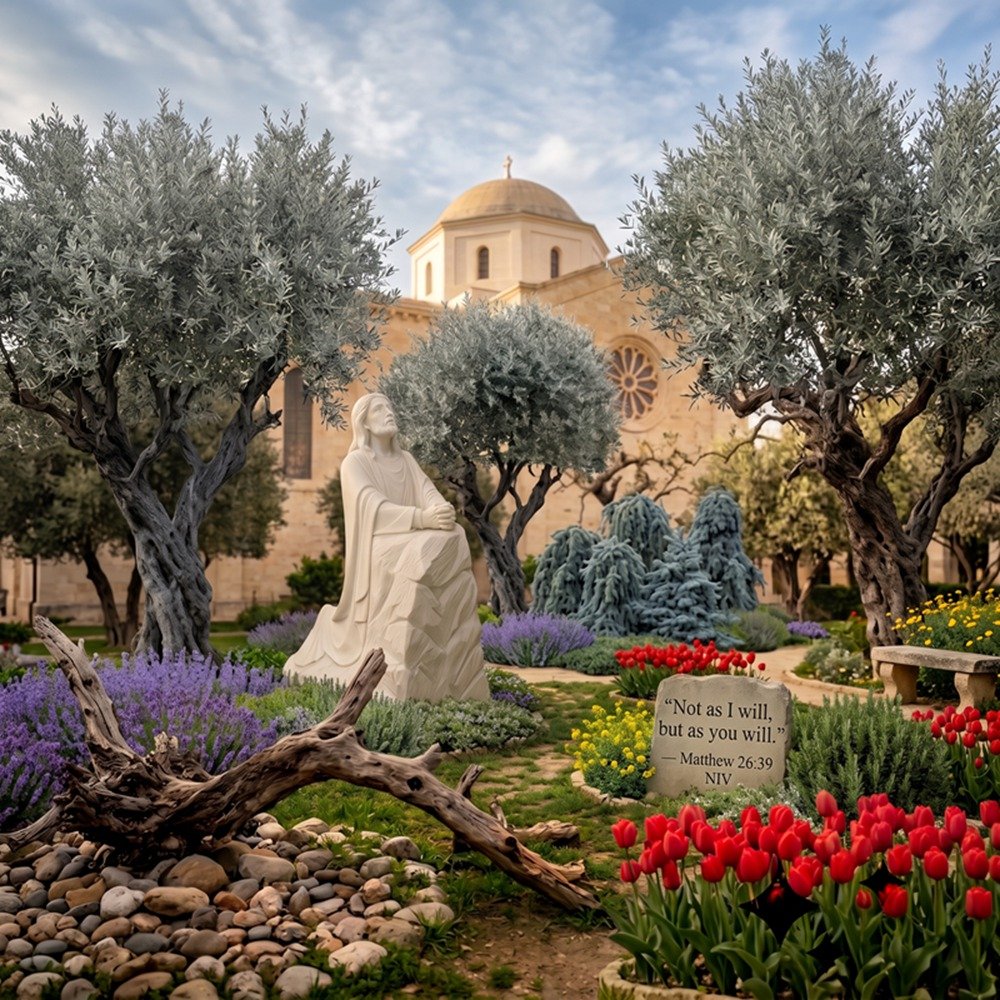
What is the Spiritual Meaning of a Gethsemane Prayer Garden?
A thoughtfully designed Gethsemane garden does more than illustrate a biblical event. It invites visitors to enter its spiritual meaning.
A Place for Honest Prayer
In Gethsemane, Christ did not hide His sorrow behind polished or distant language. He openly brought His anguish, fear, and human longing before the Father.
A Gethsemane prayer garden reminds visitors that faithful prayer does not require pretending that pain is absent. It creates a place where people can bring grief, fear, illness, uncertainty, and unanswered questions honestly before God.
Natural rock, restrained planting, quiet seating, and a kneeling Christ statue can help establish an environment where lament is welcomed as part of spiritual life.
A Call to Watch and Pray
The sleeping disciples reflect a weakness familiar to every believer. Their spirits may have been willing, but their bodies were weary and overcome with sorrow.
Jesus’ words remain central to the meaning of the garden:
— Matthew 26:41NIV
In a narrative garden, the physical distance between the sleeping disciples and the praying Christ can make this spiritual contrast visible. Visitors encounter both the weakness of the disciples and the faithfulness of Christ.
A Place of Surrendered Obedience
Gethsemane reveals that biblical obedience is not passive resignation. Christ expressed His desire honestly and then willingly submitted Himself to the Father’s redemptive purpose.
The spiritual center of the garden is therefore found in the words:
“Not as I will, but as you will.”
— Matthew 26:39NIV
A Garden of Gethsemane invites visitors to consider their own response to suffering, uncertainty, calling, and sacrifice. It asks not only, “What do I want?” but also, “How can I remain faithful to God in this moment?”
A Garden That Looks Toward the Cross and Resurrection
Gethsemane should not be interpreted in isolation. Its sorrow looks forward to the cross, and the cross looks toward the garden tomb and resurrection.
The story of exile that begins in Eden moves toward restoration through Christ’s obedience, death, and resurrection. In this sense, the garden can hold sorrow and hope together. It provides space for lament without allowing grief to become the final word.
What are the Essential Elements of a Garden of Gethsemane?
Not every garden needs to include every element. The right combination should reflect the site, available budget, denominational tradition, climate, and intended ministry use.
Olive Trees or Locally Suitable Alternatives
Olive trees are the most recognizable botanical symbol of Gethsemane. Their twisted trunks, long lives, and silver-green foliage create an immediate visual connection to the Mount of Olives.
In climates where olive trees grow successfully, one mature specimen or a small grove can become the backbone of the design.
Local horticultural advice should be obtained before choosing a variety, especially in regions with severe frost, high humidity, or poorly drained soil.
Where true olive trees cannot survive, select a non-invasive, locally appropriate tree with:
- A sculptural branching habit
- Gray-green or silvery foliage
- A restrained seasonal appearance
- Strong adaptability to local soil and climate
- Roots suitable for use near paths and sculpture foundations
Alternative trees should be identified accurately. They should not be labeled as olive trees if they are a different species.
The garden may also include Mediterranean-inspired or biblically symbolic plants such as grapevines, rosemary, thyme, sage, and lavender where climate and local regulations allow. Mustard may be used sparingly as a seasonal biblical reference, but it should only be planted where it will not spread aggressively.
Natural Rock Formations
Rock helps evoke the rugged landscape of the Mount of Olives and gives visual weight to the central prayer scene.
Natural boulders can be used to:
- Form the setting around the kneeling Christ
- Conceal sculpture foundations
- Create informal prayer seating
- Separate narrative scenes
- Guide views along a curved path
- Establish changes in elevation
Rock arrangements should feel natural rather than theatrical. Avoid creating an artificial stage or decorative waterfall unless water has a clear liturgical or symbolic purpose.
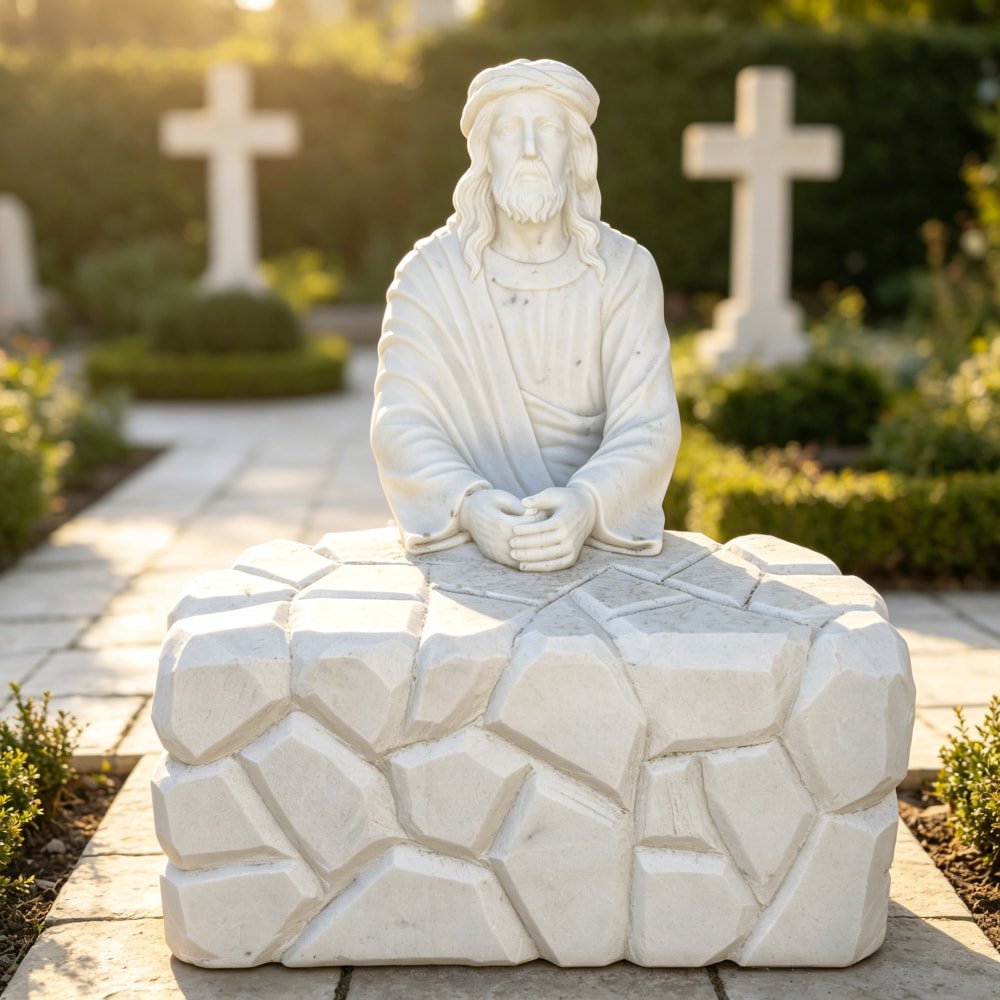
A Kneeling Christ Statue or Relief
The kneeling Christ is the spiritual and visual center of most Gethsemane gardens. The sculpture may show Jesus:
- Kneeling with His hands joined in prayer
- Leaning upon a rock
- Looking upward in supplication
- Bowing His head in sorrow
- Opening His hands in surrender
- Praying near a symbolic cup
The expression should communicate both anguish and obedience. Excessively dramatic facial expressions may distract from the contemplative purpose of the space.
For small gardens, a life-size or slightly smaller kneeling Jesus statue may be sufficient. In a large pilgrimage setting, a life-size or slightly enlarged sculpture can improve visibility from a distance.
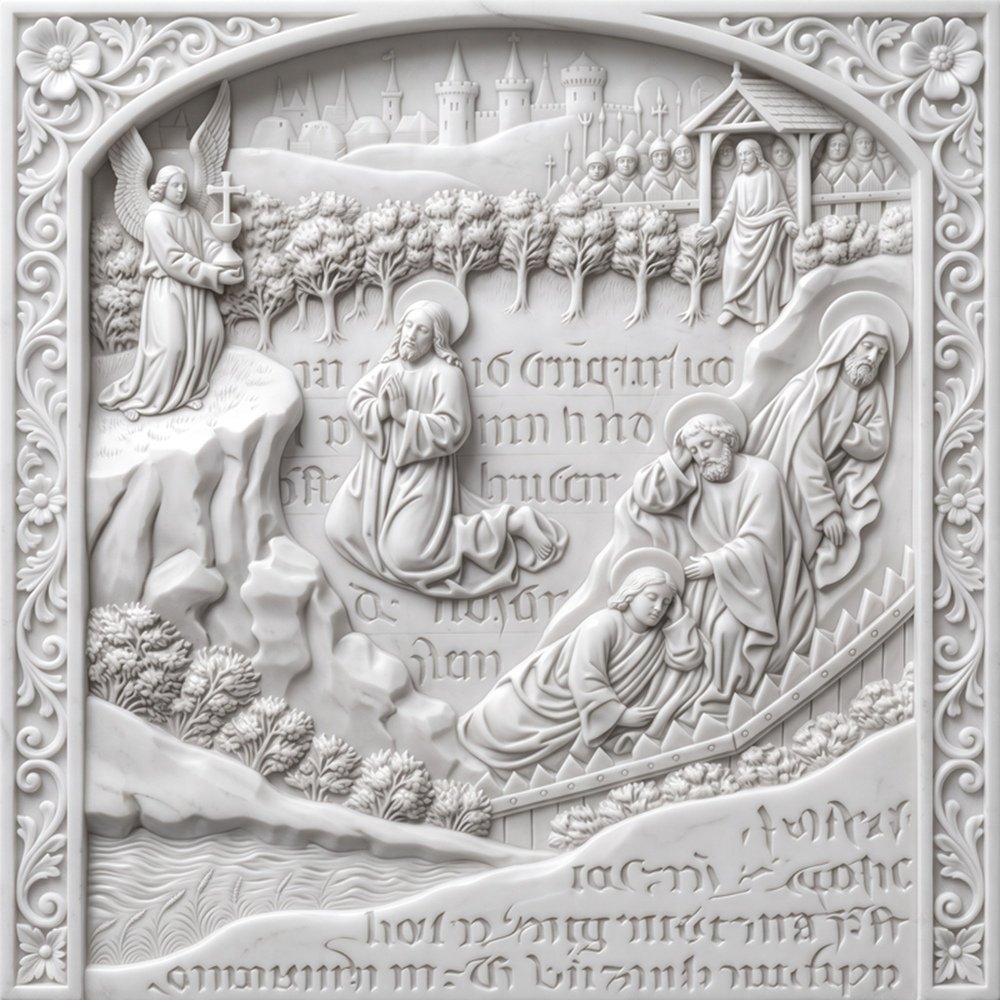
Where a freestanding statue is not practical, a marble, bronze, or carved-stone relief of Jesus praying in Gethsemane can create a meaningful devotional focal point inside a chapel, along a wall, or within a compact courtyard.
Statues of the Three Sleeping Disciples
Peter, James, and John may be represented resting near rocks or beneath trees. Their posture should communicate grief, weariness, and human weakness—not injury or death.
The disciples can be designed as:
- One integrated three-figure sculpture group
- Three separate statues positioned among rocks
- A two-part composition, with two disciples together and one resting separately
Separate figures offer greater flexibility because they can be adapted to the site’s plants, terrain, and sightlines. An integrated group may be easier to install and can provide a strong composition in a smaller garden.
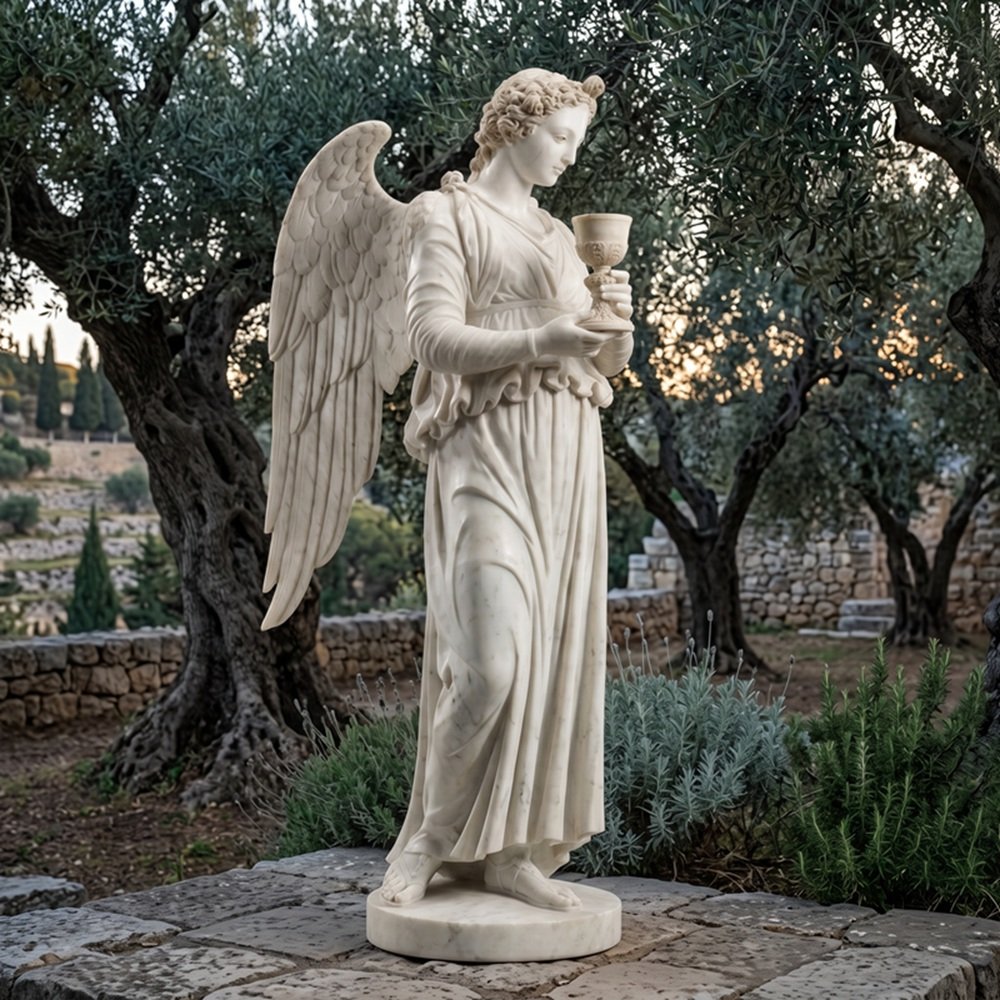
An Angel with a Symbolic Cup
Luke 22:43 records that an angel appeared to strengthen Jesus. An angel statue can therefore be included in gardens developed for communities that welcome a fuller figurative interpretation of the Gospel account.
The symbolic cup refers to Christ’s prayer concerning the suffering before Him. In Christian art, the angel is sometimes shown presenting or pointing toward the cup. This is a traditional artistic interpretation rather than a physical action described explicitly in the Gospel text.
Both elements should be treated as optional.
Their appropriateness depends upon the theology and artistic tradition of the church.
Scripture Stones and Engraved Tablets
Carefully chosen Scripture inscriptions help visitors understand the scenes and enter into prayer.
Suitable passages include:
Matthew 26:36–46
Mark 14:32–42
Luke 22:39–46
John 18:1–12
Short inscriptions may include:
“Remain here and keep watch with me.”
— Matthew 26:38
— Matthew 26:41
“Not as I will, but as you will.”
— Matthew 26:39
Keep the number of signs limited. Silence should remain the dominant voice of the garden. Too many explanatory panels can make the space feel like an exhibition rather than a place of prayer.
The church should approve the selected Bible translation before fabrication. If copyrighted translations are quoted extensively, the project should also follow the publisher’s current attribution requirements.
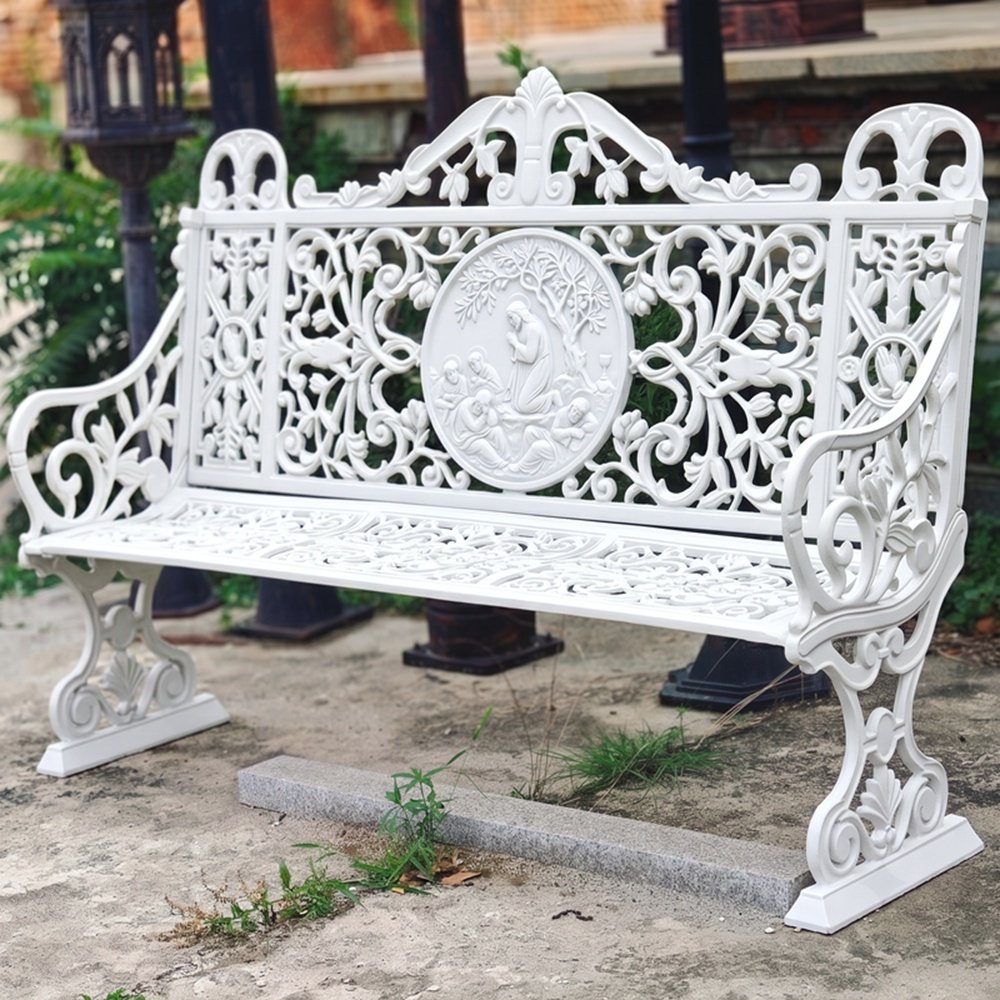
Prayer Seating
Seating allows visitors to stay rather than simply walk past the sculptures. Appropriate options include:
- Natural stone benches
- Simple wooden benches
- Stone-and-wood seating
- Low rock ledges
- Semicircular prayer seating
- Individual contemplative seats
Seats should face or gently turn toward the primary sculpture without creating the feeling of a theater. Large gardens should include wheelchair spaces beside some benches.
Restrained Nighttime Lighting
Gethsemane’s events unfolded at night, making thoughtful lighting especially meaningful.
Use warm-white light, generally around 2700–3000 K, with concealed side lighting or carefully controlled high-angle illumination.
Low uplighting may be used selectively to reveal rock textures, but strong direct lighting from below should not be aimed at the face of Christ or other figures.
The sleeping disciples should remain more subdued than the central prayer scene. Paths should be illuminated sufficiently for safety without destroying the atmosphere of darkness and stillness.
All fixtures should include appropriate shielding to reduce glare, light spill, and unnecessary illumination of the night sky.
Four Garden of Gethsemane Design Concepts
No two churches have identical sites, budgets, worship traditions, or ministry goals. The following concepts can be adapted from a small indoor devotional corner to a complete pilgrimage garden.
Indoor or Very Small Devotional Nook
Recommended setting: Chapel corner, prayer room, covered courtyard, church hallway, memorial alcove, or small indoor retreat space
Primary elements:
- A wall-mounted marble or bronze relief of the kneeling Christ
- One compact Scripture plaque
- A narrow stone prayer shelf or small rock arrangement
- One or two chairs or a short prayer bench
- A potted olive tree or locally suitable symbolic plant
- Soft, warm accent lighting
This design reduces the narrative to its spiritual center: Christ alone in honest and surrendered prayer.
The wall relief should be installed at a height that allows seated visitors to view the face and hands comfortably. Lighting should reveal the carved details without producing strong reflections or deep shadows.
A short inscription such as “Not as I will, but as you will” may be sufficient. Additional information can be placed outside the devotional space so that the prayer area itself remains visually quiet.
This concept is well suited to churches that lack suitable outdoor ground or need an accessible year-round prayer area.
Small Garden: Christ Alone in Prayer
Recommended area: Approximately 25–60 square meters, or 270–645 square feet
Primary elements:
- One freestanding kneeling Jesus statue
- One engraved Scripture stone
- Natural boulders around the primary sculpture
- One or two prayer benches
- One or two olive-form specimen trees
- A simple gravel or natural-stone path
- Low-growing, restrained planting
- Soft landscape lighting
This design centers completely on Christ’s personal struggle and obedience. Without secondary figure groups, visitors are invited to focus on the prayer, “Not as I will, but as you will.”
A gently curved path can lead visitors past the Scripture stone before revealing the statue. The figure should not necessarily be visible in full from the garden entrance. A partial screen of planting or rock can create a gradual transition from ordinary surroundings into a contemplative space.
The sculpture may face a natural rock, while seating is positioned at a respectful distance in front of or slightly to the side of the figure. Avoid placing benches so close that the sculpture feels crowded.
This concept works well for:
- Small church courtyards
- Chapel side yards
- Private retreat gardens
- Christian schools
- Hospital chapels
- Religious memorial gardens
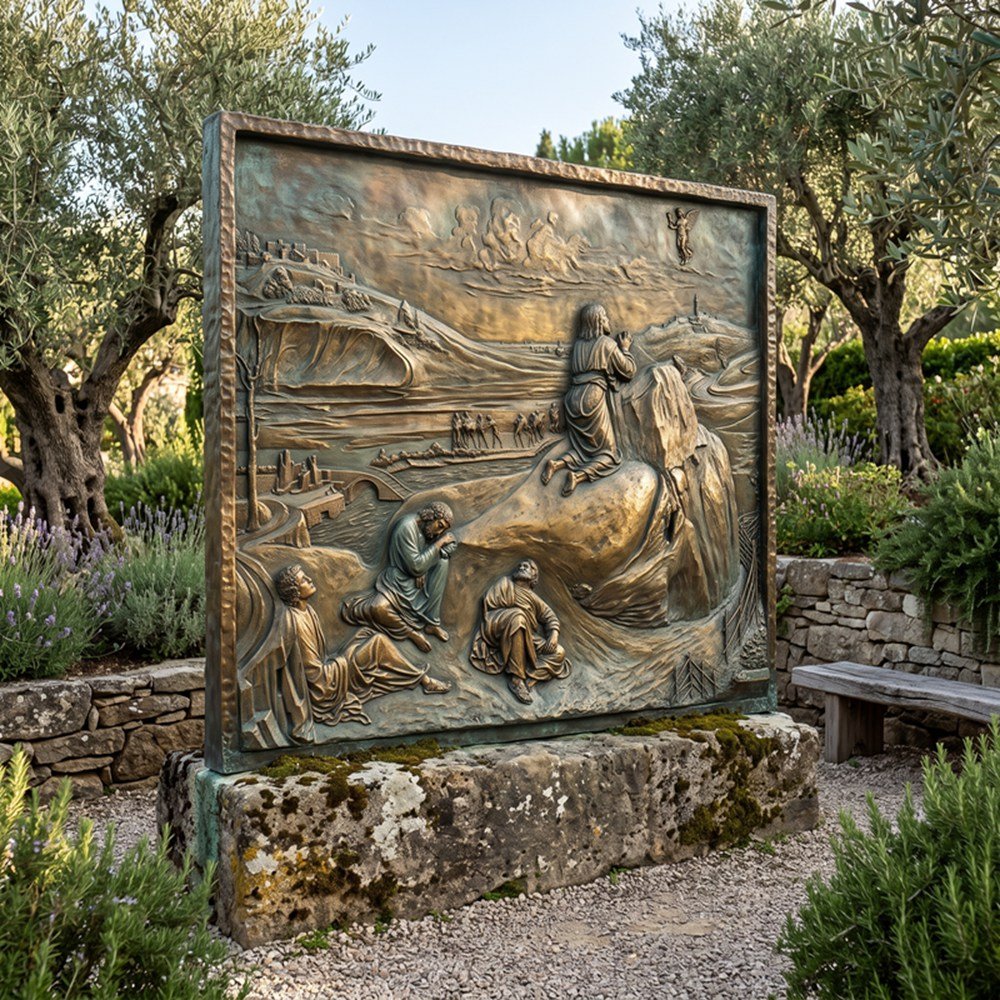
Medium Narrative Garden: Christ, the Angel, and the Sleeping Disciples
Recommended area: Approximately 100–300 square meters, or 1,075–3,230 square feet
Primary elements:
- A kneeling Christ statue
- An optional angel figure
- An optional symbolic cup
- A sculpture group of Peter, James, and John sleeping
- An introductory garden marker
- One or two Scripture stones
- Olive trees or suitable local alternatives
- Layered herbs and low-maintenance ground cover
- Stone or gravel walking paths
- Several prayer benches
- A complete but restrained lighting scheme
The design should establish two distinct narrative zones:
- The disciples overcome by sorrow and sleep
- Christ praying alone before the Father
Where the site permits, the Christ-and-angel scene may be positioned approximately 8–15 meters from the disciples. This is a reference distance rather than a fixed rule. It reflects the Gospel description that Jesus “went a little farther” to pray.
In smaller gardens, separation can be created through:
- A curved path
- A change in elevation
- A cluster of trees
- Natural boulders
- A low stone wall
- A shift in planting density
- Different lighting levels
The sleeping disciples should be encountered first. Visitors then follow the path toward the more secluded prayer scene. This sequence allows the spiritual contrast between human weakness and Christ’s faithfulness to unfold gradually.
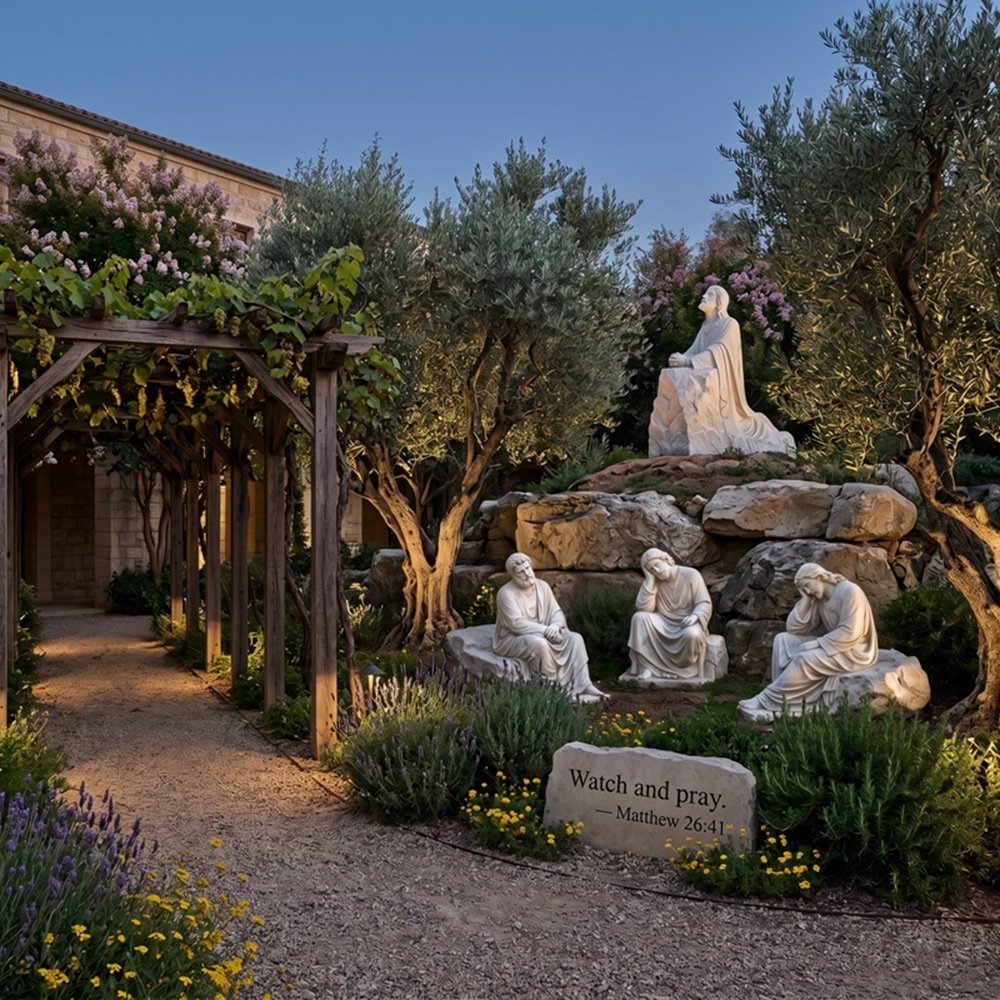
A small semicircular prayer area may be placed near the central Christ statue for Lenten devotions, Holy Week gatherings, Bible study, and personal prayer.
This concept is particularly suitable for:
- Medium-sized church grounds
- Retreat centers
- Monasteries
- Christian schools
- Religious cemeteries
- Diocesan ministry sites
Large-Scale Pilgrimage Garden
Recommended area: From approximately 500 square meters for a compact layout, with 800–2,000 square meters or more preferred for a complete multi-scene garden
Primary scenes:
- Jesus and the disciples entering the olive grove
- Peter, James, and John sleeping
- Jesus praying with the strengthening angel and symbolic cup
- Judas’ kiss and the arrest of Christ
Supporting elements:
- A winding pilgrimage path
- Scene-specific Scripture stones
- A central prayer gathering area
- Multiple accessible seating areas
- Olive-grove-inspired planting
- Professional drainage and irrigation
- Reinforced sculpture foundations
- Accessible walking routes
- Zoned nighttime lighting
- Site preparation, shipping, and installation planning
The visitor should not be able to see every sculpture group from the entrance. Each scene should emerge gradually through changes in direction, planting, rock placement, or topography.
Scene One: Entering the Garden
The first scene may show Jesus leading Peter, James, and John into the grove. A larger project can include additional disciples, although it is not always necessary to represent all of them.
Jesus may turn toward the disciples and tell them to remain and watch. The figures should form a natural walking composition rather than standing in a straight ceremonial line.
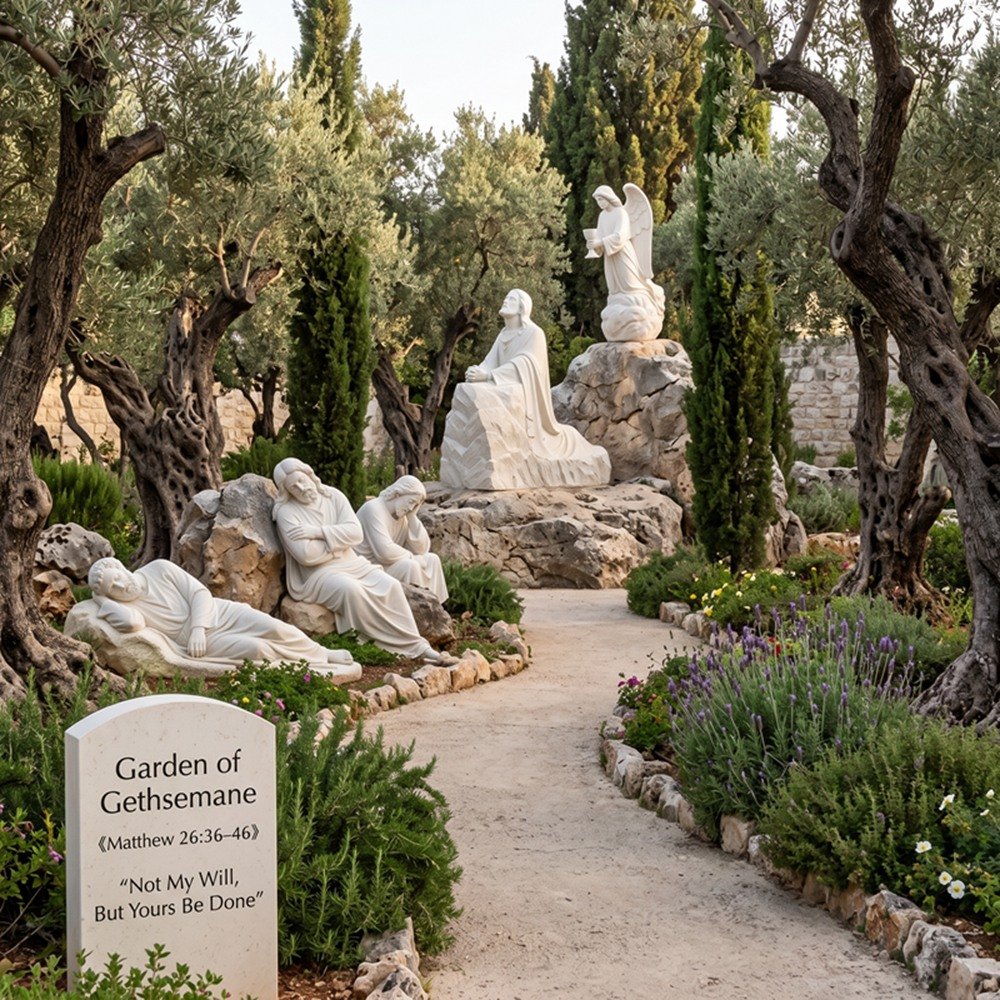
Scene Two: Kneeling Christ in prayer; angel and symbolic cup; Peter, James and John sleep against boulders
Kneeling Christ rests beside a large natural rock in anguished prayer;
The strengthening angel is positioned slightly behind, above, or to one side of Him.
Where approved by the church, a symbolic cup of suffering is included within the composition. Close at hand, nestled among rocks and trees, Peter, James, and John lie asleep in varied, emotionally authentic poses.
A nearby stone bears Christ’s question:
“Couldn’t you keep watch with me for one hour?” — Matthew 26:40.NIV
Lighting differentiates the two focal zones within one scene: the Christ‑and‑angel core receives warmer, brighter uplighting, while the area of the sleeping disciples is kept significantly dimmer. Surrounding this sculptural ensemble is a loose semicircular quiet gathering space.
Designed to preserve the intimate character of a garden rather than functioning like an outdoor auditorium, it offers seating for personal prayer, Lenten reflection, Holy Thursday vigils, small‑group devotion, clergy‑led meditation and organised pilgrimage gatherings.
Scene Three: Judas’ Kiss and the Arrest
The final scene may include:
- Jesus
- Judas
- Peter
- Malchus, the servant of the high priest
- Soldiers or temple guards
- Figures carrying symbolic torches
A compact version may show only Jesus, Judas, and two arresting figures. A complete version may include Peter drawing his sword and Jesus stopping the violence.
The arrest scene should be placed beyond a turn in the path or behind a planted screen. This prevents its visual tension from disturbing the stillness of the central prayer area.
A large Gethsemane garden may also serve as an introduction to a broader Passion of Christ route that includes the trial, the Way of the Cross, the crucifixion, burial, and resurrection garden.
Choosing Statues for Different Christian Traditions
Christian communities differ in their use of figurative sacred art. Sculpture selection should be developed in consultation with church leadership before production begins.
Protestant and Evangelical Churches
Some Protestant and Evangelical communities may prefer a simple, Scripture-centered design with fewer figurative elements.
Appropriate options may include:
A solitary kneeling Christ statue
A wall relief of Jesus praying
Scripture stones
Natural rock and olive-inspired planting
A symbolic cup
A simple cross placed beyond the prayer area
If disciples or angels are included, restrained and realistic forms may fit the worship environment better than highly ornate compositions.
The design should make clear that the artwork serves biblical teaching and reflection rather than functioning as an object of worship.
Catholic and Anglo-Catholic Settings
Catholic and Anglo-Catholic communities may welcome a fuller narrative design as an aid to devotional meditation.
Possible elements include:
- Christ in prayer
- Peter, James, and John sleeping
- The strengthening angel
- The symbolic cup
- Judas’ kiss
- The arrest of Jesus
- Scripture stelae
- Memorial or donor inscriptions
These gardens may support Rosary meditation, Lenten devotion, Holy Week vigils, retreat activities, and organized pilgrimage.
Orthodox Settings
Orthodox communities possess distinct iconographic, theological, and liturgical traditions. Western-style naturalistic freestanding sculpture may not be appropriate in every Orthodox parish.
A design for an Orthodox church should be reviewed by the priest, bishop, or an approved iconographic adviser.
In some settings, a mosaic, iconographic panel, carved relief, or architecturally integrated image may be more suitable than a three-dimensional sculpture group.
A Wise Approval Process
Before finalizing a commission, present the church leadership with:
- Concept sketches
- Proposed Scripture passages
- Sculpture poses
- Material samples
- Preliminary site plans
- Lighting concepts
- Donor inscription text
Early approval helps avoid theological, artistic, and practical conflicts later in the project.
Choosing Materials for Gethsemane Statues and Reliefs
The best material depends on climate, exposure, artistic style, maintenance capacity, and budget.
Bronze
Bronze is a strong all-around option for exposed outdoor religious sculptures.
Advantages:
- Excellent durability
- Fine sculptural detail
- Strong structural performance
- A warm and timeless appearance
- Natural patina that can add visual depth over time
- Suitable for both full figures and wall reliefs
Considerations:
- Periodic cleaning and protective waxing may be needed
- Coastal salt, pollution, and irrigation water can alter the patina
- Large figures require properly engineered internal supports
- Secure anchoring is necessary to prevent movement or theft
Bronze is especially suitable for large pilgrimage gardens, public church grounds, and sites exposed to changing weather.
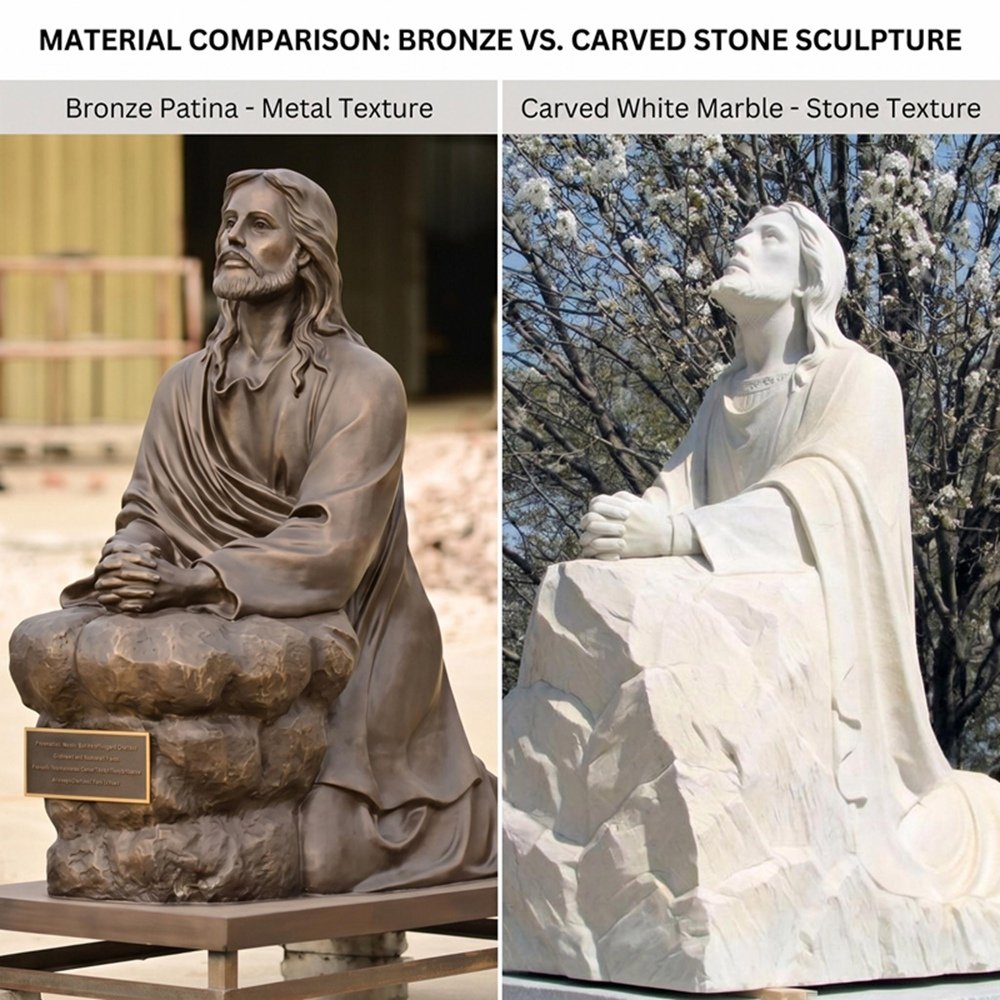
White Marble
White marble offers a luminous, classical, and reverent appearance.
Advantages:
- Strong association with traditional church art
- Beautiful treatment of faces, hands, and drapery
- Excellent visual relationship with stone architecture
- Suitable for freestanding statues, reliefs, and Scripture tablets
Considerations:
- Outdoor performance depends on the type and quality of marble
- Freeze-thaw cycles, salt, acid rain, and pollution must be evaluated
- Sculpture details should be designed to avoid fragile projections
- Drainage must prevent standing water around the base
- Irrigation should not spray directly onto the stone
- Periodic conservation may be required
Marble can be used successfully outdoors when the material, detailing, foundation, and maintenance plan are appropriate to the local climate. Sheltered placement may improve long-term preservation in severe coastal, freeze-thaw, or highly polluted environments.
Mixed-Material Projects
Large gardens often benefit from a combination of materials, such as:
- Bronze figure sculptures
- Natural-rock settings
- Stone-and-wood benches
- Stainless-steel internal anchors
- Bronze donor plaques
A mixed-material approach can balance artistic detail, weather resistance, installation needs, and budget.
Designing Lighting for Gethsemane’s Nighttime Story
Lighting should reveal the garden gently rather than transform it into a stage.
Central Christ Scene
Use warm, concealed side lighting or controlled light from slightly above. Illuminate the face, hands, and prayer posture without creating harsh shadows.
Rock surfaces may receive low-level grazing light to reveal texture.
Sleeping Disciples
Keep this zone dimmer than the Christ scene. Low-wattage shielded fixtures can provide enough visibility to understand the figures without destroying the sense of night.
Arrest Scene
The lighting may use slightly stronger contrast to suggest tension. Artificial torches can contain warm LED sources, but flashing or theatrical effects should be avoided.
Paths and Seating
Use low shielded fixtures, recessed step lights, or concealed path lighting. Fixtures should guide movement without shining into visitors’ eyes.
A professional plan may include:
- Daily evening mode
- Holy Week service mode
- Energy-saving mode
- Timers and astronomical controls
- Separate lighting zones
- Emergency safety lighting
Developing a Custom Gethsemane Garden
A successful project begins with more than selecting statues from a catalog. The sculpture, site, Scripture, planting, and ministry purpose should be developed as one coherent design.
A typical custom process may include:
- Site review: Provide dimensions, photographs, videos, topographic information, and climate conditions.
- Ministry consultation: Define the garden’s denominational context, devotional purpose, expected visitor numbers, and liturgical use.
- Scene selection: Choose a solitary Christ, a medium narrative arrangement, or a complete pilgrimage sequence.
- Concept plan: Develop the sculpture locations, primary sightlines, paths, seating, and Scripture stones.
- Artistic approval: Confirm poses, expressions, garments, scale, inscriptions, and material samples.
- Engineering coordination: Plan foundations, anchoring, drainage, irrigation, lighting, and accessibility.
- Production: Complete clay models, carving or casting, surface finishing, and quality inspection.
- Shipping and installation: Coordinate packaging, transportation, lifting, anchoring, assembly, and final site inspection.
- Maintenance planning: Establish appropriate cleaning, conservation, planting, and lighting schedules.
This process allows every element to support the same spiritual purpose rather than appearing as a collection of unrelated decorative features.
Final Reflection
The spiritual story of humanity may be contemplated through a series of gardens.
Eden bears witness to fellowship lost and exile begun. Gethsemane reveals Christ’s honest anguish and willing obedience. The garden tomb announces that death does not receive the final word.
A physical Garden of Gethsemane—whether a large pilgrimage grove, a modest church courtyard, or a marble relief within a small chapel—is precious because it gives form to truths that believers carry within their hearts.
Yet the deepest Gethsemane is not built only from bronze, marble, olive trees, and stone. It is also the quiet inner place where we come before God with our fears, grief, and unanswered questions.
It is where polished words fall away.
It is where human weakness is acknowledged.
It is where we learn to remain awake in faith.
It is where, even with a heavy heart, we whisper:
“Not as I will, but as you will.”
We may never stand beneath the ancient olive trees outside Jerusalem, but we can still enter the spiritual meaning of Gethsemane: honest prayer, faithful vigilance, surrendered obedience, and hope that looks beyond suffering toward resurrection.
May the gardens we create outwardly inspire us to tend carefully to the garden within our souls.
FAQs
How much space is needed for a Garden of Gethsemane?
A small garden centered on one kneeling Christ statue may fit within approximately 25–60 square meters. A medium narrative garden with the sleeping disciples may require 100–300 square meters. A multi-scene pilgrimage garden typically begins around 500 square meters, while 800–2,000 square meters or more allows better separation between scenes and room for group gatherings.
These figures are planning references, not fixed rules. Topography, paths, accessibility, planting, and visitor capacity all affect the final layout.
Which statues belong in a Gethsemane garden?
The most important image is Christ in prayer. Additional figures may include Peter, James, and John sleeping; the strengthening angel; Judas; Peter; Malchus; and those who came to arrest Jesus.
Not every project requires a complete sculpture set. The selection should reflect the church’s theology, budget, available space, and devotional purpose.
Is an angel holding a cup described in the Bible?
Luke 22:43 records that an angel appeared to strengthen Jesus. Jesus also prayed concerning “this cup.” However, the image of an angel physically presenting the cup is a traditional artistic interpretation rather than a detail explicitly described in the Gospel text.
Can olive trees grow in cold climates?
Some olive varieties tolerate limited cold, but severe frost and prolonged freezing can damage or kill them. Consult a local horticultural professional before planting.
If olives are unsuitable, choose a non-invasive local tree with a similar sculptural form or silver-green foliage. Identify it accurately rather than presenting it as an olive tree.
Is bronze or marble better for outdoor religious statues?
Bronze is generally a strong option for fully exposed sites because of its structural durability and weather resistance. Marble offers a brighter, more classical appearance and can also perform well outdoors when the stone quality, climate, drainage, detailing, and maintenance plan are appropriate.
The best material should be selected after evaluating the site rather than by applying one rule to every project.
How should a Gethsemane garden be illuminated?
Use warm, restrained lighting around 2700–3000 K. The central Christ figure may receive concealed side or high-angle lighting, while the disciples’ area should remain more subdued. Paths require enough light for safety, but harsh floodlights and dramatic upward facial lighting should be avoided.