Designing a church sanctuary is about more than arranging furniture. It is about shaping the heart of worship — a sacred space where architecture, liturgy, and sacred furnishings work together to inspire reverence, beauty, and prayer.
For church leaders, clergy, and building committees, the key question is not simply what a sanctuary should contain, but how it should be designed to serve the church’s tradition, architecture, and worship life. That is where thoughtful, custom sanctuary design makes all the difference.
What Is a Sanctuary?
The sanctuary (from the Latin sanctuarium, meaning “a holy place”) is the most sacred area of a church — the space that encloses the high altar and extends to the communion rails. It is the earthly counterpart of the heavenly sanctuary, the place where heaven touches earth in the celebration of the Eucharist.
In Catholic theology, the sanctuary is not merely a functional space — it is a sacramental sign. As Peter F. Anson writes in Churches: Their Plan and Furnishing (1948), the sanctuary is where “the community of faith meets, invests the place with the memories of faith, and discovers in it the mystery of faith.” The sanctuary embodies three dimensions of sacredness:
- Place of Meeting — where the eucharistic community gathers
- Place of Memory — associated with the key stories of the faith
- Place of Mystery — charged with the presence of the divine
Why Sanctuary Design Matters?
A well-designed sanctuary does more than look beautiful. It helps shape how people experience worship.
A strong sanctuary design can:
- direct attention toward the altar
- support the liturgy with clarity and dignity
- create a sense of harmony between furnishings and architecture
- reflect the identity and tradition of the church
- make the sacred space feel intentional rather than improvised
What Are the Core Furnishings of a Well-Designed Sanctuary
Every piece of sanctuary furnishing is more than functional — it carries theological meaning and helps shape the atmosphere of worship. The most important elements include the altar, tabernacle, crucifix, candles, pulpit or ambo, and statues, each serving a distinct liturgical purpose.
The Altar
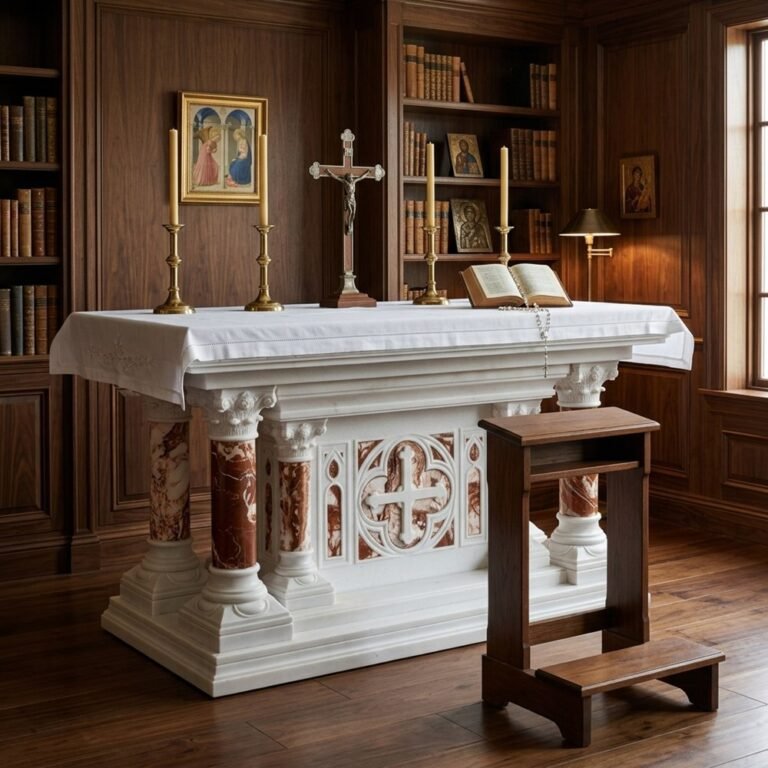
The altar is the heart of the sanctuary. It is the Lord’s table, where the Eucharist is celebrated, and Christ’s sacrifice is made present.
Traditionally, many churches choose natural stone or marble for the altar, both for its permanence and for the sense of dignity it conveys. In many traditions, relics of saints are also included, continuing a practice rooted in the early Church.
There are several altar arrangements that may be used depending on the liturgical tradition and architectural setting:
A freestanding altar offers flexibility and allows the altar to remain visually central in both traditional and contemporary celebrations. This form is often appreciated for its clarity and simplicity.
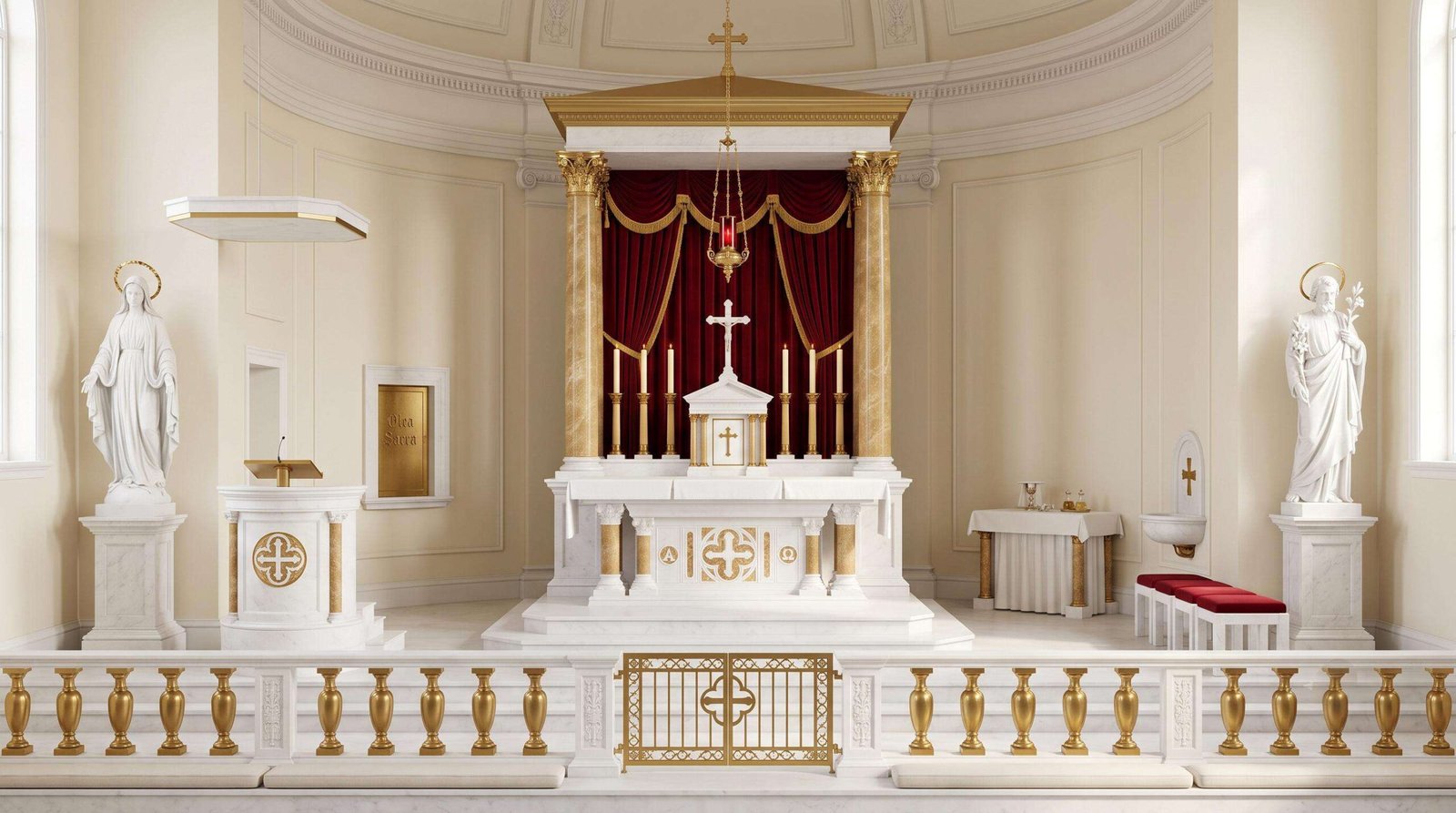
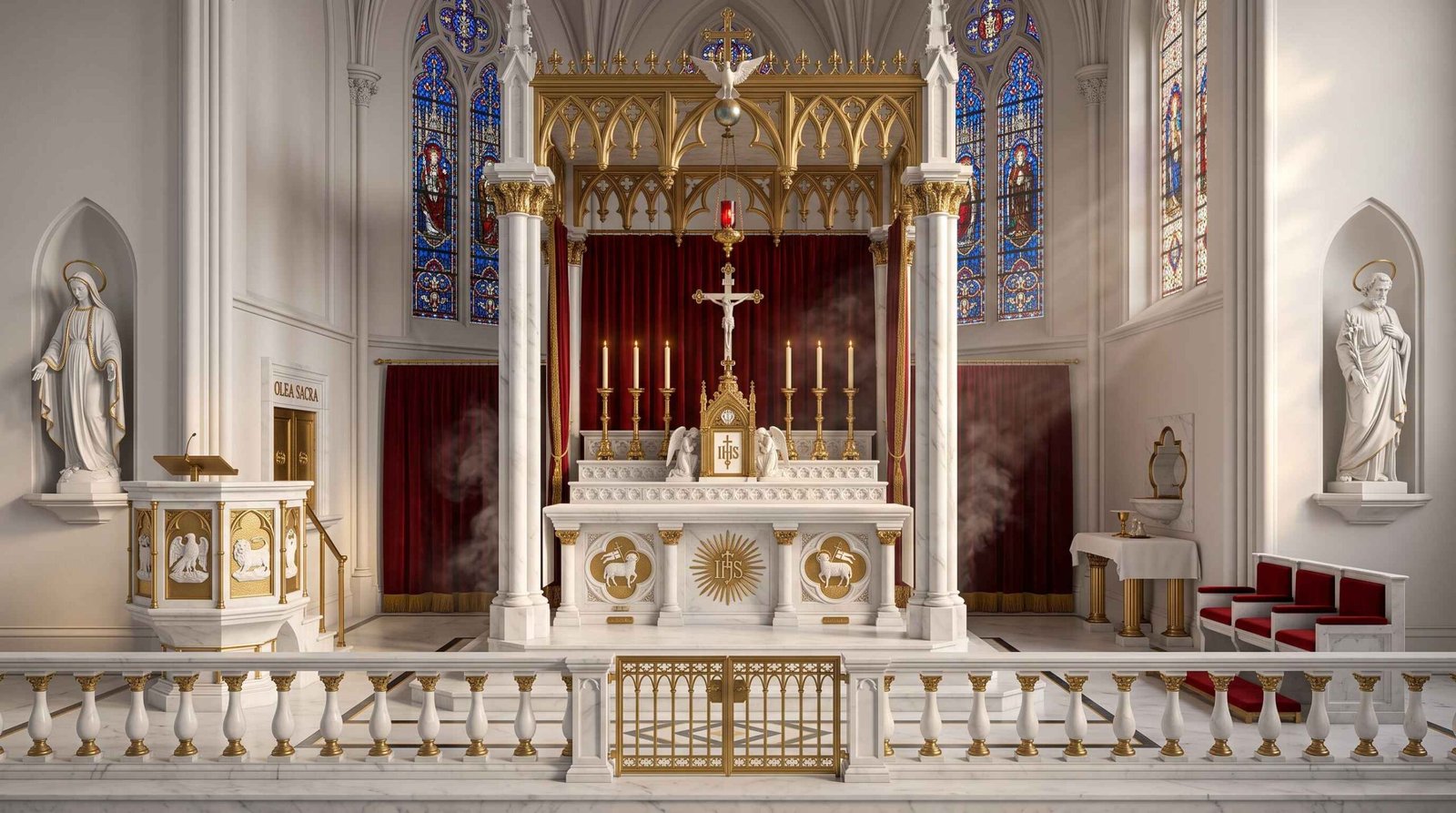
Take this marble altar we designed. It blends the quiet gravitas of classical architecture with the sacred weight of religious worship. Its Corinthian columns carry the order and poise of classical tradition; the quatrefoil cross and Alpha-Omega medallions speak in a clear, unmistakably Catholic symbolic language; and the two-tone marble intarsia inlays bring warmth and depth to the white stone. Every carved detail, every inlaid panel, every fluted column serves the overall symmetry and solemnity of the whole.
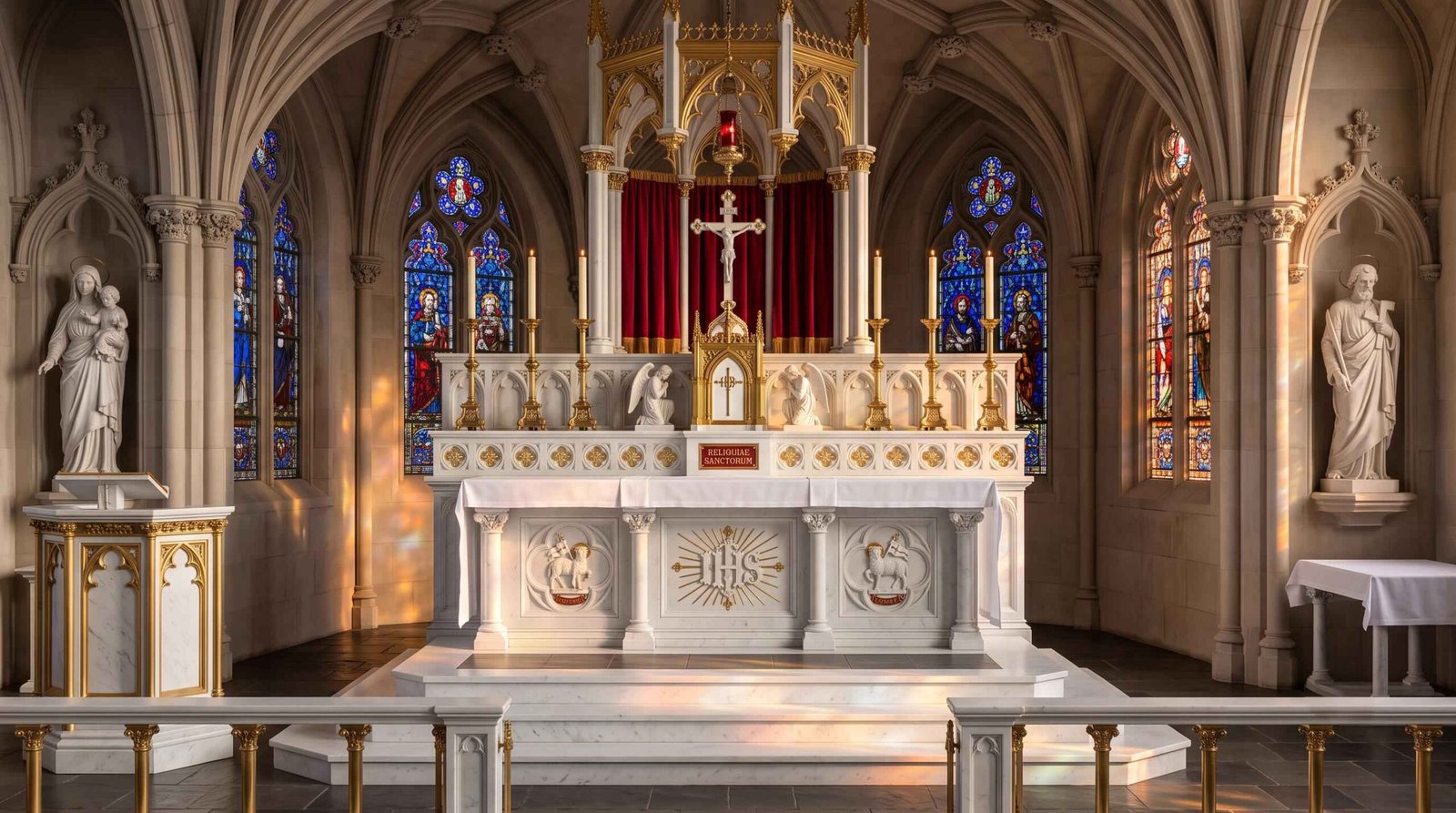
An altar with a gradine provides a more layered visual structure, with the tabernacle and candles placed behind the mensa. This arrangement is often seen in churches with Gothic Revival or historic interiors.
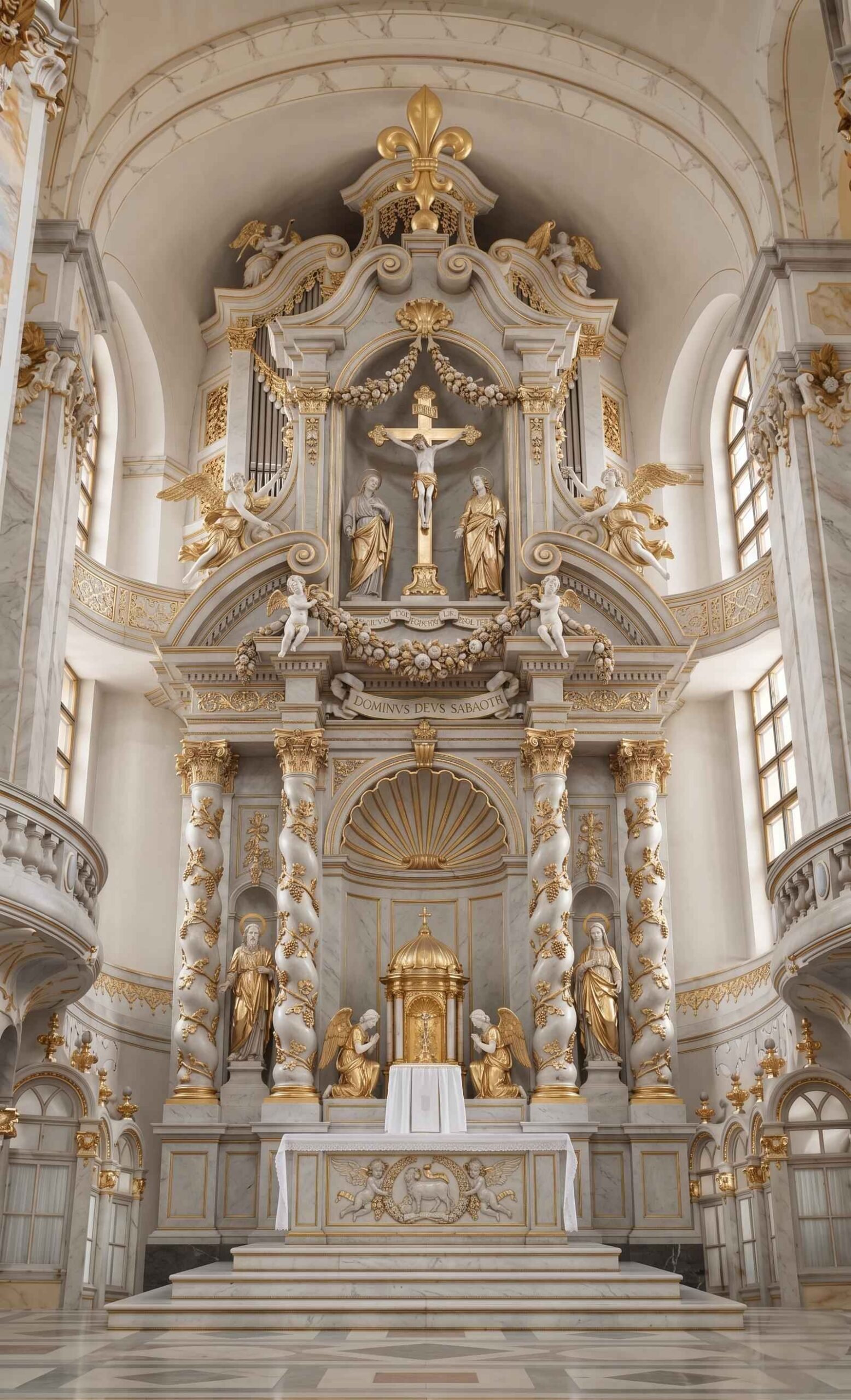
A more integrated altar ensemble, common in Baroque or Spanish Colonial churches, brings the altar, reredos, tabernacle, and decorative elements into one unified composition. In the right setting, this can create a strong sense of monumentality and visual richness.
Tabernacle
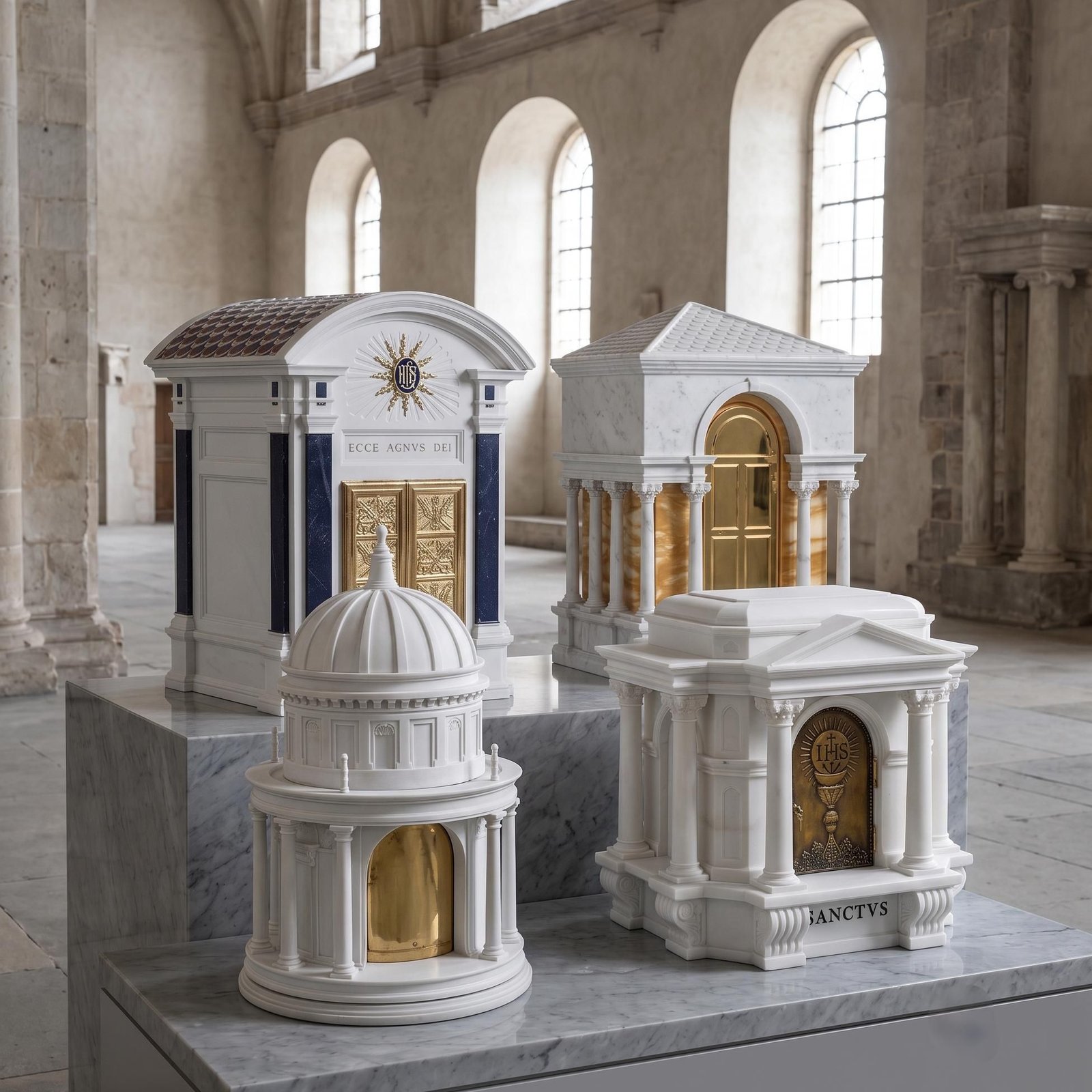
The tabernacle holds the Blessed Sacrament and serves as a visible sign of Christ’s real presence among his people. It should be placed with dignity and clarity, and its design should reflect the sacred importance of what it contains.
A well-considered tabernacle is usually securely fixed, clearly visible, and marked by a sanctuary lamp and, in some traditions, a veil. These elements help express reverence and signal the presence of the Blessed Sacrament.
Pulpit or Ambo
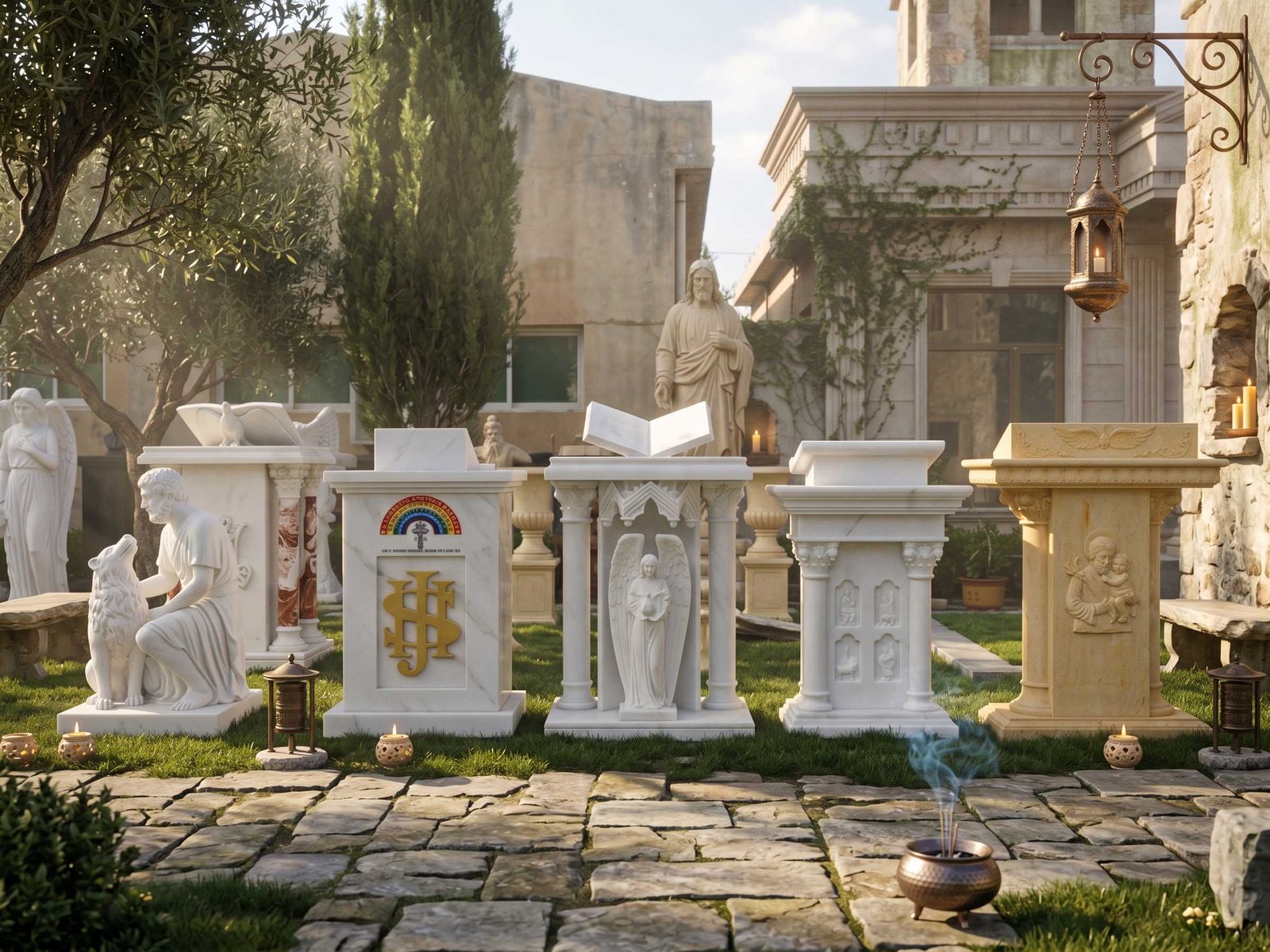
The pulpit or ambo is the place where the Word of God is proclaimed. It should be visible, accessible, and acoustically effective, while remaining in harmony with the altar and the overall sanctuary design.
Historically, the ambo began as a raised platform in the early Church, later becoming more ornate in medieval and Baroque settings.
In contemporary church design, it is often restored as a distinct liturgical furnishing for the readings and homily. Depending on the plan of the church, it may be placed on the Gospel side, at the crossing, or in another position that allows it to serve the liturgy well.
Crucifixion Statue
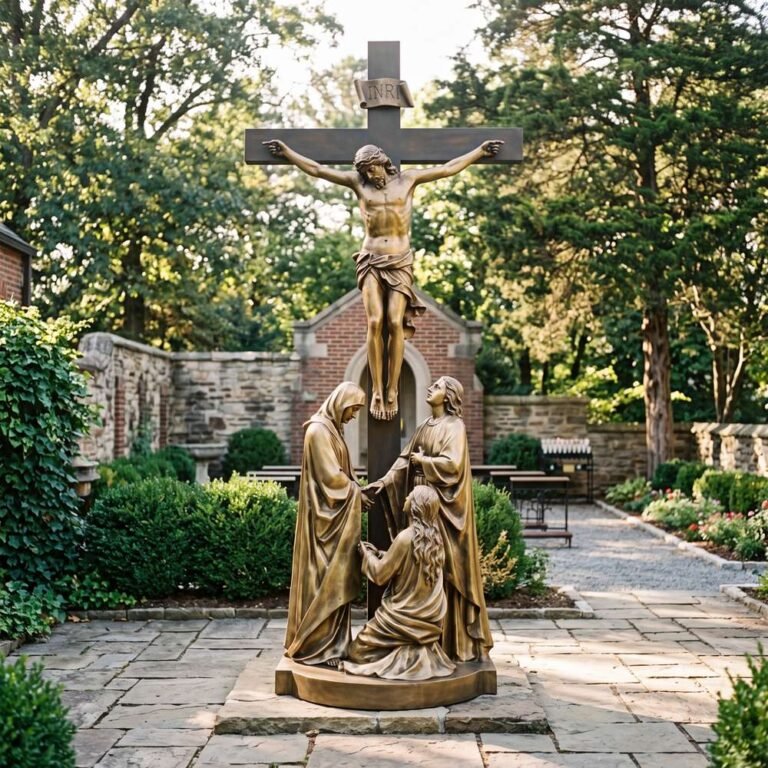
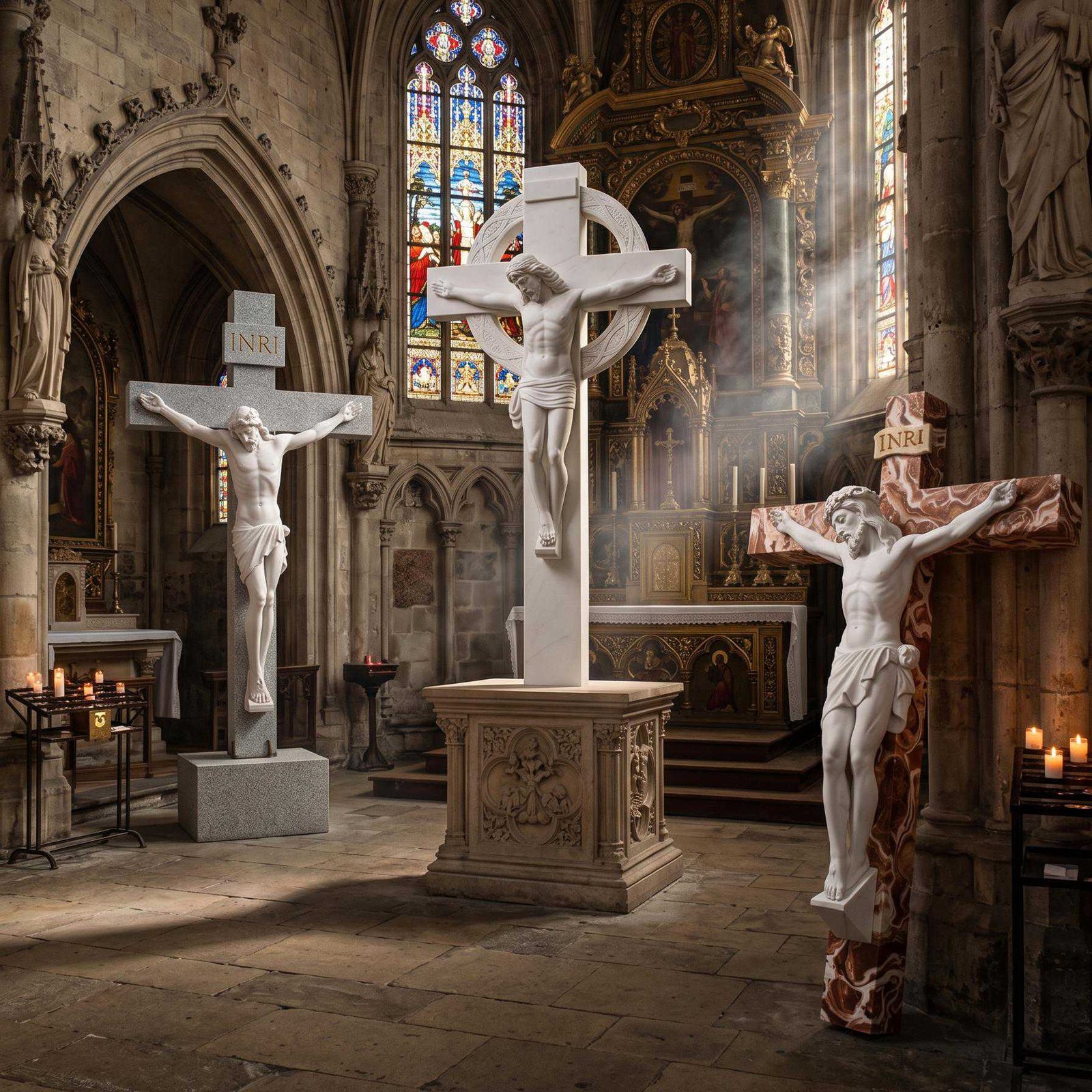
A crucifix, rather than an empty cross, is one of the most important symbols in the sanctuary. It reminds the faithful of Christ’s sacrifice, death, and resurrection, and it keeps the mystery of the Cross at the center of worship.
A carefully designed crucifix should have a strong devotional presence, with the body of Christ, the INRI plaque, and details that support its liturgical role. When placed in the sanctuary, it becomes one of the most direct visual expressions of Christian faith.
Candlesticks
Candles symbolize Christ as the Light of the World and the prayers of the faithful rising toward heaven. Their number, placement, and proportion should be chosen in accordance with the solemnity of the liturgy and the scale of the sanctuary.
Candlesticks should be stable, well-proportioned, and crafted to complement the altar and crucifix. Whether in stone, bronze, wood, or another appropriate material, they should contribute to a sense of order, reverence, and beauty.
Statues
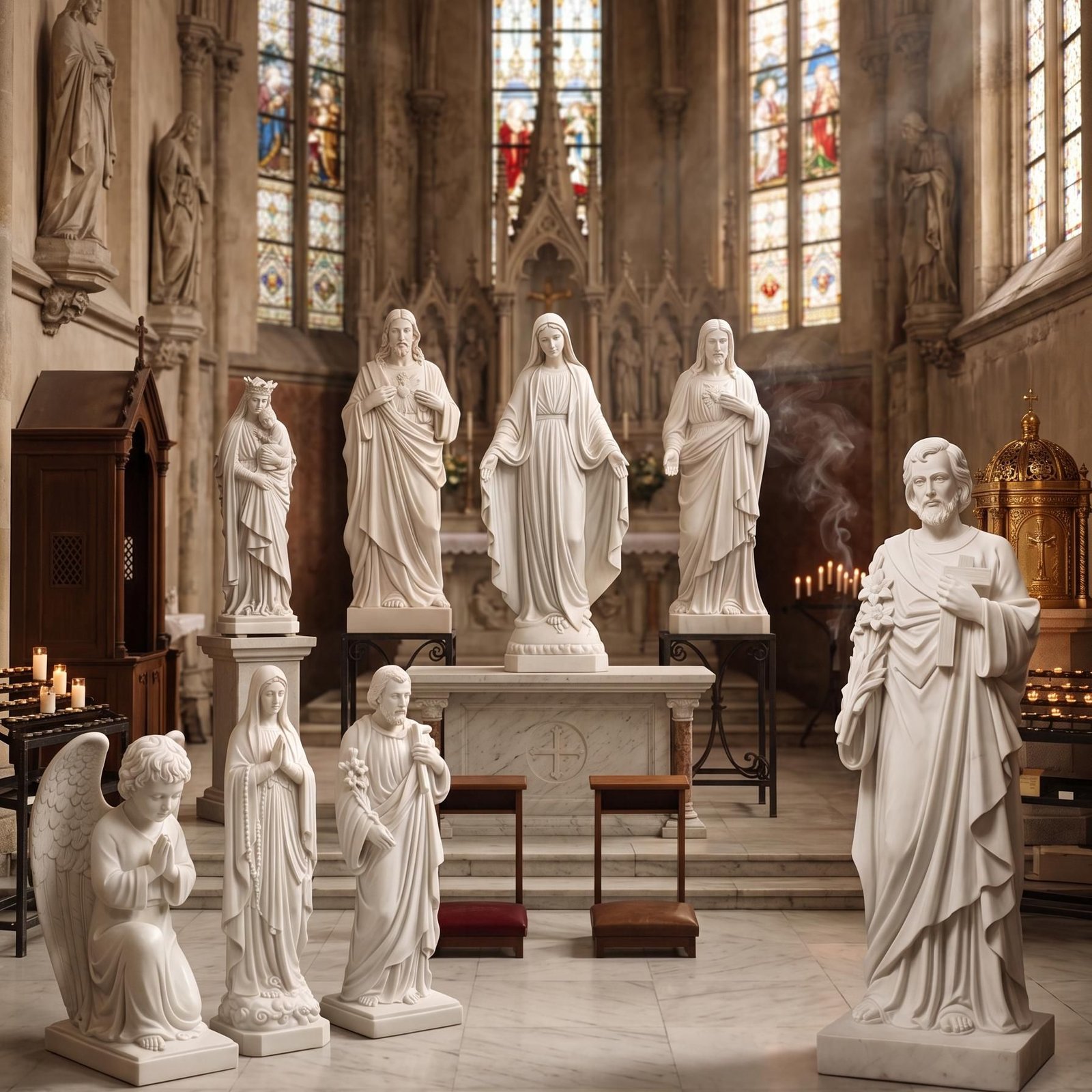
Statues of the saints remind the faithful of the communion of saints and enrich the sanctuary with devotional meaning. When placed in niches, side chapels, or other appropriate locations, they can support prayer without distracting from the altar.
Ideally, sacred sculpture should be thoughtfully designed, reverent in style, and consistent with the architectural language of the church. In many cases, statues of the Virgin Mary statues, St. Joseph statues, and patron saints become important focal points for private devotion and parish identity.
Beyond these core furnishings, a well-designed sanctuary may also include an altar canopy or baldachin, altar frontals, sedilia, an aumbry for holy oils, altar cards, a sanctus bell, incense, choir stalls, a pipe organ, baptismal font, confessionals, stained glass, and processional crosses. These elements, when selected carefully, can deepen the sense of sacred order and strengthen the overall liturgical environment.
Different Sanctuary Styles Require Different Design Solutions
Every church is different. The best sanctuary design depends on the building’s plan, denomination, liturgical practice, and congregation size.
The spatial arrangement of a sanctuary has a significant impact on how the liturgy is experienced. Different church traditions have developed different spatial models, each with its own strengths and character.
Basilican Sanctuary — The Classic Model
The basilican plan is one of the oldest and most enduring church layouts. It usually has a long nave, side aisles, and a sanctuary at the east end, creating a clear movement from the nave to the altar. It is often marked by screens or communion rails, and it can support both traditional and contemporary liturgical practice.
Well-known examples include Basilica di Santa Sabina, St. John Lateran, and St. Giles’ Church in Cheadle.
This style is well suited for Catholic, Anglican, and Lutheran churches, especially medium to large congregations. Its strengths are clear spatial order, good acoustics, and flexibility. Its main challenge is that the altar may feel somewhat distant from the congregation if the design is not handled carefully.
Cruciform Sanctuary — The Cathedral Model
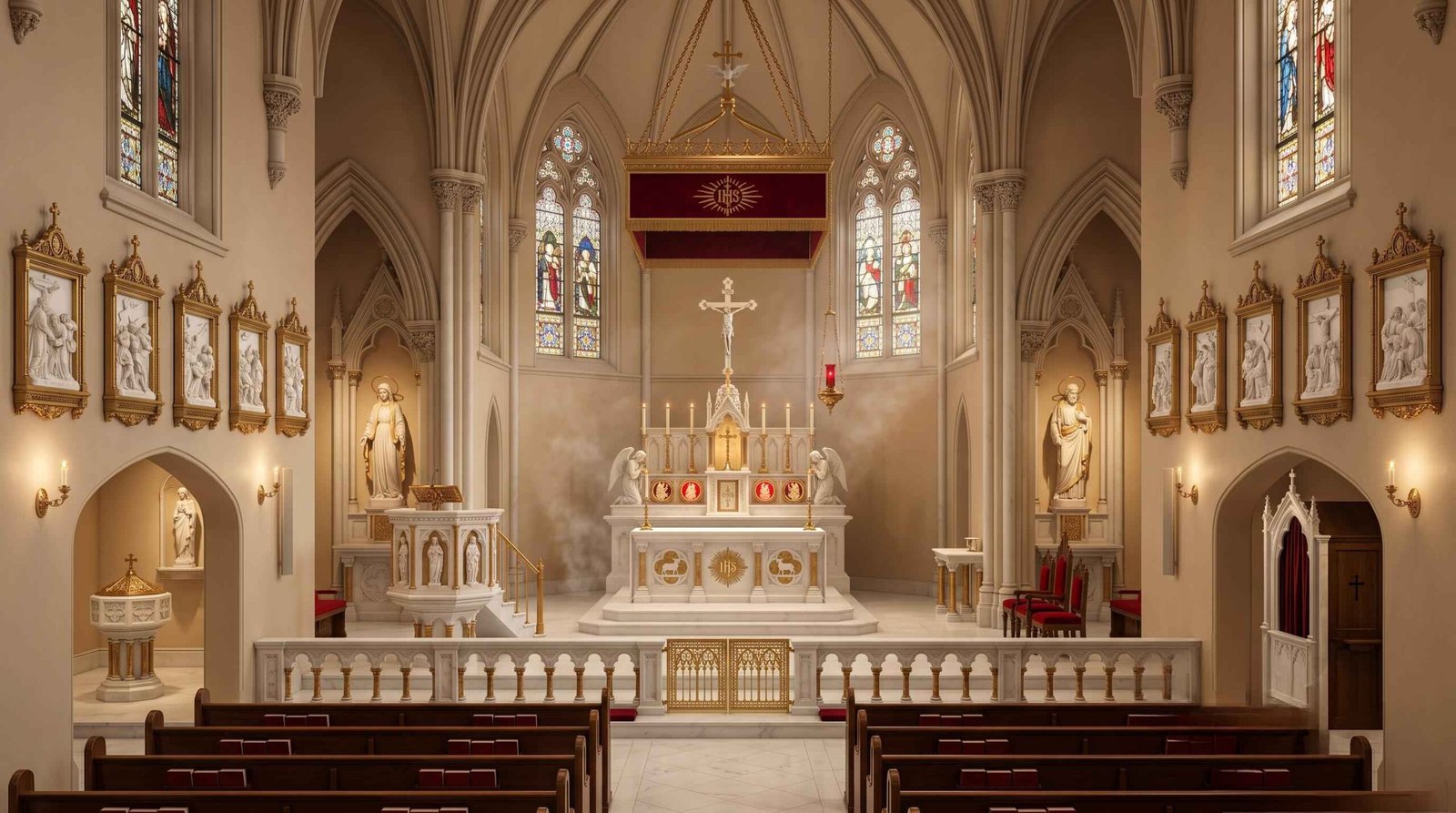
The cruciform plan is shaped like a Latin cross, with a nave, transepts, and sanctuary. The sanctuary is usually deeper than in a basilican plan and may include an ambulatory and side chapels. In some Gothic churches, screens create a more layered approach to the altar.
Well-known examples include Canterbury Cathedral, Chartres Cathedral, Westminster Abbey, and Cologne Cathedral.
This style is well suited for cathedrals, abbeys, and large churches. Its strengths are flexibility, good acoustics, and a strong sense of ceremony. Its challenges are higher cost, more complex construction, and, in very large buildings, a possible sense of distance or scale.
Centralized Sanctuary — The Ancient-and-Modern Model
The centralized plan places the altar at the center, with the congregation arranged around it. The sanctuary is often open and may be covered by a dome or vault. This layout is common in both Byzantine churches and some modern church designs.
Examples include the Pantheon in Rome, San Vitale in Ravenna, St. Mark’s Basilica in Venice, Temppeliaukio Church in Helsinki, and the Basilica of the Sacré-Cœur in Paris.
This style is well suited for Orthodox churches, modern Catholic churches, chapels, and small communities. Its strengths are strong participation, clear visibility, and a powerful sense of unity. Its challenges include difficulty with choir placement, weaker acoustics in some cases, and less suitability for more formal or complex liturgies.
Auditorium Sanctuary — The Evangelical Model
The auditorium plan features a fan-shaped or rectangular space facing a “platform,” where the pulpit is the center rather than the altar. There is typically no defined sanctuary — only a “platform” or “stage.” The focus is on sightlines and acoustics, with no screens and usually no communion rail. This arrangement is common in Baptist, Evangelical, Pentecostal, and megachurch settings.
Notable examples include Lakewood Church in Houston (one of America’s largest churches, with a fan-shaped auditorium seating over 16,000), Saddleback Church in California, and Hillsong Church campuses worldwide. In a more traditional vein, many 19th-century Protestant churches (like Broadway Tabernacle in New York) adopted the auditorium plan to maximize preaching audibility.
This style is well suited for Evangelical, Baptist, Pentecostal, and non-denominational megachurches; contemporary worship with bands; and teaching-focused ministries. Its advantages include excellent sightlines and acoustics, large capacity, flexibility for multiple uses, and a strong focus on preaching and worship. Its challenges include a weaker sense of sacredness, the marginalization of the altar and communion, a “performance” mentality, less sense of transcendence, and the feeling of being in a theater rather than a church.
Theater-in-the-Round Sanctuary — The Experimental Model
The theater-in-the-round arrangement places the altar at the center, with the congregation surrounding it on all sides. It is designed to encourage participation, closeness, and a strong sense of community.
This style is less common and is usually found in small chapels, intentional communities, and experimental church settings. Examples include the Chapel of the Holy Cross in Sedona, certain hospital and university chapels, and some modern churches with a highly participatory layout.
Its strengths are intimacy, flexibility, and a strong communal feel. Its challenges are that it may be less suitable for formal liturgies, music, or larger congregations.
How We Design Sanctuaries for Different Churches
Every project begins with listening.
We consider:
- the church’s liturgical tradition
- the architectural style of the building
- the size of the congregation
- the existing furnishings and historical elements
- budget, durability, and long-term use
From there, we develop a design that brings the sanctuary into harmony with the whole church.
Our work is not based on one standard template. Instead, we create custom sanctuary solutions that reflect the specific needs of each parish or institution.
This may include:
- a custom altar and tabernacle ensemble
- coordinated candlesticks and crucifix
- altar canopies or baldachins
- reredos and backdrop design
- communion rails or sanctuary boundaries
- statues and devotional sculpture
- materials matched to the architecture
- unified finishes in marble, bronze, wood, or stone
New Church Construction vs. Renovation
For New Church Projects
When designing a new church, the altar should be established first. From there, the rest of the sanctuary can be developed in relation to the architecture and liturgical flow.
We help clients define:
- sanctuary proportions
- altar placement
- material palette
- visual hierarchy
- furnishing coordination
For Renovation Projects
For existing churches, the goal is often to improve function without losing character.
We carefully assess:
- what can be restored
- what should remain
- what new elements are needed
- how to add without disrupting the church’s identity
In renovation work, we often create new furnishings that respect the original architecture while giving the sanctuary a more unified and dignified appearance.
FAQs
Does the tabernacle have to be on the high altar?
No. It may be placed on the main altar, in a side chapel, or in a separate Blessed Sacrament chapel. If it is on the altar, it should be central, visible, and secure.
Can the altar be made of wood?
The altar top, or mensa, is traditionally made of natural stone such as marble or limestone. The base may be wood, stone, or metal.
How high should the sanctuary be raised?
It should not be too high. A few steps are usually enough. The goal is to keep the altar clearly visible without making the sanctuary feel distant.
Can you make a custom altar or sanctuary design for our church?
Yes. We can create custom altars, tabernacles, candle holders, altar rails, crucifixes, statues, ciboria, baldachins, and other sanctuary furnishings according to your church style, size, liturgical needs, and budget.
Can you produce the design according to our drawings or reference images?
Yes. You can send us architectural drawings, sketches, 3D renderings, photos, or reference images. Our team can help turn your idea into a practical production plan.
What materials can be used for church altars and sanctuary furnishings?
Common materials include natural marble, limestone, sandstone, bronze, brass, gilded metal, wood, and stainless steel. We can recommend suitable materials based on your church design, installation location, and maintenance needs.
Can you customize the size and style?
Yes. Every project can be customized, including size, carving details, surface finish, color, inscriptions, religious symbols, and installation method.
Can you make traditional Catholic-style church furniture?
Yes. We can produce traditional Catholic-style altars, tabernacles, altar rails, candle stands, crucifixes, statues, and other liturgical furnishings with classical, Gothic, Baroque, Romanesque, or modern church designs.
Do you provide design support before production?
Yes. We can help review your project requirements, suggest suitable materials, confirm dimensions, and provide drawings or renderings before production.
Can you ship church furnishings internationally?
Yes. We have experience with international packaging and shipping. Large marble or metal church furnishings can be safely packed in strong wooden crates for sea or air transport.
Conclusion
Designing a church sanctuary is a profound theological and aesthetic task. Every furnishing — from the altar to the candlesticks, from the tabernacle to the statues — is a sacramental sign that points beyond itself to the divine. The most beloved sanctuary designs are often those where:
- Function serves liturgy — every piece does its job well
- Beauty serves reverence — every piece inspires awe and devotion
- Unity serves harmony — every piece relates to the others in material, style, and proportion
- Tradition serves the present — the wisdom of 2,000 years informs contemporary needs
Whether you choose a basilican, cruciform, centralized, auditorium, or theater-in-the-round arrangement, and whether your budget allows for a full marble-and-bronze set or simpler furnishings, the guiding principle can always be this: the sanctuary is God’s dwelling place among his people, and every element can help make that truth visible.
May your sanctuary be a place where heaven touches earth, where the faithful encounter the living God, and where beauty, truth, and goodness come together in praise.