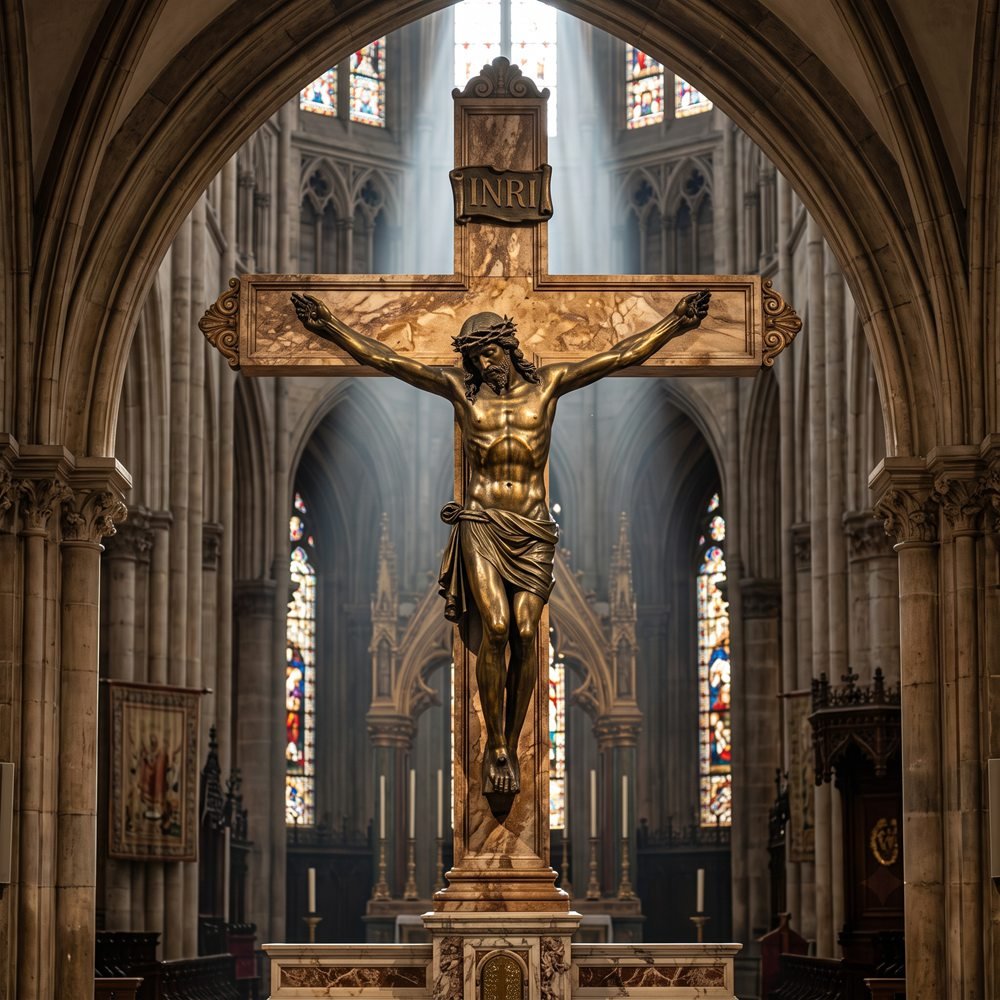
Walk into many Catholic homes, and you may notice a crucifix — above the doorway, on the bedroom wall, on a chain around someone’s neck. A cross bearing the figure of Christ.
The difference matters more than most non-Catholics realize. Both the cross and the crucifix are sacred signs. A crucifix includes the figure of Christ and draws particular attention to His Passion. And that single image — God on a cross, dying out of love — is a reminder of Christ’s love amid the ordinary moments of family life.
In this post, we look at what the crucifix means in Catholic devotion, how it gives meaning to suffering, the styles that have shaped it across the centuries, where it belongs in a Catholic home, and how to choose one — including the white marble and copper pieces we make in our own workshop.
What Do Catholics Actually See When They Look at a Crucifix?
More than an ornament, a crucifix offers a visible reminder of the Gospel in wood, stone, or metal. When a Catholic looks at a crucifix, the eye doesn’t stop at the material; it goes to the person on it. Catholic teaching distinguishes the veneration of an image from the adoration owed to God alone. As the Catechism of the Catholic Church, paragraphs 2131–2132, explains, devotion passes through the image to the person represented. The crucifix itself is not Christ.
Early Christian art often expressed faith through symbols of salvation and victory. Images of Christ on the cross developed over time, and their appearance varied across regions and artistic traditions.
Early representations of the cross could emphasize Christ’s victory through symbolic imagery rather than a detailed depiction of His suffering. Such works should be understood within their historical and artistic setting, rather than treated as evidence that early Christians ignored the Passion.
The Rabbula Gospels, dated 586, contain a well-known early Crucifixion image. There Christ stands robed in a long tunic, eyes open, no crown of thorns — not a victim but a priest and king. This image illustrates how Crucifixion scenes could emphasize Christ’s majesty as well as His suffering.
And today? A Catholic still sees both truths at once — a God who suffered, and a God who reigns. The treatment of the eyes, posture, and clothing can emphasize different aspects of the same faith. Above all, a Catholic sees a companion. The well-known San Damiano cross before which St. Francis of Assisi knelt in a crumbling chapel, is associated in Franciscan tradition with his call to repair the Church. For many Catholics, praying before a crucifix helps direct attention to Christ. Prayer is addressed to Him, rather than to the material object.
Why Does the Crucifix Give Meaning to Suffering?
Everyone suffers; the question is whether it means anything. The crucifix answers: yes. It shows God Himself entering suffering and taking it seriously enough to endure it to the end. It recalls His self-giving love and saving Passion. So when a Catholic looks at the crucifix, they can bring their suffering to Christ in hope. This does not mean that suffering should be sought or that practical care and help should be refused.
That is why a crucifix has often been a companion to the sick and the dying: held in the hand, hung where the eyes can rest on it. It does not explain pain away; it stands beside it. The saints lived this. St. Catherine of Siena received the stigmata while kneeling before a crucifix. Padre Pio received the visible wounds of Christ in 1918 while praying at the foot of a large crucifix. The pattern repeats through every century of Catholic history: suffering taken up in love becomes something else.
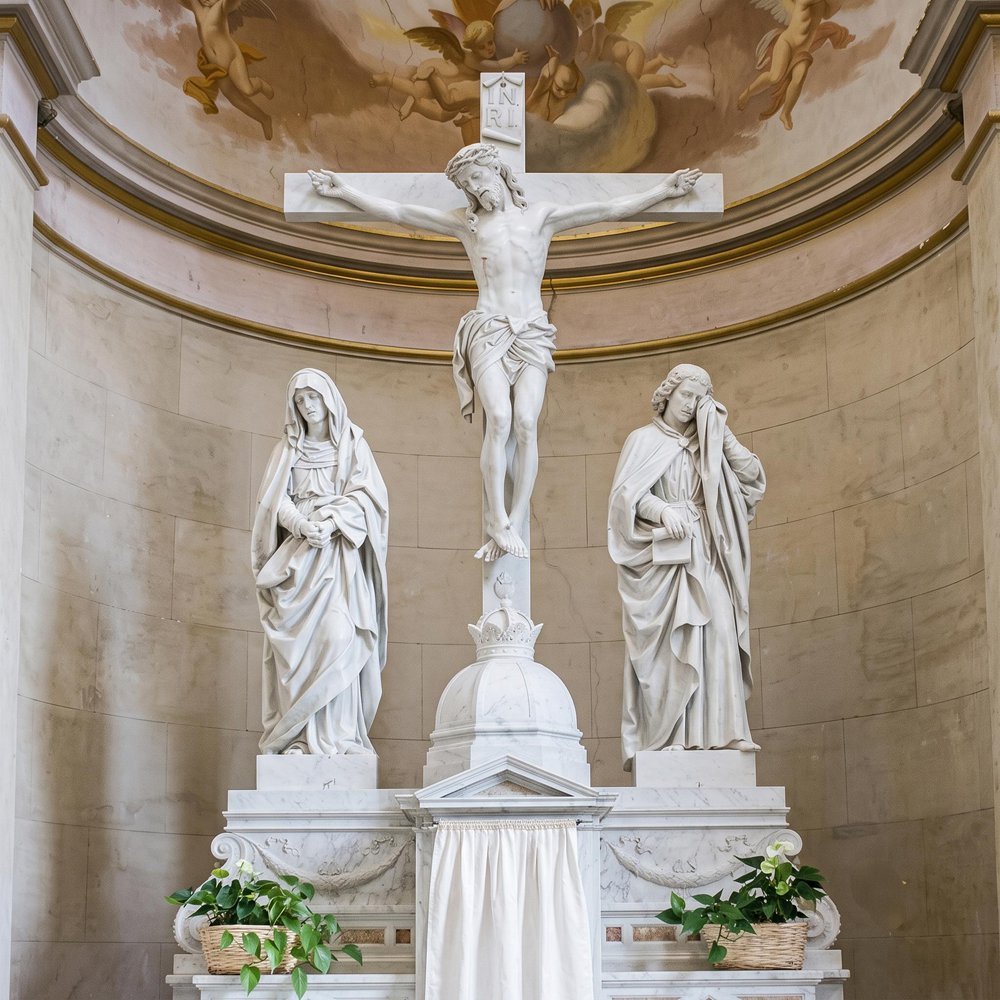
The great miraculous crucifixes of Europe — above all the Volto Santo of Lucca, which legend said was carved by Nicodemus from a cedar of Lebanon, whose face was blackened by centuries of candle and incense smoke, which kings swore by and Dante mentioned, and whose feast is still kept with a candlelight procession through Lucca every September — are treasured not because wood and metal work magic. They are treasured because they are the place where faith, hope, and prayer have gathered for generations. Catholics love the crucifix for the same reason: it is where their story meets Christ’s.
What Are the Different Styles of Crucifix Statues?
Two useful themes in crucifix imagery emphasize triumph and suffering. They express aspects of the same faith, although not every crucifix fits neatly into these categories.
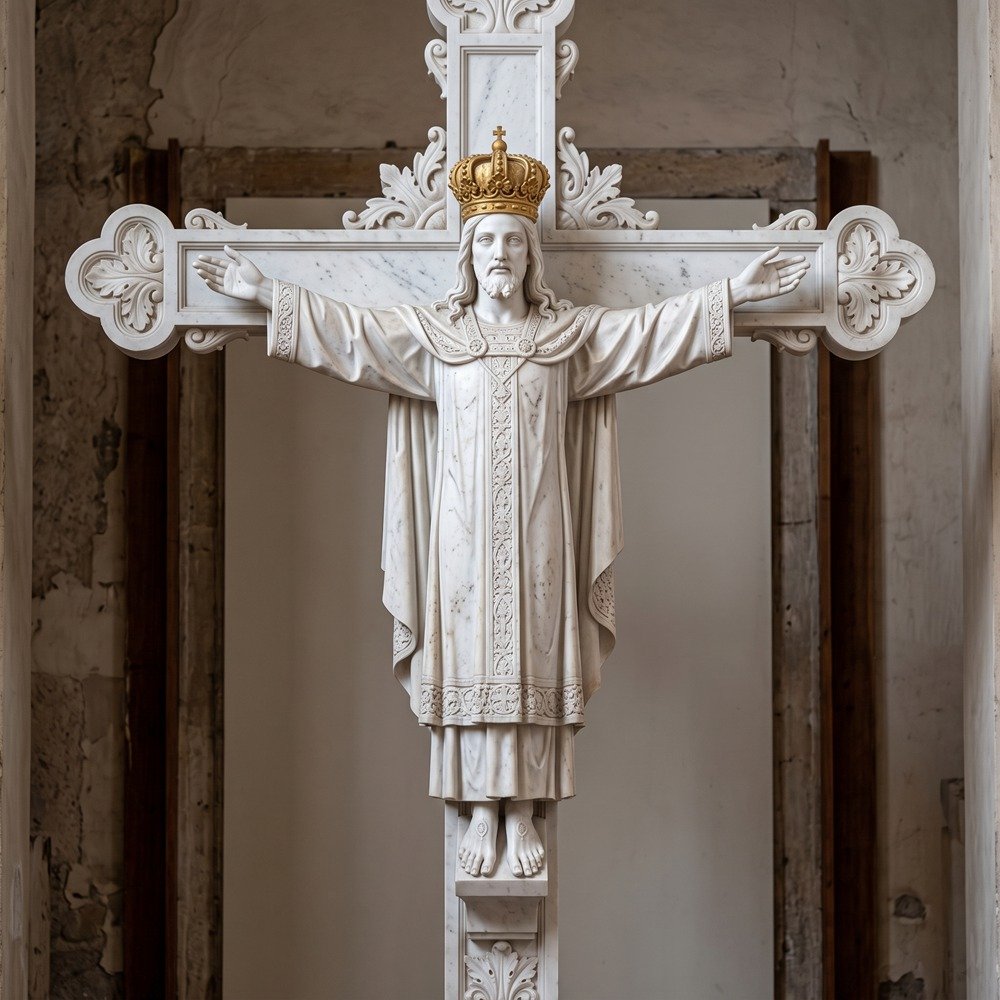
The triumphant Christ — the triumphant Christ, sometimes shown as Christus Rex, or Christ the King. Christ stands vested in a long robe as priest and king, crowned, eyes open, reigning from the cross rather than dying on it. Examples of this approach include the great Catalan Majestats of the eleventh and twelfth centuries and the Volto Santo of Lucca. The early medieval Ruthwell Cross in what is now Scotland shows the same Christ — free, sovereign, with open eyes — carved in stone for a whole congregation to read.
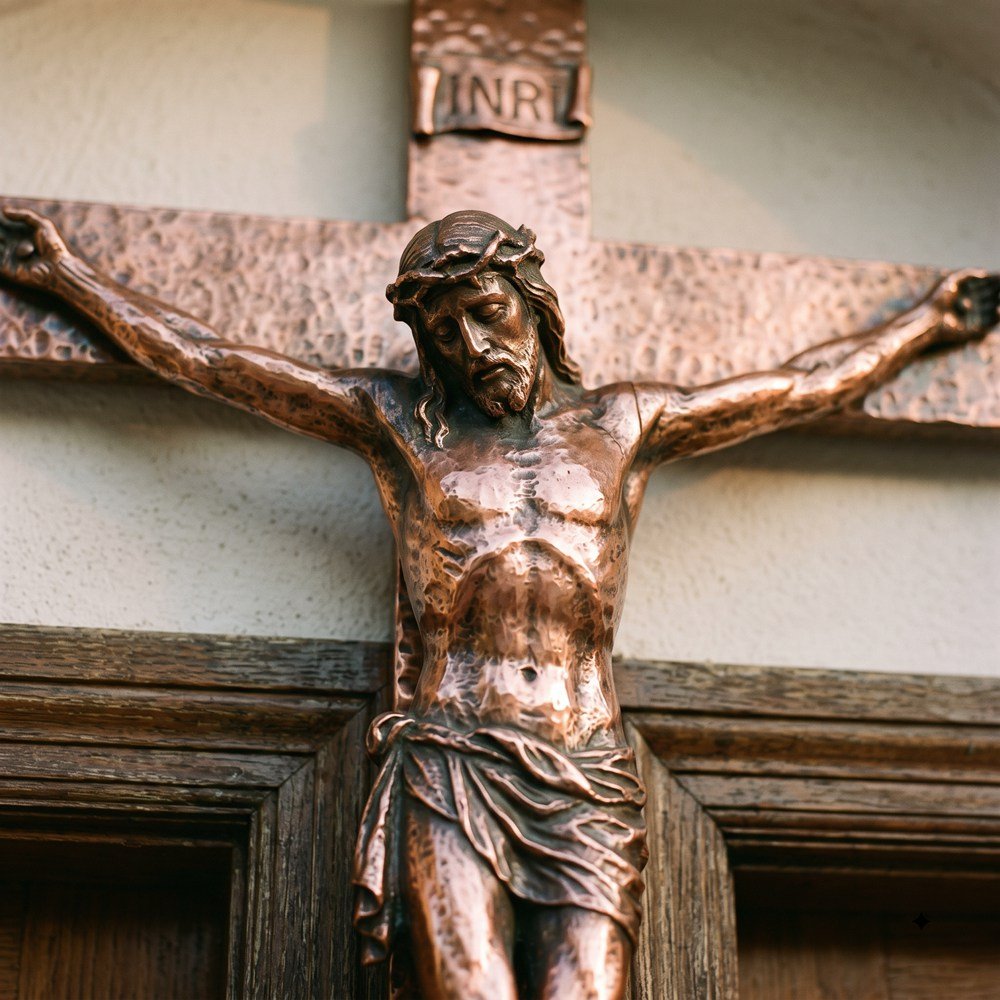
The suffering Christ — the Christus Patiens. Eyes closed, crown of thorns, the full weight of death. This is the image that became familiar from the Gothic age onward and still dominates Catholic art today. Artists have used posture, expression, and wounds to invite meditation on Christ’s Passion in different periods and traditions.
Within these two families the variations are endless — Byzantine painted icons like the San Damiano crucifix, the Celtic cross with its intricate knotwork for homes with Irish heritage, some Eastern Christian crosses with an additional lower crossbar, Renaissance and Baroque realism, and modern minimal lines for contemporary interiors. Details carry meaning too: Latin cross or Greek, one nail or two through the feet, the tilt of the head.
For a home or a church, the choice is partly spiritual — a triumphant corpus speaks of glory and hope, a suffering one of compassion — and partly architectural, because a crucifix must look at home in the space around it. As a general guide, a traditional home feels most cohesive with a carved wood or bronze corpus crucifix, while a modern interior tends to suit a minimalist metal design. Many families keep it simple in bedrooms and choose something more ornate for the common areas.
Where Should Catholic Families Display a Crucifix at Home?
Placement carries nearly as much meaning as the crucifix itself. Common choices include the following, depending on the household’s prayer habits and available space.
- At eye level. Choose a position where it can be seen during prayer, with secure fixings suited to its weight.
- Above doorways. A long-standing tradition in many cultures, offering a reminder of Christ to those who enter and leave. If the piece is meant for daily prayer, eye level serves better; for a doorway display, check visibility and secure mounting.
- In the family prayer corner or home altar, with a Bible and a vessel of holy water — a focus for family devotion. See our family altar planning guide.
- In bedrooms, especially children’s rooms, as a reminder of prayer and trust in Christ.
- In the dining room, entryway, kitchen, or office — where the family gathers, and where Christ is always welcome.
East-facing walls are traditionally favored, linked to the rising sun and the Resurrection — a custom rather than a requirement. Avoid bathrooms and areas of steady humidity or heat, which can damage wood, metal finishes, and paint over the years.
A home crucifix can be both a work of sacred art and an aid to prayer. It marks the house as a place of prayer and makes the faith visible to the youngest members of the family, who learn what they see long before they understand what they read. Families often have their crucifixes blessed by a priest — a simple step many buyers overlook — and many are passed down as heirlooms: a mother’s crucifix placed in the room of her grown daughter, a grandfather’s crucifix above the door of the son who inherited the house. If you are giving a crucifix as a gift, include a note about its significance. It is, in a real sense, the family’s first teacher.
What Material and Size Should You Choose for a Home Crucifix?
Material shapes not just how a crucifix looks, but how it wears over decades and how it feels in a room. Marble and metal offer different appearances, weights, and maintenance needs.
Copper and bronze. These are distinct materials, so confirm the exact alloy and construction. Our cast bronze identification guide explains what to request. Warm, human, and strong. Copper allows the face and hands to be modeled with a depth that flat materials cannot reach, and it takes detail beautifully. It is the material for a crucifix meant to be passed down. In a busy entryway or living room, a polished copper or bronze corpus holds its dignity among the surrounding furniture. Outdoors, its surface may change with exposure. Patina color varies with the alloy and environment, and protective finishes require inspection and maintenance. Confirm the exact metal, finished weight, mounting method, and exposure requirements. A processional crucifix also needs a construction and balance suitable for carrying.
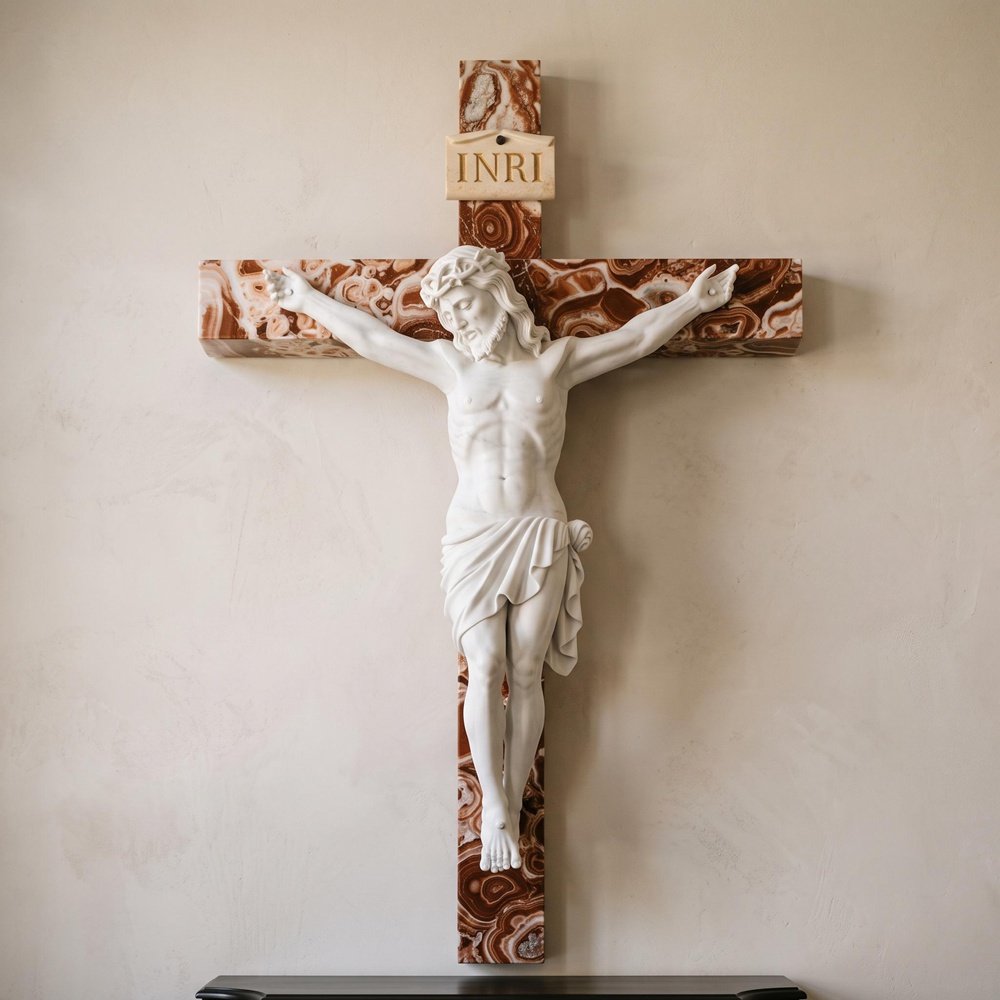
White marble. Serene, cool, timeless. A white marble crucifix carries the visual character of classical sacred art, but it still needs suitable handling and care. It is at its best indoors — a tabletop piece on a desk, a prayer corner, an altar — where permanence and quiet are the point. Two honest cautions: marble is heavy, so larger wall pieces need a proper anchor; and outdoor suitability depends on stone selection, condition, detailing, and climate. Even indoors, avoid acidic cleaners, staining liquids, and abrasive cleaning.
The alternatives, for context. Wood — especially olive wood from the Holy Land — is warm, traditional, with a long history in devotional art; it suits classic interiors but needs to stay away from steady humidity. Resin and composite pieces are budget-friendly, lightweight, and can be finished to imitate stone or bronze; they are a good first crucifix or classroom choice. Precious metals — gold-plated or sterling silver — are usually reserved for intimate, smaller pieces such as baptismal gifts. Ceramic is delicate and cottage-like, best kept away from high-traffic rooms.
| Material | Character | Best for |
|---|---|---|
| Copper/bronze | Warm, human, durable; ages with a soft patina; outdoor suitability depends on alloy, finish, and care | Wall crucifixes, entryways, outdoor and processional crosses, heirlooms |
| White marble | Natural stone; heavy; requires suitable support, cleaning, and site assessment | Desks, prayer corners, altars, sanctuaries |
| Wood/olive wood | Traditional appearance; weight and care vary by construction | Classic interiors, everyday use |
| Resin | Budget-friendly, lightweight, detailed | First crucifix, classrooms |
| Precious metal | Small, intimate, precious | Baptismal and confirmation gifts |
For size, the rule depends on where the crucifix will live:
- 4–8 inches — desk, shelf, bedside table
- 10–15 inches — bedroom wall or prayer corner
- 16–24 inches and up — living room, entryway, or prominent display
A good rule of thumb: the crucifix should be large enough to notice, but not so large it overpowers the space. Choose based on visibility, not just on available wall space — then let the crucifix be the quiet center of the room, not a loud decoration.
What’s the Right Crucifix for Your Sacred Place?
A church is a different matter, and the needs are more exact. The General Instruction of the Roman Missal, paragraph 308, calls for a cross bearing the figure of Christ crucified on or near the altar, clearly visible to the assembled people. For related planning, see our church sanctuary design guide. Beyond that comes the rest of the church’s life: an altar crucifix, a processional cross for feast days, sanctuary wall crucifixes, and smaller works for side altars, sacristies, and adoration chapels.
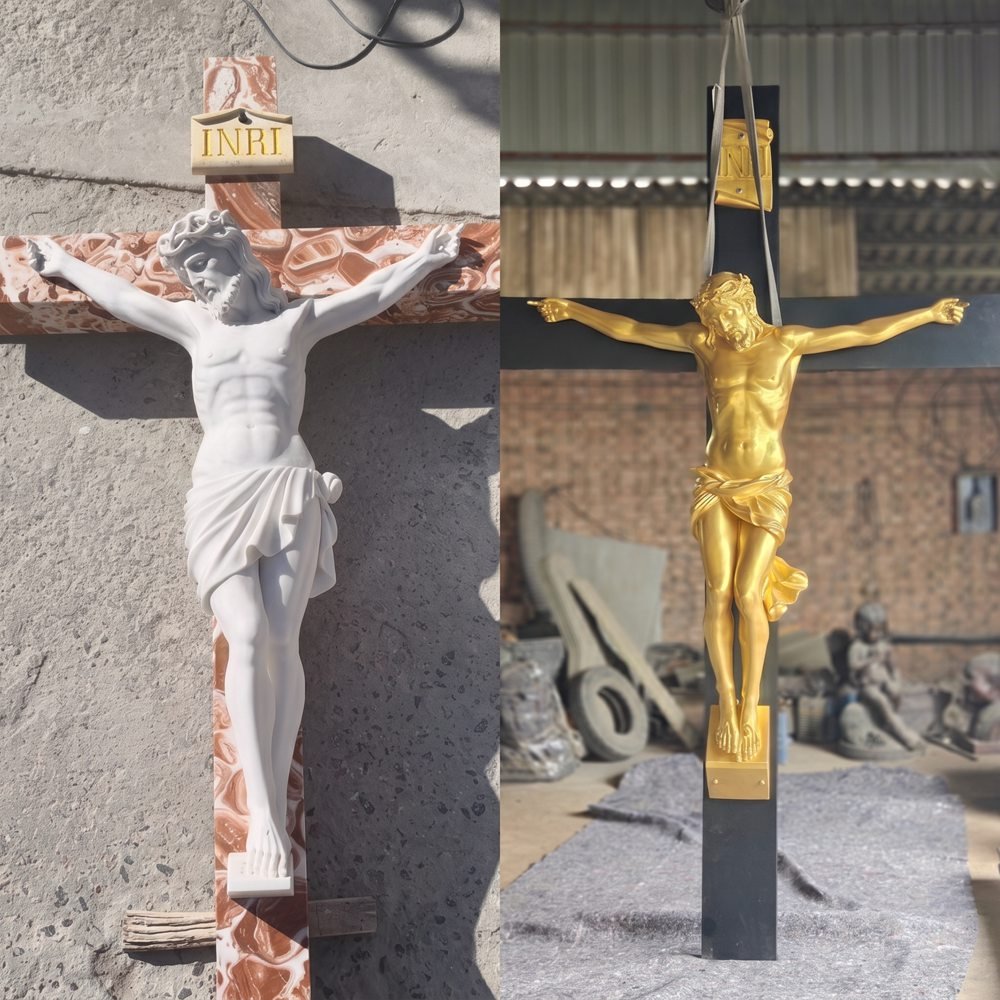
Scale changes everything. Sanctuary crucifix dimensions should be chosen for the architecture, viewing distance, and liturgical setting rather than a universal size range. Material follows function: white marble belongs on altars and in sanctuaries, where permanence and dignity are the point; metal may suit outdoor or wayside installations when appropriately specified. Processional crosses require separate attention to weight, balance, and handling. Style should match the building — classical interiors call for white marble, while modern or rustic parishes often find a patinated copper crucifix more at home.
Frequently Asked Questions
How large should a crucifix be for a small room?
Eight to twelve inches suits bedrooms and prayer corners. Choose based on visibility, not wall space.
What is the difference between a cross and a crucifix?
A crucifix includes the figure of Christ, the corpus; a plain cross does not. Our guide explains the difference between a cross and a crucifix in more detail. Catholics typically use crucifixes — in the home, the bedroom, the church — because they make Christ’s sacrifice visible while remaining connected to faith in His Resurrection. A plain cross is also a meaningful Christian symbol; it emphasizes the mystery through a different visual form.
Can a crucifix be hung outside?
Yes, if the material, finish, joints, drainage, and mounting are suited to the location. Confirm local exposure and maintenance requirements with the maker and installer.
What material lasts the longest?
There is no universal ranking for every piece. Workmanship, stone condition or alloy, exposure, support, and maintenance all affect service life. Read our guide to sculpture longevity and care.
Can I give a crucifix as a gift?
Absolutely. Crucifixes make meaningful gifts for Baptism, First Communion, Confirmation, weddings, housewarmings, and the blessing of a new home.
How do I care for a bronze or marble crucifix?
Dust marble gently with a soft cloth and follow the maker’s cleaning instructions. Avoid acidic and abrasive cleaners; staining or surface damage may require specialist attention.
Follow the care instructions for the specific bronze finish. Do not polish an intentional patina without advice, and inspect outdoor protective coatings periodically.
A Simple Checklist Before You Buy
- Cross or crucifix — which fits the space and its purpose?
- Which room (or desk, or table) will it actually live in?
- How much wall or surface space do you really have?
- Does the material suit that room’s humidity and light?
- Does the style match the home’s overall decor?
- Will it be blessed before or after it is in place?
Closing Thoughts
Your crucifix is not a decoration — it is a doorway into prayer, peace, and a daily encounter with Christ. May the one you choose become a sacred part of your daily life.
We make white marble and copper crucifixes to your exact dimensions — from a small tabletop piece for a bedside table to a life-size sanctuary crucifix.
Tell us about your space, and we will help you choose the right size, style, and finish. Our custom religious sculpture ordering guide explains the approval and quotation process.