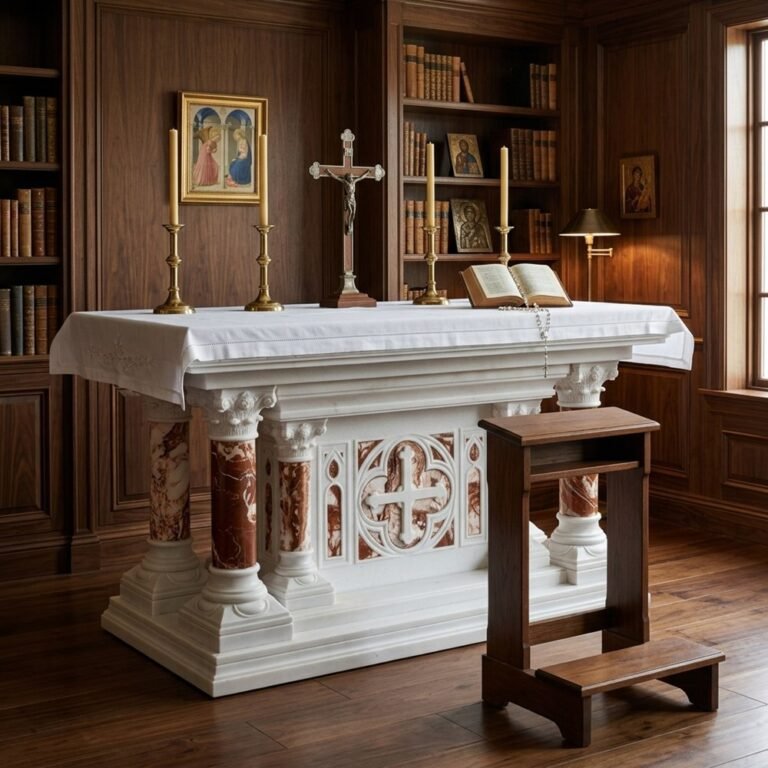
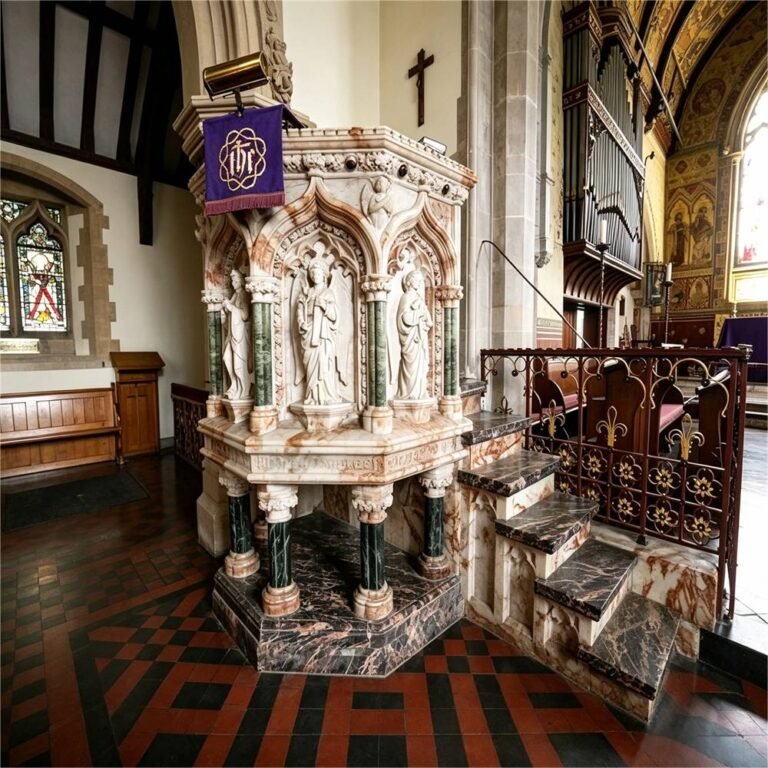
Walk into any Catholic home, and you will find it before you notice almost anything else — above the doorway, on the bedroom wall, on a chain around someone’s neck. Not a plain cross. A crucifix, with the figure of Christ upon it.
The difference matters more than most non-Catholics realize. A cross is a sign. A crucifix is a Person. And that single image — God on a cross, dying out of love — is what a Catholic sees every time a door is entered, a meal is blessed, or a child is tucked in.
In this post, we look at what the crucifix means in Catholic devotion, how it gives meaning to suffering, the styles that have shaped it over thirteen centuries, where it belongs in a Catholic home, and how to choose one — including the white marble and copper pieces we make in our own workshop.
What Do Catholics Actually See When They Look at a Crucifix?
Not an ornament. The Gospel in one image — the whole of the faith compressed into a few inches of stone, wood, or metal. When a Catholic looks at a crucifix, the eye doesn’t stop at the material; it goes to the person on it. That is why the Church insisted so early that Christ be shown in human form. At the Council of Constantinople in 681, it was decreed that our Lord should be depicted as a man rather than as a symbol — a lamb, for instance — “so that we shall be led to remember His mortal life, His Passion, and His Death, which paid the ransom for mankind.”
It took centuries for that image to appear. In the earliest Christian art, the Roman catacombs, there is no crucifixion at all. The faith of the first generations was fixed on the Risen Lord, and a dying Christ would have seemed, in the words of one historian of the liturgy, a kind of anachronism.
On a marble sarcophagus of the mid-fourth century now in the Lateran Museum, the Passion appears for the first time — but the central panel does not dare to show the crucifixion. It shows a plain cross with doves seated on its arms, crowned with the Chi-Rho. The reticence of that period is itself a piece of theology: the cross was a victory sign before it was a wound.
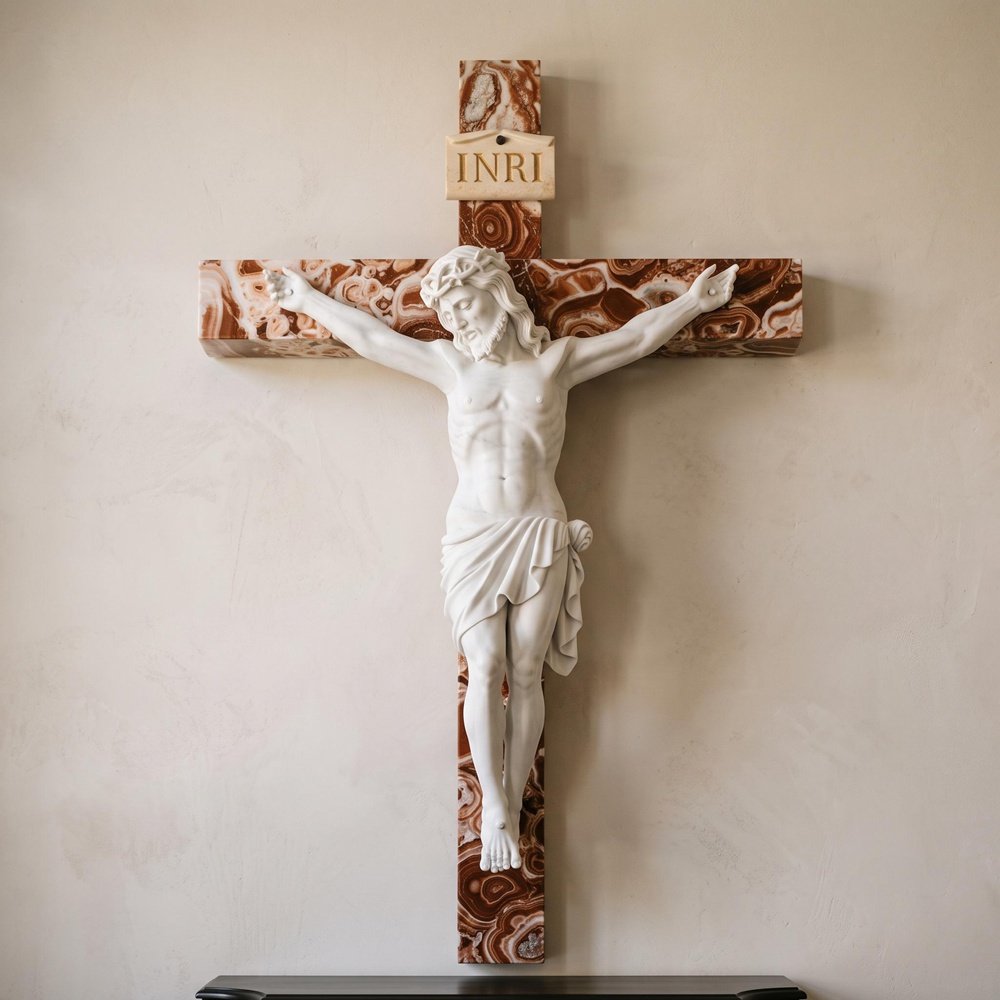
The first known realistic crucifixion in Christian art is the Rabula Gospels miniature of 586. There Christ stands robed in a long tunic, eyes open, no crown of thorns — not a victim but a priest and king. One early historian of the Scottish crosses put the whole change in a single sentence: “Not till the eighth century is Christ represented on the cross to the public eye — but even then it is a Christ free, a supreme sovereign, with eyes open, with arms unbound: living, not dead; majestic, not abject.”
And today? A Catholic still sees both truths at once — a God who suffered, and a God who reigns. The eyes tell the story: open in the earliest images, closed in art only from about the tenth century, when meditation on the Passion deepened. Above all, a Catholic sees a companion. The most famous crucifix in the world, the San Damiano cross before which St. Francis of Assisi knelt in a crumbling chapel, spoke to him three times: “Francis, go and repair My house which you see is falling down.” Ever since, the crucifix has been the image before which Catholics pray aloud — the way a family keeps a photograph of someone they love, and talks to it.
Why Does the Crucifix Give Meaning to Suffering?
Everyone suffers; the question is whether it means anything. The crucifix answers: yes. It shows God Himself entering suffering and taking it seriously enough to endure it to the end. His death, the 681 decree said, “paid the ransom for mankind.” So when a Catholic looks at the crucifix, suffering is not a blind accident and not a punishment — it is something Christ passed through, redeemed, and now shares with us.
That is why the crucifix, not the empty cross, has always been the companion of the sick and the dying: held in the hand, hung where the eyes can rest on it. It does not explain pain away; it stands beside it. The saints lived this. St. Catherine of Siena received the stigmata while kneeling before a crucifix. Padre Pio received the visible wounds of Christ in 1918 while praying at the foot of a large crucifix. The pattern repeats through every century of Catholic history: suffering taken up in love becomes something else.
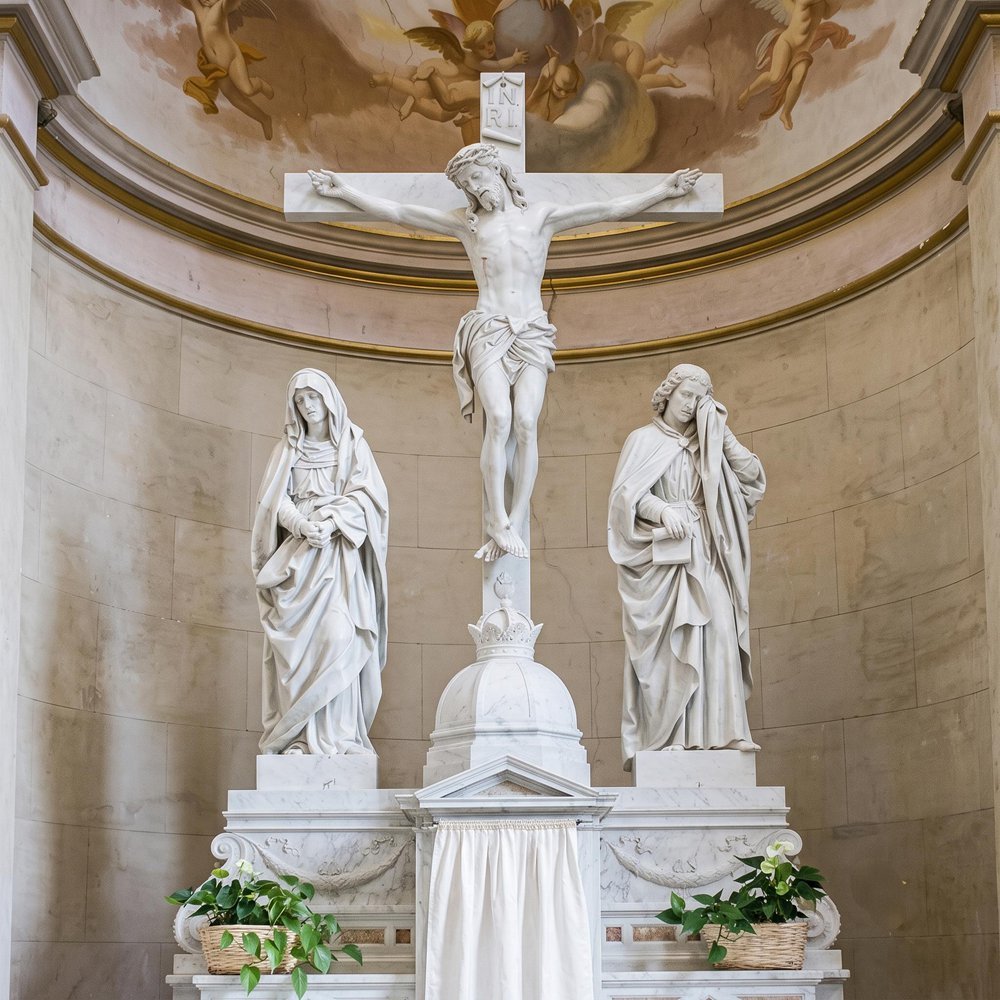
The great miraculous crucifixes of Europe — above all the Volto Santo of Lucca, which legend said was carved by Nicodemus from a cedar of Lebanon, whose face was blackened by centuries of candle and incense smoke, which kings swore by and Dante mentioned, and whose feast is still kept with a candlelight procession through Lucca every September — are treasured not because wood and metal work magic. They are treasured because they are the place where faith, hope, and prayer have gathered for generations. Catholics love the crucifix for the same reason: it is where their story meets Christ’s.
What Are the Different Styles of Crucifix Statues?
Two great families of crucifixes exist, and they express two moods of the same faith.
The triumphant Christ — the Christus Rex, or “Spanish Majesty.” Christ stands vested in a long robe as priest and king, crowned, eyes open, reigning from the cross rather than dying on it. This is the early Christian way of seeing, and its masterpieces are the great Catalan Majestats of the eleventh and twelfth centuries and the Volto Santo of Lucca. The late seventh-century Ruthwell Cross in what is now Scotland shows the same Christ — free, sovereign, with open eyes — carved in stone for a whole congregation to read.
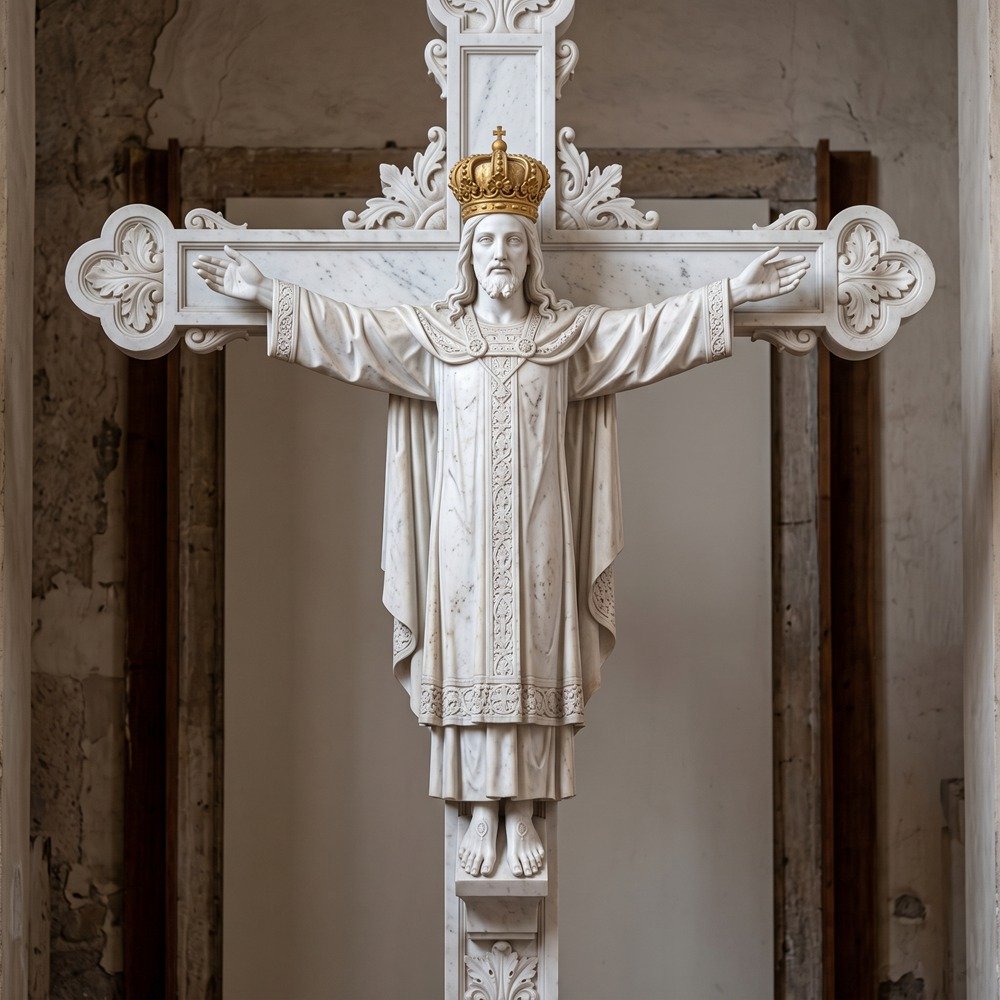
The suffering Christ — the Christus Patiens. Eyes closed, crown of thorns, the full weight of death. This is the image that became familiar from the Gothic age onward and still dominates Catholic art today. Art historians trace the turn precisely: the closed eyes of Christ on the cross appear only from about the tenth century.
Within these two families the variations are endless — Byzantine painted icons like the San Damiano crucifix, the Celtic cross with its intricate knotwork for homes with Irish heritage, the Byzantine or Orthodox crucifix with its third, lower crossbar, Renaissance and Baroque realism, and modern minimal lines for contemporary interiors. Details carry meaning too: Latin cross or Greek, one nail or two through the feet, the tilt of the head.
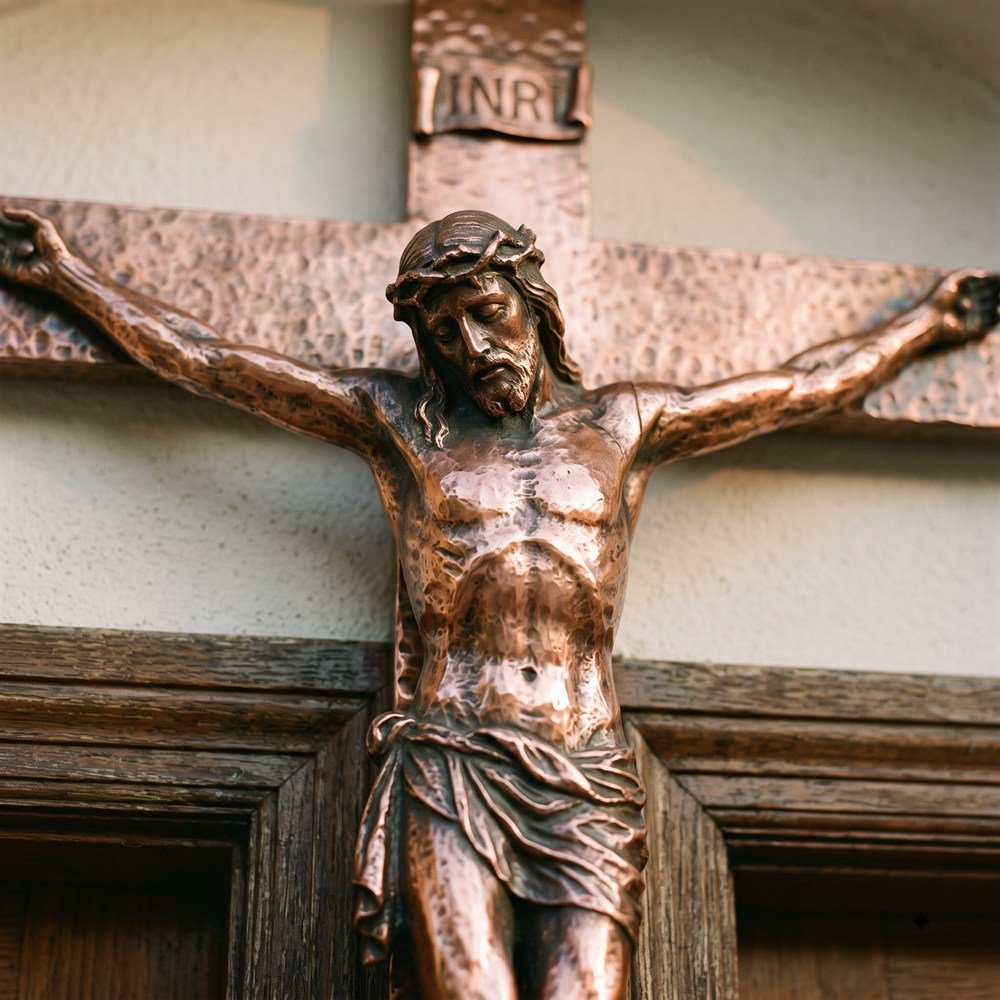
For a home or a church, the choice is partly spiritual — a triumphant corpus speaks of glory and hope, a suffering one of compassion — and partly architectural, because a crucifix must look at home in the space around it. As a general guide, a traditional home feels most cohesive with a carved wood or bronze corpus crucifix, while a modern interior tends to suit a minimalist metal design. Many families keep it simple in bedrooms and choose something more ornate for the common areas.
Where Should Catholic Families Display a Crucifix at Home?
Placement carries nearly as much meaning as the crucifix itself. The classic Catholic places have not changed in centuries.
- At eye level. A crucifix hung too high becomes decoration rather than devotion; most families hang it where it can be seen and touched.
- Above doorways. A long-standing tradition in many cultures, meant to bless those who enter and leave — an eighth-century English prayer for the dedication of a cross called it “the trophy of Thy victory and our redemption.” If the piece is meant for daily prayer, eye level serves better; if it is a blessing for the house, the doorway is right.
- In the family prayer corner or home altar, with a Bible and a vessel of holy water — the heart of family devotion.
- In bedrooms, especially children’s rooms, for spiritual protection and peace.
- In the dining room, entryway, kitchen, or office — where the family gathers, and where Christ is always welcome.
East-facing walls are traditionally favored, linked to the rising sun and the Resurrection — a custom rather than a requirement. Avoid bathrooms and areas of steady humidity or heat, which can damage wood, metal finishes, and paint over the years.
A home crucifix is not decoration. It marks the house as a place of prayer and makes the faith visible to the youngest members of the family, who learn what they see long before they understand what they read. Families often have their crucifixes blessed by a priest — a simple step many buyers overlook — and many are passed down as heirlooms: a mother’s crucifix placed in the room of her grown daughter, a grandfather’s crucifix above the door of the son who inherited the house. If you are giving a crucifix as a gift, include a note about its significance. It is, in a real sense, the family’s first teacher.
What Material and Size Should You Choose for a Home Crucifix?
Material shapes not just how a crucifix looks, but how it wears over decades and how it feels in a room. Two materials are built for a lifetime — and they are the two we work in daily.
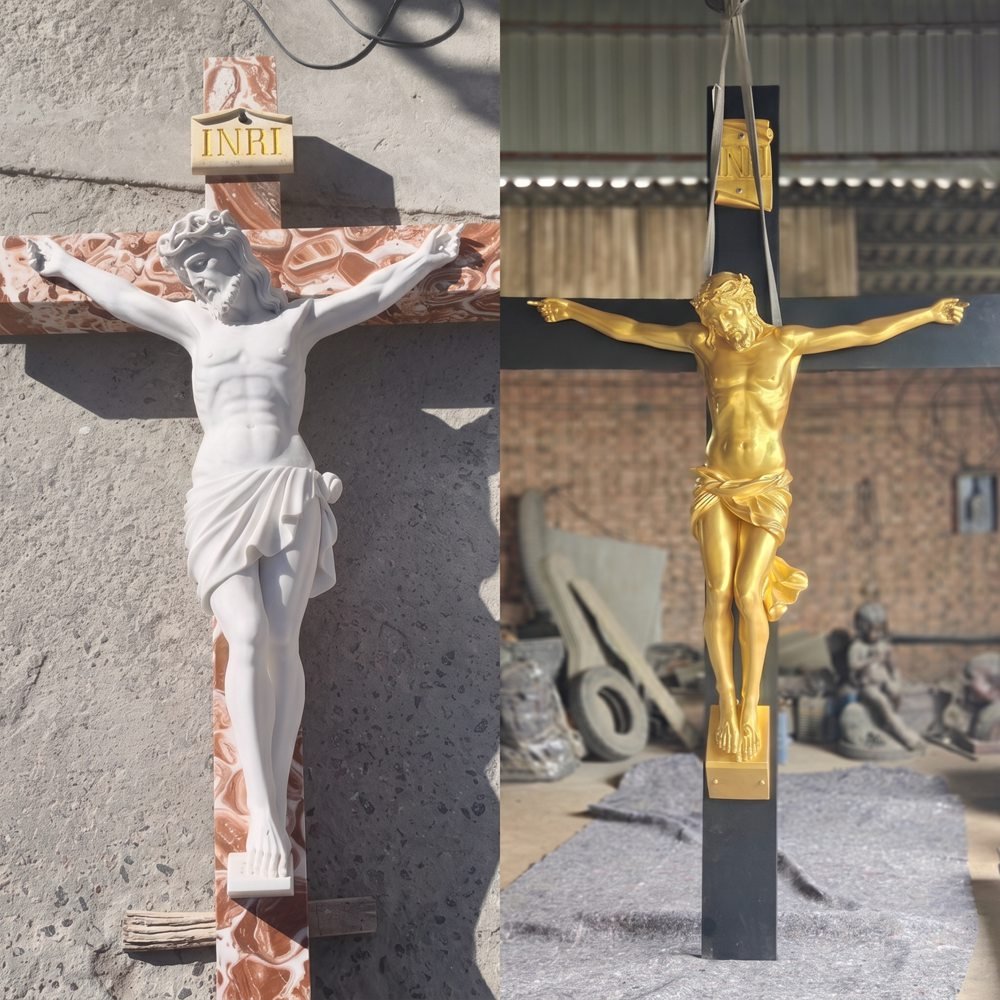
Copper and bronze. Warm, human, and strong. Copper allows the face and hands to be modeled with a depth that flat materials cannot reach, and it takes detail beautifully. It is the material for a crucifix meant to be passed down. In a busy entryway or living room, a polished copper or bronze corpus holds its dignity among the surrounding furniture. Outdoors it behaves honestly: left untreated, it weathers to a soft green patina over the years; sealed or lacquered, it stays bright. That resilience makes it the natural choice for wall crucifixes above doorways and for processional and outdoor crosses.
White marble. Serene, cool, timeless. A white marble crucifix does not fade, does not need polish, and quietly carries the dignity of a classical church. It is at its best indoors — a tabletop piece on a desk, a prayer corner, an altar — where permanence and quiet are the point. Two honest cautions: marble is heavy, so larger wall pieces need a proper anchor; and like all stone, it prefers a sheltered spot away from freezing winters and constant damp. Indoors, it will look the same in a hundred years.
The alternatives, for context. Wood — especially olive wood from the Holy Land — is warm, traditional, and the oldest material of all; it suits classic interiors but needs to stay away from steady humidity. Resin and composite pieces are budget-friendly, lightweight, and can be finished to imitate stone or bronze; they are a good first crucifix or classroom choice. Precious metals — gold-plated or sterling silver — are usually reserved for intimate, smaller pieces such as baptismal gifts. Ceramic is delicate and cottage-like, best kept away from high-traffic rooms.
| Material | Character | Best for |
|---|---|---|
| Copper/bronze | Warm, human, durable; ages with a soft patina; weather-tolerant when sealed | Wall crucifixes, entryways, outdoor and processional crosses, heirlooms |
| White marble | Serene, timeless, never fades; heavy, needs anchoring; indoor or sheltered | Desks, prayer corners, altars, sanctuaries |
| Wood/olive wood | The oldest tradition; warm and light | Classic interiors, everyday use |
| Resin | Budget-friendly, lightweight, detailed | First crucifix, classrooms |
| Precious metal | Small, intimate, precious | Baptismal and confirmation gifts |
For size, the rule depends on where the crucifix will live:
- 4–8 inches — desk, shelf, bedside table
- 10–15 inches — bedroom wall or prayer corner
- 16–24 inches and up — living room, entryway, or prominent display
A good rule of thumb: the crucifix should be large enough to notice, but not so large it overpowers the space. Choose based on visibility, not just on available wall space — then let the crucifix be the quiet center of the room, not a loud decoration.
What’s the Right Crucifix for Your Sacred Place?
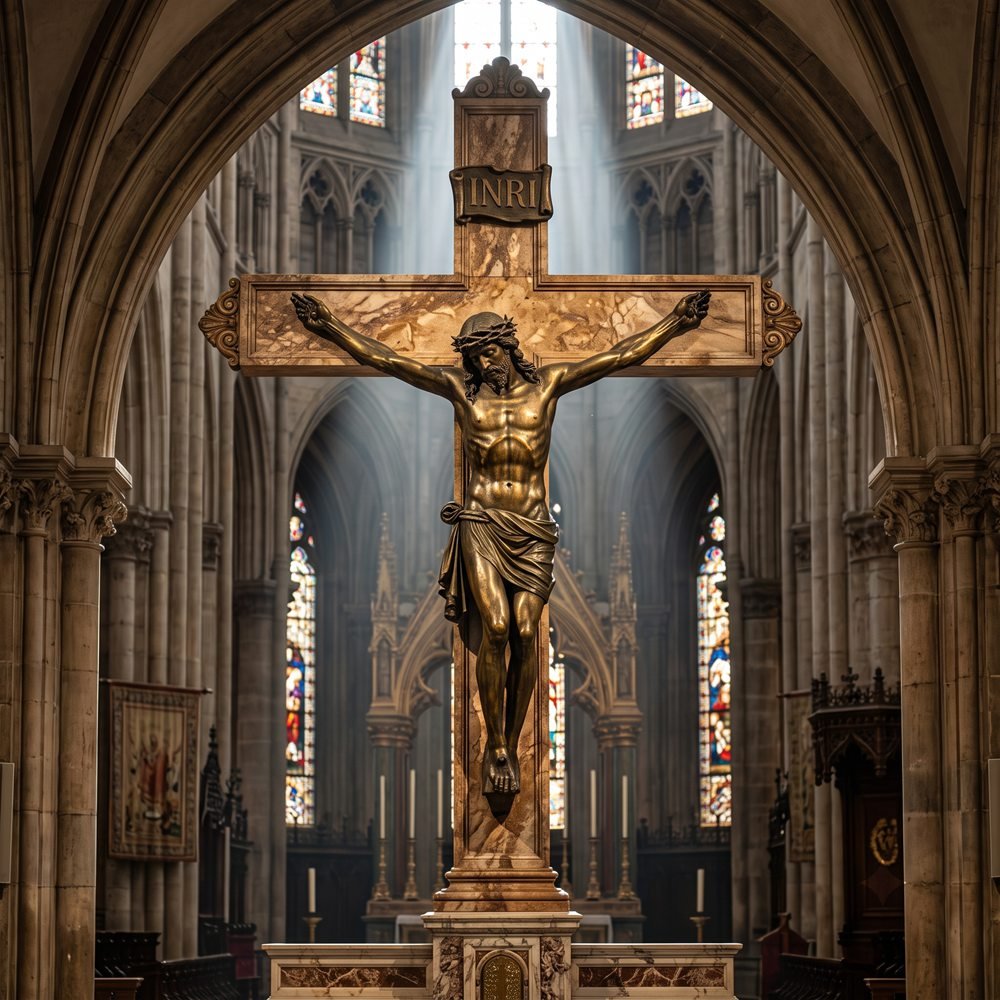
A church is a different matter, and the needs are more exact. The Church’s liturgical norms ask that a cross bearing the figure of the crucified Christ stand near the altar during Mass, visible to the whole assembly. Beyond that comes the rest of the church’s life: an altar crucifix, a processional cross for feast days, sanctuary wall crucifixes, and smaller works for side altars, sacristies, and adoration chapels.
Scale changes everything. Sanctuary crucifixes run from about forty inches up to life-size, because they must speak across a nave. Material follows function: white marble belongs on altars and in sanctuaries, where permanence and dignity are the point; copper suits processional crosses, which must be carried, and outdoor or wayside crosses, where metal bears the weather year after year. Style should match the building — classical interiors call for white marble, while modern or rustic parishes often find a patinated copper crucifix more at home.
Frequently Asked Questions
How large should a crucifix be for a small room?
Eight to twelve inches suits bedrooms and prayer corners. Choose based on visibility, not wall space.
What is the difference between a cross and a crucifix?
A crucifix always includes the body of Christ, the corpus; a plain cross does not. Catholics typically use crucifixes — in the home, the bedroom, the church — because they reflect the sacrifice of Jesus rather than only the victory of the empty tomb. A plain cross is not “wrong”; it simply says less.
Can a crucifix be hung outside?
Yes — if it is made of weather-safe materials. Sealed copper or bronze is the strongest choice for outdoor and sheltered placements. White marble is best kept indoors or in a sheltered porch or churchyard setting.
What material lasts the longest?
Copper and bronze, especially for public or outdoor use. White marble is the most enduring indoor material — it never fades. Both outlast wood and resin.
Can I give a crucifix as a gift?
Absolutely. Crucifixes make meaningful gifts for Baptism, First Communion, Confirmation, weddings, housewarmings, and the blessing of a new home.
How do I care for a bronze or marble crucifix?
Dust white marble with a soft cloth; it needs nothing else.
Bronze can be left to develop its natural patina, or gently polished — or lacquered at our workshop, if you prefer it to stay bright.
A Simple Checklist Before You Buy
- Cross or crucifix — which fits the space and its purpose?
- Which room (or desk, or table) will it actually live in?
- How much wall or surface space do you really have?
- Does the material suit that room’s humidity and light?
- Does the style match the home’s overall decor?
- Will it be blessed before or after it is in place?
Closing Thoughts
Your crucifix is not a decoration — it is a doorway into prayer, peace, and a daily encounter with Christ. May the one you choose become a sacred part of your daily life.
We make white marble and copper crucifixes to your exact dimensions — from a small tabletop piece for a bedside table to a life-size sanctuary crucifix.
Tell us about your space, and we will help you choose the right size, style, and finish.