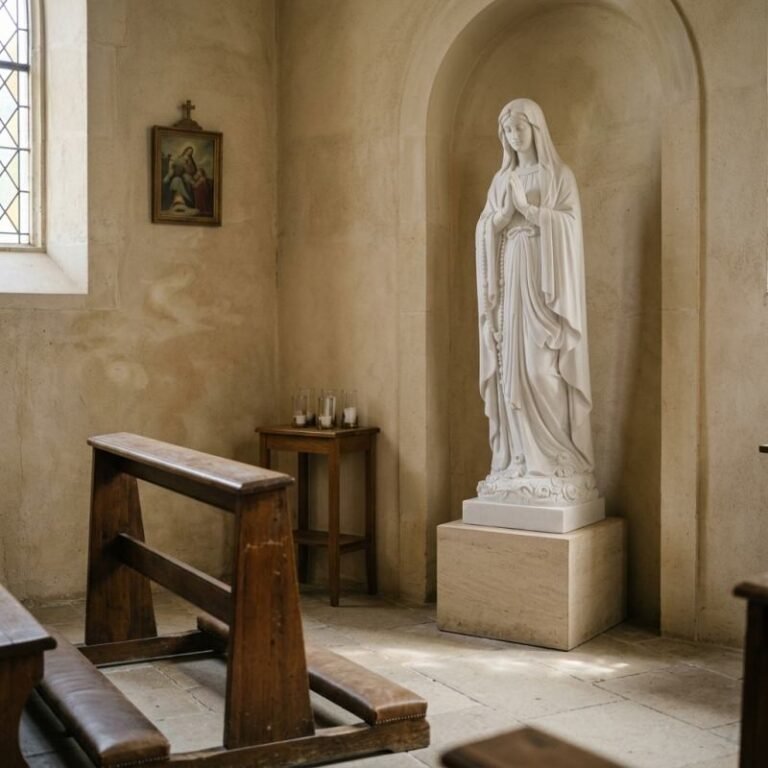
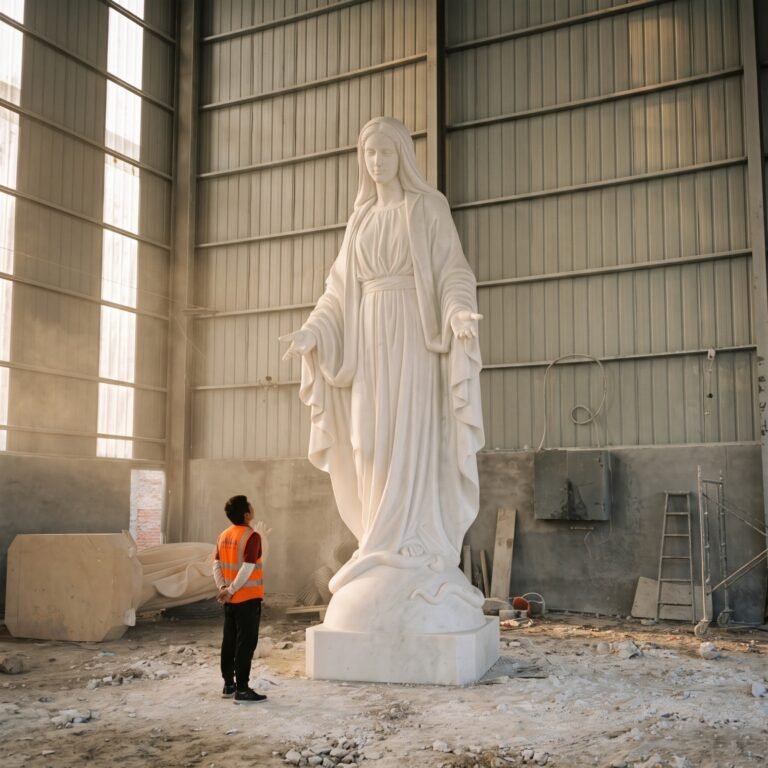
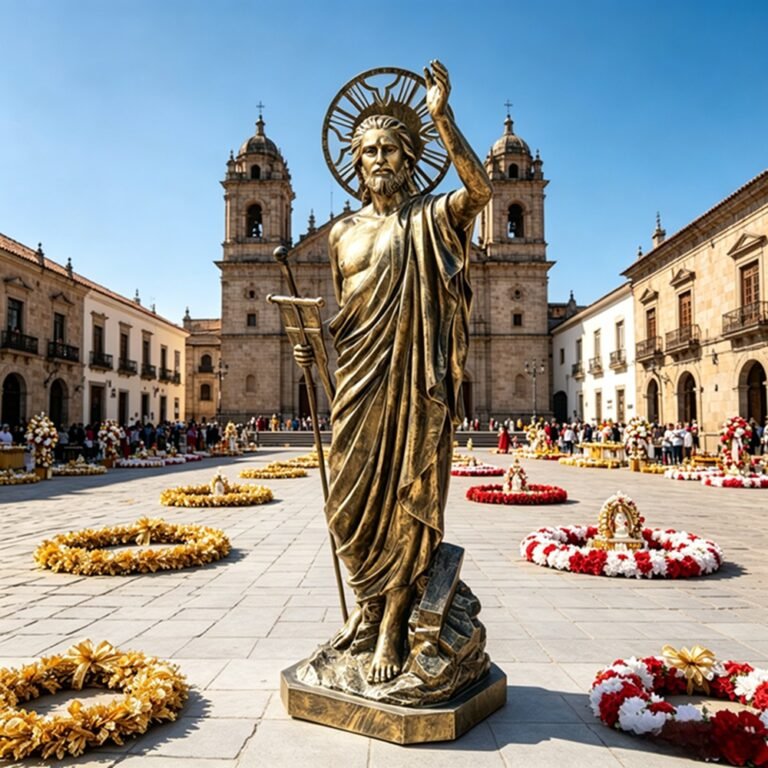
A marble Jesus statue is commissioned as a figure, but what the congregation actually sees is the figure and its pedestal together. The pedestal sets the viewing height, carries the weight of the stone, and decides whether the composition reads as part of the church’s architecture rather than a piece of furniture set down in the aisle.
This guide covers what a pedestal is, how tall it should be in each church setting, how wide and deep it needs to be, and which color and style match a marble Christ figure. If you are still deciding the figure itself, browse our Jesus statues, or see what drives the price in our marble Jesus statue cost guide and bronze Jesus statue cost guide.
What Is a Statue Pedestal?
A pedestal (also called a plinth, socle, or statue base) is the separate supporting block that sits under the statue’s own carved base.
It does two jobs at once: it is the structural member that carries and fixes the figure in place, and it is part of the sculpture’s overall composition in the room — the element that sets the figure’s scale, dignity and relationship to the viewer. In a matched commission, it is carved from the same stone and designed with the figure as one composition; it is not an afterthought added once the statue is finished.
Classically, it breaks into three parts. The plinth is the lowest stepped block in contact with the floor or altar top; the die (or stem) is the vertical central block that usually carries the inscription; the cap is the top slab the statue stands on, slightly larger than the carved base above it. Around these parts, the pedestal raises the face to a readable eye level, spreads the marble’s weight over the floor or footing, protects the carved feet and hem from cleaning, wax and damp, and provides a flat face for the name of the devotion, a dedication date or a donor memorial.
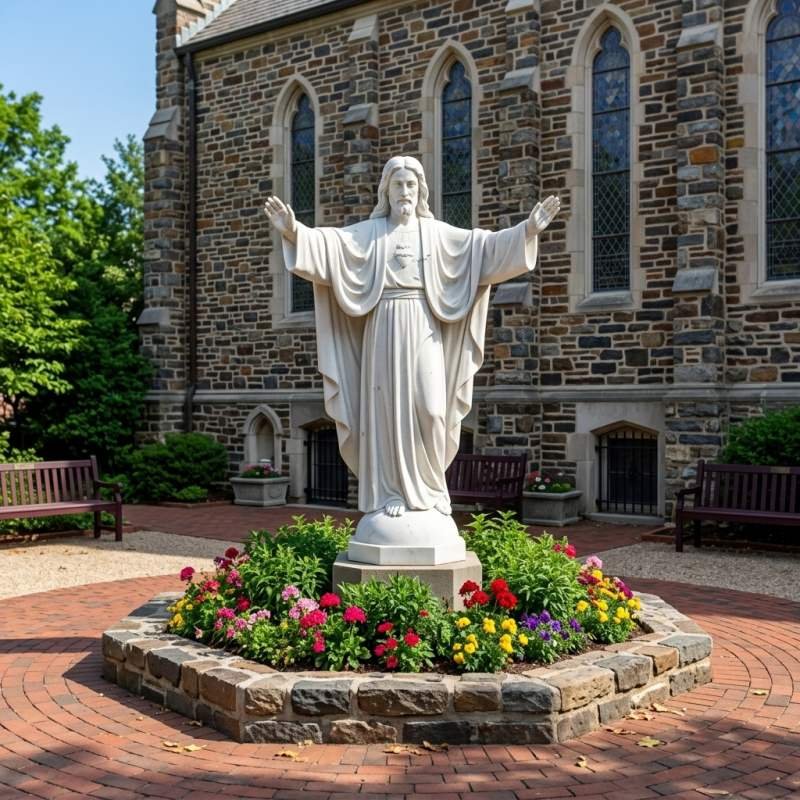
Pedestals take several forms beyond the square column: a round or polygonal plinth, or a naturalistic rock or cloud base that continues the figure’s own carved footing. A marble figure most often sits on a marble base matched to the statue — this is the most common church choice. Other common pedestal materials are granite, concrete, or a concrete core faced or trimmed in bronze. Large outdoor plinths may sit on a concrete footing. Resin, powder composite, or painted timber bases are not used for main church pieces; they mark, chip, and need refinishing within years, while the marble figure above them outlasts generations.
Based on this, one point worth checking at quoting stage: many Christ figures arrive with an integral carved base — a cloud, a rock, or drapery gathered at the feet. The pedestal sits under that carved base rather than replacing it, so it is worth asking whether the quoted statue height includes that carved base; the two numbers can shift the installed height by 10–25 cm (4–10 in). And not every figure needs a separate pedestal at all: a small niche statue, a tabletop devotional, or a figure already standing on the altar mensa already has its support, and an added block in a tight space tends to overshadow the subject instead of framing it.
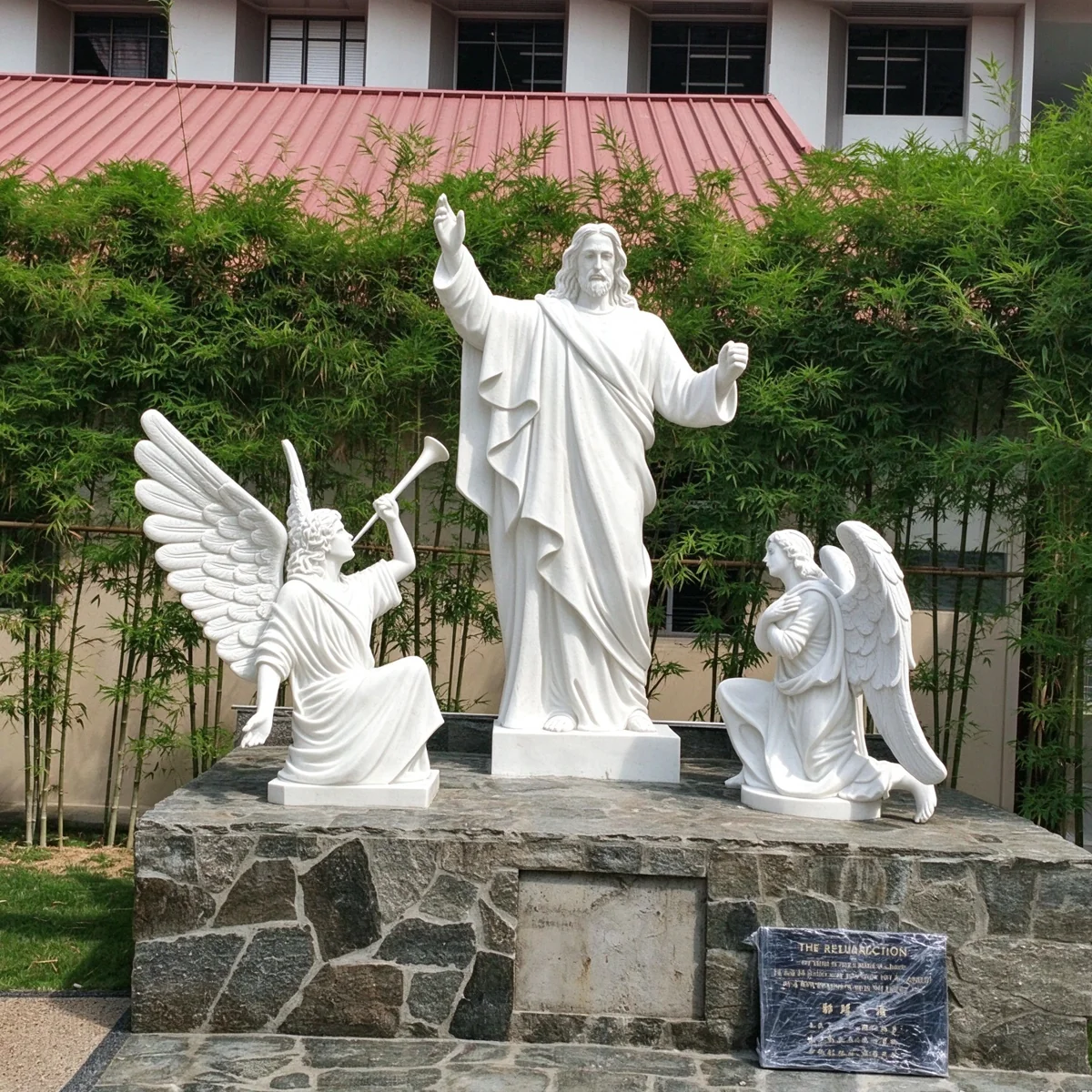
How Tall Should the Pedestal Be for Your Church Setting?
The right height puts Christ’s face close to the eye level of the person at the main viewing point — a kneeler, a pew row, or the first spot on an outdoor path.
Eye level runs roughly 1.15 m (3 ft 9 in) kneeling, 1.20 m (3 ft 11 in) seated, and 1.60–1.65 m (5 ft 3–5 ft 5 in) standing.
Much higher than that, and the viewer starts looking at the underside of the chin, where the face foreshortens into a shape.
The installed height follows a simple sum: figure height + carved base + pedestal height + anything above the head (halo, crown, cross). A 5.6 ft figure on a 1.3 ft base with a halo does not read as 5.6 ft in the room; it reads as the full installed stack.
The table below uses the same size tiers we quote for Jesus statues on the factory floor — desktop and home devotional, life-size, and monumental — paired with the pedestal each setting calls for.
| Where the statue stands | Figure height | Pedestal height | Installed height | Face level (approx.) |
|---|---|---|---|---|
| Side chapel, kneeler 1–1.5 m away | 3–4 ft (90–120 cm) | 1.3–2 ft (40–60 cm) | 4.3–6 ft (130–180 cm) | 4.1–5.2 ft (125–160 cm) |
| Sanctuary side altar, viewed 3–5 m | 4–5 ft (120–150 cm) | 1.6–2.5 ft (50–75 cm) | 5.6–7.4 ft (170–225 cm) | 5.1–6.7 ft (155–205 cm) |
| Parish nave, viewed 6–8 m | 5–6 ft life-size (150–180 cm) | 2–3 ft (60–90 cm) | 7–9 ft (210–270 cm) | 6.4–8 ft (195–245 cm) |
| Outdoor grotto/courtyard, first seen 10–15 m | 5.5–6.5 ft (160–200 cm) | 2–3 ft (60–90 cm) | 7.2–9.5 ft (220–290 cm) | 6.6–8.5 ft (200–260 cm) |
| Plaza or facade, seen 20–40 m | 8–11 ft (250–350 cm) | 2–4 ft (60–120 cm) | 10–15.4 ft (310–470 cm) | — |
Where a statue rests upon the altar mensa, the mensa itself functions as the pedestal. Adding a second tall block between the altar and the figure lifts the statue’s face too high and clashes with the altar’s existing lines.
For example, we once carved a Sacred Heart of Jesus statue standing 5.6 ft (170 cm) tall on a 1.3 ft (40 cm) base, for an overall installed height of 6.9 ft (210 cm). This places the face at roughly 6.4 ft (195 cm): high enough to be clearly seen across the nave, yet not so elevated that a visitor at the communion rail must crane upward to look beneath the chin. If you place that same figure atop a 4 ft (120 cm) block instead, the comfortable viewing position becomes an awkward steep upward gaze.
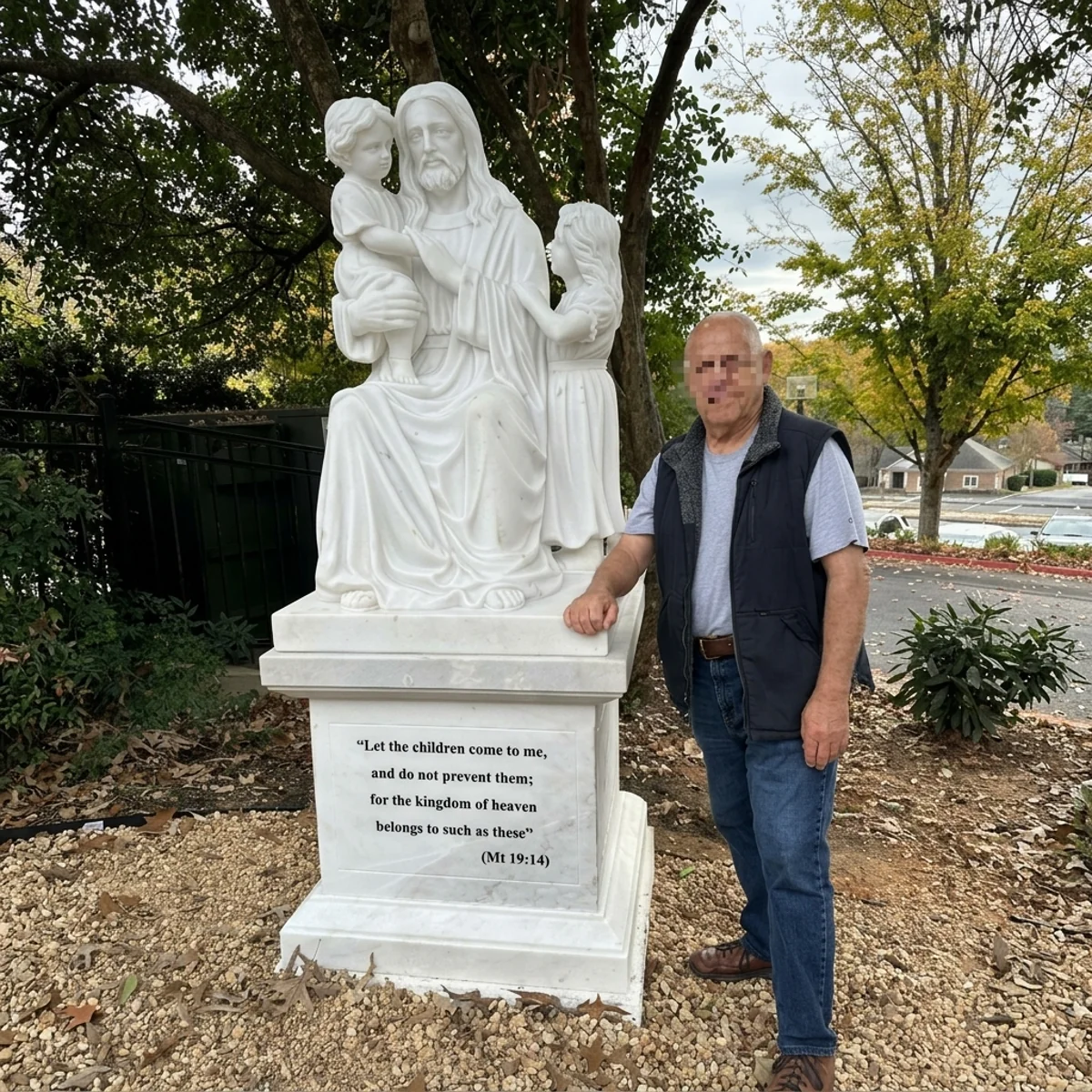
Furthermore, different pedestals create distinct visual effects.
Low plinths work well for intimate plazas. A short base holds the figure at a natural viewing height for visitors walking across the pavement, and an inscription plaque can be set into the lower step.
Medium round bases are commonly paired with garden water features. One of our American clients purchased a white marble Sacred Heart of Christ statue mounted on a round cylindrical concrete‑and‑stone pedestal, installed beside a rocky waterfall and pond. This medium round base elevates the figure above water and surrounding planting so it is visible to people approaching along the garden path.
Tall columnar pedestals are designed for landmark plazas. A client from the Philippines commissioned a monumental white Christ statue set on a tall column pedestal with a stepped gray base, installed in an open public plaza. The column elevates the figure to landmark scale, so its silhouette remains legible from far across the square.
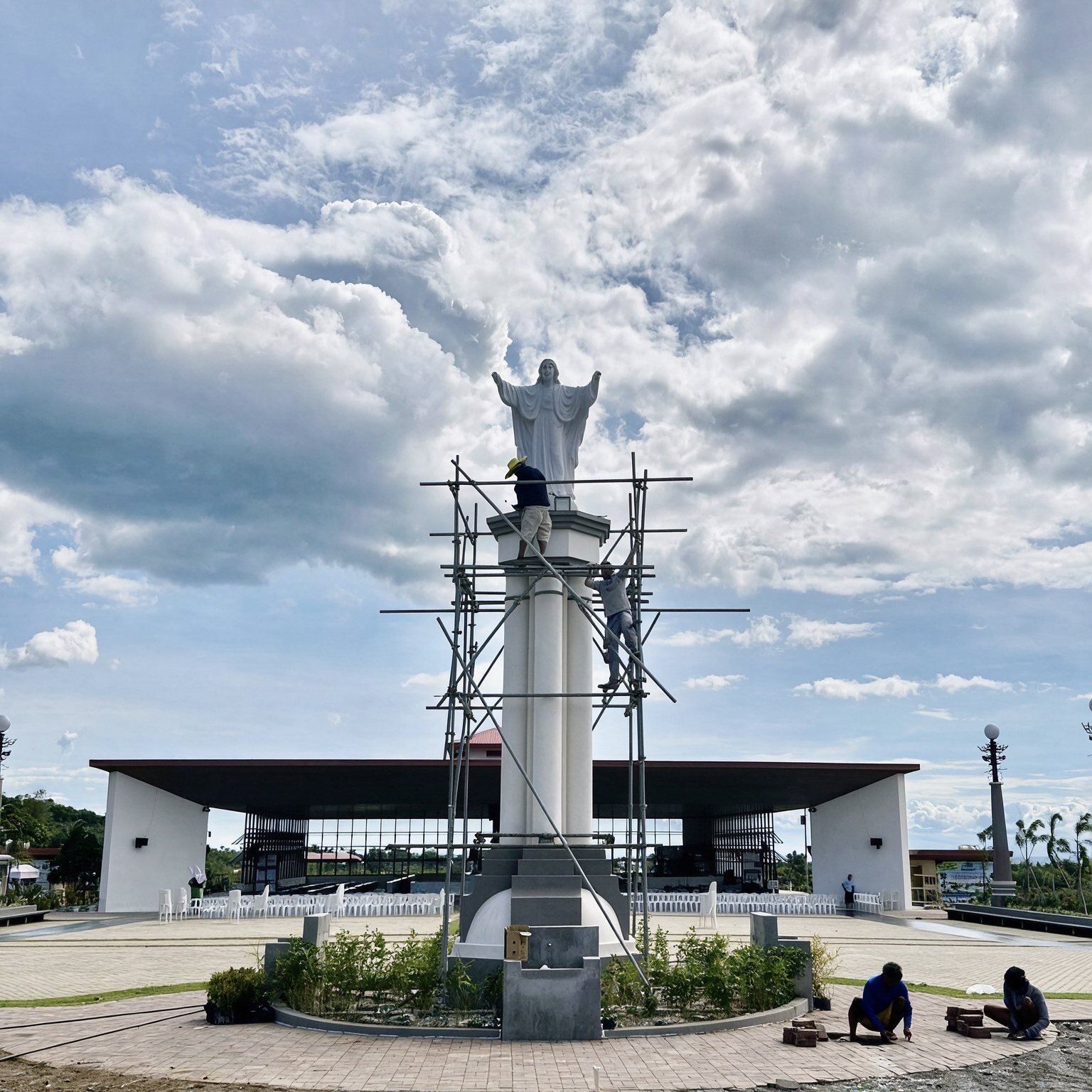
These three distinct examples illustrate that pedestal height is determined by the site, rather than by how a single statue appears on two different bases.
From this, we arrive at a conclusion: the devotional purpose of the statue dictates the ideal viewing height.
A Sacred Heart or Blessing Christ intended for close interaction requires a low base, keeping the figure near eye level. Mounted on a tall column, that same compassionate gesture becomes a landmark monument.
What’s more, if a parish is reusing an existing old plinth, its top surface dimensions, fixed height, and anchor points limit which statues can be fitted to it. A newly designed pedestal, by contrast, can be engineered to achieve your target facial viewing height.
How Wide and Deep Should the Pedestal Be?
The pedestal footprint is sized to match the statue’s carved base and drapery, not the outermost reach of the figure’s gestures.
As a general guideline, the pedestal top slab overhangs the statue’s carved base by 5–10 cm (2–4 in) on all sides. The overall pedestal footprint is roughly 1.2–1.5 times the width of the statue’s base. Depth is determined by the feet and rear drapery: add 10–20 cm behind the shoulders to accommodate a flowing mantle. For outdoor installations, add an extra 10–15 cm at the rear to accommodate rain runoff from the stone.
Note that statue type adjusts these dimensions. A standing figure with hands resting at its sides follows this sizing straightforwardly.
The outstretched‑arms Christ is a common pitfall: its hands may span 1.2–1.5 times the figure’s total height, yet the pedestal is sized to its narrow foot stance, not its arm span. For seated figures, the critical dimension becomes depth, as robes and drapery extend forward over the base. Group compositions such as the Holy Family are sized to the widest point of the combined carved base, with uniform clearance around the entire ensemble.
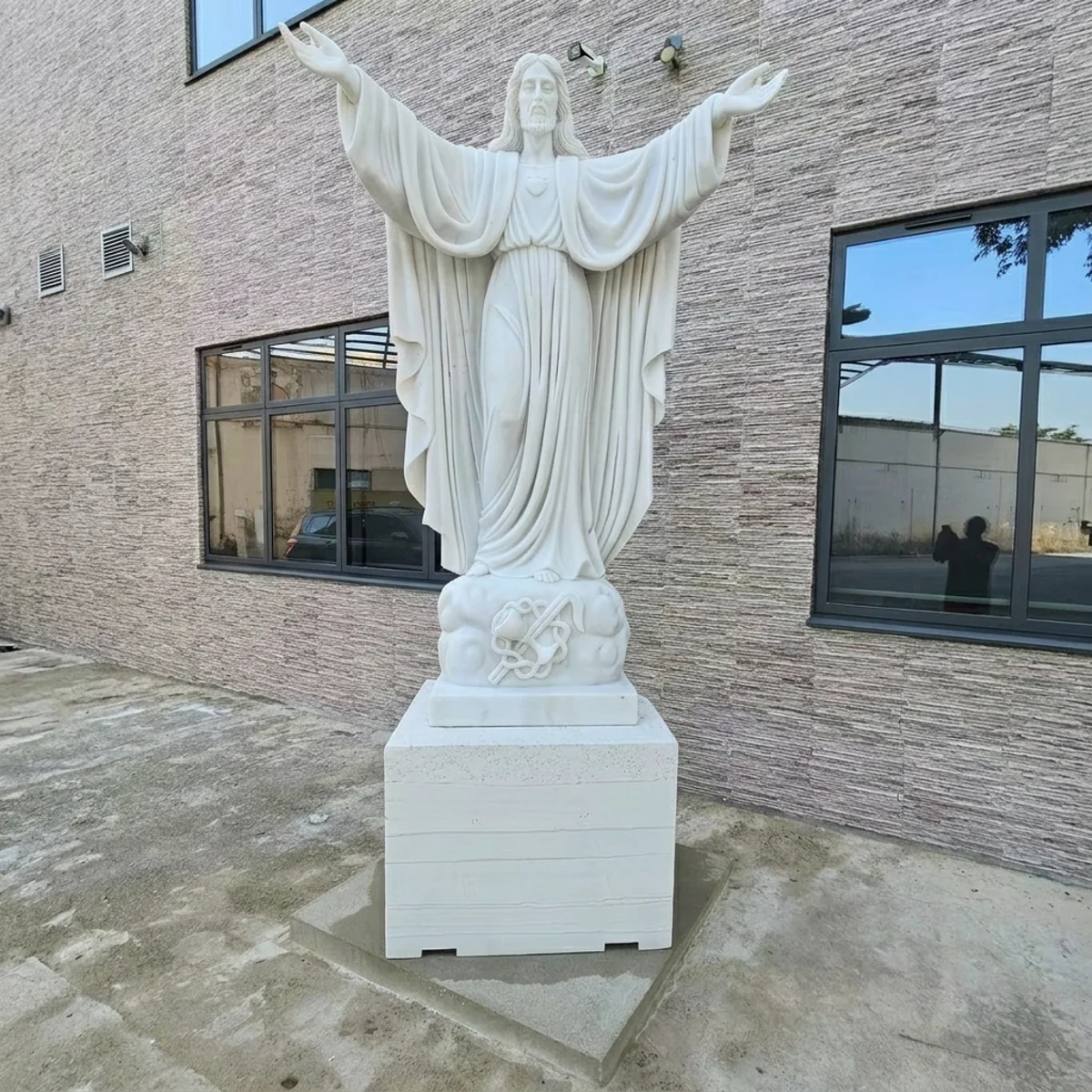
Beyond proportional harmony, the base must support and stabilise the statue safely. Marble has a density of approximately 2.7 tonnes per cubic metre. A 100 cm statue, including its integral carved base, weighs roughly 120–180 kg (265–397 lb); a 150 cm figure weighs 300–450 kg (660–990 lb); a 200 cm figure weighs 600–850 kg (1,320–1,874 lb). The supporting surface — whether floor, altar mensa or underground footing — must be engineered to bear this load.
For outdoor installations, the plinth rests on a concrete footing set below the local frost line where frost heave is a concern. Tall statues require anchoring to resist wind uplift and lateral force. The seam between the statue base and the pedestal cap must be detailed to shed rainwater. Stone selection should suit the local climate; indoor stone is not simply reused outside.
Position pedestal corners clear of aisles, maintaining approximately 90 cm (36 in) of unobstructed passage. This ensures the block will not impede kneelers, candle stands, or access to side altars.
If an inscription is required, the panel on the front face of the die should be laid out on drawings prior to stone cutting. Carving lettering onto a fully finished stone face restricts the maximum feasible letter size.
What Color and Style Work Best with a Marble Jesus Statue?
The safest, most traditional option is a pedestal cut from the same marble as the statue, with veining matched as closely as the source block permits. A white or cream Christ figure set upon a white or cream die reads as a single unified carved composition — this is why sanctuary commissions typically keep within one stone family.
The other standard approach uses contrasting natural stone to anchor the light‑coloured figure: grey granite or limestone, warm brown Emperador‑style marble, or verde green stone. Contrast works best through light‑dark value, with dark stone beneath the pale statue. Busy, heavily veined stone under a plain white figure draws the viewer’s eye away from the face and down toward the base.
A plain white Risen Christ within a Neoclassical chapel looks cleanest on matching white marble. That same statue on a dark granite plinth inside a substantial Baroque church takes on a grounded, monumental character.
Three combinations are best avoided:
Busy or vividly coloured pedestals that compete visually with the marble statue;
Two different outdoor stone types selected without verifying that moisture and rain runoff will not cause cross‑staining;
Resin, composite or painted timber bases for high‑traffic naves; these scratch, mark and chip easily, while the marble statue above will endure for generations.
There are also key design principles to guide pedestal selection. The core rule: pedestal mouldings should harmonise with the existing architectural language of the building.
A Romanesque setting suits a robust square block with minimal mouldings and rounded edges.
A Gothic space calls for recessed panels, slender sides and pointed mouldings.
A Baroque church pairs well with curved profiles, volutes and cartouche‑style inscriptions.
A Neoclassical interior works with a simple square die, stepped plinth and cap.
A modern chapel is complemented by a monolithic block with sharp edges and no applied ornament.
You do not need to replicate every motif from the existing altar or ambo. One shared detail — a matching moulding profile, stone type or panel shape — is usually sufficient to integrate the new statue into the space.
Conculsion
For a custom pedestal paired with your marble Jesus statue, please submit site photos (front, side, and wide shot from the primary viewing angle), along with the available footprint dimensions, supporting surface details, your statue reference, and specifications for any existing plinth to be reused.
We offer two pedestal solutions: a matching base fully fabricated with the statue in the same stone and finish, or a full technical package of dimensions, moulding profiles and inscription artwork for local on‑site construction. Local production avoids the high international shipping cost of the heavy stone base.
In both scenarios, shop drawings will verify the finished installation height and ideal viewing line to the statue’s face prior to carving. To get started, browse our Jesus statue collection or submit a quote request with your photos and measurements.