If you are furnishing a church, the words “pulpit” and “ambo” are often used as if they were the same piece of furniture. They are not. They have different jobs, different histories, and very different design traditions, and the difference decides which one your church needs and what it should look like.
The quick answer: a pulpit is a raised preaching platform, usually reached by a flight of steps, enclosed by panelled or balustraded sides, and very often crowned with a canopy or sounding board. An ambo is the book desk from which the Scriptures are read, lower, closer to the altar, and typically more restrained in form.
Everything else is design, and design is what this guide is about, so that you can match the right piece to your church, your tradition, and your needs.
What Is an Ambo in a Church?
The ambo is the reading desk of the church. The name comes from the Greek anabaino, “to go up,” because it was the raised place from which early Christians read the Gospel and the Epistle. The Gospel was proclaimed from the higher step, the Epistle from the lower one, which is why many historic ambos are built as a double deck. The ambo stood near the choir or the chancel, close to the altar, facing the people, and in the early Church it was also used for the announcement of feasts and fasts, the reading of the acts of the martyrs, and the singing of the cantors.
In most modern Catholic churches the ambo has absorbed the old pulpit altogether: since the Second Vatican Council a single ambo serves both the Scripture readings and the homily. This has made the ambo the most important piece of liturgical furniture in the sanctuary, and it explains the design language buyers see today.
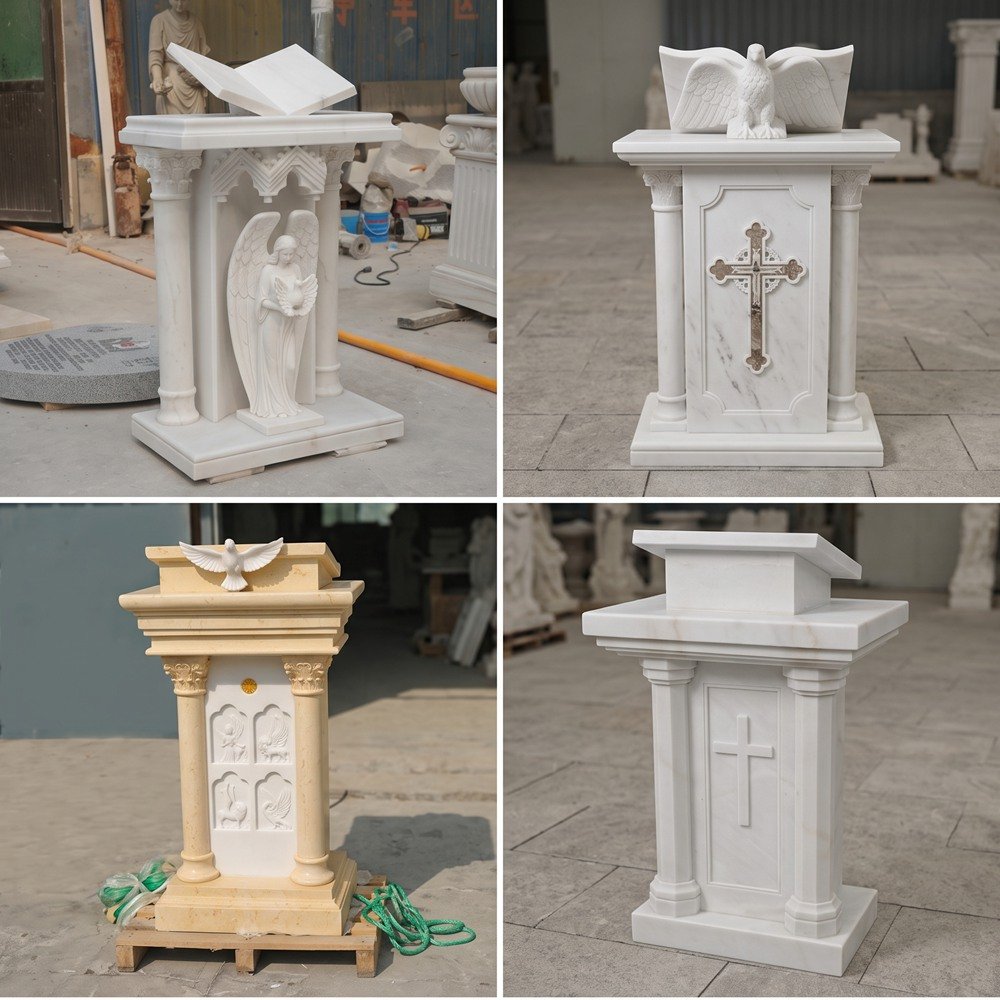
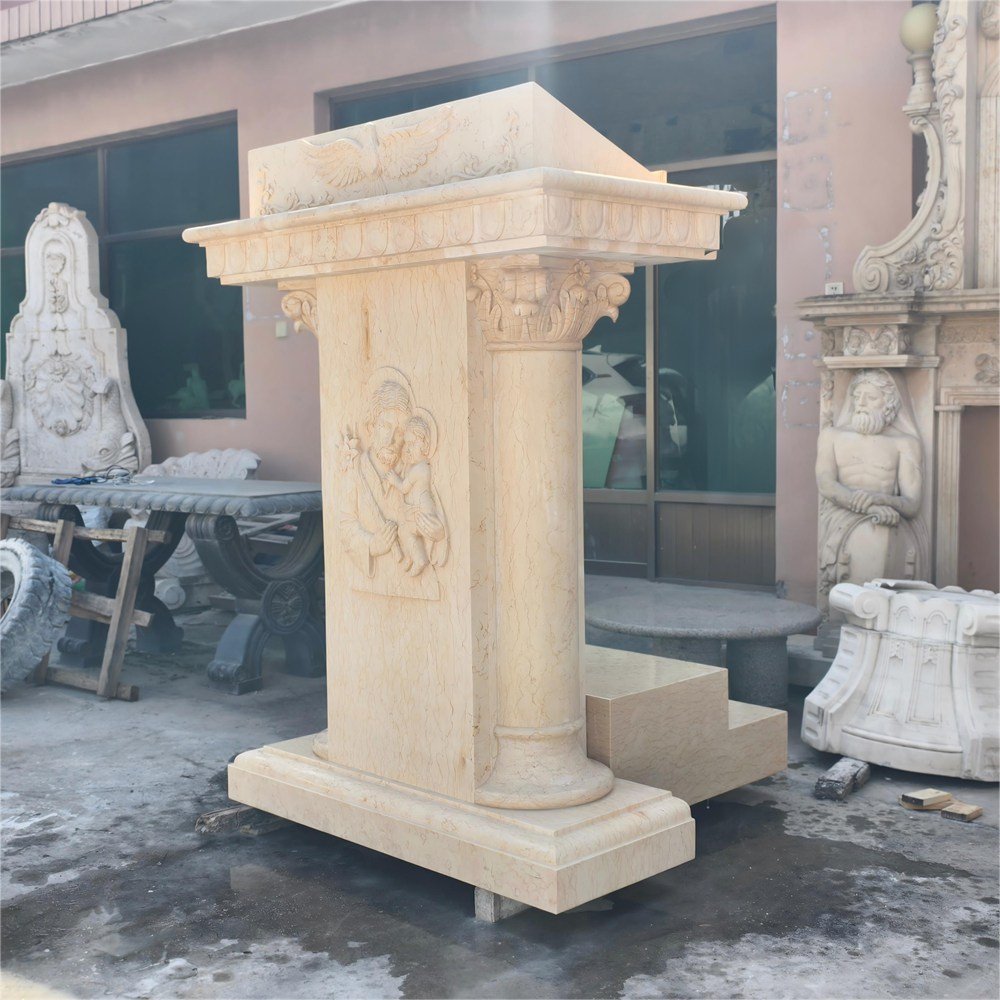
In our own factory the ambo line is exactly this:
a book desk carried on two carved marble columns, the top sloping toward the reader, the front panel carrying the symbols of the Word.
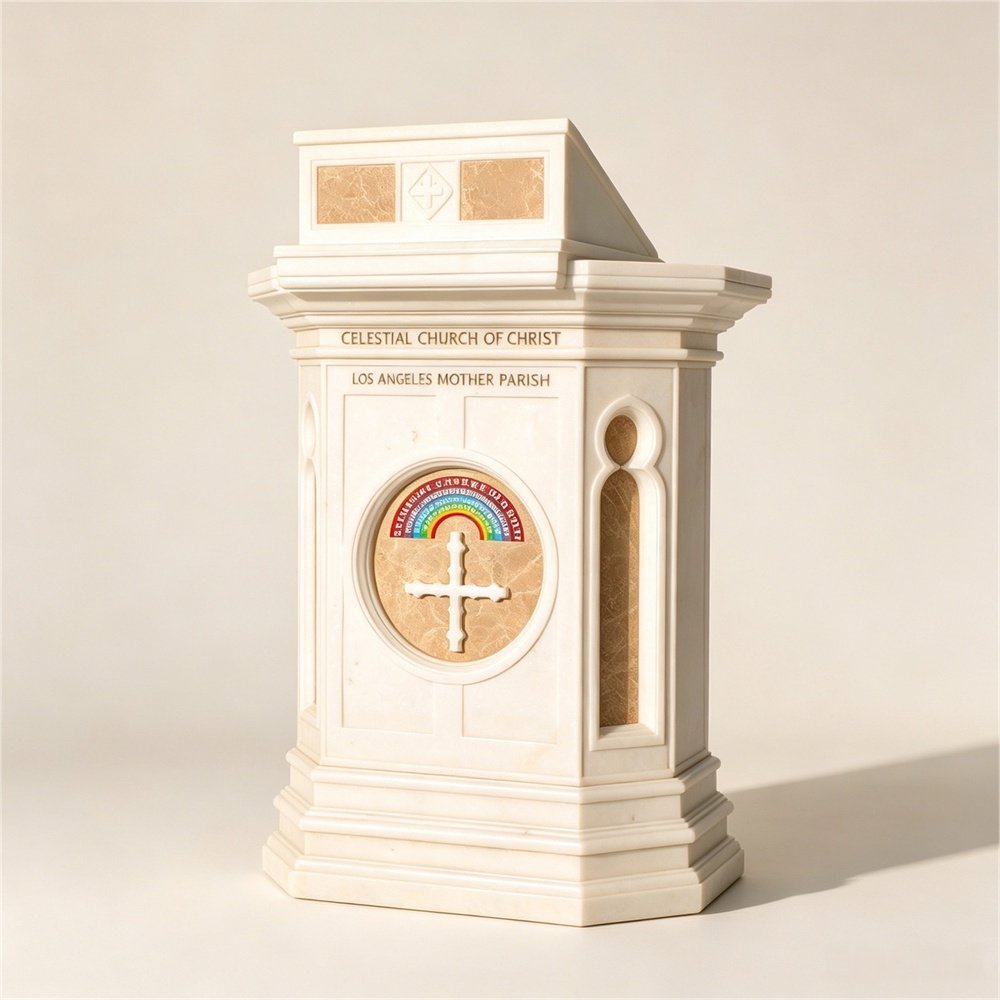
The most requested themes are a white dove of the Holy Spirit crowning the desk, the cross with an open book and a quill, the Chi-Rho monogram with Alpha and Omega, and the four living creatures of the evangelists, angel, lion, ox, and eagle, set into arched panels. Gold mosaic inlays, the gilded letters JHS, and the name of the church itself, as on the Celestial Church of Christ pieces we make for parishes from Los Angeles to Manchester, give each ambo a permanent, personal character.
What Is a Pulpit?
The pulpit is the preaching platform. The word descends from the Latin pulpitum, the stage in the Roman theatre and the platform in the forum where orators addressed the people, and it reached us through the Italian and Spanish pulpito and the French poulpitre.
Where the ambo is a desk, the pulpit is a platform: a raised enclosure reached by three to seven steps, panelled or balustraded at the front, large enough for a preacher to stand, and often topped by a canopy that throws the voice forward.
It came into its own in the fifteenth century, when preaching became a central act of worship, and a canon of 1603 ordered every English church to have one, a rule that produced the great wave of richly carved Jacobean pulpits. Before that, sermons had been delivered from the ambo, from the steps of the altar, or from open-air preaching crosses, and medieval refectories had their own pulpits for reading aloud during meals.
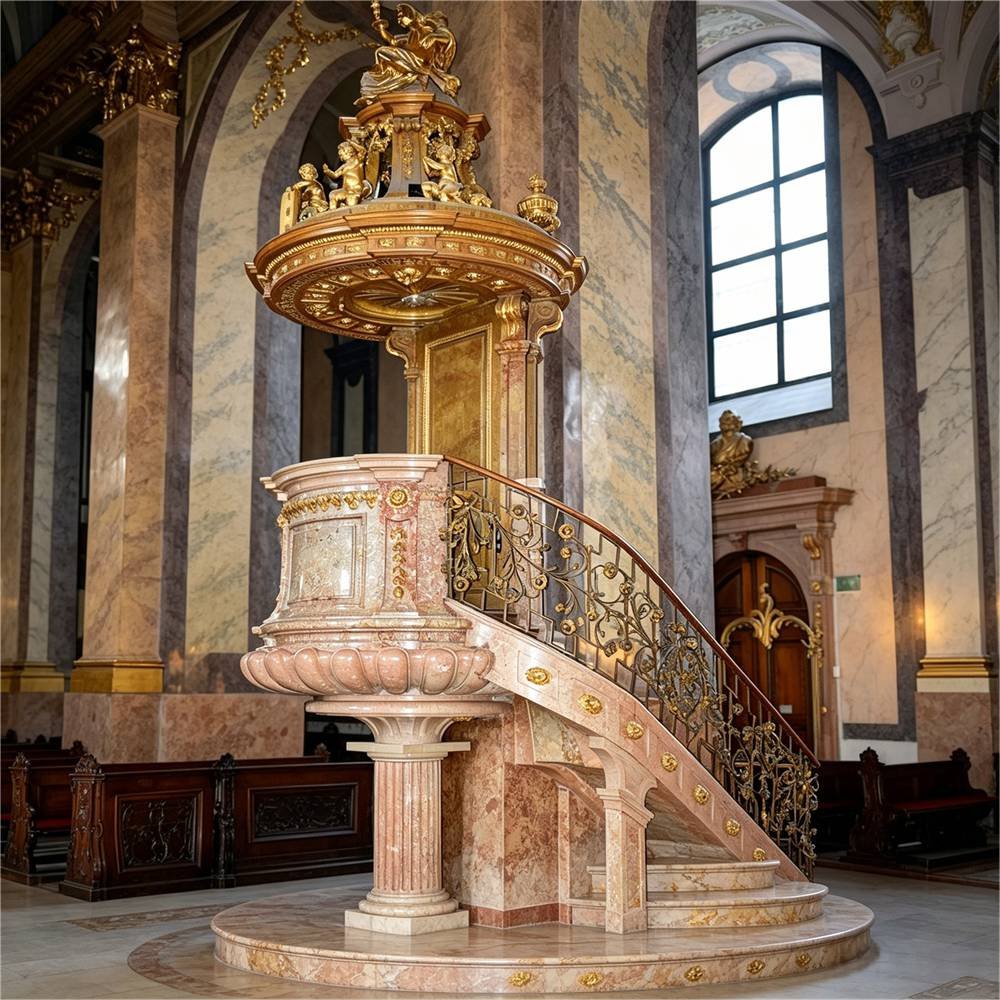
The classic pulpits we admire in old churches show the range of the type. In carved dark oak, the Gothic pulpit carries rows of saints, the Madonna and Child, vine scrolls, and traceried panels, reached by a spiral staircase with a red-carpeted tread and a carved handrail. In marble, the pulpit grows monumental: openwork panels, reliefs of the Passion, an arcaded stair rail in wrought iron, and a polygonal body under a spired canopy. The most theatrical examples are the Baroque pulpits in pink-veined marble with gilded angel figures, and the polygonal wooden pulpits with painted panels and an octagonal sounding board above.
For examlpe,the stone pulpit of 1621 at Dinder, near Wells, carries its inscription “Blessed are they that hear the word of God and keep it”; the great stone pulpit on the south side of Wells Cathedral is inscribed “Preach thou the worde”; the refectory pulpit of the Abbey of St. Werburga, now inside Chester Cathedral, is one of the finest First Pointed examples to survive; and the fifteenth-century pulpits of St. Mary’s Church at Frampton in Dorset, St. John the Baptist at Cirencester, and St. Saviour’s at Dartmouth show how richly the type could be carved.
All of these are true pulpits, raised platforms with steps, railings, and often a canopy, of exactly the kind you see in the church and museum photographs in our portfolio, and they all share the same structure: an elevated stage, a stair, a railing, and a place from which one voice addresses the whole assembly.
Why There Are Two Pieces of Furniture?
Because the liturgy has two moments that need different furniture.
The Word is read, and the Word is preached.
In the early centuries the ambo was the place for both, but as preaching grew more prominent, the church developed a dedicated platform for it, and the two pieces went their separate ways. The furniture followed a long line of descent, from the classical pulpitum and rostrum, to the early Christian ambo, to the rood-loft of the fourteenth century, and finally to the pulpit as we know it, built in the nave where the preacher could be seen and heard by the largest number of people.
Tradition decides which piece leads.
Protestant churches, especially in the Reformed and evangelical traditions, keep the pulpit as the visual and theological center of the room, often raised high above the communion table. Catholic and Orthodox churches, by contrast, center the ministry of the Word on the ambo beside the altar, and after the Second Vatican Council the Catholic ambo is expected to carry both the readings and the homily. A church that uses a pulpit and an ambo side by side is simply keeping the old distinction: the reader goes to the ambo, the preacher goes to the pulpit.
What Is the Key Difference Between a Pulpit and an Ambo?
In one sentence: the pulpit is a raised platform for preaching, reached by steps and enclosed by a railing or panelling; the ambo is a book desk for the readings, lower and closer to the altar.
The table below sets out the design difference feature by feature.
| Design feature | Pulpit | Ambo |
|---|---|---|
| Elevation | Elevated platform, reached by three to seven steps | Low to mid-height; one or two steps, or floor-standing |
| Place in the building | In the nave, usually against a pier on one side | In the sanctuary or chancel, near the altar, facing the people |
| Form | Enclosed or open platform with a panelled or balustraded front | Open book desk on two columns, a stem, or a wall bracket |
| Canopy / sounding board | Common in historic pulpits; helps project the voice | Rare |
| Decoration | Rich: saints, biblical scenes, vine scrolls, tracery, grotesques | Restrained: dove, cross, open book, Chi-Rho, simple moldings |
| Materials | Oak, walnut, stone, marble, occasionally metal | Wood, stone, marble; modern glass, concrete, or bronze |
| Movement | Always fixed | Fixed or movable; processional ambos exist |
| Dominant periods | Gothic and Jacobean (15th–17th c.), Victorian revivals | Early Christian, medieval, and post-1960s liturgical design |
History and Tradition: How Did They Develop?
The ambo is the older piece, the descendant of the raised reading places of the synagogue and the early Christian assembly.
The pulpit is the newcomer of the fifteenth century, born when preaching became a liturgical event in its own right.
The two centuries that followed, especially the Jacobean age after the canon of 1603, made the pulpit the richest piece of church furniture in England, while the ambo quietly survived in the Catholic world. In the twentieth century the Second Vatican Council reversed the flow: the Catholic ambo took back the homily, and the single marble book desk became the standard sanctuary piece, while the classic pulpit remained the pride of Protestant and older Catholic churches.
Liturgical Purpose and Placement: Where and Why?
The ambo belongs to the sanctuary, near the altar and the presidency, because the readings are part of the Eucharistic action. It faces the people and stands where the reader is heard and seen without leaving the sacred area.
The pulpit belongs to the nave, usually against a pier on the north or south side, because the preacher addresses the whole assembly from among them and needs height for sightlines and voice. Place each piece where its action happens, not where it looks best from the door, and the liturgy will feel right.
How many pieces should a church have?
The liturgical rules are surprisingly precise, and they answer the question before taste does. In the Roman Rite the norm is a single ambo: the readings, the Responsorial Psalm, the homily, and the Prayers of the Faithful are all to be proclaimed from the one ambo, so that the Word comes from a single, dignified place and the assembly is not pulled between several stands. A second ambo survives only as a heritage arrangement, in churches that keep the old pair of a larger desk for the Gospel and a smaller one for the Epistle.
In the Church of England, by contrast, the canons require convenient reading desks in every church and chapel and, unless it is genuinely not required, a decent pulpit for the sermon as well; Canon F 6 of the present Canons continues the rule first laid down in 1603, when every parish church was ordered to provide a comely pulpit. So the old question “one piece or two?” is not a matter of fashion.
Your tradition and its rubrics tell you how many pieces your church is expected to have, and your church tells you where they should stand.
Form and Structure: How Are They Designed?
An ambo is designed like a desk: a sloping book rest, a front panel, and a support, whether two columns, a single stem, or a bracket on the wall.
The proportions are modest, one or two steps at most, and the carving is usually concentrated on the front panel where the symbols of the Word can be read at eye level.
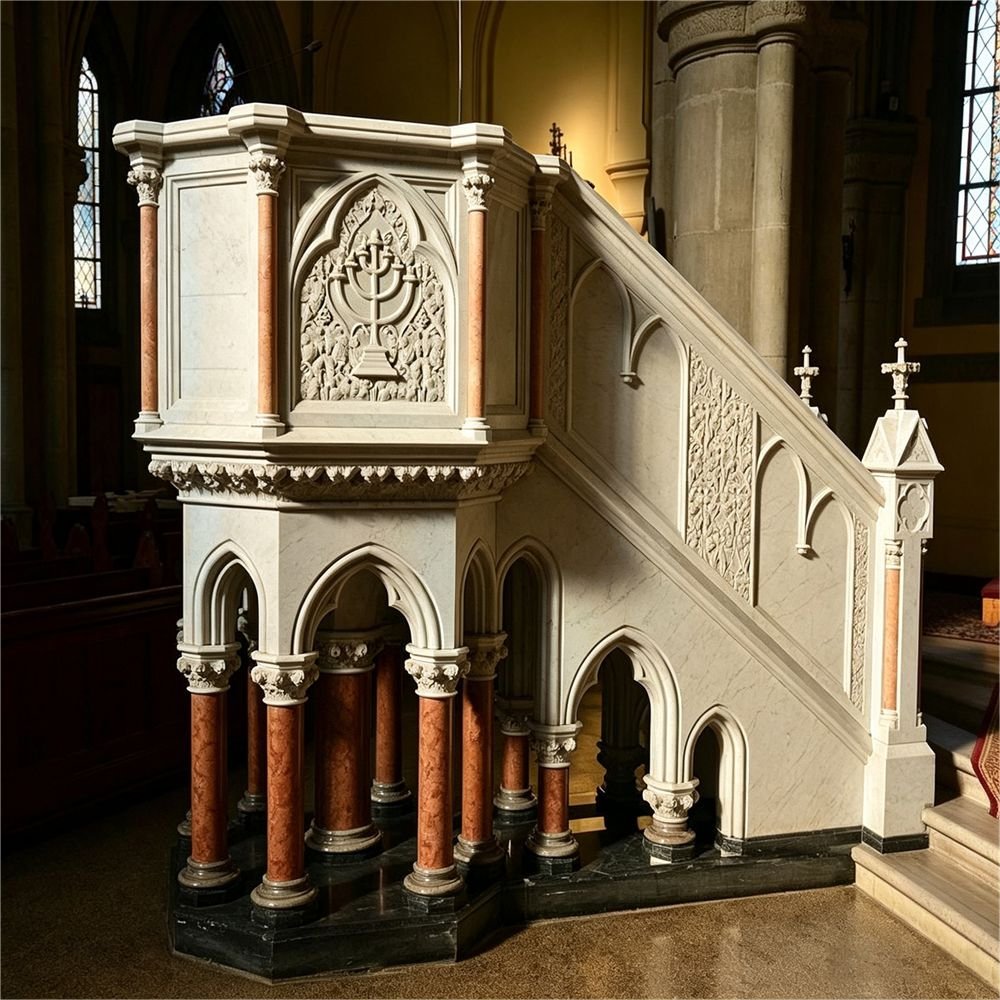
A pulpit is designed like a small tower: a base, a body tall enough for a standing preacher, a parapet or panelling around it, a stair, and often a canopy.
The carving spreads over the whole surface, because the piece is meant to be looked at from every side and from the far end of the nave. In our own factory pieces the distinction is easy to see: the ambos are open desks with carved panels and a dove or a monogram; the pulpits are enclosed platforms with steps, railings, and a crowning canopy.
Materials and Craftsmanship: What Stone Works Best?
Marble is the material that carries the dignity of the Word longest, and the choice of stone sets the tone of the whole piece.
White and cream marbles give a light, serene sanctuary and suit the ambo, where the eye should rest on the book and the symbols rather than on the material.
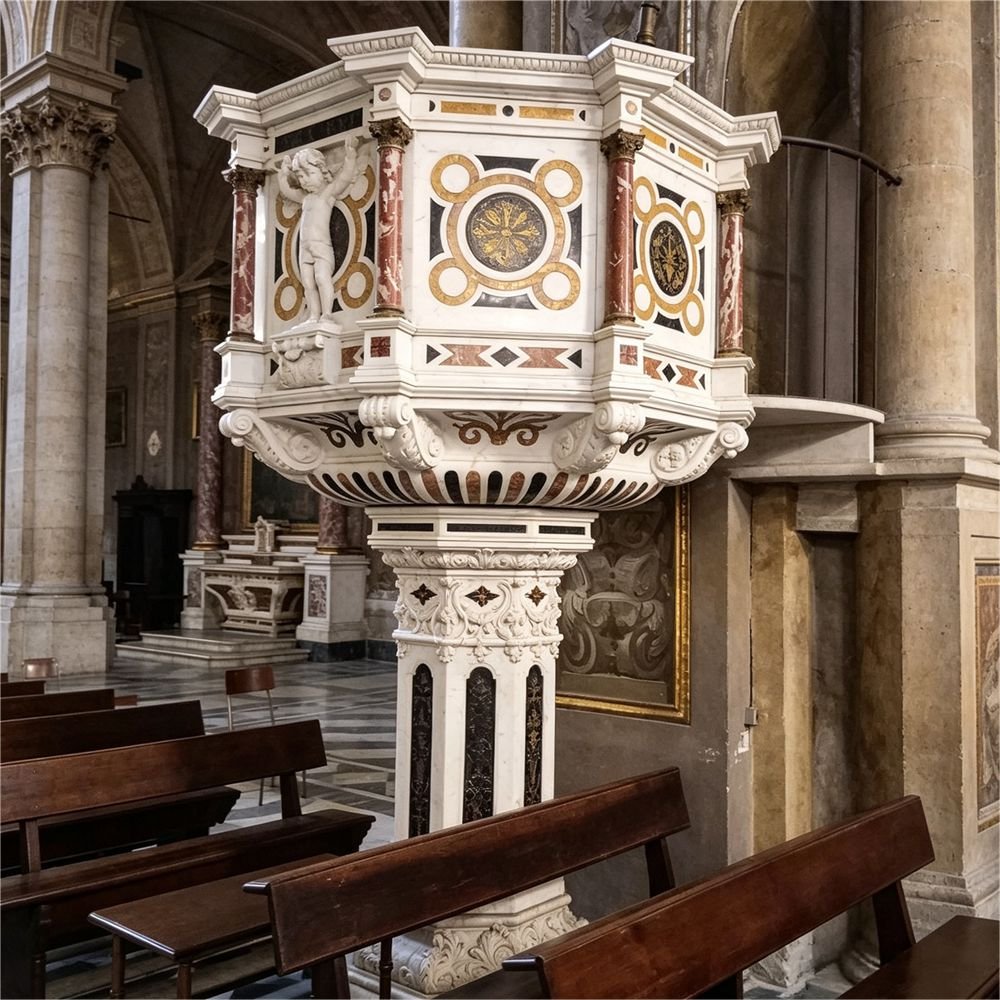
Veined marbles, in green, rosso, or warm grey, add liturgical color and are best used in columns and trims, as in our two-column ambos with red-veined or red-brown onyx shafts and white carved capitals. Gold mosaic and inlay panels, in the Byzantine manner, turn a plain front into an icon, and are a favorite request for ambos.
For a pulpit, where the body is seen at a distance, a strongly veined or richly colored stone holds its presence better, and the carving of the parapet, the vine scrolls, the figures, and the canopy becomes the craftsmanship that sells the piece. Polished marble is the church standard, easy to clean and softly reflective; honed finishes suit modern interiors.
Whatever the stone, the test is the same: it should outlast fashion and stay quiet underfoot, so that the Word, not the material, is what the congregation remembers.
How to Choose the Right One for Your Church?
What does your liturgy actually need?
The liturgical books themselves answer the first question. In the Roman Rite the norm is a single ambo: the readings, the Responsorial Psalm, the homily, and the Prayers of the Faithful all come from the one ambo. That is why the book-desk marble ambos most factories produce, including ours, match the needs of the mainstream parish: one dignified piece beside the altar does the whole ministry of the Word. If, however, your tradition or your client explicitly asks for a pulpit, that is a different product line. A true pulpit needs the raised platform, the steps, and the railing or panelled enclosure, the form that lets a preacher stand above the assembly. And if your church belongs to the Church of England, its canons expect convenient reading desks in every church and normally a decent pulpit for the sermon as well. So begin with the rubrics: they tell you how many pieces your church is expected to have, and the rest of the choice follows.
What is your tradition?
Catholic and Orthodox churches center the Word on an ambo near the altar. Protestant churches often make the pulpit the visual center of the room. Match the furniture to the way your congregation actually worships, not to fashion.
What is your building?
Match the period. A Gothic church calls for Gothic panelling and tracery; a Baroque interior answers to carved marble and gilt; a modern worship space wants a clean, minimal ambo. A piece that fights its building always looks like furniture; a piece that belongs looks like architecture.
How large is the space?
A small chapel is well served by a compact ambo. A long nave needs an elevated pulpit with good sightlines and acoustics, and a platform needs floor space for the steps and the approach. Measure the distance from the last pew before you choose a silhouette.
Wood or stone?
Wood is warm, lighter, and easier to adapt and repair. Stone and marble are monumental, permanent, and quieter underfoot. Many churches choose stone for the body and wood for the book rest, or the reverse, and get the best of both.
Do you want a canopy or sounding board?
A sounding board genuinely helps projection in echoing naves, but it changes the silhouette and can block the view from a gallery. Decide by acoustics and sightlines, not by fashion.
A Closing Thought
A pulpit and an ambo are two different answers to the same question: how does a church let the Word be heard? The pulpit announces that the Word is proclaimed; the ambo says that the Word is read, broken open, and shared at the altar. The best design is the one that disappears into the liturgy and lets the Word stand at the center.
There is no single right answer, only the answer that fits your building, your tradition, and the way your congregation worships. A piece that belongs, whether a carved stone pulpit in a long nave or a quiet marble ambo beside the altar, will serve the liturgy for generations. Choose well, and the Word will be heard.