The Saint Francis of Assisi garden statue is not simply a decorative choice. It is a statement — a quiet, enduring declaration that this space belongs to something larger than itself: to peace, to creation, to the God who made every sparrow and every stone.
Whether you are a parish priest seeking a focal point for a prayer garden, a devoted Catholic donor commissioning a memorial piece, or a religious educator choosing an image to inspire young hearts — this guide is written for you. Let us begin where every good Franciscan story begins: with the man himself.
Who Is Saint Francis of Assisi? A Brief Biography
Saint Francis of Assisi, also known as Giovanni di Pietro di Bernardone, was born around 1181 in Assisi, a small hilltop town in Umbria, Italy.
His father Pietro was a prosperous silk merchant; his mother Pica, a French noblewoman. The boy grew up wealthy, charming, and utterly captivated by the troubadour culture of medieval France — he loved fine clothes, lavish feasts, and the romantic poetry of wandering singers.
No one who knew the young Francis would have predicted what was coming.
What came was a series of encounters that broke him open: a year as a prisoner of war, a mystical vision at the ruined chapel of San Damiano, a leper whose hand he took in his own, and a voice from the crucifix that said simply: “Francis, go and repair my house, which you see is falling down.”
He obeyed — literally at first, hauling stones from a quarry. Then more profoundly, founding an Order that would become the largest religious community in the world.
He died on the evening of October 3, 1226, lying on the bare earth, singing Psalm 141. He was canonized less than two years later, on July 16, 1228, by Pope Gregory IX. His feast day is celebrated on October 4 — now also observed as World Animal Day.
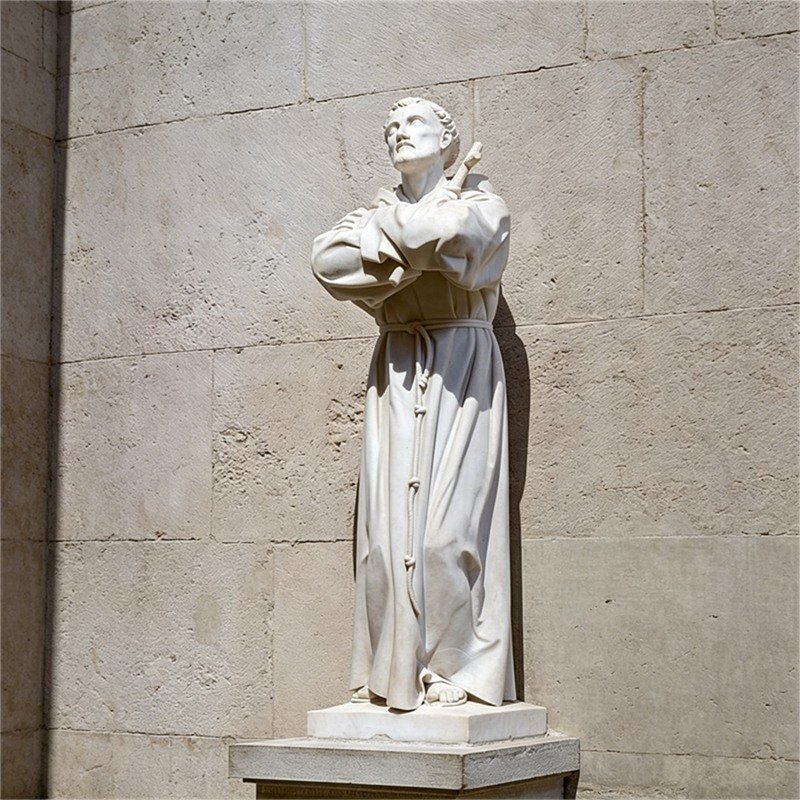
7 Facts About Saint Francis You Need to Know
Before choosing a statue, it helps to know the man behind the image.
Each of these facts is not merely biographical — each one is written into the iconography of the statues you will encounter.
But there is a deeper reason to read carefully here.
He has been domesticated into a gentle garden ornament, a patron of environmentalism, a proto-interfaith dialoguer, a social activist.
He was none of these things, exactly.
He was something far more demanding, far more orthodox, and far more extraordinary: a fiercely faithful thirteenth-century Catholic whose love for creation flowed entirely from his love for Christ crucified.
The statues in your garden deserve to represent that man — not a softened modern projection of him.
He Was a Troubadour Before He Was a Friar
Francis grew up enchanted by the troubadour tradition — wandering poet-musicians who sang of love, beauty, and chivalry across the courts of medieval France and Italy. This is not a footnote in his biography.
It shaped the entire texture of his spirituality.
He was, by temperament, a singer — and when he converted, he did not abandon that gift. He redirected it entirely toward God.
He composed the Canticle of Brother Sun and Sister Moon — widely considered the first great poem written in the Italian vernacular — as an act of pure praise. But it is crucial to understand what this poem actually is. It is not a nature manifesto. It is a liturgical act of worship: Francis praising God through creation, not worshipping creation itself.
There was, as scholars have noted, not a hint of pantheism in his approach to nature.
He Renounced Everything — Publicly and Literally
In the piazza of Assisi, before the bishop and a gathered crowd, Francis stripped off every garment his father had given him, handed them back, and declared: “Up until now I have called you father here on earth, but now I say, ‘Our Father, who art in heaven.'”
A bystander gave him a simple frock; he marked it with the sign of the cross in chalk. This became his first habit.
His poverty was a theological act — a total surrender of self-sufficiency, a declaration that God alone was sufficient.
Francis believed his followers should work with their hands to procure their necessities, and that begging was only a secondary alternative — never a lifestyle chosen for its own sake. He was not romanticizing destitution.
He was imitating the poverty of Christ.
He Tamed the Wolf of Gubbio
One of the most beloved stories in all of hagiography: the city of Gubbio was terrorized by a ferocious wolf that devoured men as well as animals. Francis went into the hills alone, made the sign of the cross, and commanded the wolf to come to him and harm no one. He then led it into the town and brokered a peace — the townspeople would feed the wolf; the wolf would stop attacking them. The wolf became a gentle presence in the city until its death, and the people mourned it.
This story is not primarily about animal welfare. It is about the power of the Gospel to reconcile what human force cannot.
The wolf’s transformation is a parable of grace — a reminder that what is most feared and most hostile can be brought to peace, not by human cleverness, but by love rooted in God.
Many statues honor this story by placing a wolf at Francis’ feet: not as a pet, but as a testament.
He Preached to the Birds — and Took It Seriously
One day, while traveling with companions, Francis encountered a great flock of birds in the trees.
He told his companions to wait, walked toward them, and preached. Not one bird flew away.
He reproached himself afterward for having neglected to preach to “his sisters the birds” sooner, and resolved never to do so again.
This is the origin of the bird imagery that appears on nearly every Saint Francis garden statue.
He Founded Three Orders
The Franciscan family comprises three branches: the Order of Friars Minor (the original friars), the Order of Poor Clares (founded with Saint Clare of Assisi in 1212), and the Third Order — now the Secular Franciscan Order — for laypeople who live Franciscan values in ordinary life. Together, they form the largest religious community in the world.
What is less often remembered is that Francis was fiercely orthodox in governing these communities.
He believed that friars guilty of liturgical abuses or heresy should be remanded to higher Church authorities without hesitation.
He was not a spiritual individualist who encouraged his followers to find their own path.
He was a son of the Church — obedient to the Pope, reverent toward the priesthood, and insistent that the sacraments be celebrated with the finest sacred vessels and proper vestments.
His humility before God expressed itself as humility before the Church’s authority, not as independence from it.
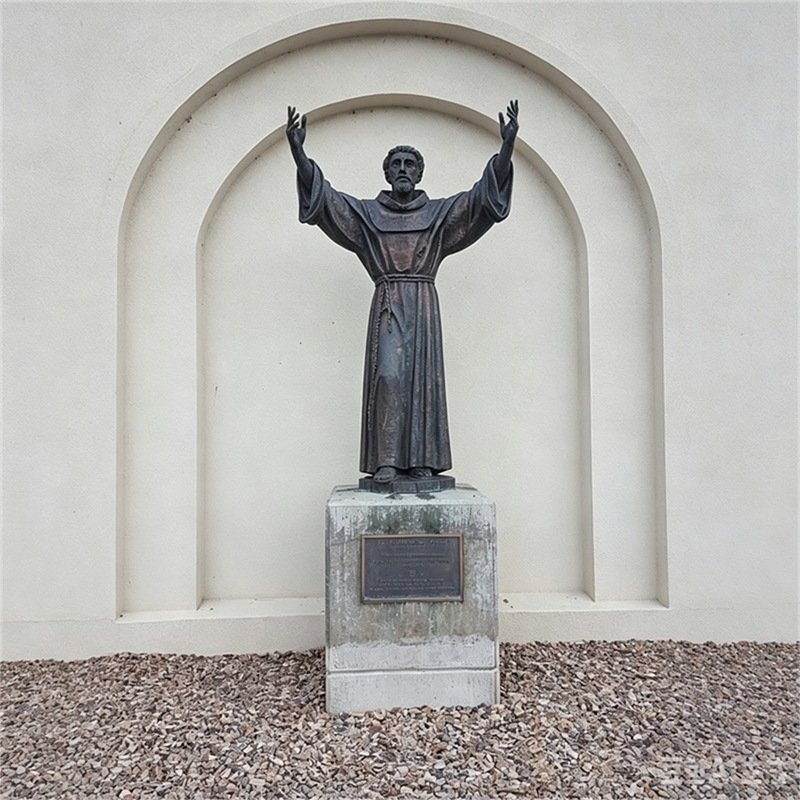
He Received the Stigmata
In September 1224, during a 40-day fast on the mountain of La Verna, Francis received a vision of a seraphic angel on a cross — and with it, the physical wounds of Christ on his hands, feet, and side.
He was the first person in recorded history for whom stigmata were clearly documented. He bore these wounds for the remaining two years of his life, in constant pain, going progressively blind, his body failing. He welcomed it. He called death “Sister Bodily Death” and died singing.
His final words to his followers were not about poverty, not about animals, not about the environment.
They were about the Eucharist — about proper reverence for the Body of Christ, about the dignity of the Mass, about the sacred vessels and vestments that honor the Real Presence.
The man who is so often depicted as a gentle garden saint spent his last breath urging his brothers to kneel before the altar.
He Went to the Sultan to Evangelize
In 1219, during the Fifth Crusade, Francis crossed enemy lines and sought an audience with Sultan al-Malik al-Kamil of Egypt.
This encounter is frequently cited today as a model of interfaith dialogue, ecumenism, and peaceful coexistence.
It is worth being precise about what actually happened — because the truth is both more demanding and more inspiring than the popular version.
Francis told the Sultan plainly that he was an ambassador of the Lord Jesus Christ, that he had come for the salvation of the Sultan’s soul, and that he was prepared to explain and defend the Christian faith — and to die for it if necessary.
He was not there to find common ground between religions.
He was there to propose the truth of the Gospel, boldly and without apology, to one of the most powerful men in the world. He did so with respect, with humility, without violence or denigration of Islam — and the Sultan received him with remarkable openness.
Francis is indeed a model for how Catholics should engage people of other faiths: with courage, with charity, with genuine respect for the person — and with an unambiguous willingness to share the truth of Christ. He was a man of peace.
He was also a man of conviction.
These were not in tension for him.
They were the same thing.
What is the meaning of different images of Francis of Aissis garden statue?
A Saint Francis garden statue is never merely decorative.
Every pose, every animal companion, every fold of the rough Franciscan habit carries centuries of theological meaning — encoded by artists, theologians, and devoted craftsmen across eight hundred years of tradition.
Before you choose a statue, it is worth understanding what each image and elements is actually saying.
Because when you place one of these figures in your garden, your chapel, or your home, you are not simply adding an ornament. You are placing a visual sermon — one that will preach quietly to every soul that passes by.
Let us walk through the six most significant depictions — and what each one says to the heart that contemplates it.
Saint Francis with a Bird
This is one of the most popular images of Francis among our clients — and for good reason.
It reaches back to one of the most beloved moments in all of hagiography: the day Francis encountered a great flock of birds along the road and, telling his companions to wait, walked toward them and preached.
Not one bird flew away.
He spoke to them of God’s generosity — how He clothed them, fed them, gave them rivers and mountains and the whole of creation as their home — and they gathered around him in perfect stillness.
Afterward, Francis reproached himself for having neglected to preach to “his sisters the birds” sooner.
The bird in his hand or on his shoulder is not merely a charming garden detail.
It is a theological statement about the relationship between humanity and creation: that when we approach the natural world with humility, reverence, and love, it responds in kind.
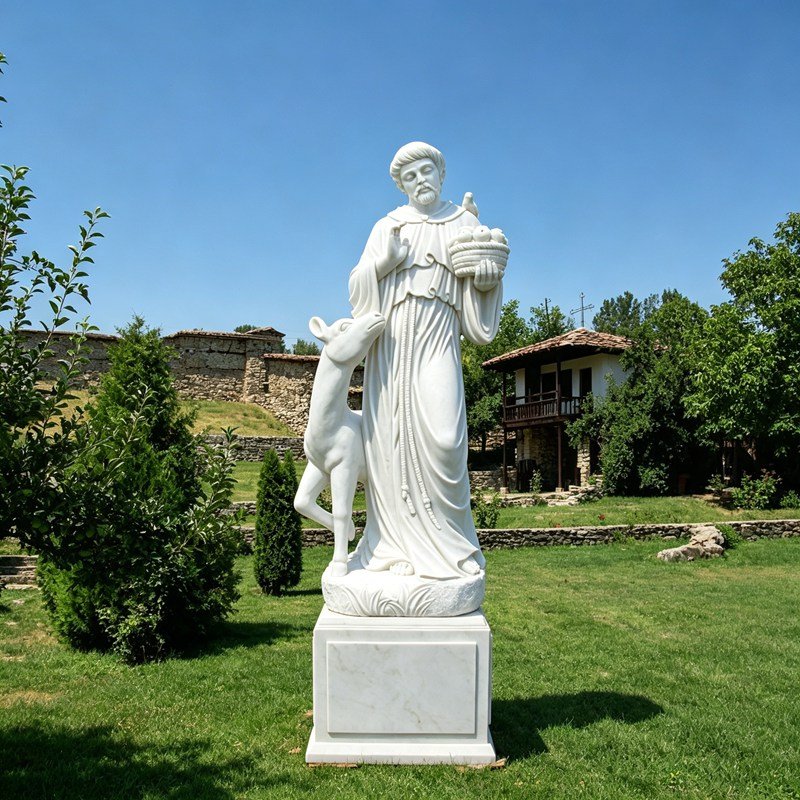
Birds in Christian iconography carry layered meaning — they represent the Holy Spirit, peace, freedom, and the soul’s longing for heaven.
A dove speaks of the Spirit’s descent at Baptism; a small sparrow recalls Christ’s words that not one falls to the ground without the Father’s knowledge.
There is profound meaning in seeing a living bird land on a stone statue of Francis.
As Franciscan Media has written, Francis would say that the birds coming to the garden are holy, the water is holy, the bugs are holy.
His statue belongs precisely where life is.
Saint Francis on the Birdbath
Water, in Catholic tradition, is the primary sacramental element: the medium of Baptism, of blessing, of purification.
Francis himself, in the Canticle of Brother Sun and Sister Moon, praised “Sister Water, so useful, humble, precious and pure.”
Water is not background. It is a character in the Franciscan story — a sister, a gift, a mirror of God’s generosity.
To place Francis at a birdbath is to create a living icon: real birds come to drink, real water catches the light, and the stone figure presides over it all with open arms.
It is one of the few garden statues that participates in the natural world rather than simply observing it.
The open-handed posture typical of birdbath statues — arms extended, palms turned outward — echoes the gesture of blessing and welcome that defined Francis’s entire ministry: an invitation extended to every creature, great and small, to come near without fear.
For parish gardens, school courtyards, or any space where children gather, this image is particularly powerful. It invites wonder — and wonder, as every good teacher knows, is the beginning of prayer.
Saint Francis in Prayer
The praying Francis — hands folded or clasped, head slightly bowed, eyes closed or cast downward — is the image most suited to spaces of formal devotion: chapel gardens, memorial corners, cemetery plots, or the quiet side of a cloister walk.
It captures the interior Francis: the mystic who spent hours alone in caves and abandoned chapels, the man who received the stigmata in a moment of contemplation so profound that his body bore the physical wounds of Christ’s Passion.
The kneeling or bowed posture carries its own symbolic weight. It speaks of humility — the virtue Francis considered the foundation of all others.
It speaks of closeness to the earth — to the soil that Francis called “Brother” and “Sister,” the ground from which all life comes and to which all life returns.
And it speaks of the Franciscan conviction that all action flows from prayer: that before Francis could repair the Church, before he could preach to the birds or tame the wolf, he had to first kneel before the crucifix at San Damiano and listen.
This image carries a particular resonance for priests, religious communities, and those who come to a garden not to walk through it, but to stay.
It is not Francis the preacher or Francis the nature lover — it is Francis the contemplative, the one who understood that the repair of the world begins on one’s knees.
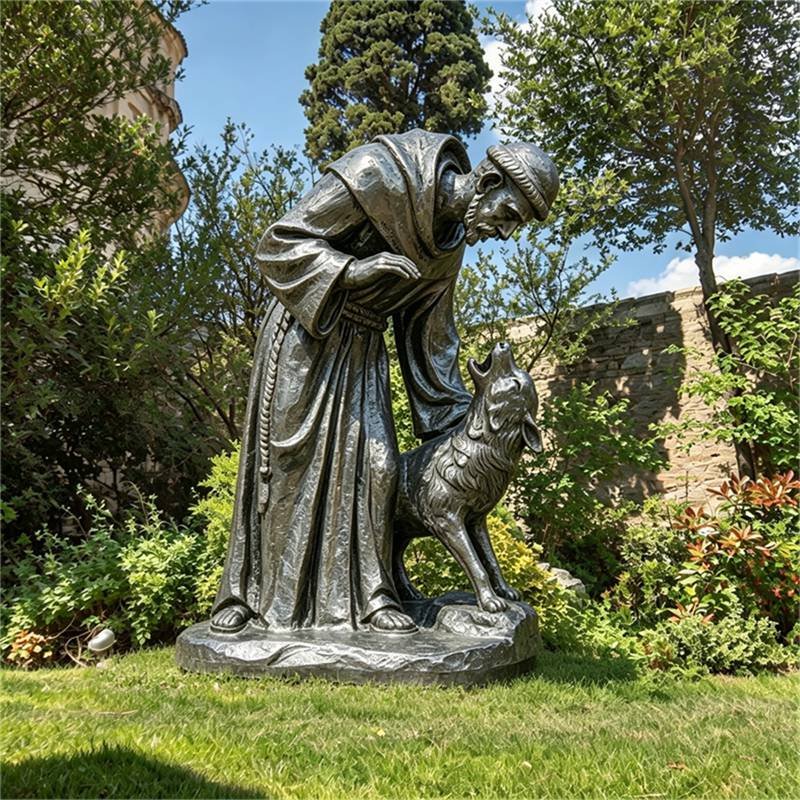
Saint Francis with the Wolf
Of all the animal companions depicted in Franciscan statuary, none carries a more dramatic or more theologically rich story than the wolf.
The city of Gubbio was being terrorized by a wolf so ferocious it devoured men as well as animals.
The townspeople lived in fear. Francis went alone into the hills, made the sign of the cross, and commanded the wolf to come to him and harm no one.
The wolf came. Francis led it into the town and brokered a peace: the people would feed the wolf; the wolf would no longer prey upon them.
The wolf lived among the townspeople until its death, and the people mourned it. 、
The wolf at Francis’s feet is not merely a charming legend.
It is one of the most powerful symbols in all of Christian art.
It represents the transformation of hostility into harmony — the triumph of love and non-violence over aggression and fear.
It speaks of reconciliation: between predator and community, between the wild and the domestic, between the parts of human nature we fear and the grace that can tame them.
In a deeper reading, the wolf is every soul that has been written off as dangerous or irredeemable — and Francis is the one who walks toward it anyway, without fear, with only a cross and an open heart.
A statue of Francis with the wolf at his feet is a particularly powerful choice for spaces of reconciliation, healing, or community gathering — anywhere that people come together across difference, and need a reminder that peace is possible.
Saint Francis Holding a Crucifix
Before Francis was the patron of animals and ecology, he was a man utterly captivated by the cross.
It was before a crucifix at the ruined chapel of San Damiano that he heard the voice of Christ speak to him. It was in meditating on the Passion that he received the stigmata on La Verna. The crucifix was not a symbol for Francis — it was the center of his entire spiritual universe.
Statues depicting Francis holding or embracing a crucifix capture this dimension of his soul: the Christocentric heart of Franciscan spirituality.
The open hands bearing the stigmata marks, the gaze fixed on the cross, the posture of total surrender — these speak of a man who did not merely admire Christ from a distance, but who sought to be conformed to Him in every detail of his life, including suffering.
This image is particularly suited to church interiors, Eucharistic adoration chapels, and memorial spaces — anywhere that the mystery of the cross is the primary focus of prayer.
It is also a powerful choice for Franciscan friaries and communities, where it serves as a daily reminder of the Order’s founding charism: not nature mysticism in the abstract, but love of Christ crucified, expressed through love of all He created.
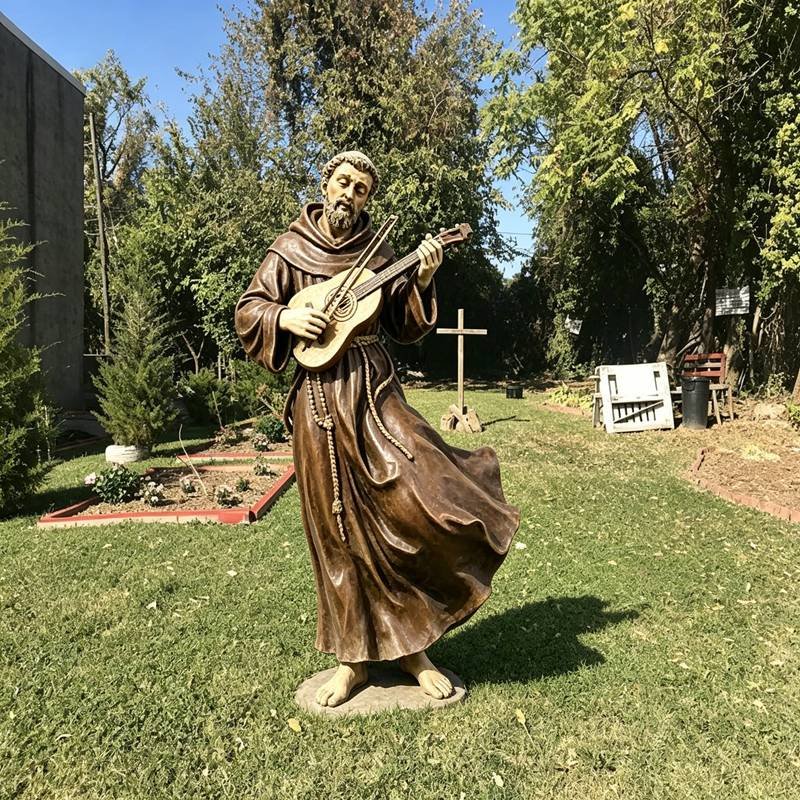
Saint Francis Holding a Rebec
This is the rarest and perhaps the most theologically surprising of all the Franciscan images — and for that reason, it may be the most profound. Before Francis was a friar, he was a troubadour: a lover of poetry, music, and the wandering singer’s life.
He grew up enchanted by the medieval tradition of poet-musicians who sang of love, beauty, and chivalry.
That sensibility never left him. It was simply redirected — from earthly romance to divine love, from the courts of Assisi to the roads of Umbria, from songs of conquest to the Canticle of Brother Sun and Sister Moon.
The rebec — a bowed string instrument that existed within Francis’s own lifetime — is the most historically authentic musical instrument to place in his hands.
Unlike two crossed branches played as a mock violin (a later folk tradition), the rebec grounds the image in the actual musical culture of thirteenth-century Italy. It honors Francis as he truly was: not only a saint and a mystic, but a poet of creation, a man who believed that praise was itself a form of prayer, and that beauty was one of God’s most generous gifts to the world.
Saint Francis with other animal
These animals symbolize gentleness and vulnerability. In Francis’ presence, they abandon their innate urge to flee. This imagery conveys that when a human soul abides in true peace with God, such serenity radiates outward to form a haven where even the shyest creatures feel secure and protected.
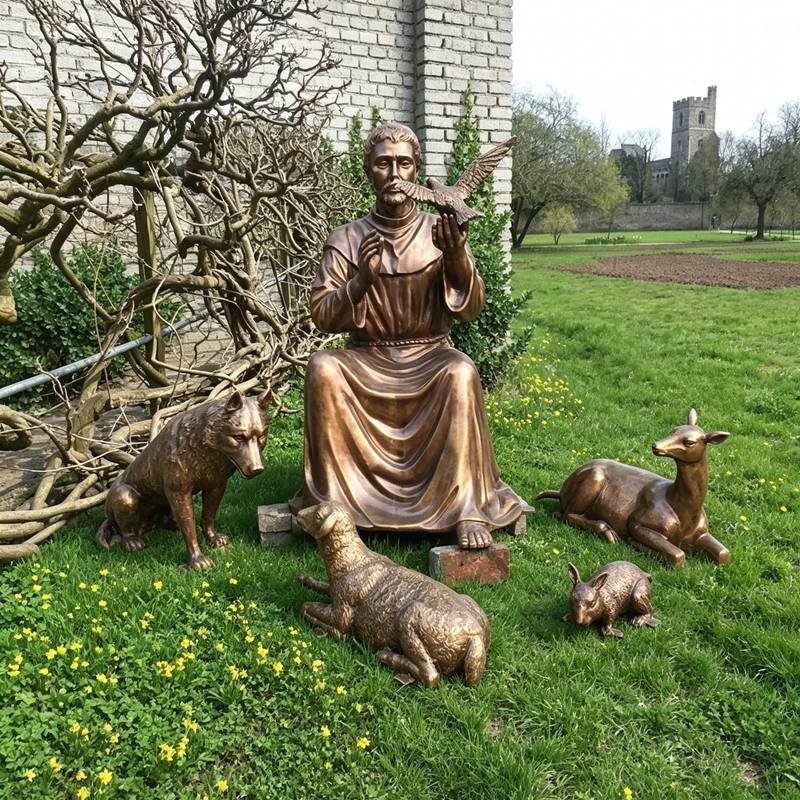
Closely linked to the Agnus Dei (the Lamb of God), the lamb beside St. Francis signifies his profound Eucharistic devotion. It embodies his faith that the Christ made present on the altar dwells also within the world’s innocent and afflicted.
Summary: The elements of Saint Francis Statues
Every element of a Saint Francis statue speaks. Here is a quick reference to the core symbolic vocabulary — drawn from eight centuries of Franciscan iconographic tradition.
| Element | Symbolic Meaning | Best Placement |
|---|---|---|
| Habit & Rope Belt | Poverty, simplicity, and humility; the three knots represent the vows of poverty, chastity, and obedience | All settings — the defining mark of every Francis statue |
| Bird (in hand or on shoulder) | The Holy Spirit, peace, freedom, and Francis’s legendary kinship with creation; the soul’s longing for heaven | Gardens, patios, flower beds, anywhere living birds gather |
| Birdbath | Sister Water (Canticle of the Sun); Baptism and blessing; a living icon where nature participates in prayer | Parish gardens, school courtyards, family backyards |
| Wolf at His Feet | Reconciliation, the triumph of love over aggression, transformation of the feared and outcast | Community spaces, healing gardens, reconciliation chapels |
| Deer / Doe | Gentleness, purity, and the soul’s longing for God (Psalm 42: “As the deer longs for streams of water”) | Woodland gardens, cemetery memorials, contemplative spaces |
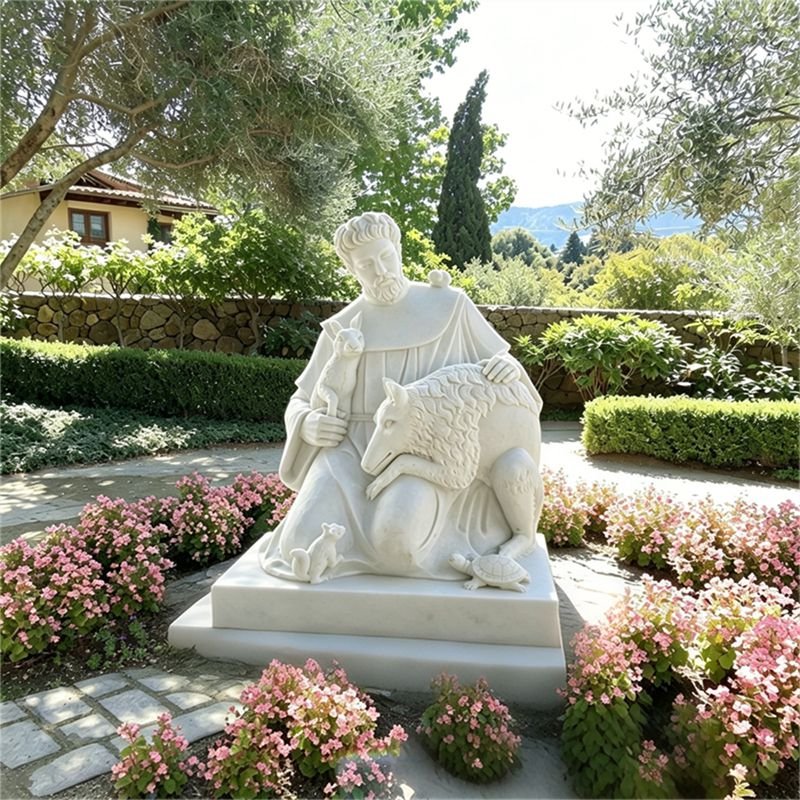
| Small Animals (Rabbit, Squirrel, Turtle) | The “lesser” creatures of creation; Francis’s care for all living things, no matter how small or overlooked | Family gardens, children’s spaces, school prayer corners |
| Crucifix | Devotion to the Passion of Christ; the stigmata; the Christocentric heart of Franciscan spirituality | Church interiors, adoration chapels, Franciscan friaries |
| Rebec (Medieval Instrument) | Francis as troubadour of God; the Canticle of the Sun; creativity and beauty as forms of prayer | Music schools, arts programs, Franciscan formation houses, personal devotional spaces |
| Stigmata Marks on Hands | Conformity to Christ crucified; the fruit of contemplative prayer; the seal of his vocation | Any statue — look for this detail in high-quality bronze and marble pieces |
| Open / Extended Hands | Blessing, welcome, and openness to all of God’s creation; Francis as peacemaker and mediator | Entrances, thresholds, gathering spaces, birdbath settings |
What Is the Best Material for Your Saint Francis Garden Statue: Marble vs. Bronze
There is no single “best” material — but there is a right answer once you know where your statue will live and how long you want it to last.
When people search for a “Saint Francis garden statue,” they are rarely thinking only of a garden. The term has become a broad entry point for an entire range of placements and intentions. Based on some feedbacks from our clients, they usually are inclined to place thrier Saint Francis garden statue in the following places:
- Church courtyards, friary walkways, and school grounds
- Memorial or Private gardens and cemetery plots
- Classroom devotional shelves and tabletop displays
This matters because the right material is inseparable from the right size and the right setting.
With that in mind, here is our honest guidance: for Saint Francis garden statue that will live outdoors or in a formal sacred space, the choice comes down to two materials — marble and bronze.
These are not merely practical choices.
They are, in their own way, a reflection of Franciscan values: choosing what endures, what is true, what will still be standing long after we are gone — just as Francis himself chose to follow Christ not for a season, but for a lifetime.
Marble vs. Bronze: A Detailed Comparison
| Factor | Marble | 🥉 Bronze |
|---|---|---|
| Lifespan | 500–2,000+ years in sheltered or indoor settings; 100–300 years outdoors with annual sealing | 100-500+ years outdoors with minimal maintenance — the most durable material available for outdoor sacred sculpture |
| Weather Resistance | Vulnerable to freeze-thaw cycles and acid rain; best in mild, dry, or sheltered climates. Requires protection in Canada, Northern Europe, and high-altitude regions | Superior across all climates — handles coastal salt air, extreme cold, heavy rain, and intense sun without structural compromise |
| Weight & Stability | Very heavy — naturally stable and resistant to theft or displacement; ideal for permanent installation | Moderate to heavy — stable in most conditions; can be anchored to a stone or concrete base for added permanence |
| Detail & Artistry | Master carvers can render fine facial features, flowing Franciscan robes, delicate bird feathers, and the stigmata marks with extraordinary precision | Lost-wax casting captures intricate engravings, expressive faces, and fine animal detail; no two hand-finished bronzes are identical |
| Aesthetic Over Time | White marble remains luminous if sealed; develops a warm golden tone with age. In candlelight or dappled garden light, it glows with a sacred quality unlike any other material | Develops a rich verdigris patina over years — a living, deepening beauty that makes the statue appear more venerable with every passing decade |
| Maintenance | Annual sealing with a penetrating stone sealant; gentle cleaning with pH-neutral soap and soft cloth; avoid pressure washing | Low — occasional waxing with paste wax to preserve or slow patina development; no sealing required; rinse with water annually |
| Price Range | $300–$10,000+ depending on size, stone quality, and carving complexity | $500–$10,000+ for quality foundry-cast pieces; investment-grade for institutional donors |
| Best Placement | Church interiors, sheltered chapel niches, memorial installations, formal estate gardens in mild climates | Outdoor parish gardens, friary courtyards, permanent memorials, cemetery installations, any climate |
| Spiritual Resonance | Purity, eternity, the luminous holiness of sacred interior space — the material of Michelangelo’s Pietà and the great tradition of Church sculpture | Permanence, dignity, the weight of centuries — a bronze Francis will outlast every person who prays before it, carrying their prayers forward in silence |
Our Recommendation: Match Your Material to Your Setting and Size
A large Saint Francis statue is a commitment — to a place, to a community, to a vision of sacred space that will endure.
For this reason, only bronze and marble are appropriate choices.
Both materials age with extraordinary grace: marble grows luminous and warm, bronze deepens into a rich verdigris that seems to carry the weight of history itself.
A well-cast bronze Francis installed in a parish garden today may still be standing — still drawing birds, still inviting prayer — two hundred years from now.
That kind of permanence is not merely practical.
It is, in its own quiet way, a theological statement: a declaration that faith is not seasonal, not temporary, not subject to the weather.
Just as Francis himself chose to follow Christ not for a season but for a lifetime — bearing the stigmata, welcoming Sister Death — so a bronze or marble statue embodies that same unconditional fidelity.
- For parish gardens, friary courtyards, and church grounds: Bronze is the gold standard. It handles every climate without compromise, develops a patina that only deepens its beauty over decades, and carries the institutional gravitas appropriate to a communal sacred space. A well-cast bronze Francis will outlast every person who prays before it.
- For church interiors, sheltered chapel niches, and formal memorial gardens in mild climates: Marble is unmatched in its luminosity and its capacity for fine detail. In candlelight, a marble Francis glows with a quality no other material can replicate. Ensure it is sheltered from direct rain and freeze-thaw exposure.
- For cold climates — Canada, Northern Europe, high-altitude regions: Prioritize bronze. Marble is vulnerable to freeze-thaw cracking and acid rain damage in harsh climates. Bronze remains structurally sound and visually magnificent regardless of temperature extremes.
Final Thought
Saint Francis of Assisi once said: “It is no use walking anywhere to preach unless our walking is our preaching.”
The same might be said of the statues we choose to place in our gardens, our churches, and our homes. They are not silent. They preach — to every person who passes, every child who pauses, every grieving soul who sits nearby in the quiet of an afternoon.
Choose the image that speaks to the particular grace you wish to invoke.
Choose the material that will endure in your climate and your setting.
Choose the size that honors the space without overwhelming it.
And then place it with intention — near water, near living things, in a spot where the light falls gently and the world slows down for a moment.
Francis spent his life trying to repair what was broken — in the Church, in the world, in the human heart. A statue of him, placed with love and care, continues that work in its own quiet way.
“Lord, make me an instrument of your peace.”
— Prayer in the spirit of Saint Francis of Assisi