Picture the Virgin Mary standing in silence — her eyes lowered, a dark mantle draped over her shoulders, and seven slender swords piercing her heart. This is not a scene of despair without hope; it is one of the most tender and enduring images in Catholic art: the statue of Our Lady of Sorrows.
Whether encountered in a side chapel during Holy Week, carried through the streets in a solemn procession, or resting quietly on a home altar, this image speaks a language beyond words. It tells the story of a mother who did not turn away from suffering — who stood beside her son at the foot of the Cross and, by doing so, became a companion to every grieving heart that has followed since.
What Is Our Lady of Sorrows?
Our Lady of Sorrows — also referenced by the Latin liturgical name Beata Maria Virgo Perdolens, Mater Dolorosa, alongside devotional titles including Our Lady of Dolours, Our Lady of the Agony, the Sorrowful Mother, Mother of Sorrows, Our Lady of Piety, Our Lady of the Seven Sorrows and Our Lady of the Seven Dolours — is one of the most revered Marian figures in Catholic tradition.
She is invoked in reflection upon human suffering and grief in earthly life.
As Mater Dolorosa, she stands as a central subject within Marian art of the Catholic Church.
What is the Story Behind Our Lady of Sorrows
The roots of this devotion reach back further than most people realize — tradition holds that veneration of Mary’s sorrows began at the very foot of the Cross itself, with St. John, the beloved disciple, standing witness to her grief.
But it was in 13th-century Italy that this devotion took organized, lasting form. In 1233, seven young noblemen from Florence withdrew from public life to devote themselves to prayer and penance, eventually founding the Servite Order — the Order of the Servants of Mary — in the region of Tuscany.
This order would go on to become the devotion’s most passionate promoter, embedding meditation on Mary’s sorrows into their daily spiritual life for centuries.
It wasn’t until the 17th century that the devotion crystallized into the specific structure we recognize today — a meditation built around seven distinct sorrows, each drawn from a moment described in Scripture.
The Church eventually established a formal feast day, Our Lady of Sorrows, celebrated on September 15th — fittingly, just one day after the Feast of the Exaltation of the Holy Cross, binding mother and son together in liturgical memory.
What Are the Seven Sorrows of Mary?
Each of the seven swords traditionally depicted piercing Mary’s heart corresponds to a specific moment of anguish recorded in the Gospels:
The Prophecy of Simeon — the elderly prophet warns Mary that “a sword will pierce your own soul too” (Luke 2:35)
The Flight into Egypt — fleeing by night with the infant Jesus to escape King Herod’s massacre
The Loss of the Child Jesus in the Temple — three days of anguished searching in Jerusalem
Mary Meets Jesus on the Way to Calvary — encountering her son bloodied and burdened by the Cross
The Crucifixion — standing at the foot of the Cross as Jesus died
Jesus Is Taken Down from the Cross — receiving her son’s lifeless body into her arms
The Burial of Jesus — watching as the stone sealed the tomb
Together, these seven moments trace a mother’s journey from quiet foreboding to unbearable loss — yet through every stage, Mary neither collapsed nor abandoned her faith. This is precisely why the devotion endures: it offers no shortcut around suffering, only companionship within it.
What Are the Types of Our Lady of Sorrows (Mater Dolorosa) Statues?
Just as the devotion itself grew across centuries and continents, sculptors gave it shape through remarkably diverse artistic formats. Beyond simple standing figures, the tradition encompasses full-length statues, intimate devotional busts, and wall relief carvings — each serving distinct liturgical and devotional purposes, yet all sharing a consistent core vocabulary of symbolic markers.
Full-Figure Statues
Full-figure statues present the complete bodily form of the Virgin, either standing or seated, and fall into three key sub-types.
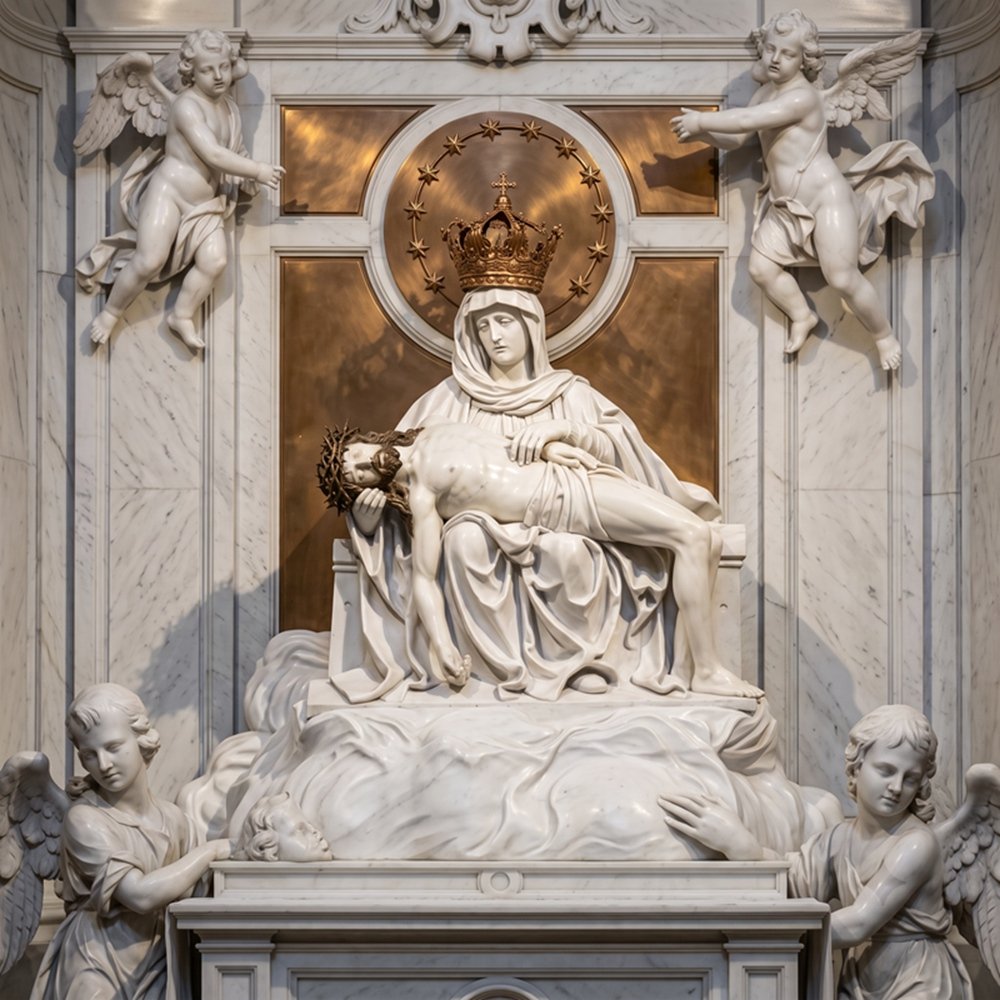
Pietà Type (Our Lady of Piety) — The Pietà portrays the seated Virgin cradling the lifeless body of Christ, corresponding to the seventh of Mary’s Seven Sorrows.
Michelangelo’s iconic Pietà (1498–1499) in St. Peter’s Basilica established the Renaissance ideal for this theme — conveying noble, restrained grief rather than histrionic weeping, an archetype that went on to inspire countless Baroque Pietà altarpieces across Central Europe.
A moving modern example stands in the Chapel of Our Mother of Sorrows at the Basilica of the National Shrine of the Immaculate Conception in Washington, D.C. Donated by the Slovak-American community, this life-size Trani marble Pietà by sculptor Ernest Morenon shows the seated Virgin holding the dead Christ, her sorrow inward and dignified rather than dramatized. The pedestal bears the invocation “Mother of Sorrows, Pray for Us,” while gilded-bronze wall reliefs surrounding the chapel depict Mary’s six remaining sorrows, completing the full cycle for pilgrim meditation.
This same iconography defines the main altar at Slovakia’s national shrine — the Basilica of Our Lady of Seven Sorrows at Šaštín-Stráže, home to a pear-wood Pietà carved in 1564 . In this Austro-Bohemian Baroque rendering, gilded and enthroned amid billowing cloud motifs, Christ notably bears both the crown of thorns and a royal crown — signifying his kingship even amid the Passion — while Mary’s countenance remains solemn, emphasizing spiritual resignation over unrestrained lament.
Baroque Full-Figure Mater Dolorosa (without the figure of Christ) — Here Mary stands or sits alone, swords piercing her heart in direct visual reference to Simeon’s prophecy. Regional schools differ markedly in emotional register:
- Spanish Andalusian (Sevillian) Baroque: Dramatic, theatrical polychrome-wood carvings — Mary often leans backward, head tilted toward heaven, with turbulent drapery externalizing her inner agony. This idiom was conceived specifically for the emotional intensity of Holy Week processions.
- Italian Late-Baroque/Rococo: More gently lyrical, with softer posture, melancholy expression, and elegant gilded-trim robes — dramatic intensity toned down compared to Spanish examples.
- Austro-Bohemian (Central European) Baroque: Typically integrated into monumental altarpieces, resting on sculpted cloud bases flanked by putti, with extensive gilding for major sanctuary settings.
- Neo-Baroque (modern reproductions): Contemporary composite-material statues reinterpreting historic aesthetics with more upright, stable postures suited for static church installation.
Folk-Baroque Type — A grassroots adaptation of high Baroque iconography, widely spread across Catholic cultures shaped by colonial history.
At the National Shrine of Our Lady of Sorrows in Dolores, Quezon, Philippines, an outdoor garden statue shows Mary in a deep-purple mantle, hands reverently holding her pierced sacred heart — a simplified, humble form prioritizing accessible piety for pilgrim communities.
A related folk format is the Santo de Vestir (mannequin-style statue), where only the head and hands are carved in wood, with the frame dressed in real fabric vestments — as seen at the Shrine of Our Lady of the Island in New York.
Devotional Bust (Busto de Imagen)
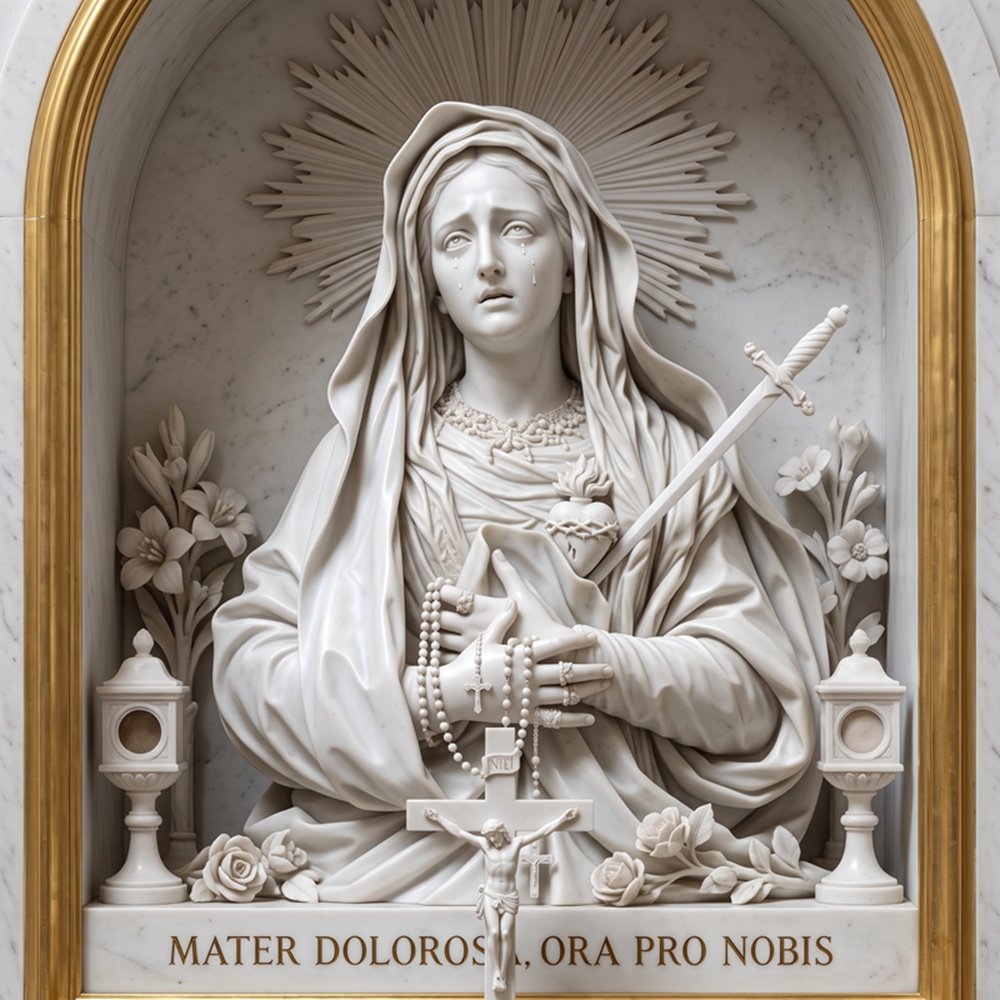
The bust format renders only the head, neck, torso, and hands, omitting lower-limb anatomy entirely — a format that flourished for intimate niche-shrine worship, especially across Spanish and Portuguese-influenced territories.
Enclosed in a gilded glass niche, all visual focus converges on her sorrow-stricken face and the single sword piercing her gilded heart — a format made for close-range contemplation rather than public procession.
Relief Sculpture
Reliefs are flat-to-raised wall carvings rather than free-standing statuary, typically ornamenting altarpieces and chapel walls.
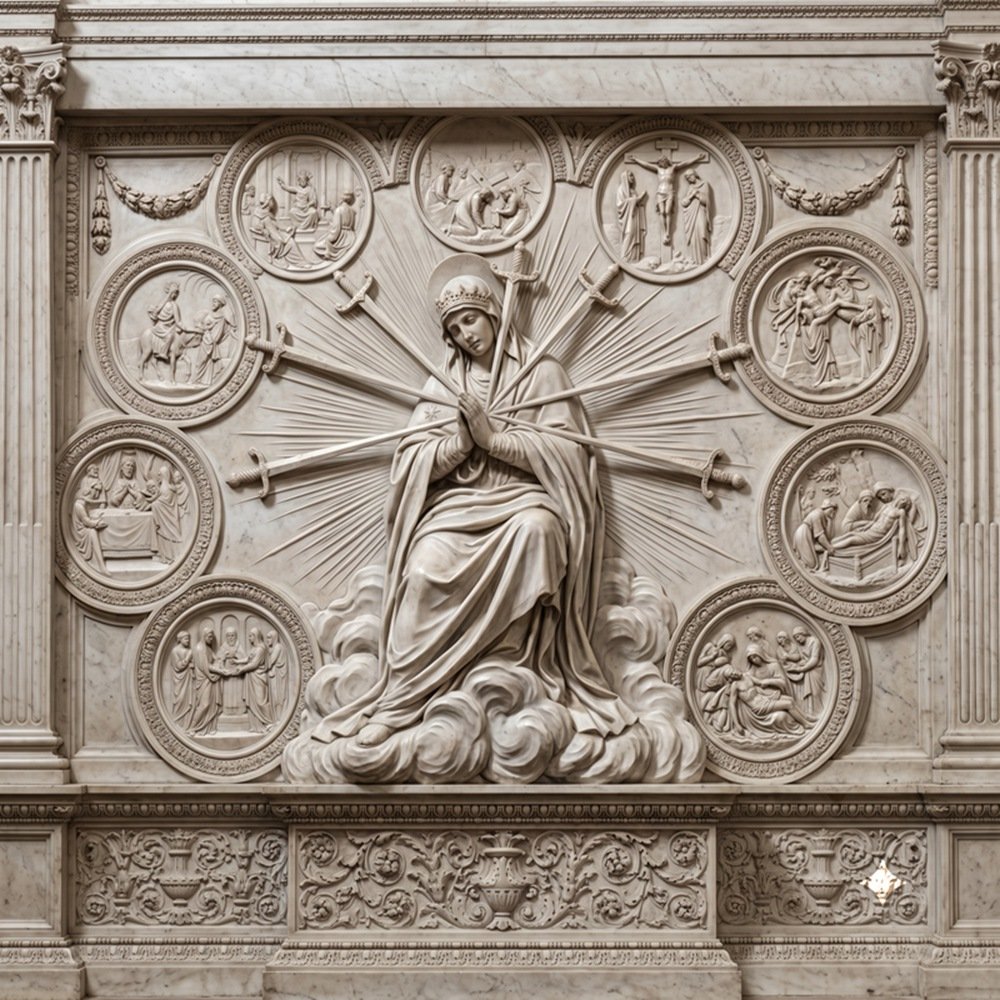
One notable marble‑relief composition originates with The Seven Sorrows of Mary by Antonio Tempesta, preserved at the Basilica of St. Stephen in the Round on the Caelian Hill, Rome.
In the original work, Mary sits enthroned upon sculpted clouds, with seven swords radiating outward from her sacred heart.
Our factory has produced a faithful marble relief version based on this drawing, retaining the original iconographic layout, figure arrangement, and symbolic details for sacred‑space installation.
Shared Iconographic Elements Across All Types
Regardless of format, a consistent set of symbolic markers defines authentic Mater Dolorosa iconography:
- Swords piercing the heart — one sword, or the full seven referencing Simeon’s prophecy; the sacred heart is often gilded or painted vivid red
- Colour palette — a deep-blue mantle nearly universal as a symbol of purity, paired with purple or crimson under-robes signifying mourning and the Passion
- Facial expression — restrained, dignified grief rather than uncontrolled weeping: furrowed brows, eyes lifted to heaven or cast down, lips closed in quiet resignation
- Halos and crowns — star-spangled nimbus halos denoting holiness, with royal crowns on major shrine statues representing Mary as Queen of Heaven
Understanding these distinctions matters practically, too: a full-figure processional statue, a wall-mounted bust for private prayer, and a narrative relief panel each serve entirely different placements and functions — main altars and outdoor shrines for full figures, glass niches for busts, and wall surrounds for reliefs.
How Can I Buy a Church-Version Replica?
If you’re seeking a statue for a parish, chapel, or personal devotion, understanding which type — Pietà, standing Baroque figure, bust, or relief — best suits your space is the first step. From there, two main purchasing paths remain, each with its own considerations.
Buying Offline
Purchasing in person — through religious goods stores, diocesan suppliers, or established church art studios — allows you to examine craftsmanship directly: the depth of the carved swords, the subtlety of facial expression, and the quality of paint or stone finish. For churches seeking a large-scale marble or resin statue meant to last generations, this hands-on inspection is often invaluable, as photographs rarely capture texture and proportion accurately.
Buying Online
Online purchasing offers far greater selection and typically better pricing, especially for imported hand-carved marble or fiberglass statues. But navigating this space requires care.
A Quick Guide to Choosing Online:
Confirm the type you need — a processional Baroque figure, a niche bust, or a Pietà group each requires different sizing and mounting considerations
Check material authenticity — confirm whether the statue is genuine marble, marble powder composite, resin, or polychrome wood; each has different weight, durability, and price points
Look for detailed, multi-angle photos — a trustworthy seller will show the statue from several angles, including close-ups of the face and the swords
Verify iconographic accuracy — ensure the number of swords, the mantle color, and Mary’s expression align with the traditional type you’re seeking, not a generic “sad Madonna” figure
Read reviews from religious institutions — parishes and religious suppliers often leave more reliable, detail-oriented feedback than general retail reviews
Confirm size and shipping specifics — large statues require freight shipping and careful packaging; ask about breakage insurance
Common Online Pitfalls to Avoid:
Photo mismatch — some listings use professional stock images that don’t match the actual product shipped, particularly with mass-produced resin figures
Vague material descriptions — terms like “premium stone” without specifying composition often signal lower-quality composite materials
Unrealistically low prices — hand-carved marble or wood statues require significant labor; prices far below market average often indicate machine-cast alternatives misrepresented as hand-carved
No return or damage policy — always confirm what happens if a statue arrives cracked or chipped during shipping, especially for larger pieces
Final Thoughts
In the liturgical observance of the Feast of Our Lady of Sorrows, Mary is venerated as Fons amoris — the Fount of Love. Whether encountered as a monumental Pietà within a Slovak national shrine, a dramatic Spanish Baroque processional statue, an intimate niche‑enshrined bust in Jerusalem, or a modest folk‑devotional garden figure in the Philippines, every iteration of this sacred icon calls the faithful to meditate upon unwavering faith persevering amid human suffering.
Statues of Our Lady of Sorrows do not bid us turn away from pain. Instead, they beckon us to abide within it, just as Mary stood steadfast at the foot of the Cross. Every sword piercing her heart, every heavy fold of her mourning mantle, every hint of sorrow chiselled into wood or marble bears witness to centuries of shared human grief transfigured into quiet, abiding faith.
“That this same sorrow has been carved in Trani marble, Slovak pear‑wood, and Filipino garden stone alike is itself a quiet testimony: grief borne in faith speaks every language.”
Our Lady of Sorrows, pray for us.