Every Christmas, in living rooms, chapels, and town squares, a small group of figures tells the oldest story we know.
Eight centuries later, the tradition still holds: a few statues, carefully arranged, turn the Christmas story into something you can see and touch.
But choosing those statues can feel like a project.
Which figures do you actually need? Marble or bronze? Indoors or outdoors?
This guide walks you through each decision — so you can build a scene that is beautiful, meaningful, and built to last.
Why Display Nativity Statues?
A nativity scene is not decoration — it is a form of faith made visible.
Faith expression and spiritual contemplation.
The scene gives the mystery of Christmas a place in your home. Each figure invites a moment of reflection: Mary contemplating her child, Joseph standing guard, shepherds drawn by the angels’ announcement. During Advent, many families use the crèche as a small daily focal point for prayer — a “living Gospel” in the corner of the room.
Commemorating the birth of Christ.
The scene is a way of remembering, and re-entering, the event at the center of the Christian faith: the Incarnation. In his 2019 apostolic letter Admirabile Signum, Pope Francis called the nativity scene “a simple and joyful proclamation of the mystery of the Incarnation.” Placing the statues each year is a small act of remembrance that the whole family shares.
A tradition that connects generations.
Children learn the story by arranging the figures; parents and grandparents pass the custom on. A well-chosen set of statues becomes a family heirloom — something your grandchildren may set up one day.
A Brief History of the Nativity Scene
The story begins in the Gospel: Jesus was laid in a manger, and from that one verse (Luke 2:7) the scene takes its name — presepe comes from the Latin praesepium, meaning “manger.”
By the 4th century, pilgrims were celebrating Christmas at the grotto in Bethlehem, and the relics of the manger were venerated in Rome’s Basilica of Santa Maria Maggiore, known as “the Bethlehem of the West.”
The turning point came in 1223. At Greccio, St. Francis of Assisi arranged a manger filled with hay, an ox and a donkey, and celebrated Mass over it, so that people could see the poverty of the newborn Christ with their own eyes.
The custom spread across Europe with the Franciscans: by the late 13th century sculpted nativity scenes appeared in churches, and in the 18th century Naples created the golden age of the presepe — scenes crowded with everyday townsfolk. In the 19th century, the tradition travelled worldwide with European emigrants, and in 1982 the Vatican began its annual nativity scene in St. Peter’s Square.
In 2019, Pope Francis signed the apostolic letter Admirabile Signum at Greccio, calling the nativity scene “a living Gospel.” Eight centuries on, the manger still stands at the center of Christmas — and of this guide.
Which Nativity Statues Do You Really Need?
Start with the heart of the scene, then build outward over the years.
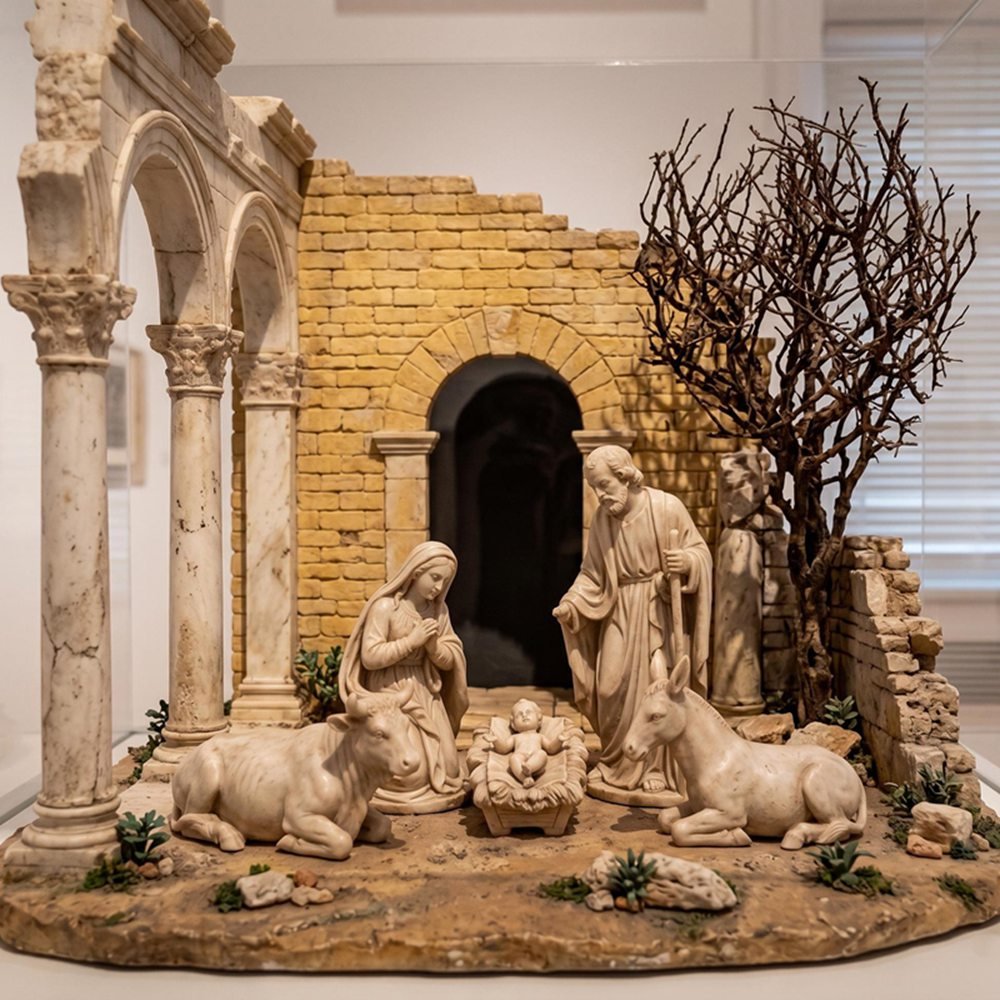
Must-have statues — the essential core of any scene:
-
Baby Jesus — the center of the scene; by tradition, placed in the manger on Christmas Eve
-
Mary — the mother, contemplating her child
-
Joseph — the guardian, usually holding a staff or a lantern
-
The manger — the “first bed,” where Jesus is laid
-
The ox and the donkey — present at the first crèche at Greccio; they echo Isaiah’s words, “The ox knows its owner, and the donkey its master’s crib” (Isaiah 1:3)
Recommended statues — the next ring of the story:
-
Shepherds — the first to receive the good news
-
Angels — the announcers of the birth
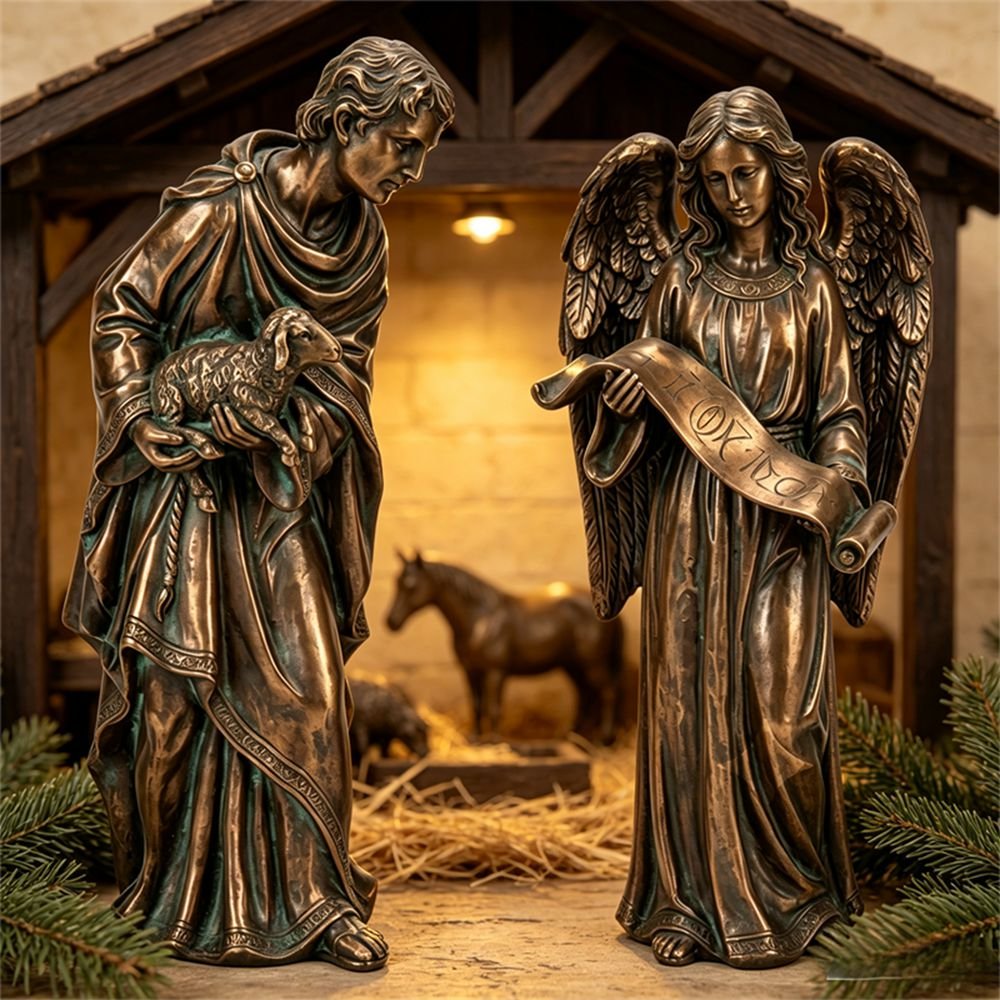
-
The Wise Men (Magi) — traditionally added at Epiphany (January 6), bearing gold, frankincense, and myrrh
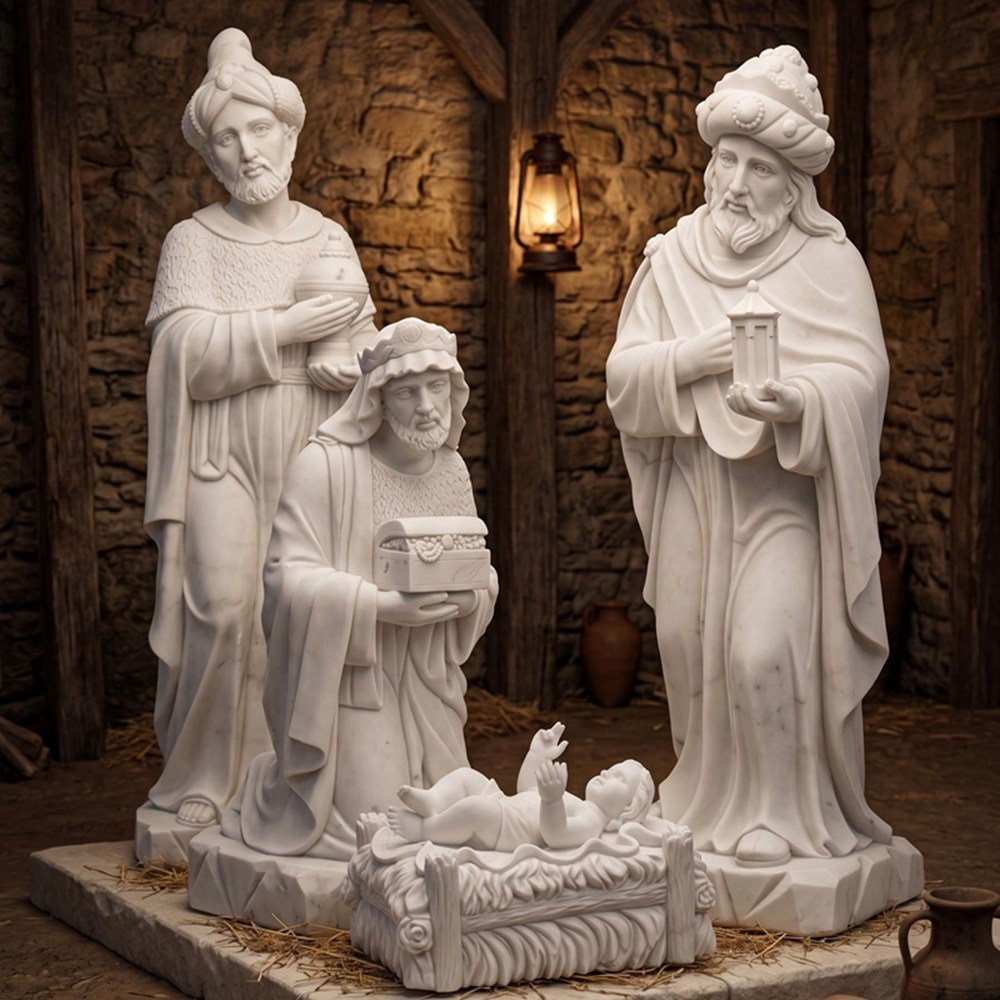
Optional figures and accessories — for a fuller, more personal scene:
-
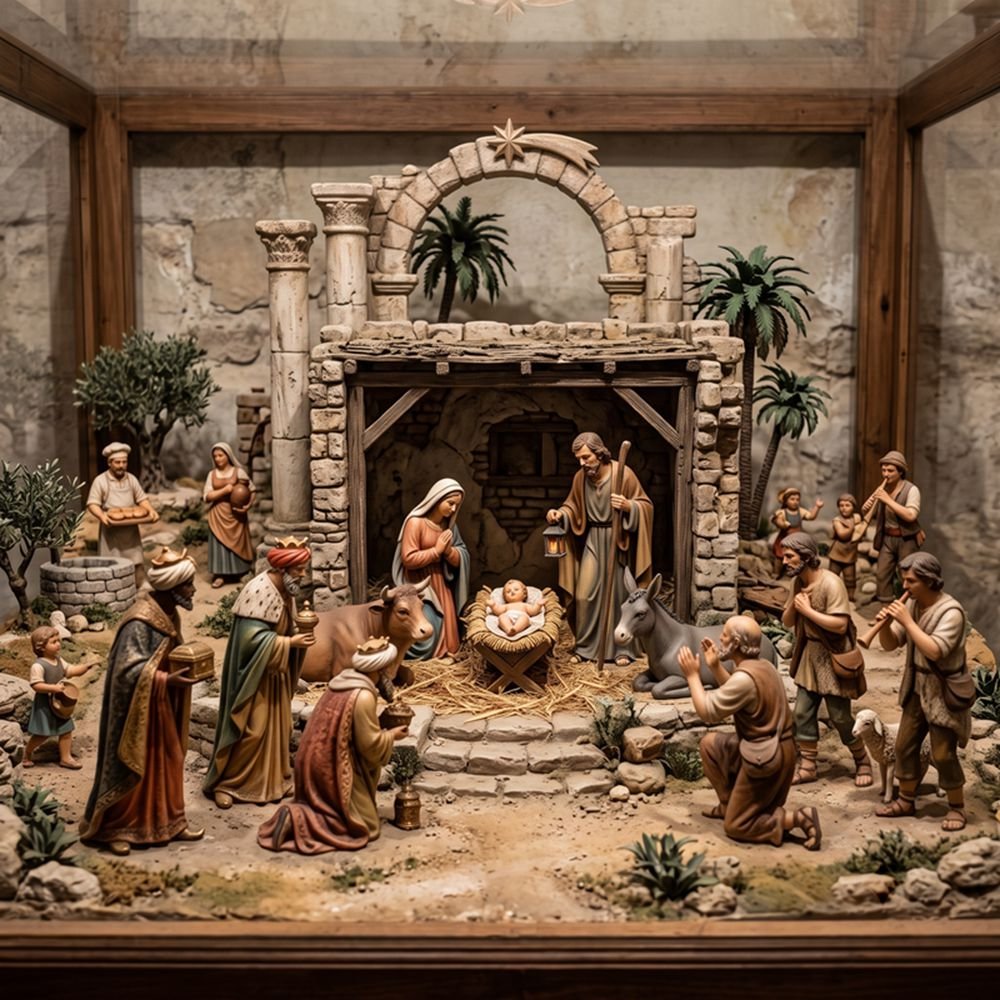
Villagers and townsfolk — a baker, musicians, women carrying water, children at play. Since the 18th century, nativity scenes have made room for everyday life; these figures speak of “everyday holiness”
-
Animals, palm trees, wells, ruined arches and the guiding star — to build a landscape around the stable.
Tip: you do not need everything in year one. Start with the essential five or seven pieces and add one or two each year. A small, well-made scene is always better than a crowded one.
Where to Place Your Nativity Statues
At home.
Choose a spot the family gathers around: the living room, a mantelpiece, or under the Christmas tree. Place the scene at eye level where children can see it, keep it out of high-traffic areas, and give it a little protection from curious pets.
Church and chapel.
A nativity scene near the entrance greets worshippers as they arrive; placed before the altar or in a side chapel, it becomes a focal point for prayer. For public displays, choose a larger scale and a stable, slightly raised base so the scene is visible — and safe — from a distance.
Indoor vs. outdoor.
Indoor scenes can be made of almost any material — marble, bronze, resin, or wood. Outdoor scenes need weather-resistant materials, a secure base against wind, and protection from frost. A warm light makes the scene visible — and inviting — after dark.
What Style of Nativity Scene Should You Choose?
Most nativity scenes fall into one of three broad styles. There is no right or wrong — the best choice depends on your space, your taste, and the story you want to tell.
Realistic Scene Reproduction
The faithful recreation of the night in Bethlehem: a stable or cave, hay and a manger, the Holy Family, ox and donkey, shepherds, angels and the guiding star. The figures are naturalistic and the setting feels complete — the tradition of the 18th-century Neapolitan presepe and the carved Alpine cribs. Best for traditional homes, churches, and collectors; wood and marble are the classic materials.
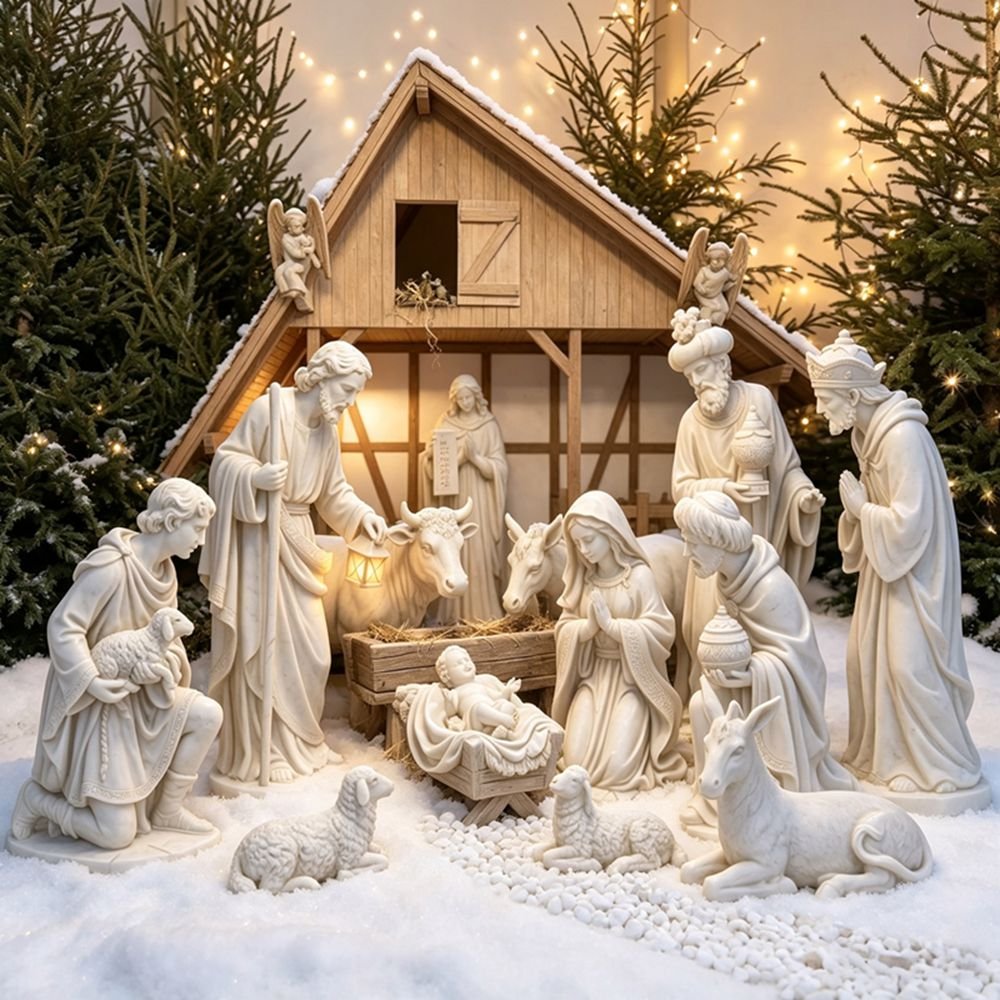
Regional Character
The Christmas narrative is reimagined through the lens of local culture. Provençal santons depict regional villagers in distinctive local attire; Kraków szopkas feature elaborate tower-style cribs modeled after the city’s famous landmarks; Latin American nativity scenes incorporate native garments, flora and fauna. These renditions root the Gospel story within a specific place, carrying a warm folk-art character. They are perfect for collectors and for sharing the nativity tale through a localized cultural perspective.
Modern Style
Clean lines, simplified geometry, and natural textures, with plenty of negative space. Some modern nativity interpretations adopt abstract or flat forms. This style is widely loved in Nordic and design-forward homes, ideal for minimalist arrangements beneath the Christmas tree. It remains a top pick for contemporary interiors, young families and holiday gifting.
A simple approach: choose the style first, then the finish. Realistic scenes pair beautifully with stone or carved timber; regional sets shine with hand-finished folk detailing; modern pieces stand out with matte stone or metal.
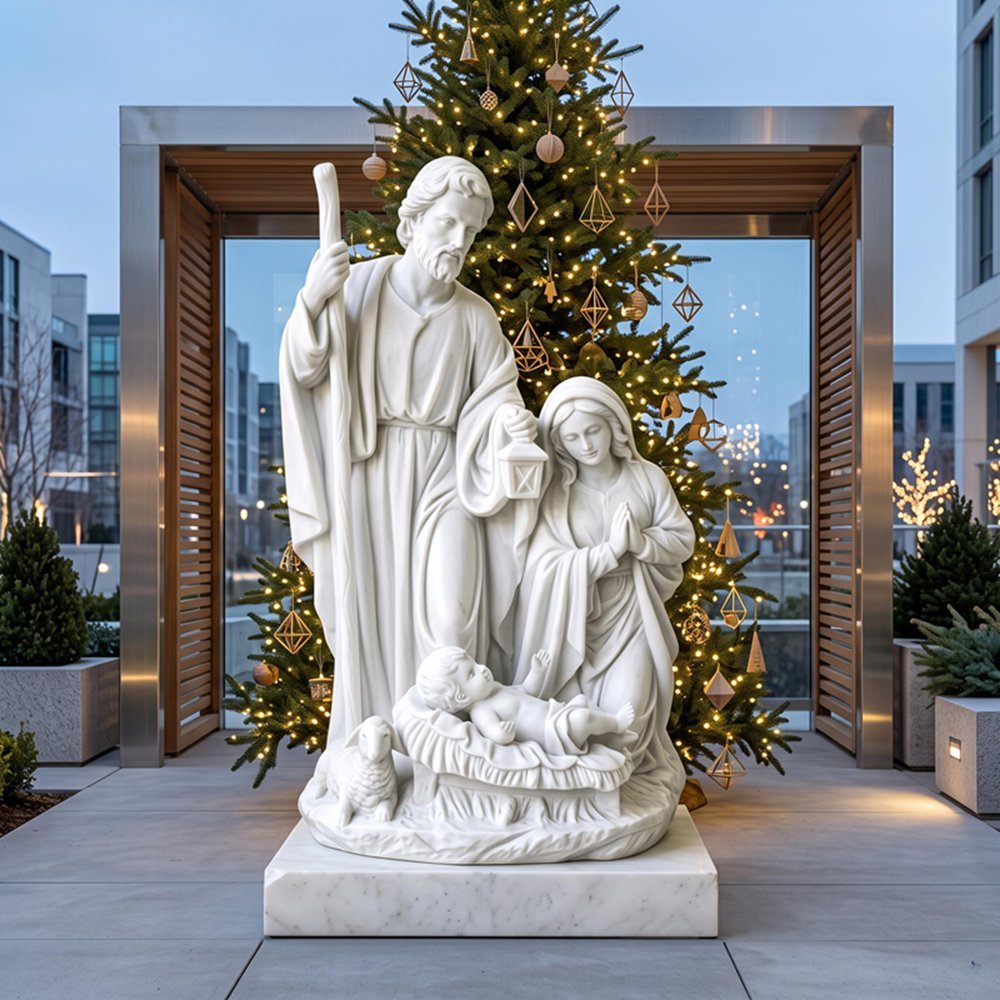
How to Choose the Material: Marble or Bronze?
The two most-asked-about materials are marble and bronze — and each has a clear “home.”
Marble nativity statues are refined and luminous. White or cream marble suits classical interiors and chapels, and it is easy to maintain indoors — a soft dry cloth is enough. But marble is porous: frost, rain, and pollution can stain or crack it over time, so it is not recommended for outdoor display. It is also heavier than it looks, so make sure your shelf or base can carry the weight.
Bronze nativity statues are built for the long term. Bronze is weather-resistant and frost-tolerant, making it the natural choice for outdoor scenes, church gardens, and courtyards. Over time, it develops a beautiful patina, or it can be sealed to keep the original finish. The look is monumental and formal, the weight is considerable, and the cost is usually higher — but a bronze scene is made to last for generations.
|
Consideration
|
Marble
|
Bronze
|
|---|---|---|
|
Best location
|
Indoors
|
Indoor or outdoor
|
|
Style
|
Classical, refined
|
Monumental, formal
|
|
Weather resistance
|
Low — not frost-safe
|
High
|
|
Maintenance
|
Occasional dusting
|
Occasional cleaning; patina care
|
|
Weight
|
Heavy
|
Heavier
|
|
Typical use
|
Living rooms, chapels, altars
|
Courtyards, gardens, church entrances
|
If you want a lightweight, budget-friendly option for indoor or sheltered outdoor use, consider a resin or stone-composite set; for a warm, rustic look, wood is a beautiful alternative.
How to Position Your Nativity Statues
Central layout — the manger is the focal point. Place the manger, with Baby Jesus, at the center. Flank it with Mary and Joseph, then let the other figures radiate outward. A simple rule: every figure’s eyes should point toward the Child.
Layering and perspective. Set the scene on a low platform or a few stacked levels to give it depth. Place larger figures toward the back and smaller ones in front — or keep the Holy Family slightly raised. Use cloth, moss, or wood to create ground levels: a “hillside” for the shepherds, a “road” for the Wise Men approaching from a distance. Angels can stand above the scene, with the star over the manger to complete the composition.
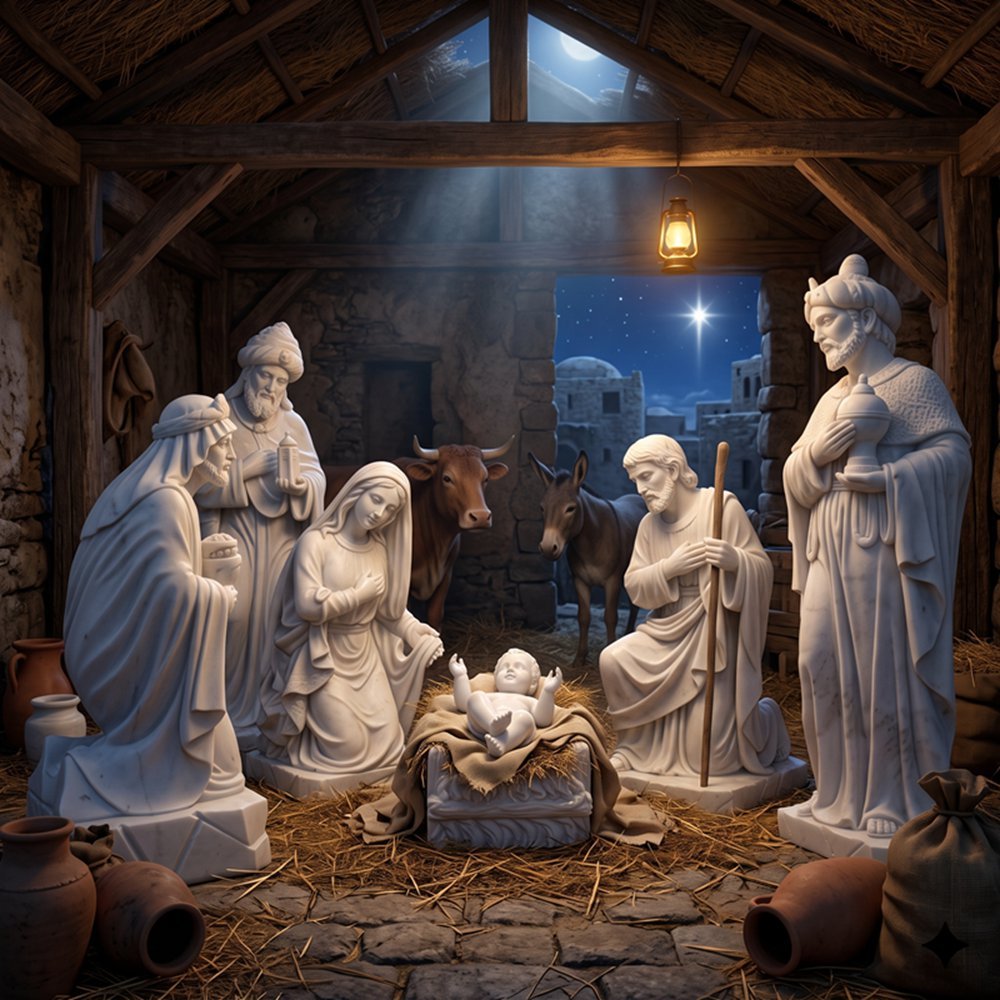
Stability and installation. Indoors, use museum putty or non-slip pads under each figure to keep them safe from knocks and pets. Outdoors, anchor larger pieces to a stable base such as a concrete paver, and check how exposed the spot is to wind. A single warm spotlight on the manger draws the eye to the heart of the scene.
Conclusion
“Sadly, today the Christmas tree has replaced the nativity scene in many Christian homes. The best way to put Christ back into Christmas is to set up a nativity scene in your home from Advent to Epiphany — however humble and simple it may be.” — Joe Morley
Choosing nativity statues comes down to one question: what will help your family — or your parish — enter the Christmas story this year? Start with the essential figures, choose a material that suits your space, and place the manger at the center. Whether it is a small marble set by the tree or a bronze scene in the garden, the message is the same one St. Francis set out to show at Greccio: God with us.
FAQ
When should I set up the nativity scene?
Traditionally during Advent — the four Sundays before Christmas. Many families set it up at the start of December.
When is Baby Jesus placed in the manger?
By custom, on Christmas Eve; the Wise Men are added at Epiphany (January 6).
When should I take the scene down?
The traditional end is Epiphany; some families keep the scene until Candlemas (February 2).
Can marble statues be placed outdoors?
Not recommended. Frost and moisture can damage marble. For outdoor scenes, choose bronze or a weather-resistant resin or stone composite.
How do I clean nativity statues?
Marble: a soft, dry cloth; mild soap and water only if needed, and never acidic cleaners. Bronze: wipe gently with a soft cloth; avoid abrasives on sealed pieces. Resin: a damp cloth is usually enough.
How do I keep statues from tipping over?
Use museum putty or weighted bases indoors, and anchor outdoor pieces to their base. Keep small figures out of reach of small children.
I have limited space — what should I buy?
A tabletop set with the essential figures is all you need. Quality over quantity.
What size should I choose?
Match the figures to the display surface: 3–5 inch figures for a mantel or tabletop; 8–12 inches for larger displays; oversized or life-size pieces for churches and outdoor scenes