The Rosa Mystica is one of only two floral titles for the Virgin Mary that survived centuries of liturgical revision — and it survived because it earns its place. Every other flower metaphor was quietly removed from the Litany of Loreto over the centuries of editing.
The rose remained.
Not because it was decorative, but because it was precise: theologically precise, scripturally rooted, and capable of carrying a meaning that no other image could replace.
The statue that renders this title gives it a body.
Mary standing with a crown, hands joined in prayer, three roses of different colors blooming on her chest — white, red, and gold — each one replacing a sword that pierced her heart in an earlier vision.
The three roses in sequence represent purity and fiat, sacrifice and redemption, penance and immolation.
The image is quiet. But it is not simple. Every element of it is doing work. And to understand what that work is, you need to understand four things: what the statue actually depicts, where the image came from, why the rose was chosen above all other flowers, and what the three roses specifically ask of the person who places one in their sacred space.
What Is the Maria Rosa Mystica Statue?
The Rosa Mystica — Mystical Rose — is one of the most ancient titles given to the Virgin Mary in the Catholic tradition. It appears in the Litany of Loreto, that sequence of Marian invocations prayed in the Western Church since at least the sixteenth century, formally approved by the Vatican in 1587.
But as a title, it reaches back far further: to St. Ephrem the Syrian in the fourth century, who wrote the first Marian hymns framing Mary as a flowering, thornless spiritual garden; to St. John of Damascus in the seventh century, who called her an “unfading, mystical flower”; to the twelfth century, when the phrase Rosa Mystica first entered the earliest versions of the Litany itself.
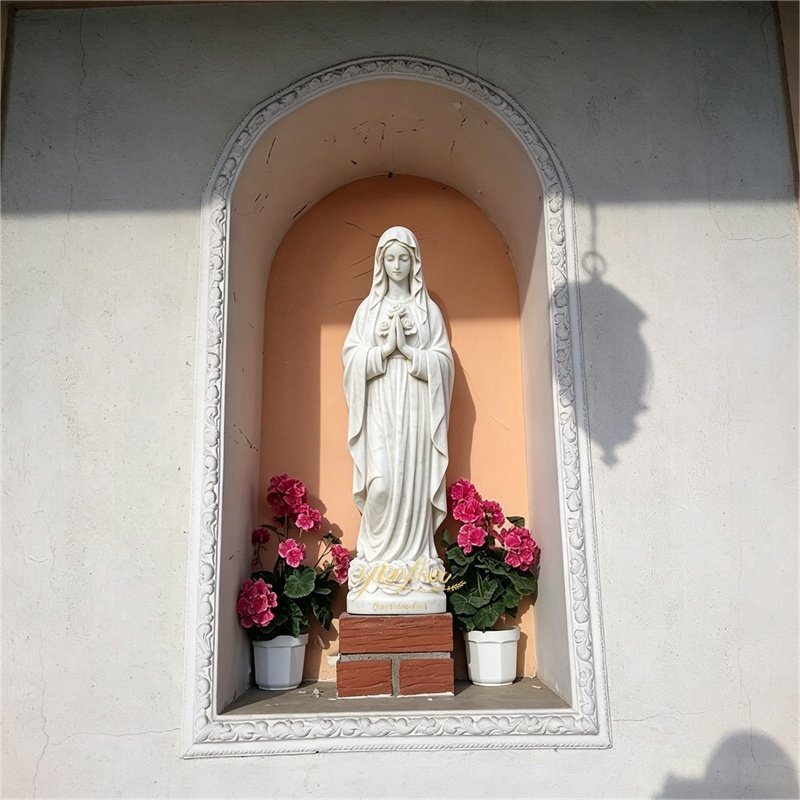
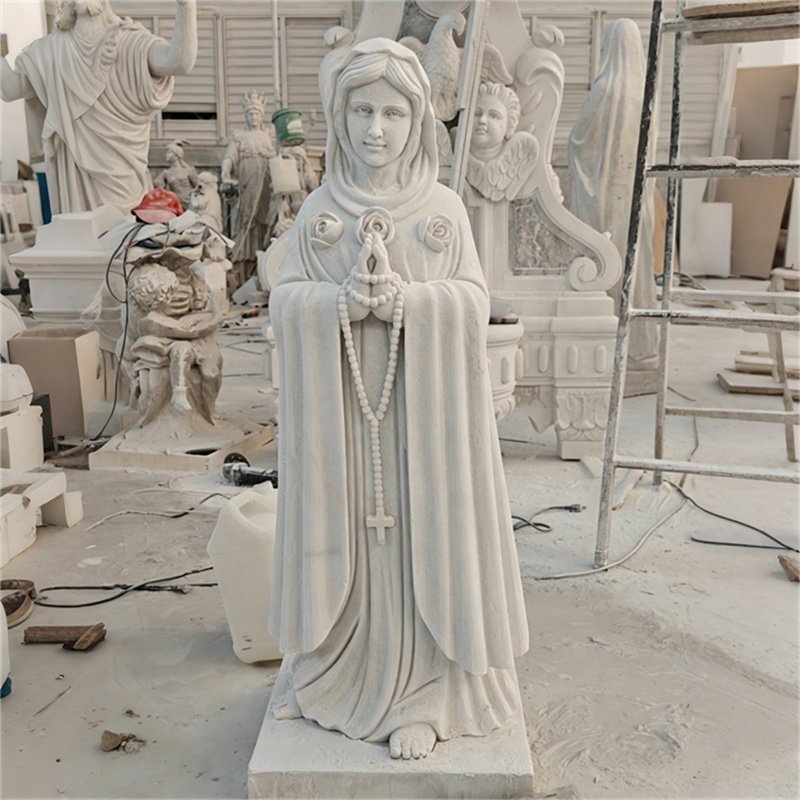
The statue that carries this title follows a specific iconography established by the apparitions of the mid-twentieth century. Mary is depicted standing, her hands joined before her chest — often holding a rosary and cross chain — with three roses of distinct colors positioned over her heart.
Her expression is the focal point: peaceful, forward-gazing, the face of what the tradition calls an earth mother — present, composed, and entirely without anxiety.
The three roses are not ornament. They are the theological center of the image — and a statue in which they are vague or decorative rather than clearly distinct has failed in its primary purpose, regardless of how beautiful the overall figure may be.
What Are the Apparitions of the Maria Rosa Mystica?
These three apparitions are the origin of this sacred imagery. The specific iconography of the Rosa Mystica statue — the three roses, the white gown, the transformation from sorrow to peace — comes from a series of apparitions reported in northern Italy in the mid-twentieth century, all connected to a single devoted woman: Pierina Gilli, a young nurse from Brescia.
The First Vision — July 13, 1947
On the thirtieth anniversary of the third Fátima apparition, Pierina reported seeing the Virgin Mary in the Cathedral of Montichiari, clothed in a violet gown of mourning, her heart pierced by three swords. The Virgin identified herself as the Mother of Jesus and spoke of her sorrow — for sins committed against God, and in particular for the infidelities of those consecrated to religious life: priests and nuns who had abandoned or betrayed their vocation from within. She asked for a day of prayer and reparation on the thirteenth of each month.
Then she disappeared.
The Second Vision — August 13, 1947
One month later, in the same cathedral, the figure Pierina saw was transformed. The violet gown had become a radiant white dress. The three swords were gone. In their place, three roses bloomed — white, red, and gold — each positioned over the heart with a clarity that Pierina understood immediately as intentional.
The grief of the first vision had not disappeared. It had been answered.
The Virgin spoke: I am the Rosa Mystica. She asked that her image be made known and that the faithful pray for the renewal of consecrated life.
The Third Apparition — April 17, 1966
Nearly two decades later, at a small outdoor shrine at Fontanelle near Montichiari — by then already a place of pilgrimage — the Virgin appeared again in the white gown with the three roses. She spoke of Fontanelle as a place of grace: healing for the sick, peace for the troubled, perseverance for the faithful. Pierina herself had long invited the ill to the spring water at the site, and the tradition of bringing the sick to Fontanelle became one of the defining features of the Rosa Mystica devotion.
The apparitions at Montichiari and Fontanelle have not received formal approval from the Catholic Church — the local diocese has maintained cautious reserve rather than either approval or condemnation. But the devotion has spread across Italy, Germany, the Philippines, India, and throughout the Catholic world. The image has taken on a life that no ecclesiastical decision can fully contain — because the three roses it carries speak to something the faithful recognize immediately as true.
Why Mary is Known as Rose Mystica?
The rose was not chosen arbitrarily.
It was chosen because no other flower carries the precise combination of meanings that Mary’s title requires — and those meanings reach back through Scripture, patristic theology, and the history of the Church in ways that make the choice feel less like a decision and more like an inevitability.
The Biblical Foundation
The rose metaphor enters Marian theology through three core Scripture passages that the early Church Fathers read as prefigurations of Mary:
- Song of Songs 2:1 — “I am the rose of Sharon, and the lily of the valleys.”
The rose originally stood for divine, hidden love. Christian theologians reinterpreted this flower as a foreshadowing of Mary — the pure vessel who bears Christ, the love that the world could not yet see. - Isaiah 11:1 — “A shoot shall sprout from the stump of Jesse, and from his roots a bud shall blossom.”
The blooming sprout became a standard Marian metaphor: Mary is the stem, Christ is the perfect rose bloom growing from her womb. - Sirach 24 — Divine wisdom is compared to a rose bush flourishing in Jericho. The Church links this wisdom directly to Mary, the Seat of Wisdom — the living garden in which divine grace takes root and flowers.
What “Mystica” Actually Means
This is the correction that matters most, and it is almost universally missed: mystica does not mean mysterious.
The Greek and Latin term mysticus means hidden, interior, concealed within.
The rose’s bloom, fragrance, and fruit are hidden inside the bush before opening.
In the same way, Mary’s divine grace — the Trinity dwelling within her soul, the miracle of the Incarnation — was invisible to the world. Hidden interior realities, only revealed through her motherhood.
She is the hidden spiritual garden where divine grace secretly grows, unseen to ordinary human eyes.
That is what mystical means.
Not strange.
Not unknowable.
Hidden — and therefore more real, not less.
The Thornless Rose
This part is the comparation of Mary and Eve.
This is the most foundational reason for the rose title, and the one that makes the three roses on the statue theologically coherent rather than merely decorative.
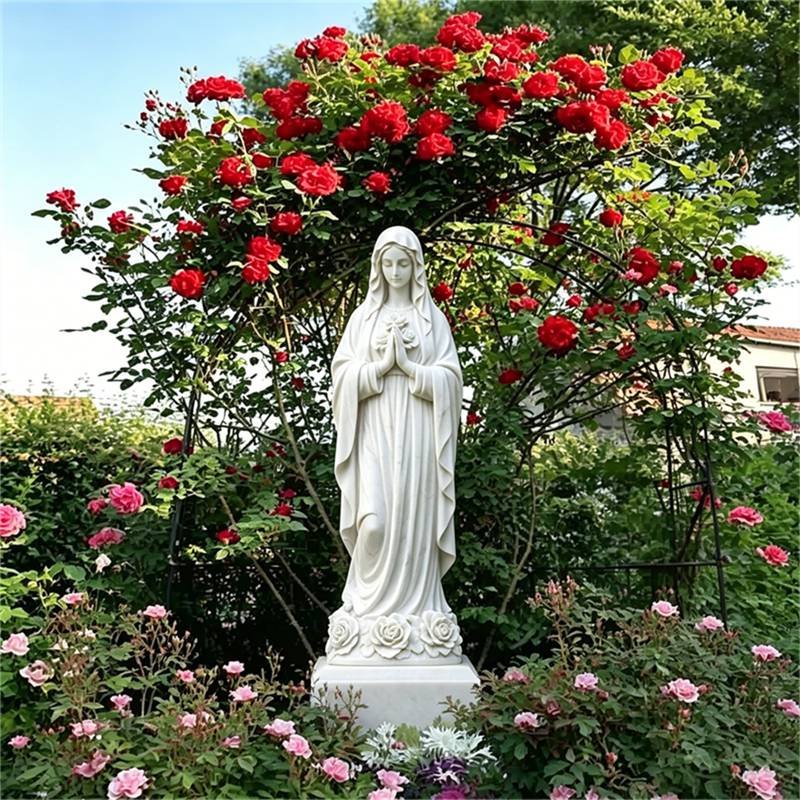
After original sin, Eve’s earthly paradise grew thorny roses — thorns symbolizing sin, pain, corruption, and death.
Mary is the rosa sine spinis: the thornless rose. Born Immaculate, free from all sin, she carries no thorns of corruption.
She reverses Eve’s failure: where Eve brought sin’s thorns into the world, Mary brings the perfect, unblemished bloom of salvation.
St. Bernard of Clairvaux stated it with characteristic economy: Eve was a thorn wounding humanity; Mary is the rose healing all wounds.
The three roses carved on every Rosa Mystica statue carry that contrast within them.
They are not decorative flowers.
They are the theological opposite of the thorns — and the person who understands that will never look at the statue the same way again.
The Rose as Queen of Flowers
There is a fourth layer, simpler but no less important: the rose is universally recognized as the most beautiful, fragrant, and noble of flowers.
In the spiritual garden of saints and angels, Mary ranks highest in grace and holiness — just as the rose stands above all other blooms.
The title is also a title of glory.
And the thirteenth-century rise of the Holy Rosary devotion sealed the connection permanently: rosarium literally means rose bush.
Every Hail Mary prayed on the beads is a spiritual rose offered to Our Lady — which is why the statue so often depicts her holding the rosary chain alongside the three roses of the apparition.
What Is the Meaning of the Three Roses on the Maria Rosa Mystica Statue?
The three roses are not interchangeable.
Each carries a specific color, a specific virtue, and a specific demand.
Together they constitute a complete account of what the interior life requires — and the statue that renders them is a daily examination of conscience in stone or bronze.
The White Rose — Purity and Fiat
It does not mean the absence of sin, but the presence of something: the positive orientation of the whole person — mind, will, memory, imagination, and desire — toward God.
The white rose is Mary’s fiat: the yes spoken at the Annunciation and never taken back.
It asks:
What part of yourself have you withheld? Where is the yes that you have not yet spoken?
The Red Rose — Sacrifice and Redemption
The rose of suffering accepted and offered. Not suffering as an end in itself, but the Cross understood as participation in the redemptive act at the center of all history.
The red rose is the Stabat Mater — the mother standing at the foot of the Cross and not leaving. The grief of the first vision at Montichiari, transformed in the second into a rose: the suffering has not been removed. It has been transfigured.
It asks:
What cross have you been carrying as a burden rather than bearing as a gift?
The Gold Rose — Penance and Immolation
The fruit of the white and the red. Purity creates the capacity for prayer — an undivided soul can attend to God without the constant distraction of competing desires.
Suffering deepens prayer — it strips away the illusions that make shallow prayer possible.
And prayer, sustained through purity and suffering, produces the gold: the transformation of the person into something that reflects divine light rather than absorbing it.
It asks:
How seriously do you pray? Not how often — how seriously.
Three roses. Three demands. One image that holds all of them simultaneously and does not allow you to choose one while ignoring the others.
Purity without suffering produces sentimentality.
Suffering without prayer produces despair.
Prayer without purity produces self-deception.
The three roses belong together — and the statue that renders them is a reminder that the spiritual life is not a menu from which you select what suits you. It is a complete program. And it asks for everything.
Where to Place a Rosa Mystica Statue in Your Sacred Space?
A Rosa Mystica statue is not a decoration.
It is a devotional object — which means its placement is a theological decision as much as an aesthetic one.
The question is not only where it will look beautiful. It is where it will be encountered, contemplated, and prayed before.
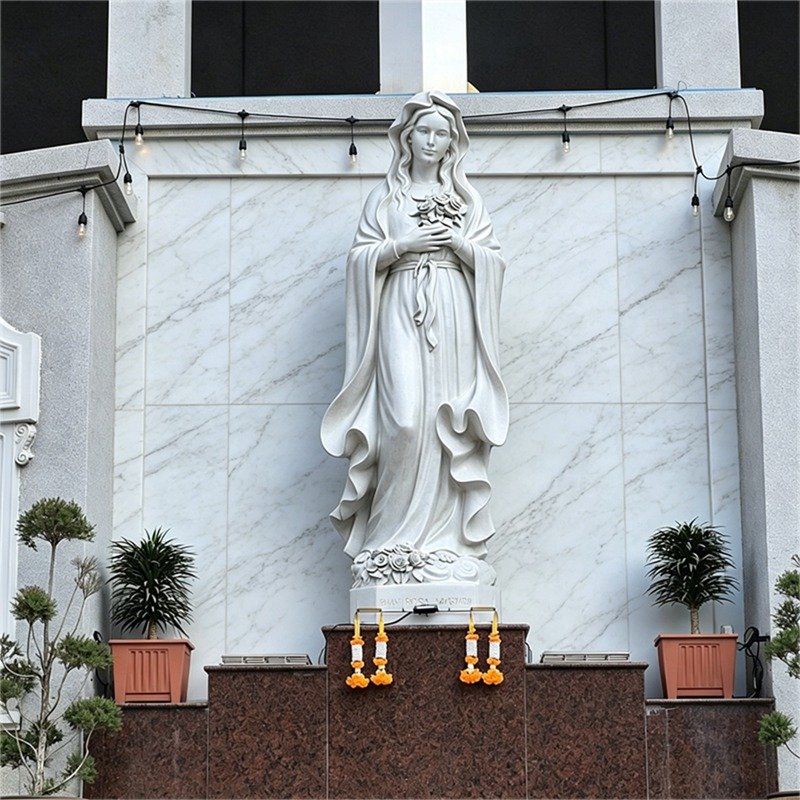
The Home Altar or Prayer Corner.
The most intimate placement.
For private household devotion, compact desktop statues stand 2–2.6 feet tall, while substantial floor-standing statues built for full home altars measure 2.8–3.6 ft.
White marble is the traditional material here: its translucency in candlelight echoes the luminous quality of the apparition itself, and its fine grain holds the carved detail of the roses and the folds of the gown with a precision that no other material matches.
The Garden Shrine.
A garden shrine is a place of passage as much as a place of prayer: people move past it, pause before it, and carry something of it with them as they continue.
Small-to-medium statues sized at 3.9–4.9 feet work well for roadside resting spots, central courtyard focal statues reach 5.6–7.2 feet, and grand monumental memorial garden sculptures rise 7.5 feet and higher.
For outdoor installations in northern climates, bronze is the material of first choice — it develops a patina over years of exposure that deepens its presence rather than diminishing it.
If marble is preferred, specify a high-density stone with a frost-rated surface sealer and a foundation below the local frost line.
The Church or Chapel Niche.
A statue in which they are reduced to decorative suggestion has failed in its primary purpose, regardless of how beautiful the overall figure may be.
The Hospital or Care Setting.
A statue in which they are reduced to decorative suggestion has failed in its primary purpose, regardless of how beautiful the overall figure may be.
Where to Get a Maria Rosa Mystica Statue for Your Sacred Space
Rosa Mystica statues are available at almost every price point and in almost every material.
The question is not where to find one.
The question is how to find the right one — a piece whose carving does justice to the theological weight of the image it carries.
A statue in which the three roses are vague, the face is generic, and the posture is mass-produced has not failed aesthetically.
It has failed theologically.
Local In-Person Shopping Options
Parish Gift Shops
Your neighborhood Catholic parish gift shop is the most accessible starting point.
These stores stock small and medium hand-painted resin Rosa Mystica statues: affordable, compact options perfect for home altars or quiet bedside prayer nooks.
That said, resin pieces come with inherent limitations of scale and material.
They are mass-manufactured to hit a low price bracket, identical to thousands cast from the same single mold.
While this lightweight, budget-friendly choice works for casual personal devotion, it lacks the durability and sacred individuality required for any permanent long-term installation.
Religious Art & Antique Stores
If you live in a city with rich Catholic heritage, local religious art galleries and antique shops are well worth visiting.
They sometimes carry vintage Marian statues crafted from plaster, solid wood, or natural marble, complete with classic devotional details: star-studded halos and delicate angel reliefs.
Each antique piece carries the quiet weight of generations of prayer before it, ideal for collectors seeking a piece with lived spiritual history.
Online Marketplaces
Digital retailers including Etsy, Amazon, and specialized Catholic faith supply websites offer unmatched shopping convenience, yet buyers must proceed with careful caution.
All listing photos are shot under ideal studio lighting and flattering selective angles that hide weak carving details.
Always request clear, close-up reference photos focused specifically on the three sacred roses and Our Lady’s facial features before placing your order.
If a seller cannot supply these critical detail shots, it signals a lack of care for the icon’s sacred design standards.
Our YouFine Religious Sculpture
If you want to cut through the endless research, quality checks, and vendor vetting entirely, we humbly invite you to work directly with our factory, YouFine Religious Sculpture.
We bring 43 years of dedicated professional religious sculpture craftsmanship to every custom Rosa Mystica commission, specializing in premium white marble and bronze devotional statues.
Each custom project begins with a thorough, personalized brief covering your exact installation space, required statue scale, chosen material, and precise artistic rendering of the three symbolic roses.
We share full step-by-step photographic documentation at every carving or casting stage, so you follow the creation process from start to finish.
All our Marian statue designs adhere strictly to traditional liturgical iconographic rules: distinct thornless rose motifs, clearly defined three-rose layouts, star halos, and intricate rosary detailing — no sacred symbol is watered down into vague decorative flourish.
Contact us directly to begin the commission process.
Every Rosa Mystica statue we produce is a singular piece — carved once, for one space, for one community of prayer. That is what the image has always deserved.
Final Thoughts
Mary is called the Mystical Rose for reasons that reach back two thousand years and forward into every sacred space where her statue stands today. She is the thornless bloom — the reversal of Eve’s thorned garden, the sinless vessel of the Incarnation. She is the hidden interior mystery — mystica not as strange, but as concealed within, invisible to ordinary eyes, real beyond what the visible world can contain. And she is the queen of the spiritual garden — the highest bloom in the order of grace, bearing within herself the one from whom all grace flows.
The three roses on her chest are not decorations. They are a program.
White: Are you undivided?
Red: Are you willing to suffer?
Gold: Are you truly praying?
A statue that carries those three questions into your home, your garden, or your chapel is not a decoration. It is a daily examination of conscience rendered in stone or bronze — present in the morning when you pass it, present in the evening when you return, present in every season of your life when the questions it carries are the ones you most need to hear.
Commission it with the seriousness it asks of you.
Place it where you will actually encounter it.
And let the three roses do what they were always meant to do.
References
- Vatican — Litany of Loreto (Official Text)
https://www.vatican.va/special/rosary/documents/litanie-lauretane_en.html - Catholic Philly — St. Ephrem on Mary: A Cause for Wonder (December 2021)
https://catholicphilly.com/2021/12/catholic-spirituality/st-ephrem-on-mary-a-cause-for-wonder/ - Encyclopædia Britannica — Saint John of Damascus
https://www.britannica.com/biography/Saint-John-of-Damascus - Holyart — The Apparitions of Maria Rosa Mystica and Its Sanctuary in Fontanelle
https://www.holyart.co.uk/blog/religious-items/the-apparitions-of-maria-rosa-mystica-and-its-sanctuary-in-fontanelle/ - Bible Hub — Song of Songs 2:1
https://biblehub.com/songs/2-1.htm - Bible Hub — Isaiah 11:1
https://biblehub.com/isaiah/11-1.htm - Holy Bible — Sirach (Ecclesiasticus) 24 — Divine Wisdom and the Rose of Jericho
New American Bible Revised Edition (NABRE) - St. Bernard of Clairvaux — Homilies in Praise of the Virgin Mother, 12th century
(Referenced in: Gambero, L., Mary and the Fathers of the Church, Ignatius Press, 1999) - Catechism of the Catholic Church — §§ 490–493: The Immaculate Conception
https://www.vatican.va/archive/ENG0015/__P1G.HTM - Stabat Mater — Medieval Latin sequence, attr. Jacopone da Todi, 13th century
(Approved for universal liturgical use by Pope Benedict XIII, 1727) - YouTube — Litany of Loreto, Title 29: Mystical Rose [Video]
https://www.youtube.com/watch?v=PrOHxUKHvvc